
What BlackRock Just Filed
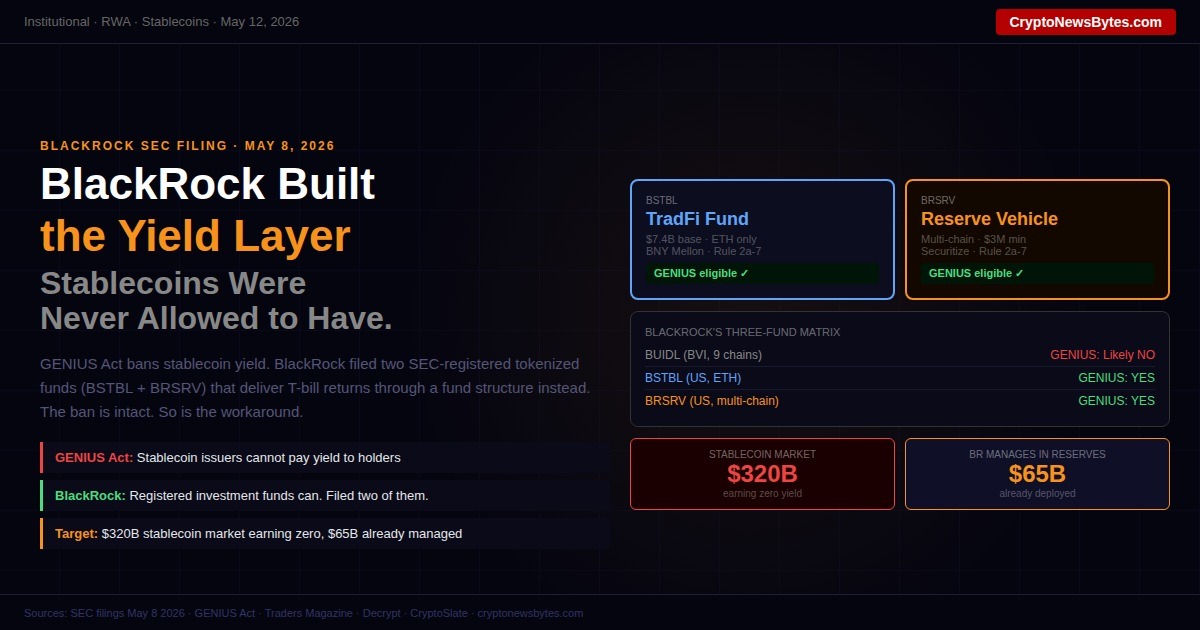
- On May 8, 2026, BlackRock filed two SEC applications for tokenized money market funds: BSTBL (a digital share class of its existing $7.4 billion Treasury fund, Ethereum-only, BNY Mellon custody) and BRSRV (a new fund built from scratch for stablecoin issuers, multi-chain, Securitize as transfer agent)
- The GENIUS Act yield ban bars stablecoin issuers from paying yield to holders. It does not apply to registered investment funds that issue tokens on a blockchain. BlackRock’s structure is entirely inside that distinction
- Both filings explicitly state the funds intend to qualify as eligible reserve assets for stablecoin issuers under the GENIUS Act. BUIDL, BlackRock’s existing tokenized Treasury fund, is registered in the BVI and may not qualify under the new US-registration requirements
- BlackRock currently manages approximately $65 billion in stablecoin reserves. Jon Steel, its global head of product for cash management, confirmed the firm received increased demand from stablecoin issuers after the GENIUS Act was signed
- BlackRock also filed a 17-page comment letter to the OCC on the final day of the 60-day public comment window, urging regulators not to impose a 20% cap on tokenized reserve assets, a limit the OCC had floated in its proposed framework
In This Article
- What BlackRock Actually Filed: BSTBL and BRSRV
- The GENIUS Act Yield Ban: The Rule BlackRock Read Carefully
- How the Structure Works: The Legal Workaround Explained
- The Three-Fund Matrix: BUIDL vs BSTBL vs BRSRV
- The OCC Letter: Lobbying the Rules While Building the Products
- What This Means for the $320 Billion Stablecoin Market
- The Bigger Picture: Asset Managers Are the Structural Winners
- Frequently Asked Questions
The GENIUS Act banned stablecoin yield. BlackRock responded by building a regulated on-chain fund that delivers it through a different legal structure. On May 8, 2026, the world’s largest asset manager filed two SEC applications for tokenized money market funds that sit cleanly outside the GENIUS Act prohibition while targeting the exact capital pool the Act left idle: $320 billion in stablecoins sitting in wallets earning nothing.
This is not a crypto story. It is a financial engineering story. BlackRock read the legislation, identified the distinction between stablecoin issuers and registered investment funds, and filed two products that exploit that distinction with surgical precision. The yield ban is real. So is the workaround.
What BlackRock Actually Filed: BSTBL and BRSRV
The two May 8 filings address different counterparties with different structures, and understanding the distinction matters for grasping the full scope of what BlackRock is building.
| Product | BSTBL | BRSRV |
|---|---|---|
| Full name | BlackRock Select Treasury Based Liquidity Fund (tokenized share class) | BlackRock Daily Reinvestment Stablecoin Reserve Vehicle |
| Structure | Digital share class of existing $7.4B fund | New fund built from scratch |
| Regulation | Rule 2a-7 money market fund, AAA-rated | Rule 2a-7 equivalent, US-registered |
| Blockchain | Ethereum only | Multi-chain (chains TBD) |
| Transfer agent | BNY Mellon | Securitize |
| Target investor | TradFi bank treasury desks, subscribe via wire, no crypto infrastructure needed | Crypto-native stablecoin issuers, digital wallet holders |
| Minimum entry | Not specified | $3 million |
| Underlying assets | Cash, US Treasuries, short-term instruments (avg maturity under 60 days) | US gov securities under 93 days, overnight repo agreements |
| GENIUS Act reserve eligible | Explicitly stated in filing | Explicitly stated in filing |
The design logic is deliberate. BSTBL is the TradFi on-ramp: a bank treasury desk can subscribe via wire transfer, hold a tokenized share of a 35-year-old AAA fund, and never touch crypto infrastructure. BRSRV is the crypto-native product: a stablecoin issuer can use it to satisfy reserve requirements under the GENIUS Act and earn yield on the T-bills the fund holds simultaneously.
The GENIUS Act Yield Ban: The Rule BlackRock Read Carefully
The Guiding and Establishing National Innovation for US Stablecoins Act was signed into law in July 2025. Its core premise was simple: stablecoins are payments infrastructure, not bank accounts. Congress drew a hard line. Stablecoin issuers are explicitly barred from paying any form of interest, yield, or return to token holders.
The political logic behind the ban was equally simple. Banks pay depositors interest because they lend the deposits out and capture a spread. Stablecoin issuers invest reserves in T-bills and capture the yield themselves. If stablecoin issuers could pay yield to holders, they would functionally be operating as uninsured shadow banks with a better technology stack than actual banks. Congress, under significant bank lobbying pressure, refused to allow that outcome.
How the Structure Works: The Legal Workaround Explained
The structural distinction BlackRock exploits is clean and legally unambiguous. The GENIUS Act yield ban applies to stablecoin issuers. It does not apply to registered investment funds that happen to issue tokens on a blockchain. BlackRock’s funds are the latter. They are SEC-registered investment vehicles that issue tokenized shares as their ownership record. They are not stablecoins, they are not payment tokens, and their issuers are not subject to the GENIUS Act yield prohibition.

The flow works in two directions simultaneously:
For retail stablecoin holders: A holder of USDC in an Ethereum wallet can purchase BSTBL tokens, which represent a share in the BlackRock Treasury fund. The stablecoin is used to buy a fund share. The fund earns yield on T-bills. The fund share accrues value accordingly. The USDC holder now receives economic exposure to T-bill yield, but they received it from a registered investment fund, not from a stablecoin issuer. The GENIUS Act ban does not apply.
For stablecoin issuers: Circle, Tether, or any other GENIUS Act-compliant issuer can place its reserves into BRSRV, which qualifies as an eligible reserve asset under the Act. The reserves are therefore compliant. They are also invested in T-bills. The issuer earns yield on reserves held in a compliant vehicle. What the issuer cannot do is pass that yield to token holders, but the fund structure now gives holders a separate route to access T-bill returns directly.
The Three-Fund Matrix: BUIDL vs BSTBL vs BRSRV

| Fund | BUIDL | BSTBL | BRSRV |
|---|---|---|---|
| Jurisdiction | BVI registered | US registered | US registered |
| Regulation | BVI fund structure | Rule 2a-7 | Rule 2a-7 |
| Transfer agent | Securitize | BNY Mellon | Securitize |
| Chains | 9 chains | Ethereum only | Multi-chain |
| AUM | $2.5B | $7.4B (base fund) | New fund |
| Primary use case | DeFi collateral | TradFi reserves | Stablecoin reserves |
| GENIUS Act eligible? | Likely NO (BVI) | YES (US reg) | YES (US reg) |
| Bank access | Crypto native | Via wire transfer | Via crypto wallet |
The matrix is complete by design. BUIDL serves DeFi protocols that need high-quality collateral across multiple chains. BSTBL serves bank treasury desks that want on-chain exposure without crypto infrastructure. BRSRV serves stablecoin issuers that need GENIUS Act-compliant, yield-bearing reserves. Every institutional counterparty that interacts with on-chain dollar instruments now has a BlackRock product built for their specific entry point.
The OCC Letter: Lobbying the Rules While Building the Products
BlackRock’s filings did not arrive in isolation. On the final day of the OCC’s 60-day public comment window on its proposed framework for permitted payment stablecoin issuers, BlackRock submitted a 17-page comment letter urging the agency not to impose a quantitative cap on tokenized reserve assets.
The OCC had floated a possible 20% threshold limiting how much of a stablecoin’s reserves could be held in tokenized instruments. BlackRock called that limit “extraneous” and argued that risk profiles are driven by credit quality, duration, and liquidity, not by whether an asset happens to be held on a distributed ledger. BlackRock also backed the OCC’s proposed “Option A” for a flexible, principles-based regulatory environment and advocated for same-day settling government securities.
What This Means for the $320 Billion Stablecoin Market
The $320 billion stablecoin market is currently divided into two populations: issuers, who earn T-bill yield on reserves, and holders, who earn nothing. BlackRock’s filing creates a third option for holders, convert USDC into BSTBL and participate in T-bill returns through a registered fund structure.
The question of how large the conversion will be depends on friction and minimum investment thresholds. BRSRV’s $3 million minimum effectively limits direct access to institutional and high-net-worth participants. Retail holders of small USDC balances cannot directly buy BRSTBL or BRSRV at those minimums. The near-term beneficiaries are institutional USDC holders, corporate treasuries, DeFi protocols, stablecoin issuers, not individual users.
The longer-term implication is structural. Once the pipeline from stablecoin capital to T-bill yield exists at the institutional level, the pressure on stablecoin issuers to offer competitive retail products intensifies. Circle and Tether cannot pay yield under the GENIUS Act. BlackRock can deliver it through a fund wrapper. Over time, that distinction may reshape which product institutional capital prefers to hold.
The Bigger Picture: Asset Managers Are the Structural Winners
One dynamic that is easy to miss in the technical product details: asset managers are the guaranteed winners of the current stablecoin regulatory structure, regardless of which stablecoin wins market share.
Under the GENIUS Act, stablecoin issuers must hold reserves in approved instruments, T-bills, repo agreements, government money market funds. Asset managers manage those reserves and earn fees. The stablecoin issuer earns the yield spread between the fee they pay and the yield the fund generates. The holder earns nothing. Asset managers are therefore structurally positioned to profit from the growth of the stablecoin market whether Circle or Tether or a bank-issued stablecoin dominates.
BlackRock managing $65 billion in existing stablecoin reserves today is not incidental. It is the business model. BRSRV makes that relationship more explicit: the fund is purpose-built for stablecoin reserve compliance. Every stablecoin that grows under the GENIUS Act framework is a potential BRSRV customer. BlackRock is not betting on which stablecoin wins. It is building the infrastructure that every winner will be required to use.
The tokenized asset market now exceeds $30 billion with over 767,000 investors, a $10 billion acceleration since January 2026 alone. Boston Consulting Group and Ripple project the tokenized asset market will reach $18.9 trillion by 2033. Larry Fink has stated that every asset class will eventually be tokenized. BSTBL and BRSRV are not a thesis. They are execution.
Frequently Asked Questions