
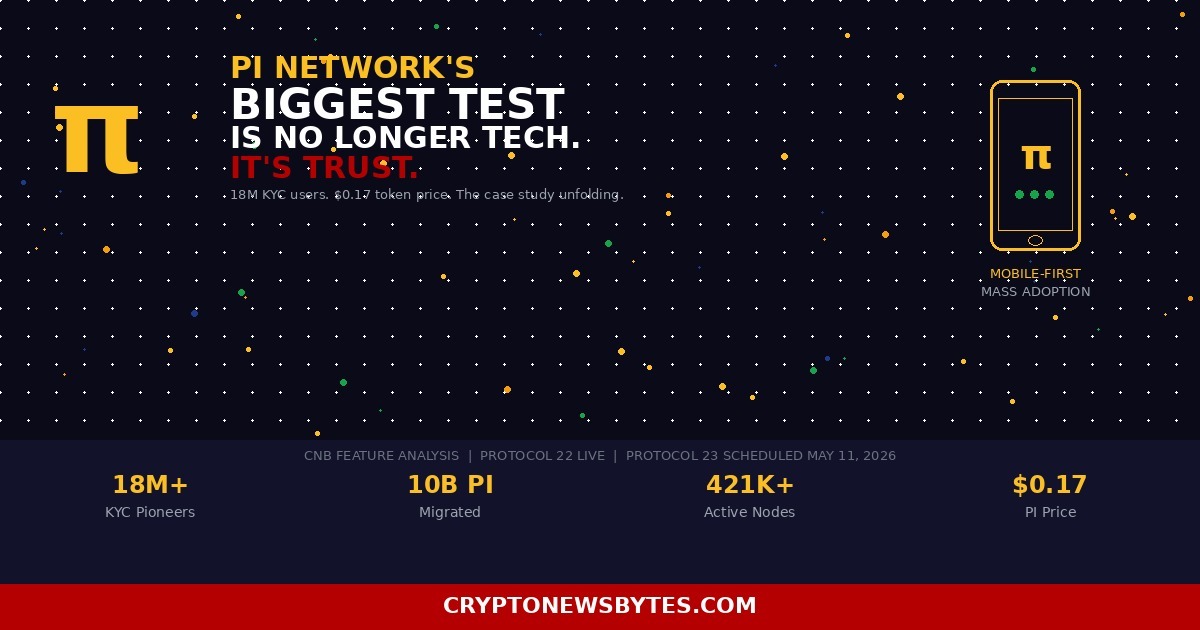
For years, Pi Network existed in a strange corner of the cryptocurrency industry. Too large to ignore. Too unfinished to fully validate. Millions of users downloaded an app on their phones and tapped a button each day to participate in something the project called mining. Entire online communities formed around the belief that Pi could become the first mass-adopted cryptocurrency designed for ordinary people rather than for the traders, miners, and venture capitalists who built the rest of the industry.
In 2026, the conversation around Pi Network is beginning to change. The debate is no longer whether Pi can attract users. It already has. On May 6, Pi Network co-founder Dr. Chengdiao Fan took the Convergence Stage at Consensus 2026 in Miami, the largest cryptocurrency industry conference in North America, to deliver a 20-minute keynote titled “Aligning Web3, AI, and Blockchain for Utility.” It was one of the most substantive public addresses the project has ever delivered. The next day, co-founder Dr. Nicolas Kokkalis appeared on a separate Convergence Stage panel. The dual appearance was deliberate. Pi Network was no longer asking to be taken seriously by the crypto industry. It was showing up at the industry’s most prominent gathering and making its case directly.
The numbers behind the keynote are real. As of early May, the network reports more than 18 million KYC-verified Pioneers and roughly 10 billion PI migrated to its Open Mainnet, supported by over 421,000 active nodes. The Pi Mainnet completed a mandatory upgrade to Protocol 22 in late April. Protocol 23, which introduces native smart contract capabilities for the first time, was scheduled to deploy on May 11, four days after Fan’s keynote. The project is moving into an operational phase that its supporters have been promising for seven years.
And yet, the PI coin trades at roughly $0.17. It is down 93.7 percent from its February 2025 peak of $2.98. It is not yet listed on Binance, Coinbase, or Kraken, though Kraken has added PI to its 2026 listing roadmap for technical review. The skepticism that has shadowed Pi Network for years has intensified rather than faded, even as the technical milestones have multiplied. That tension, between enormous community scale and unresolved structural questions, may define Pi Network’s future more than any token price prediction ever could.
A Different Kind of Crypto Experiment
Pi Network was founded in 2019 by Dr. Nicolas Kokkalis and Dr. Chengdiao Fan, both Stanford graduates. The pitch was different from the start. Unlike the cryptocurrencies that emerged through venture funding, mining farms, or institutional ecosystems, Pi was designed for mass-market onboarding through mobile participation. Users did not need GPUs, ASICs, or deep blockchain expertise. They needed a smartphone, a verified identity, and the patience to tap a button each day. Participation became frictionless. The technical barrier disappeared.
That approach worked at a scale few crypto projects have ever achieved. Pi expanded globally, particularly in regions where mobile-first internet access dominates and traditional financial infrastructure remains limited. The network’s user base grew faster than its skeptics expected and, in some respects, faster than its own infrastructure could process. The KYC verification queue stretched into years. Mainnet migration became a multi-phase process spanning the better part of 2024 and 2025. By the time Pi launched its Open Network Mainnet on February 20, 2025, the project had something most altcoins never achieve: a real distribution advantage, an installed base of millions of users with verified identities and an emotional stake in the network’s outcome.
Supporters argue that this accessibility is precisely what gives Pi its long-term potential. In a sector dominated by sybil attacks, airdrop farming, and speculative trading, a network that requires identity verification for every account creates a different kind of asset. CoinMarketCap’s Pi project page describes the network’s one-account-per-person policy through its KYC solution as a structural differentiator. The January 2026 Pi Core Team update characterized the project as a “massive identity-verified blockchain.” Whatever else Pi might be, it is one of the largest identity-verified user bases in the cryptocurrency industry.
The Consensus 2026 Keynote: A Critique and an Invitation
Fan’s Consensus 2026 keynote was structured around an unusually direct critique of the cryptocurrency industry’s dominant token model. “There is too much value extraction without equivalent value creation,” she told the audience, arguing that many projects raise capital first and fail to deliver meaningful utility afterward. “There are tokens used mostly for raising capital without actual product innovation. People have too easy and immediate access to capital without actually doing the hard work to finish the building.” The argument was a precise inversion of the industry norm, and it carried particular weight delivered from the Convergence Stage at a conference with more than 20,000 in-person attendees and the largest concentration of institutional crypto capital in North America.
Fan framed Pi’s model as a deliberate alternative. The keynote highlighted Pi Launchpad, a new ecosystem model for projects building on Pi’s Layer-1 blockchain that requires working products before token launch and directs proceeds into liquidity pools rather than founder allocations. She positioned Pi’s verified user base, which she said now includes 60 million engaged users and 18 million KYC-verified identities, as the strategic resource that AI cannot replicate. “Authentic data, user acquisition, and trusted human participation” are, in Fan’s framing, becoming the durable competitive advantages in a market where AI dramatically lowers the technical barrier to building software products. The implication is that Pi’s slow, identity-first approach was building exactly the asset that the AI era would make valuable, even when the broader market did not recognize it at the time.
The conference appearance also addressed a longstanding pattern that Pi watchers know well. Crypto analyst Dr. Altcoin noted ahead of the event that Pi Network’s price has historically declined following major conference appearances by the founders. The analyst suggested Consensus 2026 could be the first to break that pattern, pointing to Protocol 23’s scheduled May 11 activation and the Desktop App Studio launch as concrete technical catalysts that did not exist during previous conference appearances. Whether the post-conference price pattern actually broke this time is a question the next several weeks will answer. The structural question Fan’s keynote raised is more durable: can a crypto project that explicitly rejects the speculation-first playbook produce the institutional and market confidence it needs to be valued on utility?
The Utility Problem
Yet the criticism surrounding Pi Network has not disappeared. In some ways, it has become sharper. The core issue is utility. For any cryptocurrency to sustain long-term legitimacy, it must eventually prove that users are doing more than holding tokens and discussing future potential. A functioning economic ecosystem requires measurable activity, external adoption, merchant participation, transaction demand, and credible decentralization. Critics argue Pi has not fully demonstrated those elements yet.
Some analyses point to a large gap between registered users and economically active users. Others question whether the ecosystem remains too internally circular, with most activity occurring between existing Pi participants rather than reflecting external market demand. Questions around token unlocks, migration delays, and locked balances have become recurring themes within the community itself. CoinCodex’s quantitative models, last updated May 11, 2026, show 23 bearish technical indicators against 2 bullish ones. The 200-day simple moving average is projected to drift toward $0.1823 by mid-June. Most analyst models from CoinCodex and Gate.io predict PI trading in a tight $0.12 to $0.20 range through the remainder of 2026.
Even some longtime supporters acknowledge the frustration. Token unlock schedules have continued to inflate circulating supply, including roughly 205 million tokens scheduled for release earlier this year, creating persistent downward pressure on the spot price. The project’s enclosed mainnet structure means that no major regulated exchange has fully listed PI for institutional trading. That frustration matters because crypto history is filled with projects that successfully built communities but struggled to convert social momentum into sustainable economic infrastructure.
Pi Network in 2026: What Supporters See and What Critics See
Source: Pi Core Team official blog (April-May 2026), CoinMarketCap, CoinCodex technical analysis, Phemex Pi Network research, community statements | @cryptonewsbytes
| Question | Supporter View | Critic View |
|---|---|---|
| User base | 18M+ KYC-verified is a real distribution advantage. Most altcoins never reach this scale. | Registered does not equal economically active. Daily users are a fraction of total. |
| Mainnet progress | Protocol 22 live April 27. Protocol 23 with smart contracts due May 11. Steady technical execution. | Smart contracts arrive 7 years after launch. Most blockchains shipped this in their first year. |
| Exchange listings | Kraken added PI to 2026 review roadmap. MiCA whitepaper filed for EU listings. | No Binance, no Coinbase. Mainstream listings are now table-stakes for serious projects. |
| Token price | Suppressed by structural lock-ups. Real value will emerge from utility, not speculation. | Down 93.7% from peak. Market is rendering its verdict on utility deficit. |
| Ecosystem activity | Pi App Studio apps live on Mainnet. Merchant Engine deployed. PiFest activity rising. | Economic activity is largely internal. External adoption metrics remain thin. |
| Core Team transparency | Silence on price reflects regulatory caution, particularly U.S. SEC posture. | Community asks for clarity on timelines, unlocks, and roadmap go unanswered. |
Both perspectives are based on verifiable facts. The disagreement is not about the data; it is about which data weighs more in the long-run analysis. | @cryptonewsbytes
Infrastructure Versus Hype
One reason Pi Network continues to attract attention is because it sits at the intersection of two competing crypto narratives. The first is hype-driven speculation, the cycle of rapid listings, aggressive token velocity, and short-term price action that has defined much of the industry’s last decade. The second is slow infrastructure-building, the unfashionable work of governance, identity, and ecosystem coordination that most academic blockchain research suggests determines whether a network actually functions at scale.
Pi’s approach has often looked almost opposite to the speculative model. The project’s prolonged ecosystem development, gradual migration, gated participation, and heavy emphasis on identity verification have produced both resilience and criticism. Supporters see deliberate construction. Critics see delays and centralization. The reality may be somewhere in between. Building large-scale blockchain ecosystems is historically difficult. Even major enterprise blockchain initiatives have struggled with governance, interoperability, and industry-wide adoption challenges. Academic research repeatedly shows that technology alone is rarely the hardest problem. Governance, incentives, and ecosystem coordination often determine success or failure.
Pi Network now faces that exact transition point. The mandatory node upgrade to version 19.6 in February, the migration of 2.5 million previously blocked users through compliance edge cases, the rollout of KYC validator rewards in March, the Protocol 22 deployment in late April, and the Protocol 23 smart contract launch scheduled for May 11 are not the events that typically draw mainstream financial media attention. They are also exactly the kind of operational milestones that determine whether a network can support real economic activity. The question is whether the broader cryptocurrency market, which has often rewarded speed over substance, will give Pi Network the runway to prove its slower approach.
Pi Network’s 2026 Protocol Roadmap: From Mainnet Stability to Smart Contracts
Source: Pi Core Team @PiCoreTeam X posts, CryptoTimes Protocol 22 coverage, official minepi.com blog | @cryptonewsbytes
✓ DONE: Mandatory Node Upgrade v19.6 (February 15, 2026) All Mainnet nodes required to upgrade by Feb 15. Non-compliant nodes disconnected. First step in multi-phase 2026 protocol rollout. |
| ↓ |
✓ DONE: 2.5M Pioneer Unlock + KYC Validator Rewards (Q1 2026) 2.5 million previously blocked users unblocked through compliance technical patch. KYC validator rewards distribution rolled out by end of March 2026. |
| ↓ |
✓ DONE: Pi Day 2026 + Second Migration Program (March 14, 2026) Testnet Token Launchpad introduced. Second migrations enable referral bonus transfers to Mainnet. 119,000+ Pioneers completed second migrations. |
| ↓ |
✓ DONE: Protocol 22 Upgrade (April 27 to May 1, 2026) Network-wide protocol upgrade focused on scalability and stability. 100% block synchronization, no transaction failures post-upgrade. PiRC1 token framework introduced. |
| ↓ |
⇳ DEPLOYING: Protocol 23 with Native Smart Contracts (May 11, 2026) First native smart contract capability on Pi Mainnet. Anticipated to unlock DEX functionality, on-chain swaps, and meaningful third-party application development. Single most important technical milestone in the project’s history. |
| ↓ |
⌚ PLANNED: Protocols 24 through 26 by June 2026 Continued protocol layer maturation. Pi DeFi, PiDAO governance initiatives, and Supernode program expansion all on the Q2 2026 schedule. |
The Protocol 23 deployment is the inflection point. Until smart contracts are live, third-party developers cannot meaningfully build the kind of applications that would prove utility. Once they are live, the question shifts from technical readiness to actual builder and merchant adoption. | @cryptonewsbytes
Why 2026 Could Matter
The significance of 2026 for Pi Network is less about a single event and more about convergence. Several developments are happening simultaneously. Expanded Mainnet migration efforts are clearing long-standing compliance backlogs. Node infrastructure upgrades have stabilized the technical foundation. Ecosystem tooling, including a new Developer SDK that allows applications to integrate Pi payments in under 10 minutes, has lowered the barrier for third-party developers. Scrutiny from critics has intensified, applying pressure for real-world utility. And rising expectations from long-term holders, many of whom have participated for five or six years, are testing the patience that has defined the community since 2019.
Pi Network’s own announcements frame this period as part of a broader ecosystem maturation process. The challenge is that crypto markets rarely reward patience indefinitely. As the industry matures, users increasingly expect measurable adoption, transparent governance, and operational proof rather than future-oriented narratives alone. For Pi Network, the next phase is likely less about onboarding millions more users and more about proving that the ecosystem can function independently, openly, and sustainably at scale.
The regulatory dimension also matters. Pi Network filed its MiCA whitepaper in late 2025, a key step toward potential listing on regulated European exchanges. The U.S. regulatory environment is more complex. SEC Chair Paul Atkins’s pivot away from regulation by enforcement and the parallel push for the Clarity Act through the Senate may reshape how projects like Pi can communicate about price, exchange listings, and ecosystem milestones to U.S.-based users. The Pi Core Team’s notably cautious communication around token valuation reflects awareness of this regulatory backdrop.
The Bigger Question
Pi Network may ultimately become one of crypto’s most important case studies, regardless of outcome. Not because of price. Not because of speculation. But because it tested a larger idea: can a cryptocurrency bootstrap a global user base before building a fully open economic network? The answer is still unfolding. What happens next will determine whether Pi Network becomes a durable digital economy, a prolonged experiment in community-driven crypto adoption, or another example of how difficult it is to turn internet-scale enthusiasm into decentralized infrastructure.
The numbers in 2026 suggest the project has moved past the question of whether it can build technology. Protocol 22 deployed without transaction failures. Smart contracts are days away. The KYC verification system, while frustrating to many users, has produced one of the largest identity-verified user bases in cryptocurrency. The Mainnet is operational and processing real transactions. The technology has, in measurable ways, arrived.
What remains is harder to engineer. Trust is not deployed in a protocol upgrade. Utility is not produced by a roadmap. Exchange listings happen when major institutions decide a project is worth the regulatory and reputational risk of supporting it. Merchants integrate a payment token when they believe their customers will actually use it. None of these depend on the Pi Core Team’s technical execution. They depend on a much harder thing to produce, which is institutional and market confidence that the project is exactly what it claims to be. For now, Pi Network remains one of the cryptocurrency industry’s most polarizing projects. Too large to dismiss. Too unfinished to fully define. And that uncertainty may be exactly why the world continues watching.
Frequently Asked Questions
What is the current Pi Network price in 2026?
As of mid-May 2026, PI is trading around $0.17, with a market capitalization near $1.93 billion based on a circulating supply of approximately 10.29 billion tokens. The token reached an all-time high of $2.98 on February 26, 2025, and is currently down approximately 93.7 percent from that peak. CoinCodex’s quantitative models indicate a bearish near-term outlook, with 23 of 25 technical indicators signaling bearish conditions and most analyst models projecting PI trading in a $0.12 to $0.20 range through the remainder of 2026.
How many users does Pi Network have in 2026?
Pi Network reports more than 18 million KYC-verified Pioneers, with approximately 10 billion PI migrated to the Open Mainnet as of early May 2026. The network is supported by over 421,000 active nodes and over 1 million CPUs. The total registered user base, including unverified accounts, is significantly larger, though the KYC-verified figure is the more meaningful measure of active participants because it represents users who have completed identity verification and can engage in Mainnet activity.
Is Pi Network listed on Binance, Coinbase, or Kraken?
As of May 2026, Pi Network has not been fully listed on Binance, Coinbase, or other major U.S. regulated exchanges. Kraken has added PI to its 2026 listing roadmap for technical review, which is the most concrete step toward a major exchange listing the project has achieved. Pi Network filed its MiCA whitepaper in late 2025, signaling intent to seek regulated European exchange listings. Token unlocks, regulatory positioning, and the project’s enclosed mainnet phase have all contributed to the slow pace of mainstream exchange access.
What is Protocol 23 and why does it matter for Pi Network?
Protocol 23 is the Pi Mainnet upgrade scheduled for deployment on May 11, 2026. It is expected to introduce native smart contract capabilities for the first time, enabling developers to build decentralized applications, DEX functionality, on-chain swaps, and other programmable financial primitives directly on Pi. It is the single most important technical milestone in the project’s history because, until smart contracts are live, third-party developers cannot meaningfully build the applications that would demonstrate utility at scale. The successful deployment of Protocol 23 shifts the question for Pi Network from technical readiness to actual builder and merchant adoption.
Further Reading
The regulatory pivot reshaping how projects communicate about token value, exchange listings, and U.S. ecosystem strategy.
The Senate’s final-term push for the legislative framework that would determine the long-term U.S. regulatory environment for projects like Pi.
A look at how Asian regulatory frameworks are reshaping which projects gain institutional access, a model relevant for Pi’s mass-market positioning.
The institutional infrastructure being built around crypto in 2026 and what it tells us about which kinds of projects are gaining regulatory legitimacy.
This article is for informational purposes only and does not constitute financial or investment advice. Sources: Pi Founders at Consensus 2026 (minepi.com), Pi Network official blog (Jan-Apr 2026), CryptoTimes Protocol 22 coverage, CoinMarketCap Pi Network updates, Phemex Pi Network analysis. Published May 12, 2026.