
There is a specific slide from Saylor’s Consensus 2026 keynote that no bank’s wealth management team will put in a client presentation. It shows, in a single bar chart, the annualized returns of every major asset class since August 2020. Bitcoin at 40%. Nasdaq at 18%. S&P 500 at 15%. Gold at 15%. Money markets at 3%. Bonds at negative 1%. Bank accounts at roughly 0.4% yield with no capital appreciation.
The reason banks will not show you this is not that the data is wrong. The data is sourced from Strategy.com as of May 5, 2026, using the same Bloomberg data sets that every institutional investor uses for performance attribution. The reason banks will not show you this is that it directly contradicts the risk-return narrative they use to justify their fee structures, their fixed-income allocations, and their institutional bias toward instruments they control, distribute, and earn fees from.
Number One: Bonds Lost Money
The bond market is the single largest asset class in the world, roughly $130 trillion globally. It is the foundation of how pension funds, insurance companies, endowments, sovereign wealth funds, and retail savings accounts store capital. The implicit promise of bonds is that they are the safe asset. They do not grow like equities, but they preserve value and provide income.
The PIMCO Active Bond ETF, one of the most sophisticated actively managed bond products in the world, returned negative 1% annualized from August 2020 through May 2026. That is not a crash. It is not a crisis. It is the normal outcome when the Federal Reserve raises rates from near zero to over 5% in 18 months, crushing the market value of every bond issued at lower yields. The 2022 rate hiking cycle was the worst year for bond returns in over a century. Saylor’s slide simply shows what that means for a six-year holding period that included it.
Bitcoin returned 40% annualized over the same period. You took on 41% volatility versus bond volatility of 4%. You received 41 percentage points more return per year. No asset allocation framework that treats bonds as the risk-free anchor and Bitcoin as the speculative outlier can explain that outcome without acknowledging that its foundational risk-return assumptions were wrong during this period.
Number Two: Bank Accounts Are Systematically Worse Than Disclosed
Bank accounts yield approximately 0.4% on average in the United States, according to the FRED data Saylor cited. That is not 0.4% above inflation. That is 0.4% nominal return, before inflation, before taxes on the interest income. In a period where the Federal Reserve’s own preferred inflation measure averaged well above 2%, the real return on a bank account was deeply negative for most of the measurement window.
The banking system earns its margins partly by capturing the spread between what it pays depositors (near zero) and what it charges borrowers (prime rate plus credit spread). The depositor financing the bank’s loan book at 0.4% while the bank lends at 7% or higher is the structural subsidy that makes banking profitable. That spread exists because of regulatory frameworks that make bank deposits the default safe asset, and because most depositors do not actively reallocate.
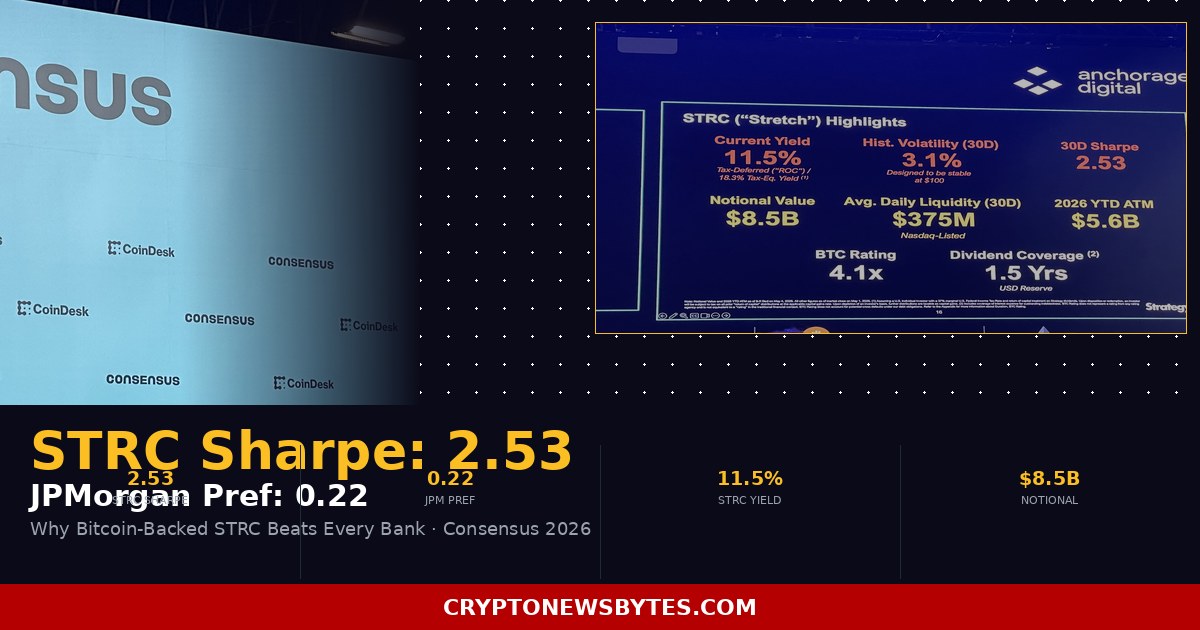
STRC’s tax-equivalent yield of 18.3% for a U.S. investor at the 37% marginal rate, set against a bank account yielding 0.4%, is a 17.9 percentage point difference in effective return. That is not the comparison banks want in a client portfolio review. It is the comparison that explains why 120,000 retail accounts and approximately 3 million estimated beneficiaries already hold STRC through Schwab, Fidelity, Robinhood, and other brokerages where it is freely available.
STRC Tax-Equivalent Yield vs Banking Instruments
For illustrative purposes. Assumes 37% U.S. marginal tax rate. Source: Strategy, Consensus 2026
Source: Strategy slides, Consensus 2026 Miami | Bloomberg and FRED data | @cryptonewsbytes
Number Three: Digital Credit Is Liquid, Transparent, and Free
1. Annualised returns since Aug 10, 2020
2. Return vs volatility (bubble size = relative Sharpe)
3. Sharpe ratio: STRC vs banks, hedge funds, bonds
4. Tax-equivalent yield: STRC vs traditional instruments
Source: Strategy keynote slides, Consensus 2026 Miami. Past performance is not indicative of future results. Not financial advice. CryptoNewsBytes was in the room. | @cryptonewsbytes
Further Reading
The complete keynote breakdown with all 12 HTML slide recreations, yieldcoin ecosystem, and Layer 3 adoption data.
The structural explanation for why Bitcoin as collateral produces better risk-adjusted returns than banking assets as collateral.
While Saylor presents the data against banks, a new generation of stablecoin-native banks is being chartered to replace the infrastructure those numbers are attacking.
This article is for informational purposes only and does not constitute financial advice. All performance data sourced directly from Strategy’s presentation slides at Consensus 2026 by CoinDesk, Miami, May 18, 2026. CryptoNewsBytes was present at the event. Past performance is not indicative of future results.