TL;DR
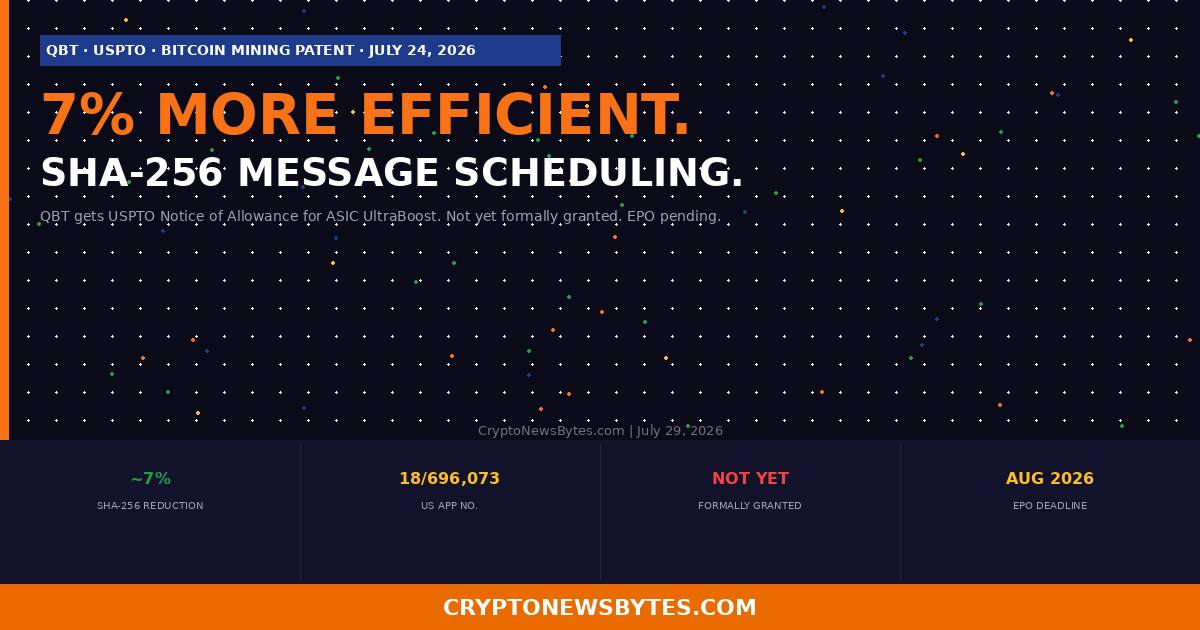
▶ Quantum Blockchain Technologies (AIM: QBT) received a USPTO Notice of Allowance for US Application No. 18/696,073 on July 24, 2026.
▶ The patent covers ASIC UltraBoost: eliminating redundant computations in SHA-256 message scheduling, reducing total operations by approximately 7%.
▶ This is not a final patent grant. QBT must pay issue and publication fees before the patent is formally issued.
▶ The European Patent Office application faces objections due August 2026. EPO grant is not confirmed.
▶ QBT is seeking ASIC manufacturer licensing deals and semiconductor advisers. CEO Francesco Gardin named as driving the strategy. No revenue timeline confirmed.
Quantum Blockchain Technologies (AIM: QBT) received a Notice of Allowance from the United States Patent and Trademark Office on July 24, 2026, for its patent application titled “Message Scheduling for Cryptographic Hashing” (US Application No. 18/696,073), internally known as ASIC UltraBoost. The technology is designed to improve the efficiency of Bitcoin mining ASIC chips by eliminating redundant computations in the SHA-256 message scheduling process, the part of the mining algorithm that prepares data before the main compression function runs. QBT’s own technical documentation puts the efficiency gain at approximately 7% reduction in total SHA-256 operations across the three iterations of SHA-256 used in Bitcoin mining.
Three things to be precise about before going further. A Notice of Allowance is not a granted patent. It means the USPTO examiner has determined the claims are allowable, but the patent does not formally issue until QBT pays the required issue and publication fees, a step the company says it has instructed its attorneys to coordinate. The European Patent Office equivalent application is in a different position: the EPO issued an initial examination report raising formal subject-matter and novelty objections, and QBT has until August 2026 to respond with amended claims and technical arguments. EPO grant is not confirmed. Only the US Notice of Allowance has been received.
The commercial picture is at an early stage. QBT is seeking licensing arrangements with established ASIC manufacturers and is looking to hire semiconductor sector advisers to support the monetisation process. CEO Francesco Gardin confirmed the strategy but management explicitly cautioned that there was no certainty over timing, structure, or near-term revenue. The ASIC chip manufacturing market for Bitcoin mining is dominated by Bitmain, MicroBT, and Canaan. Whether any of those three engage with QBT on licensing is the question the Notice of Allowance opens but does not answer.
What Is SHA-256 Message Scheduling and Why Does 7% Matter?
SHA-256 and Bitcoin mining explained
Bitcoin mining works by repeatedly running the SHA-256 hashing algorithm to find a number (called a nonce) that produces a hash output below a target value. SHA-256 has two stages: message scheduling, which preprocesses the input data into 64 words, and compression, which runs the actual hash computation. Bitcoin mining runs SHA-256 three times per attempt. ASIC chips (Application Specific Integrated Circuits) are hardware built exclusively to run SHA-256 as fast as possible. Any efficiency gain in the algorithm translates directly into either more hashes per second from the same chip or the same hashes per second using less power.
The existing dominant optimisation in the market is called ASICBoost, patented by Sergio Demian Lerner in 2016 and widely licensed to Bitmain and other manufacturers. ASICBoost optimises the compression function. ASIC UltraBoost targets a different stage: the message schedule. The two optimisations address different parts of the algorithm and are not mutually exclusive. QBT’s own documentation describes ASIC UltraBoost as “building on all other existing optimisations in the market, including ASIC Boost” rather than replacing them.
The 7% figure refers to the reduction in total operations across all three SHA-256 iterations in a standard Bitcoin mining round. QBT notes in its technical materials that a more accurate hardware-level efficiency figure will be available once ASIC UltraBoost is implemented in actual silicon, since software-level operation counts and hardware clock-cycle efficiency do not map one to one. The 7% is a theoretical algorithmic reduction, not a measured chip benchmark. That distinction matters when evaluating the commercial opportunity. ASIC manufacturers will want silicon-validated numbers before committing to licensing.
In the context of Bitcoin mining economics, a 7% efficiency gain is significant if it holds in hardware. Post-fourth-halving in April 2024, miners receive 3.125 BTC per block. At $65,900 Bitcoin, that is approximately $206,000 per block. The mining industry operates on margins that a 7% chip efficiency improvement can swing materially, particularly for large-scale operators where electricity costs dominate. The supply shock dynamics Saylor described at Bitcoin 2026 and $10 billion in annual new Bitcoin supply against $20-100 billion in institutional demand and put additional pressure on miners to extract maximum efficiency from existing hardware cycles.
QBT vs the ASIC Manufacturer Landscape: The Licensing Path
QBT is an AIM-listed R&D company. It does not manufacture chips. Its commercial model is IP licensing, which means the value of the ASIC UltraBoost patent depends entirely on whether a major ASIC manufacturer pays to use it. The three companies that dominate Bitcoin mining hardware are Bitmain (Antminer series), MicroBT (Whatsminer series), and Canaan (Avalon series). All three are Chinese-headquartered. All three have their own internal R&D teams and patent portfolios.
The licensing precedent in this space is ASICBoost. Bitmain implemented ASICBoost in its Antminer hardware. The patent was contentious within the Bitcoin community because covert implementation of ASICBoost is technically incompatible with Segregated Witness transactions, which created a financial incentive for Bitmain to resist the SegWit upgrade in 2017. ASIC UltraBoost does not carry the same protocol-level controversy since it optimises the message schedule rather than a component that interacts with transaction structure. That removes one barrier to adoption but does not resolve the fundamental question: will Bitmain, MicroBT, or Canaan pay a UK AIM-listed company for an efficiency gain they could attempt to engineer around or develop independently?
QBT’s leverage is the patent itself. Once formally granted, any manufacturer implementing the message scheduling optimisation without a licence faces infringement exposure. The strength of that leverage depends on how broadly the claims are written and whether the EPO grant follows, since international protection significantly increases enforcement options. The EPO objections currently on the table, formal subject-matter and novelty issues tied to prior academic work and an Intel patent filing, are described by QBT’s attorneys as addressable. If that assessment is correct and the EPO grant follows, QBT holds a dual-jurisdiction position that meaningfully improves its licensing negotiating position.
Bitcoin Mining ASIC Efficiency Landscape: Where UltraBoost Fits
Source: QBT technical documentation, Proactive Investors July 2026, Share-Talk July 2026 | @cryptonewsbytes
Source: QBT patents page (quantumblockchaintechnologies.co.uk), Morningstar/RNS original filing, Proactive Investors July 2026. Note: 7% is algorithmic, not hardware-validated. | @cryptonewsbytes. Not financial advice.
What the Notice of Allowance Process Actually Means
What is a USPTO Notice of Allowance?
A Notice of Allowance is issued by a USPTO examiner when they determine that all claims in a patent application are allowable. It is not a granted patent. After receiving a Notice of Allowance, the applicant must pay an issue fee (currently $1,200 for a large entity, $600 for a small entity) within three months. Once the fee is paid and the USPTO processes it, the patent is formally issued and published. The patent number is assigned at that point. QBT received the Notice of Allowance on July 24, 2026. The patent will formally issue after fees are paid, typically within a few weeks of payment.
QBT first filed the ASIC UltraBoost application in the UK in September 2021, establishing the priority date. The application was subsequently filed internationally under the Patent Cooperation Treaty to extend protection across jurisdictions while maintaining that priority date. The US application (18/696,073) went through multiple examination rounds, including a Final Rejection that QBT’s attorneys addressed through an examiner interview in April 2026. The Notice of Allowance following that interview confirms the examiner accepted QBT’s arguments.
The EPO application is on a different timeline. An initial examination report raising formal subject-matter and novelty objections was received in May 2026. The objections reference prior academic work by the inventor and an Intel patent filing. QBT’s attorneys view these as issues of claim scope and wording rather than fundamental flaws in the invention, and the company is preparing amendments ahead of the August 2026 response deadline. The EPO process typically takes longer than the US process even after examination begins. A European grant is possible but not imminent.
Why This Matters Beyond QBT
The Circle-IBM patent acquisition we covered on July 27 and the Datavault AI Notice of Allowance for its naked short selling blockchain patent represent the financial services IP layer of blockchain. QBT represents something different: the infrastructure IP layer. A patent on SHA-256 message scheduling efficiency is a patent on a component inside every Bitcoin ASIC chip made going forward. If the claims hold and the major manufacturers cannot engineer around them, this is a royalty stream built into the physical hardware of Bitcoin mining itself.
The honest risk assessment: QBT is a small AIM-listed company with a market cap well below that of its potential licensing targets. Enforcing a US patent against Bitmain, which is headquartered in China and manufactures in Southeast Asia, is a different proposition than enforcing it against a US-based chip designer. The commercial outcome depends on factors that have nothing to do with the quality of the technology: negotiating leverage, enforcement jurisdiction, the scope of the granted claims, and whether the EPO grant follows. None of those are certain. What is certain is that on July 24, 2026, the USPTO agreed that QBT’s message scheduling optimisation is novel, non-obvious, and patentable. That is the first gate in a long process.
Frequently Asked Questions
What is ASIC UltraBoost?
ASIC UltraBoost is Quantum Blockchain Technologies’ proprietary optimisation of the SHA-256 message scheduling process used in Bitcoin mining ASIC chips. It eliminates redundant computations in the message schedule, the stage that preprocesses data before the main compression function runs. QBT’s technical documentation puts the efficiency gain at approximately 7% reduction in total SHA-256 operations across the three iterations used in Bitcoin mining. The technology builds on ASICBoost (which targets the compression function) rather than replacing it.
Has the ASIC UltraBoost patent been granted?
No. QBT received a USPTO Notice of Allowance on July 24, 2026, which confirms the examiner has determined the claims are allowable. The patent will be formally granted after QBT pays the issue and publication fees, expected within weeks of payment. The European Patent Office application has not been granted and faces formal objections with a response deadline of August 2026.
Who are QBT’s likely licensing targets?
The three dominant Bitcoin mining ASIC manufacturers are Bitmain (Antminer series), MicroBT (Whatsminer series), and Canaan (Avalon series), all Chinese-headquartered companies. QBT has not named specific targets. The company is seeking semiconductor sector advisers to support the licensing process. CEO Francesco Gardin stated there was no certainty over timing, structure, or near-term revenue from any licensing arrangement.
What is the difference between ASIC UltraBoost and ASICBoost?
ASICBoost, patented by Sergio Demian Lerner in 2016, optimises the compression function stage of SHA-256. It is widely licensed and implemented in major ASIC products. ASIC UltraBoost targets the message scheduling stage, a different part of the algorithm. QBT describes the two as complementary rather than competing: a chip implementing both would theoretically achieve additive efficiency gains, though no hardware benchmark for the combined approach has been published.
Further Reading
The week’s largest blockchain IP move: Circle acquires IBM’s dominant US blockchain patent position. The infrastructure and financial services IP layers of blockchain are both being contested simultaneously.
The supply economics that make mining efficiency gains commercially significant: $10B in annual Bitcoin supply post-halving against $20-100B in projected institutional credit demand.
This article is for informational purposes only and does not constitute financial advice. Sources: QBT Investegate RNS July 24 2026 (primary: notice of allowance), QBT Proactive Investors July 24 2026 (confirmation), Share-Talk July 24 2026, CoinTrust July 24 2026, QBT patents page quantumblockchaintechnologies.co.uk (7% figure), Proactive Investors May 7 2026 (EPO examination report), TipRanks May 7 2026 (EPO objections detail), QBT Morningstar/RNS September 2021 (original ASIC UltraBoost filing). Published July 22, 2026.