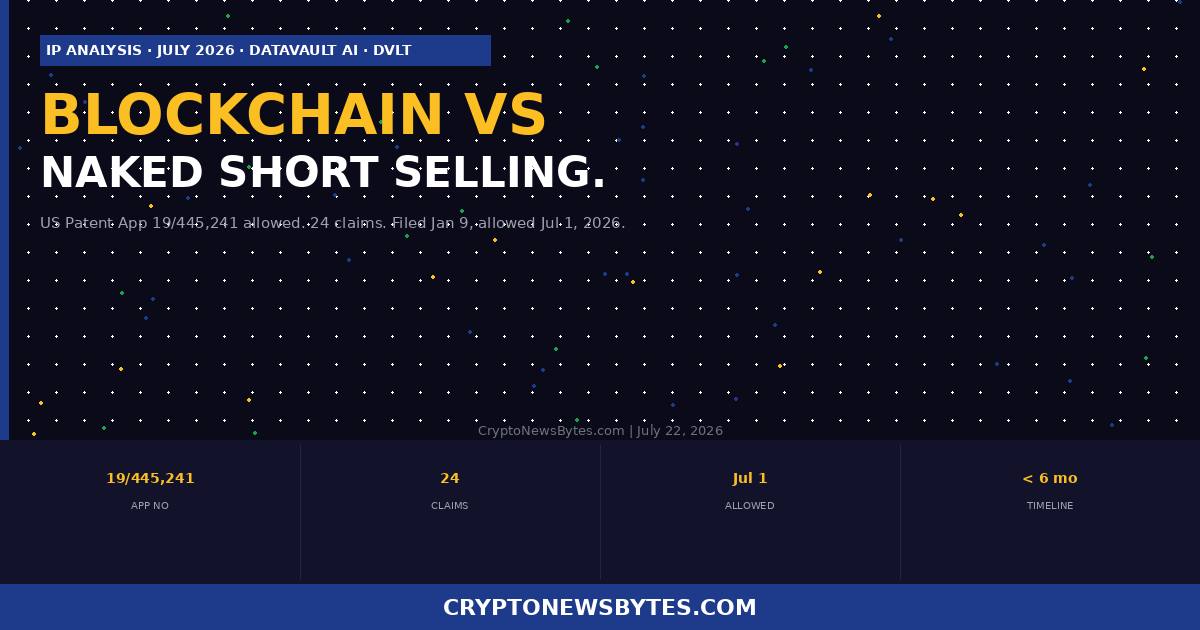
The United States Patent and Trademark Office issued a Notice of Allowance on July 1, 2026, allowing all 24 pending claims in US Patent Application No. 19/445,241, filed by Datavault AI Inc. (NASDAQ: DVLT) on January 9, 2026. The application is titled ‘Method and System for Mitigating Naked and Excessive Short Selling through Tokenized Dividend Distribution.’ Under six months from filing to allowance is fast for a capital markets blockchain patent. The company’s shares closed at $0.3563 on the day of announcement, up 1.28% in after-hours, against a 51% decline over the prior 12 months. DVLT’s market cap was $297.74 million at the time of the announcement.
A Notice of Allowance is not a granted patent. It means the USPTO examiner has reviewed the claims and determined they are allowable as written. The patent formally issues after Datavault AI pays the issue fee, a standard administrative step that typically takes four to eight weeks. Once issued, the granted patent number will differ from the application number 19/445,241. The 24 claims cover a specific set of technologies. Understanding what they cover, and why this is harder to build than it sounds, requires a brief explanation of the problem the patent is designed to solve.
Naked short selling is the practice of selling shares you have not borrowed and do not own, technically prohibited in the US under Regulation SHO since 2005 but persistently difficult to detect and enforce. The difficulty is structural: the conventional dividend process provides no cryptographic proof of who actually holds shares versus who holds synthetic or undelivered positions masquerading as real ones. When a company pays a dividend, the custodial system distributes it to everyone showing a share position, including positions that may not represent genuinely delivered shares. That is the gap Datavault AI’s patent claims to close.
What the 24 Allowed Claims Actually Cover
US Patent Application 19/445,241: The Allowed Claims Summarised
Notice of Allowance dated July 1, 2026 | Granted to: Datavault AI Inc. (NASDAQ: DVLT) | Sources: Business Wire Jul 8 2026, Investing.com, StockTitan | @cryptonewsbytes
| Claim Category | What It Covers | Why It Matters |
|---|---|---|
| Tokenized dividend generation | Issuing digital dividend tokens on a distributed ledger corresponding to shares entitled to a declared dividend | Creates an on-chain record of dividend entitlement that conventional custodial systems lack |
| Shareholder verification | Assigning tokens only to verified shareholders of record at a defined record date | Differentiates genuine shares from synthetic or undelivered positions in the reconciliation |
| Settlement reconciliation | Reconciling token issuance with reported share positions to surface discrepancies between tokens and actual delivered shares | The core detection mechanism: discrepancy between tokens and shares indicates a naked or synthetic position |
| Automated share recalls | Automating settlement enforcement and share recall processes when discrepancies are identified | Converts detection into enforceable action without requiring manual intervention per incident |
| CUSIP reclassification | Supporting CUSIP identifier reclassification for tokenized shares within the system | Integrates the blockchain record with the existing US securities identification infrastructure |
| Real-time audit reporting | Providing real-time reporting and audit capabilities for regulators, issuers, and market participants | Creates the auditor-accessible proof layer that makes enforcement legally actionable |
Source: Business Wire Jul 8 2026 (Datavault AI press release), Investing.com, StockTitan, 01net.it coverage of official release | @cryptonewsbytes
The technical architecture pairs each dividend event with a set of digital tokens recorded on a distributed ledger. Those tokens are assigned only to verified shareholders at the record date. The system then compares the number of tokens issued against the total share positions reported by custodians and broker-dealers. If more share positions show up in reports than tokens were issued, the difference represents shares that were never actually delivered: the signature of naked short selling. The official Business Wire press release describes the system as designed to surface settlement discrepancies, automate recalls, support CUSIP reclassification, and provide real-time audit capabilities for regulators, issuers, and market participants.
Why Naked Short Selling Is Hard to Detect Without Blockchain
Regulation SHO, adopted in 2005, requires short sellers to locate and borrow shares before selling. The locate requirement was supposed to prevent naked short selling by ensuring borrowed shares exist before they are sold. In practice, enforcement depends on custodians and broker-dealers accurately reporting their positions and on regulators having visibility into whether delivered shares actually settled. The system is not transparent. The locate is a paperwork confirmation rather than a cryptographic proof. Multiple parties can simultaneously claim ownership of the same shares through chains of hypothecation, lending, and rehypothecation without any external observer being able to verify that the total claimed positions match the actual issued shares outstanding.
This is where the blockchain mechanism in Datavault AI’s patent creates a structurally different audit trail. The immutability of a distributed ledger means that token issuance records cannot be retroactively altered. If 100 million tokens are issued against a dividend for a company with 100 million shares outstanding, and 105 million share positions are reported by custodians, the five million discrepancy is cryptographically provable rather than requiring a paper investigation. The reconciliation step specified in the patent claims is the audit function that converts that proof into actionable data for regulators and issuers.
The DTCC’s Digital Securities Management (DSM) initiative and the broader tokenized securities infrastructure that Ondo Finance, Securitize, and others are building address adjacent problems in the settlement space. Datavault AI’s patent addresses a specific problem within that space that existing tokenization projects have not targeted: using the dividend record to expose discrepancies in share positions rather than simply moving existing settlement processes onto a blockchain. Whether the patent creates durable licensing revenue depends on whether this specific mechanism is adopted by the market participants named as the target licensees: exchanges, transfer agents, broker-dealers, custodians, issuers, and digital asset platforms.
The Honest Context: What a Notice of Allowance Is Not
A Notice of Allowance means the USPTO examiner has approved the claims. It is not a granted patent. The patent issues only after Datavault AI pays the issue fee. If the fee is not paid within the required window, the application goes abandoned. Assuming the fee is paid, the issued patent will have a new grant number distinct from the application number 19/445,241. The issued patent will be enforceable. Until then it is not.
The stock reaction of +1.28% reflects modest enthusiasm appropriate to the stage. A Notice of Allowance is meaningful but not transformative. Datavault AI’s shares are down roughly 51% over the prior 12 months and trade near $0.35 with a market cap of $297 million, a micro-cap that reflects market scepticism about the company’s broader product suite, which includes audio technology (WiSA, ADIO, Sumerian), meme coins (Dream Bowl I on Biconomy Exchange), and now blockchain capital markets IP. The Investing.com report noted the stock’s performance against its IP news cleanly: the market is pricing a small probability that the licensing opportunity materialises into material revenue, not certainty. The 24 allowed claims are real, the application number is real, and the problem the patent addresses is real. The gap between that and a profitable licensing business is the honest distance between a Notice of Allowance and a revenue line.
The licensing target list is worth examining. Exchanges and transfer agents operate under significant regulatory and technology procurement constraints. Broker-dealers and custodians have compliance budgets, but integrating a blockchain-based dividend reconciliation system requires either a new workflow or integration with existing DTCC infrastructure. The DTCC’s own tokenization initiatives, including settlement modernisation programs, may intersect with or compete with what Datavault AI is patenting. The most immediately plausible licensing target from the list may be digital asset platforms, which already operate on distributed ledgers and could implement the reconciliation logic as a native feature rather than a retrofit. The Ondo tokenized stocks launch on July 2 and the tZERO vs Securitize patent dispute both illustrate how rapidly intellectual property is becoming a competitive differentiator in the tokenized securities space. Datavault AI’s patent, once issued, enters that competitive landscape.
Frequently Asked Questions
What is the difference between a Notice of Allowance and a granted patent?
A Notice of Allowance means the USPTO examiner has reviewed the claims and determined they are allowable. It is the step immediately before grant. The patent is formally issued after the applicant pays the issue fee, which typically takes four to eight weeks. Only the issued patent is enforceable. Datavault AI’s US Patent Application No. 19/445,241 has received a Notice of Allowance dated July 1, 2026, but the issued patent number will be different and will only be publicly confirmed when the grant posts to the USPTO database.
What is naked short selling and why is it hard to detect?
Naked short selling is selling shares you have not borrowed and do not own, prohibited under SEC Regulation SHO since 2005. It is hard to detect because the conventional securities settlement system does not provide cryptographic proof that every position reported by custodians represents a share that was actually delivered. Multiple parties can simultaneously claim ownership of the same shares through lending and rehypothecation chains. The locate requirement under Reg SHO is a paperwork confirmation, not a cryptographic verification.
How does blockchain solve the detection problem?
Datavault AI’s patented system pairs each dividend event with digital tokens issued to verified shareholders of record. The total tokens issued equals the genuine shares outstanding. The system then reconciles those tokens against the total share positions reported by custodians. A discrepancy between tokens issued and positions reported indicates shares that were never actually delivered, which is the detectable signature of naked or excessive short selling. The immutability of the blockchain makes the discrepancy cryptographically provable rather than requiring a paper audit.
Further Reading
The institutional tokenized securities infrastructure Datavault AI’s patent targets. JPMorgan’s on-chain treasury fund is exactly the kind of product that would benefit from a blockchain-native dividend reconciliation layer to detect settlement discrepancies.
The regulatory framework that determines whether tokenized dividends and blockchain-based share records fall under SEC or CFTC oversight, directly affecting how Datavault AI’s patent would be licensed and enforced.
This article is for informational purposes only and does not constitute financial advice. Sources: Business Wire Jul 8 2026 (Datavault AI official press release), Investing.com Jul 8 2026, StockTitan Jul 8 2026, Parameter.io Jul 8 2026, Barchart Jul 9 2026, 01net.it Jul 8 2026, NYSE/NASDAQ Regulation SHO SEC documentation, USPTO application database 19/445,241. Published July 22, 2026.