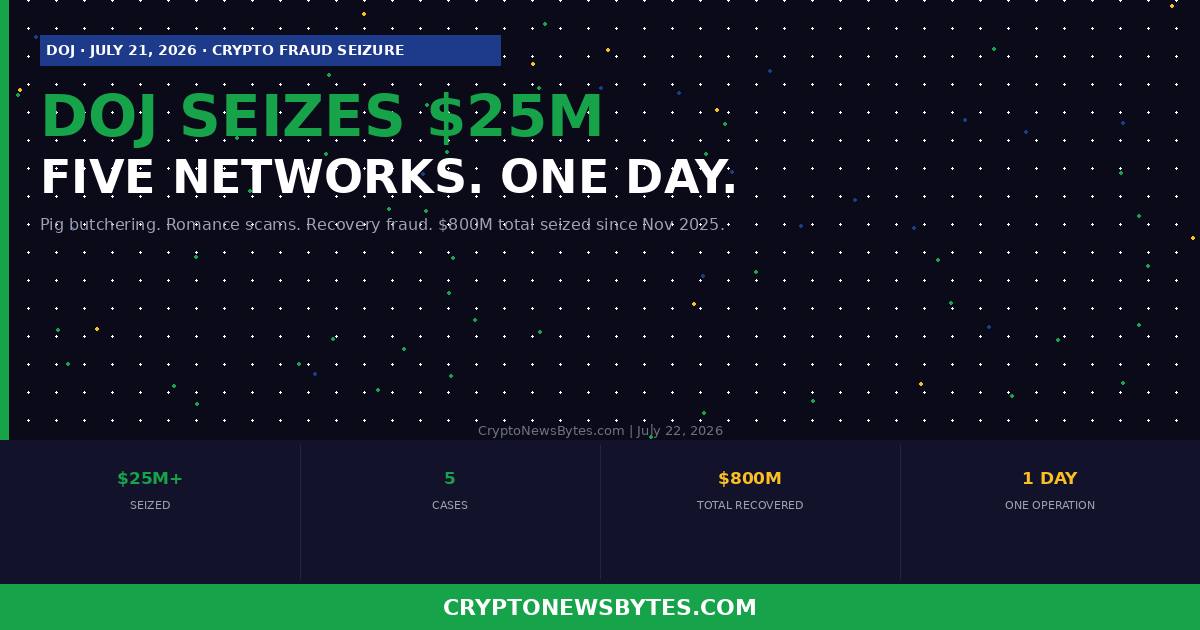
The US Attorney’s Office for the District of Columbia and the Secret Service Washington Field Office announced on July 21, 2026 that five separate cryptocurrency fraud investigations have resulted in the seizure of more than $25 million in digital assets. The seizures came from five civil forfeiture complaints filed simultaneously in US District Court. Every laundering network in all five cases was traced to Southeast Asia, with IP addresses in China, Malaysia, and Cambodia. The $25 million is the latest tranche in what the DOJ says is more than $800 million recovered since US Attorney Jeanine Ferris Pirro launched the Scam Center Strike Force in November 2025.
The five cases describe what the crypto fraud ecosystem actually looks like in 2026 at the individual victim level. One victim in the National Capital Region lost money to a fraudulent investment platform and when they tried to withdraw, the perpetrators disappeared. Another was manipulated through a romance scheme, one of roughly 200 victims in that single investigation alone. A third was targeted by recovery fraud, where scammers contacted a previous fraud victim claiming they could recover the stolen funds, then charged a fee and disappeared with that too. The technical sophistication of these operations is considerable. Investigators found proceeds laundered through hundreds of intermediary wallet addresses before funds were commingled with other victims’ money and sent offshore.
What makes this announcement significant beyond the dollar amount is the forensic picture it provides. These are not high-profile exchange hacks or DeFi protocol exploits. These are cases built one victim at a time: a tip from Canadian authorities, a referral from a private sector partner, a report from a resident who lost money and filed a complaint. The Secret Service’s Cyber Fraud Task Force then traced those funds across hundreds of blockchain addresses, identified the laundering networks, froze the accounts, and built civil forfeiture cases. That process is slower and less dramatic than a DeFi hack post-mortem, but the $800 million recovered since November 2025 suggests it is working.
The Five Cases: What Was Stolen and How
DOJ July 21, 2026: Five Cryptocurrency Fraud Seizures
Source: US Attorney’s Office District of Columbia press release, July 21, 2026 | @cryptonewsbytes
| Case | Scheme Type | How It Was Detected | Amount Sought |
|---|---|---|---|
| Investigation 1 | Fraudulent investment platforms (pig butchering) | Canadian authorities flagged suspicious wallet addresses. 270+ victim transactions traced. | $10,400,913 |
| Investigation 2 | Romance scams (online relationship fraud) | Private sector partner flagged suspicious transactions. 200+ victims identified. Funds laundered through hundreds of intermediary addresses. | $12,086,914 |
| Investigation 3 | Fraudulent crypto investment scheme | May 2026: National Capital Region victim reported after perpetrators cut off contact when withdrawal was requested. | $1,230,900 |
| Investigation 4 | Fraudulent investment account | March 2026: National Capital Region victim transferred millions. Second victim on same platform identified. Funds traced to six addresses and frozen. | $2,392,231 |
| Investigation 5 | Recovery fraud (scam-on-a-scam) | Fraud victim was re-targeted by scammers claiming to recover previously stolen funds. Victim paid fees to new scammers. Ongoing investigation. | $285,000 |
| Total civil forfeiture sought | $26,396,058 | ||
Source: US Department of Justice USAO-DC press release, July 21, 2026. All five investigations remain ongoing. | @cryptonewsbytes
The Scam Center Strike Force: What It Is and Why $800M Matters
The Scam Center Strike Force was launched by US Attorney Pirro in November 2025 specifically to target transnational cryptocurrency fraud networks, primarily those operating out of Southeast Asia. The $800 million recovery figure, which the July 21 announcement cited as the cumulative total since the Strike Force launched, puts the $25 million seizure in context. This is not a single case. It is an ongoing operational drumbeat of civil forfeiture filings, each one representing months of forensic blockchain tracing, international coordination, and victim documentation.
The most important operational detail in the press release is the private sector referral in Investigation 2. A private company, unnamed in the announcement, identified suspicious transactions and brought them to the Secret Service’s Cyber Fraud Task Force. That cooperation between financial intelligence from private blockchain analytics firms and government investigators is increasingly the standard model for these recoveries. On-chain data is public. The tools to trace it, from Chainalysis and Elliptic to internal analytics at major exchanges, exist in the private sector. The Secret Service has the legal authority to freeze and seize. The combination is producing results.
Investigation 1 began with a tip from Canadian authorities, which illustrates the international coordination layer. The laundering networks in these cases route funds across jurisdictions specifically to exploit gaps between national law enforcement systems. A Canadian tip to the Secret Service Washington Field Office triggering a US forfeiture complaint is the cross-border response to a cross-border crime. The fact that all five laundering networks in these five cases had IP addresses in China, Malaysia, and Cambodia is not a coincidence. Southeast Asia has become the operational base for organized crypto fraud at scale, with pig butchering script farms in Myanmar and Cambodia well-documented by investigative journalists since 2023.
What Pig Butchering, Romance Scams and Recovery Fraud Actually Look Like
The three fraud types represented in these five cases are worth distinguishing because they target different victims in different ways and each requires a different defence.
Pig butchering, the scheme behind Investigations 1 and likely 4, gets its name from the practice of fattening a pig before slaughter. Fraudsters build trust with victims over weeks or months, usually through social media or messaging apps, before introducing what appears to be a highly profitable cryptocurrency investment platform. Victims make increasingly large deposits as they see apparent gains. When they try to withdraw, they are told they owe taxes, fees, or verification payments. The platform disappears when the victim runs out of money or stops paying. The DOJ traced more than 270 victim transactions in Investigation 1 alone.
Romance scams, the scheme behind Investigation 2, use the same trust-building playbook but frame the relationship as romantic rather than financial. Victims believe they are in a relationship with someone who then introduces crypto investment as a way to build a future together. The 200 victims in Investigation 2 represent one network. FBI data puts romance scam losses in the billions annually across the United States. The laundering complexity in Investigation 2, funds moved through hundreds of intermediary addresses and commingled with other victims’ proceeds, is designed specifically to defeat blockchain tracing by mixing funds until the origin is obscured.
Recovery fraud, Investigation 5, is the most cynical category. A victim who has already been defrauded is contacted by new scammers claiming to represent law enforcement or recovery services that can retrieve the stolen funds, for a fee. The victim, desperate to recover their losses, pays the fee. They lose again. Investigation 5 is the smallest in dollar value at $285,000 sought but illustrates that fraud victims are systematically re-targeted by secondary networks that buy or trade victim lists.
What This Means for Crypto Investors Right Now
The profile of every victim in these five cases is consistent: someone who believed they were making a legitimate cryptocurrency investment through a platform or relationship that turned out to be fraudulent. None of them sent funds to a known scammer. They all thought they were doing something reasonable. The scale of the $800 million recovery since November 2025 reflects both how much money is being lost and how much better the government has gotten at recovering it. Recovery is not the same as prevention. The Secret Service and DOJ can trace funds and file civil forfeiture complaints. They cannot un-do the psychological and financial damage to victims who often liquidate retirement accounts, take out second mortgages, or borrow from family before realizing the investment was fraudulent. The warning the DOJ has issued consistently since the Strike Force launched: if a crypto investment opportunity comes to you unsolicited, through social media, a messaging app, or an online relationship, and it shows consistently high returns with no volatility, it is almost certainly fraud. Legitimate investments do not come to you. You go to them.
Frequently Asked Questions
What is a civil forfeiture complaint and what happens to the money?
A civil forfeiture complaint is a legal action filed against the property itself rather than against a named individual. The government argues the property was derived from or used in illegal activity and asks a court to transfer ownership to the United States. If the court agrees, the funds are forfeited. The DOJ has authority to return forfeited funds to victims through restitution programs. The five complaints filed July 21 are the first legal step. They do not guarantee recovery. All five investigations are ongoing.
What is the Scam Center Strike Force?
The Scam Center Strike Force was launched by US Attorney Jeanine Ferris Pirro in November 2025 specifically to target transnational cryptocurrency fraud networks, primarily those operating from Southeast Asia. It operates through the Secret Service’s Cyber Fraud Task Force and coordinates with international law enforcement and private sector blockchain analytics partners. The DOJ says more than $800 million has been recovered through the Strike Force since its launch.
How do I report cryptocurrency fraud?
The DOJ press release directs victims to contact their local US Secret Service field office at secretservice.gov/contact and file a report through ic3.gov, the FBI’s Internet Crime Complaint Center. Reports filed with IC3 are shared across federal law enforcement. Filing a report even if recovery seems unlikely contributes to the investigative data that allows the Secret Service to identify laundering networks and build civil forfeiture cases like the five filed July 21.
Further Reading
The week’s other major crypto loss: a DeFi protocol exploit on Arbitrum. Different attack vector, same lesson about infrastructure security.
The CFTC’s role in crypto enforcement, the same agency that oversees much of the cryptocurrency market under the SEC/CFTC five-category framework.
This article is for informational purposes only and does not constitute financial advice. Sources: US Department of Justice USAO-DC press release July 21 2026 (primary source), US Secret Service Washington Field Office, Scam Center Strike Force official page justice.gov/usao-dc/scam-center-strike-force. Published July 22, 2026.