
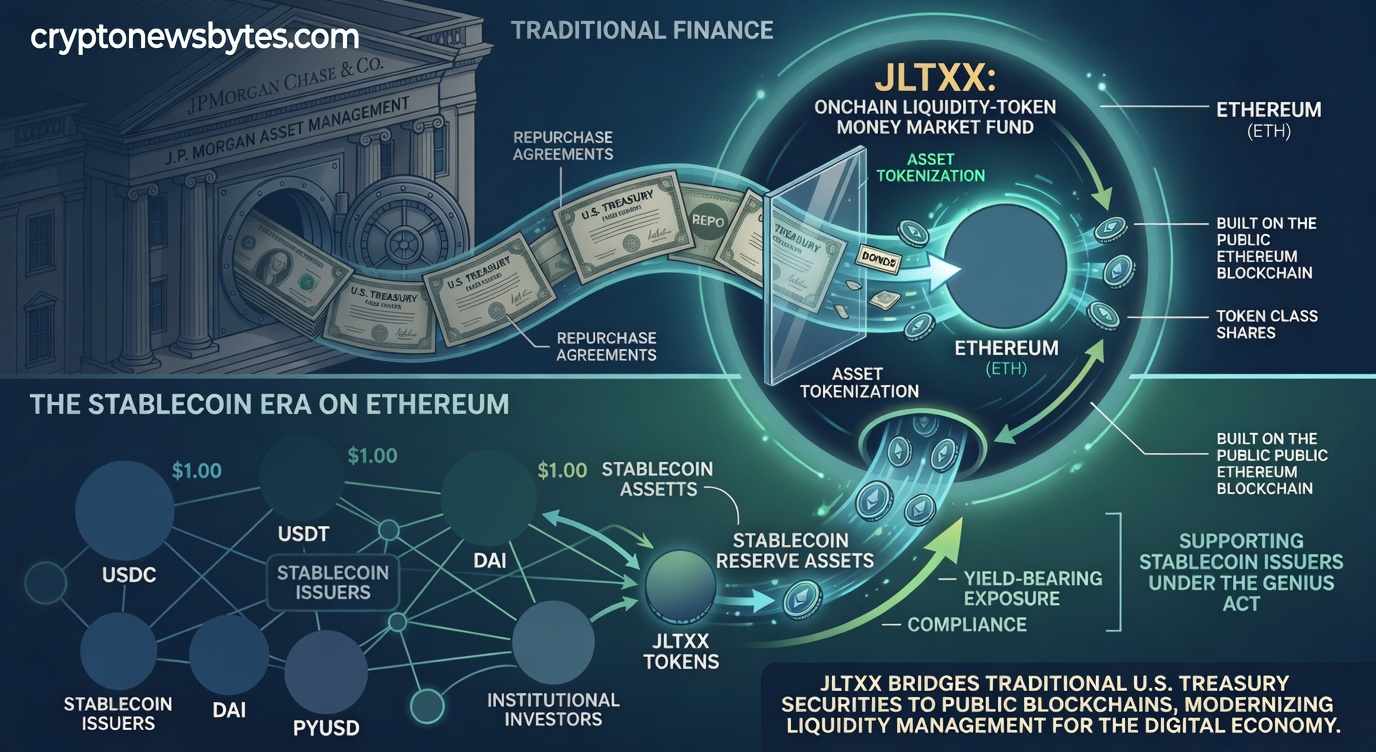
JPMorgan Asset Management filed with the U.S. Securities and Exchange Commission on May 12, 2026 to launch a second tokenized money market fund on Ethereum. The fund is called the JPMorgan OnChain Liquidity-Token Money Market Fund and will trade under the ticker JLTXX. It is not a pilot. It is not a proof of concept. It is a registered SEC product structured from the ground up to serve as a GENIUS Act-compliant reserve asset for stablecoin issuers, and it lands five months after JPMorgan’s first tokenized fund quietly seeded itself with $100 million of the bank’s own capital.
The strategic logic is not complicated once you understand what the GENIUS Act actually changed. The stablecoin framework signed into law in July 2025 prohibited stablecoin issuers from paying interest on reserves, which forced a hard separation: stablecoins became pure payment instruments, while yield-bearing reserves had to live somewhere else. JLTXX is that somewhere else. It is the product Wall Street built specifically for the regulatory gap that Congress created.
What JLTXX Actually Is and How It Works
JLTXX invests exclusively in short-term U.S. Treasury securities and fully collateralized overnight repurchase agreements. Treasury holdings are capped at maturities of 93 days or less. All securities are U.S. dollar-denominated. A portion of assets remains in cash at all times to support redemptions. The fund targets a stable $1.00 net asset value and is structured to meet the SEC’s Rule 2a-7 standards for money market funds, meaning it sits within the same well-understood regulatory framework that governs conventional institutional money markets.
The blockchain layer works through what the filing calls Token Class Shares. Investors hold tokenized representations of fund shares on Ethereum. Those token balances correspond one-to-one with ownership records maintained in the fund’s official Investor Register off-chain. The tokens are not stablecoins. They are not freely tradeable instruments. Eligible blockchain addresses must be approved before buying or transferring shares, creating a permissioned system layered on top of the public Ethereum network. Minting and burning of tokenized shares is handled by Kinexys Digital Assets, JPMorgan’s in-house tokenization platform that rebranded from Onyx in 2025.
The minimum investment is $1 million. Ethereum is currently the only supported network, though the filing states explicitly that expansion to additional blockchains is anticipated. The filing was submitted as a 485BPOS, the amendment form used by registered investment companies, which signals a broader institutional distribution pathway than MONY, JPMorgan’s first tokenized fund, which launched via SEC Rule 506(c) and was restricted to qualified investors only.
The GENIUS Act Created the Market. JLTXX Is the Product.
The GENIUS Act’s prohibition on stablecoin issuers paying interest is the regulatory event that makes JLTXX commercially significant. Before the act, a stablecoin issuer could in theory design a product that blurred the line between a payment instrument and a yield-bearing instrument. The act ended that ambiguity. Stablecoins are payment rails. Yield lives elsewhere.
JLTXX’s SEC filing states directly that the fund is structured to satisfy the reserve requirements that stablecoin issuers must maintain under the GENIUS Act. That language is not boilerplate. It is a product positioning statement. JPMorgan is telling stablecoin issuers that instead of holding idle reserves in cash or T-bills through a traditional custodian, they can hold tokenized T-bills through JLTXX, earn yield on those reserves, and remain fully compliant with their GENIUS Act reserve obligations simultaneously.
For the stablecoin industry, the yield question is one of the most consequential open questions in its business model. Major stablecoin issuers collectively hold tens of billions in Treasury reserves. Under current structures, that yield flows entirely to the issuer, not the holder of the stablecoin. The GENIUS Act locked that structure in. JLTXX does not change who earns the yield, but it changes where the reserves live and how efficiently they can be deployed, redeemed, and moved on-chain, which matters enormously for issuers running real-time liquidity operations.
Wall Street’s Tokenized Treasury Race: Who Is Doing What
Live and filed products as of May 2026 | @cryptonewsbytes
| Institution | Product | Chain(s) | AUM / Status | GENIUS Act Target |
|---|---|---|---|---|
| JPMorgan | JLTXX (new filing) | Ethereum (+ future) | Filed May 12 | Yes, explicitly |
| JPMorgan | MONY (first fund) | Ethereum | Live Dec 2025 | Corporate treasury focus |
| BlackRock | BUIDL | ETH, SOL, Aptos + 5 more | $2.8B live | Partial |
| BlackRock | BSTBL (tokenized $6.1B MMF) | Ethereum | Filed May 2026 | Yes |
| Franklin Templeton | BENJI (FOBXX) | BNB, Avalanche, Canton, Stellar, Polygon | Live, multi-chain | Partial |
| Ondo Finance | OUSG | Ethereum, XRP Ledger | Live | Retail-eligible |
Sources: SEC filings, rwa.xyz, Unchained, Decrypt, CoinDesk | @cryptonewsbytes
JLTXX vs MONY: Why JPMorgan Filed Twice in Five Months
JPMorgan’s first tokenized fund, MONY, launched in December 2025 and was seeded with $100 million of JPMorgan’s own balance sheet. It was structured under SEC Rule 506(c) and aimed squarely at institutional investors managing corporate treasury cash on-chain. JLTXX has a different target and a different filing type. Where MONY was a 506(c) private placement, JLTXX was filed via a 485BPOS, which is the form used by registered investment companies for product updates and expansions. The distinction matters because 485BPOS filings suggest a broader distribution pathway, one that reaches beyond the closed circle of qualified investors that MONY was limited to.
The product sequence tells a story. MONY was JPMorgan proving to itself that tokenized on-chain money markets could work operationally, using its own capital as the test. JLTXX is JPMorgan going to market with a product designed for an external customer base that did not exist before the GENIUS Act created it: regulated stablecoin issuers looking for yield-bearing, on-chain compliant Treasury reserves. These are two meaningfully different products built for two meaningfully different use cases within five months of each other.
Kinexys and the XRP Ledger Pilot: JPMorgan’s Broader Tokenization Push
JLTXX is not the only tokenization move JPMorgan made in a single week. In the days before the SEC filing, the bank’s Kinexys platform partnered with Ondo Finance, Ripple, and Mastercard to complete the first tokenized U.S. Treasury fund transfer from a U.S. account to JPMorgan’s Singapore branch via the XRP Ledger and interbank rails. The two announcements together reveal a deliberate infrastructure buildout: JLTXX for domestic institutional reserve management, Kinexys cross-chain rails for cross-border settlement.
Kinexys, which rebranded from Onyx in 2025, is now the institutional backbone across both products. It handles the permissioned system layered on top of Ethereum for JLTXX and processed the cross-chain collateral and settlement transactions in the XRP pilot. The bank is not building on blockchain because it believes in decentralization. It is building because its regulated clients need on-chain settlement rails, and Kinexys is the bank’s answer to owning that infrastructure layer.
Tokenized RWA Market Growth: 2024 to May 2026
Total market and Treasury segment | @cryptonewsbytes
Total tokenized RWA market
400%+ growth since start of 2025
Tokenized Treasuries segment
Largest segment of the tokenized RWA market
Sources: rwa.xyz, SEC filings, Unchained, CoinDesk | @cryptonewsbytes
BlackRock Filed the Same Week. The Race Is Real.
The week JPMorgan filed JLTXX, BlackRock submitted its own SEC paperwork for two tokenized money market products. The first is the BlackRock Daily Reinvestment Stablecoin Reserve Vehicle, investing in cash, short-dated Treasuries, and overnight repos. The second tokenizes a share class of BlackRock’s existing Select Treasury-Based Liquidity Fund, which currently holds $6.1 billion in assets, on Ethereum.
BlackRock already runs the largest tokenized fund in the world through BUIDL, which passed $2.8 billion in AUM across eight blockchains by early 2026. The BUIDL launch in March 2024 was the product that proved institutional tokenized funds could scale. What changed between then and now is the regulatory certainty provided by the GENIUS Act. BUIDL launched in a regulatory gray area and succeeded anyway. Everything being filed in May 2026 is being built into a clear legal framework, which is why the volume of filings jumped so sharply in such a short window.
Franklin Templeton’s BENJI runs on five blockchains, including BNB Chain, Avalanche, Canton, Stellar, and Polygon, with further Solana expansion expected. Ondo Finance’s OUSG operates on Ethereum and the XRP Ledger and targets a broader investor base including retail-eligible accounts. The tokenized Treasury market that was nascent in 2024 is now contested territory involving some of the largest asset managers in the world.
Why Ethereum and Why a Permissioned Layer on Top of It
JPMorgan’s choice to build on Ethereum while running Kinexys as a permissioned layer on top of it is the practical answer to a genuine institutional dilemma. Fully permissioned private chains offer control but sacrifice interoperability, liquidity depth, and composability with the broader DeFi and stablecoin ecosystem. Public chains offer all three, but the regulatory requirement for know-your-customer compliance and the financial requirement for controlled share transfers mean that pure public deployment is not viable for a registered SEC product.
The Kinexys permissioned overlay solves this by approving blockchain addresses before allowing them to hold or transfer JLTXX shares. The public Ethereum ledger handles settlement transparency and immutability. The permissioned layer handles compliance. The filing itself flags blockchain technology as a primary risk factor, calling it “relatively new and untested technology” in the context of registered investment company operations, which is a remarkable sentence for a $4 trillion institution to put in an SEC document, and an honest one.
JPMorgan stock closed at $304.88 on the day of the filing, up 1.63%. That reaction is modest for a product that may eventually reshape how trillions in institutional cash move. The market is treating this as an incremental announcement, which is probably the right framing for a single filing from a single bank. What is harder to dismiss as incremental is that JPMorgan, BlackRock, Franklin Templeton, Goldman Sachs, and Fidelity are all now filing, launching, and scaling tokenized Treasury products within the same regulatory window. The experiment phase ended with BUIDL in 2024. What is happening now is buildout.
Frequently Asked Questions
What is JPMorgan’s JLTXX fund?
JLTXX is the JPMorgan OnChain Liquidity-Token Money Market Fund, filed with the SEC on May 12, 2026. It invests exclusively in short-term U.S. Treasury securities and overnight repurchase agreements on Ethereum, managed by JPMorgan’s Kinexys Digital Assets platform. It is JPMorgan’s second tokenized money market fund, following MONY which launched in December 2025, and is specifically structured to serve as a compliant reserve asset for stablecoin issuers under the GENIUS Act.
How does the GENIUS Act connect to JLTXX?
The GENIUS Act, signed in July 2025, prohibits stablecoin issuers from paying interest on their stablecoin products. This created a structural need: stablecoin issuers must hold compliant reserves and cannot earn yield through the stablecoin itself. JLTXX fills that gap by offering a GENIUS Act-compliant reserve vehicle where issuers can park their Treasury reserves, earn yield, remain fully liquid, and settle on-chain through Ethereum’s public ledger, all while meeting statutory reserve requirements.
What is Kinexys and what role does it play?
Kinexys Digital Assets is JPMorgan’s in-house blockchain and tokenization platform, rebranded from Onyx in 2025. For JLTXX, Kinexys manages the minting and burning of tokenized share balances on Ethereum, runs the permissioned address approval system that ensures only compliant investors can hold or transfer shares, and handles collateral and settlement processing. Kinexys also powered JPMorgan’s recent cross-chain pilot with Ondo Finance, Ripple, and Mastercard on the XRP Ledger.
How does JLTXX compare to BlackRock’s BUIDL?
BUIDL launched in March 2024, currently holds over $2.8 billion in AUM, and runs across eight blockchains including Ethereum, Solana, and Aptos. It is the largest tokenized fund by AUM and proved the institutional market exists. JLTXX differentiates itself through its explicit GENIUS Act reserve compliance positioning, its Ethereum-first approach via Kinexys, and its target customer: specifically stablecoin issuers rather than a broader institutional investor base. Both are competing for the same structural capital shift, but from slightly different angles of the market.
Further Reading
The market structure bill that will sit alongside the GENIUS Act in defining how tokenized assets are regulated in the U.S. faces its most contested Senate session yet.
As the U.S. locks in stablecoin and RWA frameworks, Japan is simultaneously building its own tokenized asset regulatory architecture. The global race is not just institutional, it is jurisdictional.
As tokenized Treasury funds begin settling on public blockchains, the security of the agent infrastructure managing those positions becomes a live financial risk, not an academic one.
This article is for informational purposes only and does not constitute financial or legal advice. Sources: Unchained, Decrypt, CoinDesk, FXStreet, SEC EDGAR (485BPOS filing, May 12-13 2026), rwa.xyz. Published May 14, 2026.