
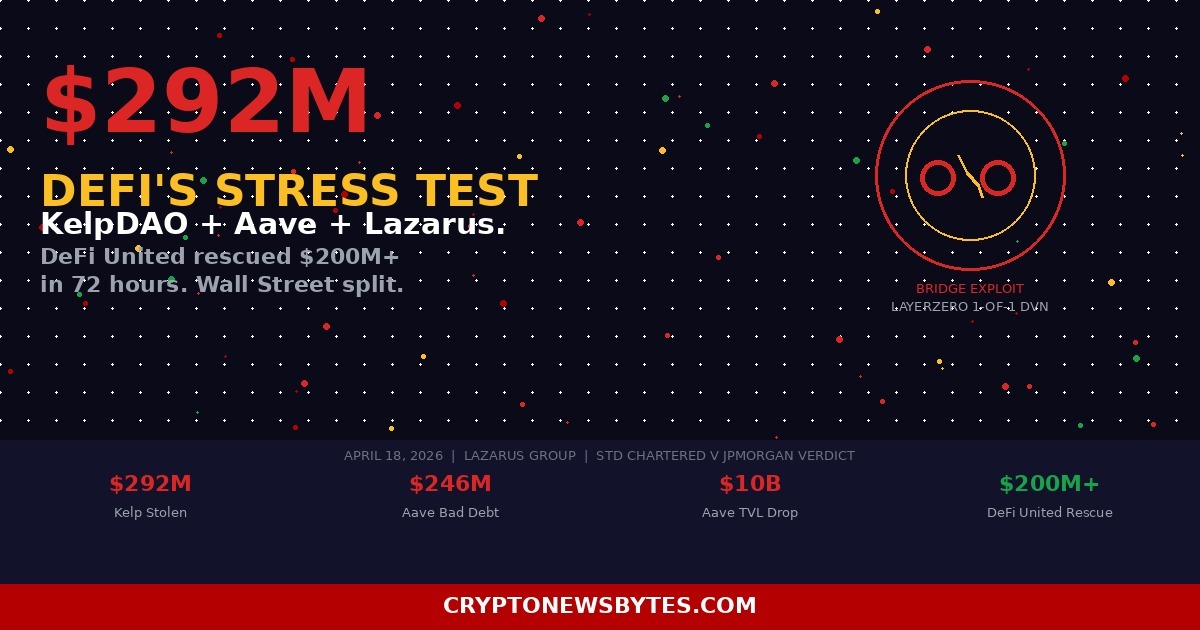
At 17:35 UTC on April 18, 2026, an attacker tied to North Korea’s Lazarus Group sent a single forged cross-chain message through KelpDAO’s LayerZero bridge. The bridge accepted it, releasing 116,500 rsETH tokens, roughly 18% of the entire restaked-Ethereum supply, into an attacker-controlled wallet. At then-current prices the haul was worth $292 million, the largest DeFi exploit of 2026 to date. The technical mechanism was almost embarrassingly simple. KelpDAO’s bridge had been configured to accept verification from a single Decentralized Verifier Network node. One signature was enough. The attacker did not break the smart contracts. The verification layer was the entire vulnerability.
What happened next is the story Wall Street is now arguing about. Within hours, the attacker deposited roughly 90,000 of the unbacked rsETH into Aave as collateral and borrowed approximately $246 million in real ether and other assets across Ethereum and Arbitrum. Aave was left holding worthless collateral against real liabilities. Lenders rushed to withdraw. The total value of assets on Aave plunged by $10 billion within the first 24 hours. The AAVE token dropped 16%. Lido paused rsETH-related deposits. SparkLend, Fluid, and Upshift activated emergency asset freezes. RaveDAO’s token collapsed 90%. By Sunday evening, the Crypto Fear and Greed Index had crashed to 27, deep in fear territory. Bitcoin briefly broke below $74,000.
And then DeFi did something it has never done before at this scale. It self-organized a coordinated, industry-wide rescue. Aave service providers, Lido Finance, EtherFi, and Aave founder Stani Kulechov launched an initiative called “DeFi United,” pooling more than $200 million of fresh ether to cover the bad debt and restore rsETH backing. Arbitrum’s security council froze 30,766 ETH worth $71 million tied to the exploit. By April 29, eleven days after the attack, Standard Chartered published a research note declaring DeFi “bent, not broken” and reaffirming its $2 trillion tokenized RWA forecast for 2028. JPMorgan, the same week, published competing research arguing that persistent security flaws continue to curb DeFi’s institutional appeal. Both can be right. The question for the next 12 months is which view drives institutional capital allocation decisions.
The Anatomy of a Cross-Chain Bridge Exploit
KelpDAO is a liquid restaking protocol. Users deposit ether, receive rsETH in return, and deploy that rsETH across DeFi for additional yield through Eigenlayer’s restaking framework. The token sits at the center of a sprawling DeFi ecosystem: it is accepted as collateral on Aave, integrated with Lido, used in Pendle yield strategies, and bridged across more than 20 separate blockchain networks via LayerZero’s omnichain infrastructure. That architecture is what made the protocol useful. It is also what made the exploit possible.
LayerZero is a cross-chain messaging protocol that lets independent blockchains send verified instructions to one another. When a user wants to move rsETH from Ethereum to Arbitrum, LayerZero’s Decentralized Verifier Networks (DVNs) confirm that the message is legitimate before the destination chain accepts it. LayerZero V2 allows protocols to configure how many DVNs must sign off on a message. Best practice is two or more, with each DVN run by an independent operator. KelpDAO’s bridge was configured with one. The single DVN was operated by a single entity. As security researcher Fishy Catfish summarized in a widely shared technical breakdown: “There is no security floor. A configuration can be a 1/1 DVN and the DVN you chose can be a single node ran by a single entity.”
Lazarus Group exploited that single point of failure. The attacker submitted a forged cross-chain message claiming that 116,500 rsETH had been deposited on a source chain. The single DVN signed off. KelpDAO’s bridge on the destination chain accepted the signature and minted 116,500 rsETH out of nothing on Ethereum, sending them to the attacker’s wallet. The smart contracts performed exactly as designed. The verification layer they trusted was the failure. Within minutes, the attacker had the largest unbacked liquid restaking position in DeFi history, and the next 18% of rsETH supply was effectively worthless because the market did not yet know that 18% of supply had no underlying ether backing it.
How $292 Million Vanished in One Forged Cross-Chain Message
Source: CoinDesk technical analysis, Intellectia.ai post-mortem, Aave incident report, Chainalysis attribution | @cryptonewsbytes
1 17:35 UTC, April 18: Forged LayerZero Message Lazarus submits a single fabricated cross-chain message to KelpDAO’s LayerZero bridge claiming a deposit on a source chain. The bridge’s 1-of-1 DVN configuration accepts the signature without independent verification. |
| ↓ |
2 Bridge Mints 116,500 Unbacked rsETH KelpDAO’s destination chain bridge releases 116,500 rsETH to the attacker’s wallet. ~18% of total rsETH supply (630,000 tokens) is now circulating without underlying ether backing it. |
| ↓ |
3 90,000 rsETH Deposited as Collateral on Aave Attacker deposits ~90,000 of the unbacked rsETH into Aave across Ethereum and Arbitrum. Aave’s risk system accepts rsETH as eligible collateral at standard parameters. |
| ↓ |
4 $246M Borrowed in Real ETH and Other Assets Attacker borrows roughly $246 million in real ether and other assets against the worthless rsETH collateral. Funds are immediately bridged out and routed through known DPRK mixer infrastructure. |
| ↓ |
5 Contagion: $10B Aave TVL Drop, Lender Bank Run Lenders rush to withdraw from Aave. TVL drops $10B in 24 hours. AAVE token -16%. Aave deposits down 38%, active loans down 31%. Lido pauses rsETH. SparkLend, Fluid, Upshift freeze markets. RaveDAO -90%. Crypto Fear & Greed Index falls to 27. |
The attack required no smart contract bug. KelpDAO’s contracts performed as designed. The 1-of-1 Decentralized Verifier Network configuration was the entire vulnerability. Chainalysis confirmed Lazarus Group attribution within three days based on mixer usage patterns and fund-dispersal methodology. | @cryptonewsbytes
EXPLAINER
What Is a DVN, and Why Did 1-of-1 Matter?
A Decentralized Verifier Network (DVN) is the security layer LayerZero uses to confirm that a cross-chain message is legitimate before the destination blockchain accepts it. Think of it as the bouncer at the door: when a protocol on Ethereum sends instructions to a protocol on Arbitrum, the DVN checks that the sender is real, the message is unmodified, and the action is valid. LayerZero V2 lets each protocol pick how many DVNs must sign off before the message goes through. Two DVNs run by independent operators is the industry-recommended floor. Three or more is best practice for high-value applications.
KelpDAO chose 1-of-1: a single DVN, run by a single entity, with no second opinion. That made the bridge as secure as that one node. Compromise the node, forge the signature, and the destination chain accepts whatever message is sent. Lazarus did exactly that. The smart contracts performed correctly. The verification floor was the breach point.
The DeFi United Rescue: How the Industry Self-Organized in 72 Hours
What followed the contagion was unprecedented. By April 23, Aave service providers, Lido Finance, EtherFi, and Aave founder Stani Kulechov had organized a coordinated rescue under the banner “DeFi United,” pooling fresh ether to cover the impaired collateral and restore rsETH backing. The total raised exceeded $200 million within 72 hours. Arbitrum’s security council moved separately on April 22, freezing 30,766 ETH (worth approximately $71 million) tied to the exploit before the funds could be fully laundered. By April 29, the bad debt position on Aave had been substantially backstopped, deposit and borrowing activity had begun to normalize, and the total cost to the lending protocol’s depositors was held to a small fraction of the headline $292 million figure.
This is what Standard Chartered’s “bent, not broken” framing captures. In traditional finance, a bank holding $246 million in suddenly worthless collateral, with depositors withdrawing 38% of funds in 24 hours, would require a central bank backstop to survive. Aave got the same outcome through a voluntary, protocol-coordinated industry response in a fraction of the time. The structural argument is that DeFi has now demonstrated, at scale, that it has organic resilience mechanisms. The bank-run dynamic was real. So was the response. The protocol came out the other side functional.
JPMorgan reads the same data and arrives at a different conclusion. Their April 29 institutional research note acknowledges the recovery but argues that the Kelp incident represents a pattern, not an isolated event. DeFi has now lost over $770 million across multiple major exploits in the first four months of 2026 alone, including the $285 million Drift Protocol social engineering attack on April 1, the $40 million Step Finance private key compromise in January, and the Resolv Labs cross-protocol cascade in March. The Drift attack and the Kelp attack are now both attributed to North Korean state-sponsored operators, executed within 18 days of each other, both targeting cross-chain or operational infrastructure rather than smart contract bugs. The Bybit breach in February 2025 was $1.5 billion, also attributed to Lazarus, also via infrastructure rather than code. JPMorgan’s argument is that the underlying threat surface is widening, not narrowing.
The 72-Hour Rescue: How DeFi United Backstopped a $246M Bank Run
Source: Aave Service Provider statements, Stani Kulechov public posts, CoinDesk DeFi United coverage (April 23 2026), Arbitrum security council disclosures | @cryptonewsbytes
T+0h CRISIS: Bank Run on Aave Begins $246M bad debt detected. AAVE token -16%. Aave deposits drop 38% in 24 hours. Active loans drop 31%. RaveDAO token collapses 90%. Lido pauses rsETH-related deposits. |
| ↓ |
T+12h EMERGENCY FREEZE: SparkLend, Fluid, Upshift Halt rsETH Markets Lending protocols across the ecosystem activate emergency asset freezes to prevent further unbacked rsETH from being used as collateral. Contagion contained at the protocol perimeter. |
| ↓ |
T+24h ARBITRUM SECURITY COUNCIL: 30,766 ETH Frozen ($71M Recovered) Arbitrum’s security council moves to freeze attacker addresses on the L2, preventing ~$71 million from being fully laundered. First major recovery action of the response phase. |
| ↓ |
T+48h DEFI UNITED LAUNCHES: $200M+ Pooled in 72 Hours Aave Service Providers + Lido Finance + EtherFi + Stani Kulechov coordinate fresh ETH deployment to backfill the rsETH backing. No central bank, no bailout, no regulator. Voluntary, protocol-coordinated capital from the largest DeFi entities. |
| ↓ |
T+11d RESOLUTION (April 29): Standard Chartered Calls DeFi “Bent, Not Broken” Aave deposit and borrowing activity normalize. Bad debt substantially backstopped. Standard Chartered reaffirms $2T 2028 RWA tokenization forecast. JPMorgan publishes competing note arguing institutional appeal is impaired. Wall Street verdict split. |
In traditional finance, a bank-run dynamic of this scale typically requires a central bank backstop or government intervention to resolve. DeFi got the same outcome through voluntary, protocol-coordinated industry capital in approximately 72 hours. Total cost to Aave depositors held to a small fraction of the headline $292 million figure. | @cryptonewsbytes
Wall Street’s Split Verdict on DeFi Post-Kelp
Source: Standard Chartered DeFi research (April 29 2026), JPMorgan institutional DeFi note (April 29 2026), CoinDesk coverage | @cryptonewsbytes
| Question | Standard Chartered (“Bent Not Broken”) | JPMorgan (“Persistent Flaws”) |
|---|---|---|
| Did DeFi pass the stress test? | Yes. $200M+ industry rescue deployed in 72 hours. Bank-run contained without depositor losses. | Recovery happened, but the underlying threat surface remains. Each exploit attracts new threat actors. |
| 2028 RWA tokenization forecast | $2 trillion (maintained) | Caps institutional appeal. Slower adoption. |
| Cross-chain infrastructure | Vulnerable but improvable. Industry is moving toward 2-of-2 minimum DVN standards. | Structural risk multiplier. Each integration creates new attack surface. |
| Lazarus pattern | Government and industry coordination is improving (Treasury OCCIP initiative). | DPRK threat is escalating. April 2026 = $770M+ stolen across DeFi alone. |
| Institutional capital direction | Will continue to flow into tokenization and on-chain settlement. | Will favor regulated, off-chain alternatives until security improves. |
Both notes were published the same week (April 29, 2026). Standard Chartered’s $2 trillion 2028 RWA forecast was issued in late 2025 and explicitly reaffirmed in this update. JPMorgan’s note was the first major institutional research piece to argue the security trajectory is deteriorating despite the rescue. | @cryptonewsbytes
The LayerZero Exposure Map: $4.5 Billion Still At Risk
The most operationally consequential analysis to emerge from the post-mortem came from CoinGecko on April 22. The research team mapped LayerZero-powered applications across the DeFi ecosystem and identified configurations vulnerable to the same attack vector as Kelp’s bridge. Roughly half of all active LayerZero applications were running with insufficient DVN minimum standards. The total market capitalization at risk: more than $4.5 billion.
The single largest exposure is Tether’s omnichain USDT0 stablecoin, which carries $4.065 billion in circulating supply and accounts for over 87% of the at-risk value among the top ten LayerZero deployments. While most USDT0 deployments use safer 2-of-2 DVN configurations, the contracts on Ethereum, Optimism, and Base remain configured 1-of-1, the same single-point-of-failure architecture that Kelp exploited. Tether has acknowledged the analysis but has not yet announced upgrade timelines for the at-risk deployments. Pendle Finance’s PENDLE token ranks second at roughly $229 million in exposed value, followed by Aethir, Zama, and Vana. Many of the lower-ranked governance tokens in CoinGecko’s top ten are unlikely to function effectively as collateral on lending platforms, which reduces but does not eliminate their attractiveness to attackers.
LayerZero Exposure Map: Top 5 Assets Still Vulnerable to Same Attack Vector
Source: CoinGecko LayerZero security analysis, April 22 2026 (snapshot) | @cryptonewsbytes
| USDT0 (Tether omnichain) | |
| PENDLE (Pendle Finance) | |
| ATH (Aethir) | |
| ZAMA | |
| VANA |
Total at-risk LayerZero TVL across all configurations: ~$4.5 billion. USDT0’s Ethereum, Optimism, and Base contracts are flagged as running 1-of-1 DVN setups. Industry response so far has been protocol-by-protocol upgrades; no coordinated minimum-standards framework has been adopted. | @cryptonewsbytes
The DPRK Pattern: 18 Days, Two Hits, $577 Million
The KelpDAO exploit is the second confirmed North Korean DeFi operation in April 2026. On April 1, the same threat ecosystem (UNC4736, also tracked as AppleJeus, Citrine Sleet, and Golden Chollima) drained $285 million from Solana-based Drift Protocol through a six-month social engineering campaign that culminated in a durable nonce attack on Drift’s Security Council administrative powers. Eighteen days and $577 million in combined losses later, the same operator group breached KelpDAO via a different attack vector.
Chainalysis confirmed Lazarus Group attribution for the Kelp attack within three days based on mixer usage patterns and fund-dispersal methodology. The operational sophistication is now unambiguous. North Korea is running a professional, multi-team crypto theft operation that has extracted over $1.7 billion from the DeFi ecosystem across 2025 and 2026 combined, on top of the $1.5 billion Bybit breach in February 2025. The pattern has shifted decisively away from smart contract bugs and toward what one industry analyst called “the seams” of DeFi: cross-chain messaging configurations, administrative key management, social engineering of contributors, and supply chain infiltration. The smart contracts themselves are increasingly hardened. The infrastructure connecting them is not.
This is also the precise vulnerability surface that the U.S. Treasury’s OCCIP initiative announced on April 9 was designed to address. By extending bank-level cyber threat intelligence to eligible digital asset firms, Treasury is attempting to give crypto platforms the same early-warning system that traditional financial institutions use against the same threat actors. Whether OCCIP eligibility will reach DeFi protocol operators with no centralized legal entity remains an open question. The Drift hack happened on April 1. The OCCIP initiative was announced on April 9. The Kelp hack happened on April 18. The compressed timeline indicates the policy infrastructure is moving as fast as it can; the threat is moving faster.
DeFi Losses by Month, 2026: April Was Outlier Bad
Source: DefiLlama, Live Bitcoin News, CoinDesk hack tracking, Chainalysis | @cryptonewsbytes
| January 2026 | |
| February 2026 | |
| March 2026 | |
| April 2026 (so far) |
$606M+ stolen across 12 incidents in April 2026 alone. Both major hits (Drift, Kelp) attributed to North Korea by Chainalysis. The only month worse than this in DeFi history was February 2025 (Bybit $1.5B, also DPRK). | @cryptonewsbytes
What Happens Next: The Three-Track Resolution
The Kelp incident is now resolving on three parallel tracks. The first is technical: protocols using LayerZero across the ecosystem are auditing and upgrading their DVN configurations, with the industry pushing toward 2-of-2 minimum standards as a baseline. LayerZero itself published a post-mortem alongside KelpDAO and is in active remediation with the affected team. The second track is financial: the DeFi United rescue is winding down its capital deployment, and impaired Aave depositors are being made whole through the coordinated industry response rather than through any centralized backstop. The third track is regulatory and political. The Treasury OCCIP initiative is now operational, the SEC’s innovation exemption is days from release, and the Clarity Act faces a May Senate Banking Committee markup that will determine whether the legislative architecture for U.S. crypto markets has the durability needed to support institutional capital that is right now actively deciding whether DeFi is safe enough to enter.
Standard Chartered’s $2 trillion tokenized RWA forecast for 2028 was reaffirmed eleven days after the Kelp attack. JPMorgan’s note arguing that institutional appeal is impaired was published the same week. Both pieces of research are looking at the same incident and reaching opposite conclusions about institutional capital flow. The market itself will adjudicate. SWIFT’s blockchain ledger MVP is targeting end-2026 for live transactions. The OCC has approved nine conditional crypto trust bank charters and is processing more. Securitize and Computershare announced this week a partnership letting U.S.-listed firms issue tokenized shares alongside traditional stock. None of those programs paused because of the Kelp hack. The institutional infrastructure continues building. The security infrastructure has to catch up.
Frequently Asked Questions
What happened in the KelpDAO hack on April 18, 2026?
North Korea’s Lazarus Group exploited a vulnerability in KelpDAO’s LayerZero-powered cross-chain bridge by submitting a single forged cross-chain message. The bridge’s 1-of-1 Decentralized Verifier Network configuration accepted the signature without independent verification, releasing 116,500 unbacked rsETH tokens (worth approximately $292 million, or 18% of total rsETH supply) to attacker-controlled addresses. The attacker then deposited approximately 90,000 of those unbacked tokens into Aave as collateral and borrowed about $246 million in real ether and other assets across Ethereum and Arbitrum. The smart contracts performed as designed; the verification layer was the entire vulnerability.
What is the DeFi United rescue?
DeFi United is the coordinated industry rescue effort organized by Aave service providers, Lido Finance, EtherFi, and Aave founder Stani Kulechov in the days following the KelpDAO exploit. The initiative pooled more than $200 million of fresh ether to cover Aave’s bad debt position and restore rsETH backing. Combined with Arbitrum’s security council freezing 30,766 ETH ($71M) tied to the exploit, the rescue contained the depositor losses to a small fraction of the headline $292 million figure. It is the largest coordinated DeFi rescue effort in history.
Are other DeFi protocols vulnerable to the same attack?
Yes. CoinGecko’s April 22 analysis identified that nearly half of all active LayerZero-powered applications were running with insufficient DVN minimum standards, exposing more than $4.5 billion in market value to the same attack vector. The single largest exposure is Tether’s omnichain USDT0 stablecoin at $4.065 billion in circulating supply, with deployments on Ethereum, Optimism, and Base flagged as running 1-of-1 DVN configurations. Pendle’s PENDLE token at $229M ranks second. The industry is now upgrading toward 2-of-2 minimum DVN standards but no coordinated minimum-standards framework has been formally adopted.
Why does Wall Street disagree on what the hack means?
Standard Chartered argues the rescue demonstrates DeFi has organic resilience mechanisms: a $200M+ industry response in 72 hours contained a bank-run dynamic without depositor losses, validating the bank’s $2 trillion 2028 RWA tokenization forecast. JPMorgan looks at the same incident and reads it as part of a deteriorating pattern: $770M+ in DeFi losses across just the first four months of 2026, two North Korean operations within 18 days totaling $577M (Drift + Kelp), and a threat surface shifting from smart contract bugs to harder-to-patch infrastructure attack vectors. Both reads of the data are defensible. The institutional capital flow over the next 12 months will determine which proves correct.
Further Reading
The April 1 social engineering operation that preceded the Kelp incident. Same threat actor ecosystem, different attack vector.
The federal response framework launched April 9, eight days after Drift and nine days before Kelp.
The institutional tokenization buildout that Standard Chartered’s $2T forecast is anchored on.
The custody infrastructure being built in parallel with the security challenges DeFi is working through.
This article is for informational purposes only and does not constitute financial or legal advice. Sources: CoinDesk (Standard Chartered note), CoinDesk (DeFi United), CoinDesk (technical post-mortem), Crowdfund Insider (CoinGecko exposure). Published April 30, 2026.