
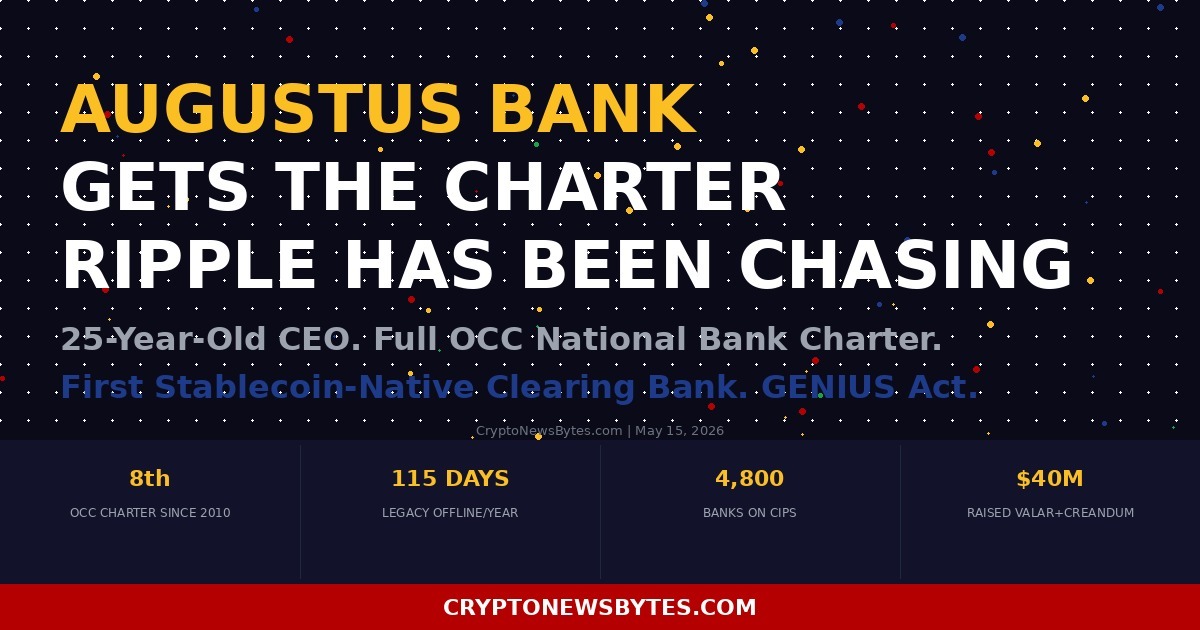
On May 11, 2026, the Office of the Comptroller of the Currency granted conditional approval for Augustus Bank, N.A., making it one of fewer than ten full-service national bank charters issued in the United States since 2010. Its co-founder, Ferdinand Dabitz, is 25 years old and will become the youngest CEO of a federally chartered bank in at least 140 years. That is the headline every outlet ran. It is the least interesting part of the story.
What the age story obscures is the specific thing Augustus was built to do: replace the correspondent banking system that moves dollars across borders. The backbone of that system, SWIFT and CHIPS, was built in the early 1970s. It operates during bank hours on working days, which means it sits idle for roughly 115 days a year. Settlements take two days by design. The infrastructure was built for human clerks processing paper instructions, and it has never been fundamentally rebuilt. Augustus is the first federally chartered U.S. bank built from scratch around the premise that it should be.
Why a Full Charter Is Different From What Ripple Has
The distinction between a full national bank charter and a trust charter matters enormously, and most coverage of crypto banking milestones has blurred it consistently. A trust charter is what Ripple, Circle, and most crypto-adjacent firms have been pursuing through the OCC. Trust charters allow a company to hold assets in custody and provide certain fiduciary services. They do not allow the institution to accept customer deposits. They do not provide access to a Federal Reserve master account. They are not, in any meaningful sense, a bank.
A full national bank charter, which is what Augustus has received conditionally, is the real thing. It permits customer deposits. It enables access to the Federal Reserve’s master account system, which means direct participation in Fedwire and the ACH network. It places Augustus inside the actual dollar settlement infrastructure rather than adjacent to it. The OCC has issued fewer than ten of these since the financial crisis effectively paused new bank creation in 2010. The rarity of the charter is not incidental. It reflects how difficult the OCC makes the process, which is precisely why the team Augustus assembled matters more than the age of its CEO.
The Team the OCC Actually Said Yes To
Ferdinand Dabitz will be the face of Augustus Bank. Greg Quarles will run it. Quarles spent 18 years at the OCC as a commissioned national bank examiner and assistant deputy comptroller before becoming CEO of Green Dot Bank, United Texas Bank, and H&R Block Bank. He knows the specific institution that just approved this charter from the inside. His presence on the application is the single most likely reason it succeeded.
CFO Joe Schenone held senior roles at JPMorgan Chase and MUFG. He is one of a small number of executives in American finance who has successfully converted two technology companies, LendingClub and Smartbiz, into chartered banks. The bank’s Chief Risk Officer, Kyle Steed, is a former bank regulator. Chief Credit Officer Andy Riggs was on the founding team of Brex’s asset management business. Dabitz himself is a Thiel Fellow who dropped out of college to build what is now a functioning European payments business processing billions in euros annually, with Kraken as a customer and 10x year-over-year volume growth in 2024.
Quarles said it directly in the official announcement: “My main insight from 30 years in banking, including 18 at the OCC, is that it is incredibly hard to rethink banking from the inside. To re-design banking from first principles, you have to build from scratch.” That framing is not marketing. It is a precise description of what the OCC evaluated and approved: a startup with the operational track record, the regulatory expertise, and the executive depth to actually run a federally chartered bank, wrapped around a genuinely new technical architecture.
Full National Bank Charter vs Trust Charter: What Actually Differs
Why Augustus’s OCC approval is categorically different from Ripple’s and Circle’s pursuits | @cryptonewsbytes
| Capability | Trust Charter | Full National Bank Charter (Augustus) |
|---|---|---|
| Accept customer deposits | No | Yes |
| Federal Reserve master account access | No | Yes (eligible) |
| Direct Fedwire / ACH participation | No | Yes |
| Issue loans | No | Yes |
| Asset custody and fiduciary services | Yes | Yes |
| FDIC deposit insurance eligible | No | Yes (requires separate application) |
| Who holds this | Ripple (pursuing), Circle (pursuing), Kraken (pursuing) | Augustus (conditional), fewer than 10 since 2010 |
Sources: OCC, PRNewswire (Augustus official release), Banking Dive, Bitcoin.com News | @cryptonewsbytes
The Correspondent Banking System Augustus Is Targeting
SWIFT was founded in 1973. CHIPS, the Clearing House Interbank Payments System that processes the majority of high-value dollar transactions, dates to 1970. Both were designed around the operational realities of the pre-internet era: batch processing, human verification, banking hours, and physical document workflows. More than 90% of global clearing volumes currently pass through just ten banks, including JPMorgan, Citi, and Deutsche Bank. The BIS has reported that the number of active correspondent banks in the Western system has fallen by roughly 30% since 2011, a trend called de-risking, where large correspondent banks quietly cut off smaller institutions and emerging market banks to reduce compliance costs.
The structural consequence is that the dollar’s global dominance depends on an infrastructure that is simultaneously shrinking, expensive, slow, and inaccessible to large portions of the world that need it most. Augustus’s pitch is that stablecoin-native clearing, running on programmable money 24 hours a day, 365 days a year, at the speed of compute rather than the speed of a human clerk, is the direct replacement for that infrastructure. The GENIUS Act made it legally possible to build a fully chartered bank around that architecture. Augustus is the first company to actually receive approval to do it.
The geopolitical dimension is not subtle. China’s CIPS network now links 4,800 banks across more than 180 countries. Russia was excluded from SWIFT in 2022 and has since built its own systems. BRICS Pay is scheduled to launch in 2026, designed to link Brazil’s Pix, Russia’s SPFS, and China’s CIPS into a single cross-border network that routes payments entirely outside SWIFT and the dollar. Augustus frames its mission explicitly around this competition: securing Western currency dominance by upgrading the infrastructure that underpins it before alternatives make that infrastructure irrelevant.
Legacy Correspondent Clearing vs Augustus: The Infrastructure Gap
What Augustus is replacing and why it matters for the dollar’s global position | @cryptonewsbytes
Legacy correspondent system (SWIFT / CHIPS)
Augustus Bank, N.A. (stablecoin + AI native)
Sources: Augustus PRNewswire release, BIS correspondent banking data, SWIFT historical records | @cryptonewsbytes
The GENIUS Act Made This Possible. Here Is Exactly How.
Augustus Bank would not exist in its current form without the GENIUS Act. Before the act was signed in July 2025, the legal framework for a federally chartered bank to natively hold, transfer, and settle in stablecoins was undefined. Building a bank core around programmable money carried regulatory risk that no executive team could fully underwrite. The GENIUS Act resolved that by creating a specific legal framework for stablecoins within the banking system, including reserve requirements, AML obligations, and supervisory standards.
Dabitz acknowledged this directly: “Only this unique regulatory moment at the intersection of U.S. financial regulatory innovation, the GENIUS Act, and AI enables us to finally do so.” The OCC’s new guidance, which allows federally chartered banks to interact with stablecoins, created the legal pathway. The GENIUS Act created the product category. Augustus was built to sit at the intersection of both at the exact moment both came into force.
The conditional approval is not a final charter. Augustus still has pre-opening requirements to satisfy before it can fully operate as a national bank. Conditional approvals can be revoked if compliance conditions are not met, and the GENIUS Act’s regulatory framework is still new enough to face potential amendments or legal challenges. These are material risks, and investors in the space should treat the conditional status as exactly what it is: a green light to continue building toward full authorization, not an open door to begin operating.
The Pushback: ICBA, Kraken, and the Community Bank Argument
The week Augustus received its conditional approval, the Independent Community Bankers of America asked the OCC to pause consideration of Kraken’s separate national trust charter application. ICBA President Rebeca Romero Rainey argued that crypto firms pursuing stablecoin access, Fed master accounts, and trust charters simultaneously create interconnected risks to financial stability without facing equivalent regulatory requirements to traditional banks. That argument did not stop Augustus, but it is not going away.
The ICBA’s concern is structural, not personal. Traditional community banks operate under full capital requirements, CRA obligations, FDIC insurance mandates, and examination cycles that impose significant ongoing compliance costs. If a stablecoin-native bank can access the same Fed infrastructure under a lighter or differently structured regulatory regime, the competitive asymmetry is real. Augustus will face the same OCC examination and capital requirements as any national bank once fully operational, but the argument about regulatory parity will intensify as more firms follow the path Augustus has now demonstrated is open.
The broader question the LinkedIn post asked, what happens to correspondent banking if Western clearing gets rebuilt around code, does not have a comfortable answer for incumbents. The correspondent system is not going to collapse overnight. JPMorgan processes trillions in daily dollar clearing and has every incentive to defend that position. But the OCC just approved a competitor built specifically to make those volumes contestable, at the moment the GENIUS Act made the regulatory architecture possible and BRICS Pay is making the geopolitical case urgent. That combination is not subtle.
Frequently Asked Questions
What is Augustus Bank and what did the OCC approve?
Augustus Bank, N.A. is a U.S. national bank application built around stablecoin settlement and AI-native banking infrastructure. On May 11, 2026, the OCC granted conditional approval to establish it as a full-service national bank, one of fewer than ten such charters issued since 2010. Augustus was previously known as Ivy and already operates as a licensed payments firm in Europe, processing billions in euro clearing for clients including Kraken. Co-founder Ferdinand Dabitz, 25, will serve as CEO and will become the youngest CEO of a federally chartered U.S. bank in at least 140 years.
Why is a full national bank charter different from a trust charter?
A trust charter, which Ripple, Circle, and Kraken have been pursuing, allows a firm to hold assets in custody and provide fiduciary services. It does not permit customer deposits, direct Federal Reserve master account access, or participation in Fedwire and ACH. A full national bank charter covers all of these. It places the institution inside the U.S. dollar settlement infrastructure rather than adjacent to it, which is why the OCC issues so few and why the application process is significantly more demanding.
What problem is Augustus trying to solve?
Augustus is targeting the correspondent banking system that processes cross-border dollar clearing. SWIFT was founded in 1973 and CHIPS in 1970. Both operate during banking hours on working days, sitting idle for roughly 115 days a year. Settlements take one to two days by design. The number of active correspondent banks has fallen 30% since 2011 as large banks have de-risked by cutting off smaller institutions. Augustus’s architecture is designed to replace batch processing with real-time stablecoin settlement, available 24 hours a day, 365 days a year, built for machine agents rather than human clerks.
Is the conditional approval the same as a final charter?
No. A conditional OCC approval means the agency has reviewed the application and found it meets the requirements to proceed toward a charter. Augustus must still satisfy specific pre-opening conditions before it can operate as a fully licensed national bank. Conditional approvals can be revoked if requirements are not met. The GENIUS Act framework the bank depends on is also still relatively new and subject to potential amendment. Full operational clearance is a separate milestone from the conditional approval announced on May 11.
Further Reading
Augustus Bank is not the only institution the GENIUS Act unblocked. JPMorgan’s JLTXX, BlackRock’s new tokenized fund filings, and a reshaped USPTO all arrived in the same regulatory window.
While Augustus is being built to replace correspondent clearing, JPMorgan is building the reserve infrastructure stablecoin issuers will use. Both are GENIUS Act products. Both are live in May 2026.
Warren’s proposed amendment to block Fed master accounts for crypto firms directly affects the kind of access Augustus is building toward. The CLARITY Act debate and Augustus’s charter application are happening simultaneously.
This article is for informational purposes only and does not constitute financial or legal advice. Sources: Augustus PRNewswire, Fortune, Banking Dive, CoinTelegraph, BIS correspondent banking data. Published May 15, 2026.