
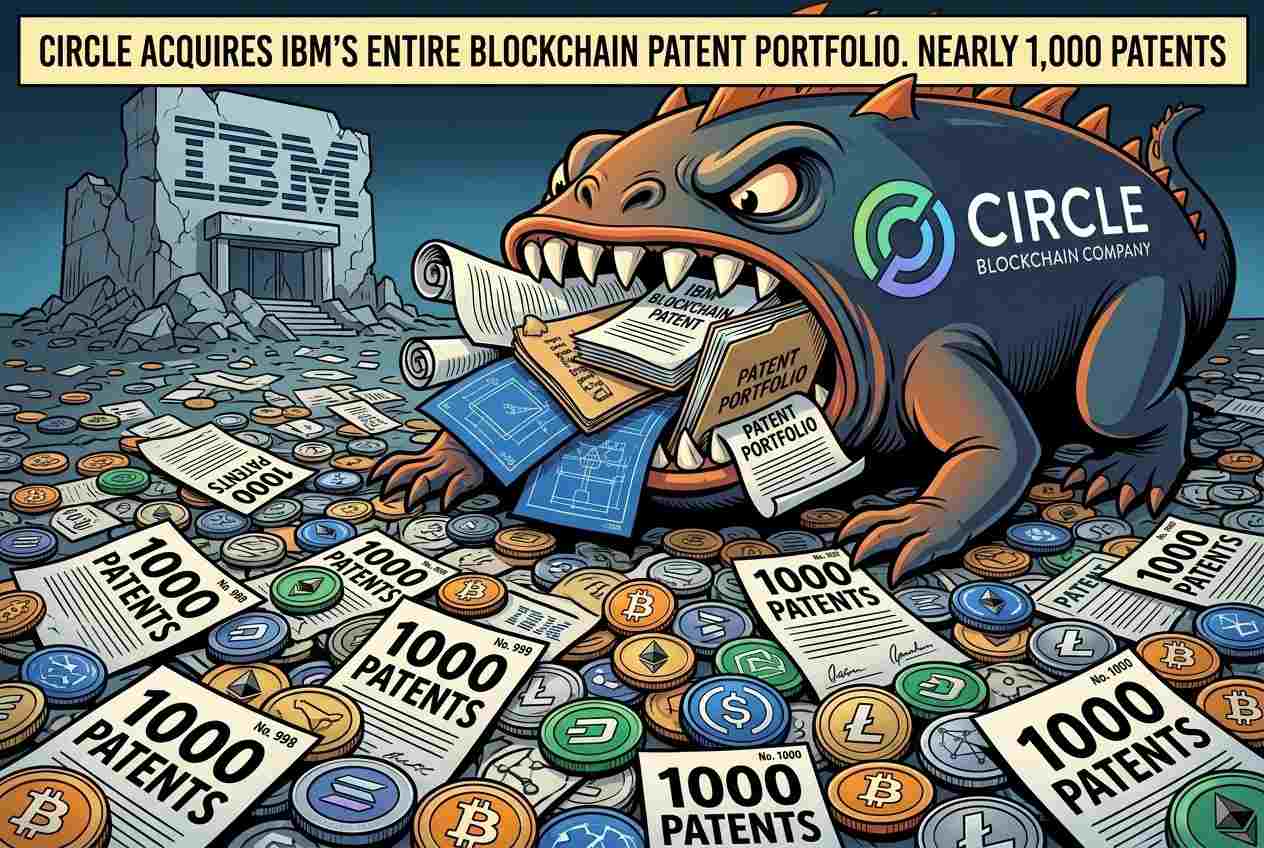
Circle Internet Group (NYSE: CRCL) announced on July 27, 2026 that it has acquired fundamental assets from IBM’s blockchain patent portfolio. The portfolio contains more than 680 patent families and nearly 1,000 issued patents worldwide, spanning foundational blockchain technology, banking, financial services, insurance, enterprise infrastructure, supply chain verification, and secure cloud operations. Circle says the acquisition makes it the largest holder of blockchain patents in the United States. CRCL shares rose 2.8% in premarket trading on the announcement. IBM shares gained 1.6%. No financial terms were disclosed.
IBM was previously ranked first among owners of active US blockchain patent families per Patent Sight data published by Statista in 2022, ahead of Ant Group, Bank of America, and all other US blockchain patent holders. When Circle bought this portfolio, the top position in US blockchain IP moved with it. That is not a minor competitive shift. Whoever holds the dominant blockchain patent position in the United States has the ability to shape how competitors build, license, and defend their own infrastructure. Circle has just taken that position.
The individual patent numbers in this portfolio have not been publicly disclosed by Circle or IBM. The press release describes six technology categories covered and states the total counts. Absent a USPTO assignment database filing or a specific annex to the acquisition agreement, the individual titles and numbers are not publicly confirmed. This article covers what is known from the Circle official press release published today and notes explicitly what has not been disclosed. The specific patents in the portfolio will be identifiable once USPTO assignment records update, typically within weeks of a transfer.
What the Portfolio Covers
Circle-IBM Blockchain Patent Portfolio: Six Technology Categories
680+ patent families, ~1,000 issued patents | Source: Circle official press release, July 27, 2026 | @cryptonewsbytes
| Technology Category | Relevance to Circle’s Products | Known Patent Numbers |
|---|---|---|
| Foundational blockchain technology | Core to USDC issuance, transfer, and Circle Payments Network settlement | Not publicly disclosed at time of writing |
| Banking and financial services | Directly applicable to Circle’s banking partnerships, Circle National Trust charter, and CPN institutional rails | Not publicly disclosed |
| Insurance | Tokenized insurance products, on-chain parametric cover, a category growing alongside RWA tokenization | Not publicly disclosed |
| Enterprise infrastructure | Supports Arc, Circle’s enterprise blockchain described as the Economic OS for the internet | Not publicly disclosed |
| Supply chain verification | Cross-chain and cross-counterparty provenance tracking, directly applicable to tokenized real-world assets | Not publicly disclosed |
| Secure cloud operations | Infrastructure security for USDC reserve management, custody operations, and key management | Not publicly disclosed |
Note: Individual patent titles and numbers have not been disclosed by Circle or IBM. USPTO assignment records will update within weeks of the transfer and will allow public identification of the transferred patents. Source: Circle official press release July 27 2026 | @cryptonewsbytes
Why This Is a Bigger Move Than a Typical IP Acquisition
IBM has been the dominant US blockchain patent holder for years. Patent Sight data cited by BeInCrypto placed IBM first among active US blockchain patent family owners in 2022 ahead of all other US holders. Circle did not simply add patents to an existing portfolio. It acquired the estate that defined the US top position, and that position transferred with the deal. The strategic implication is specific: competitors building on blockchain technology across banking, insurance, supply chain, and cloud operations now face a counterparty that holds the largest relevant patent estate in the country. That changes licensing conversations, competitive positioning, and potentially enforcement options in ways that do not apply to a company with a modest patent portfolio.
Circle’s immediate stated use is defensive and product-supportive rather than offensive licensing. The press release says the expanded IP position directly supports USDC, Circle Payments Network, Arc, and a growing suite of onchain products and agentic financial tools. That framing is consistent with a company that wants patent coverage for its core business rather than a patent assertion entity running licensing campaigns. Circle and IBM also announced plans to explore additional commercial opportunities beyond the acquisition, which is typically language for a partnership or preferred supplier relationship that was part of the deal economics even though undisclosed. The Circle official press release is the only confirmed primary source for all figures in this article.
The timing sits against two parallel developments CNB has been tracking. T. Rowe Price launched TKNZ on July 16, the first actively managed multi-token spot crypto ETF, which holds USDC-settled positions. And the CLARITY Act Senate floor vote this week will determine whether USDC is governed under a permanent federal stablecoin framework or continues under the GENIUS Act alone. A Circle that holds the largest blockchain patent portfolio in the US, the largest stablecoin by market share, and a pending IPO on NYSE has a different institutional posture in both of those conversations than a Circle without that patent position.
What Is Not Known
The acquisition price was not disclosed. The specific patent numbers were not disclosed. Whether Circle intends to license the portfolio offensively to third parties was not addressed in the press release. Whether any patents in the portfolio are currently being asserted against competitors was not addressed. IBM’s motivation for selling, whether driven by a strategic pivot away from blockchain, a balance sheet optimization, or the deal economics of the commercial partnership component, was not addressed.
The USPTO assignment database will be the definitive public record of which patents transferred. Assignments are typically recorded within four to eight weeks of a transaction closing. Once those records update, it will be possible to identify the specific patent titles, application numbers, and grant dates that moved from IBM to Circle. At that point, the strategic picture of what Circle now holds, and what competitors face, will be considerably clearer than the category-level description in today’s press release.
Frequently Asked Questions
What is a patent family and how does 680 families compare to other holders?
A patent family is a group of related patent applications filed in multiple countries covering the same invention, typically originating from a single priority filing. IBM’s position at the top of US blockchain patent family rankings pre-sale is documented by Patent Sight data. Bank of America is the other major US institutional holder with a large blockchain patent portfolio. With 680+ families acquired from IBM’s portfolio, Circle now holds the top US position. The exact size comparison with Bank of America requires the USPTO assignment records to be updated before a precise ranking is possible.
Why did IBM sell its blockchain patent portfolio?
IBM did not provide public comment on its motivation in the Circle press release. IBM has been reducing its focus on blockchain products since winding down IBM Blockchain in 2022 after enterprise adoption fell short of projections. IBM Food Trust, built on IBM Blockchain, was discontinued. The patent portfolio appears to be the last major blockchain IP asset IBM held. The commercial partnership language in the announcement suggests IBM received value beyond the patent sale price, potentially preferred access to Circle’s infrastructure for IBM’s cloud and financial services clients.
Will Circle use these patents to sue competitors?
The press release frames the acquisition as defensive and product-supportive, not as an offensive licensing campaign. Circle said the patents directly support USDC, the Circle Payments Network, Arc, and agentic financial tools. However, a company holding 1,000 blockchain patents has the option to assert them if it chooses. Nothing in the announcement rules out future licensing or assertion activity. The tZERO vs Securitize patent dispute active in 2026 illustrates how IP in the tokenized securities space is being used offensively. Whether Circle follows a similar path depends on strategic decisions it has not publicly addressed.
Further Reading
The legislative framework governing USDC, the core Circle product this IBM patent portfolio now protects. The CLARITY Act floor vote this week determines the permanent federal stablecoin regulatory structure.
USDC is classified as a payment stablecoin, not a security, under this framework. Circle’s newly acquired IBM patents now sit underneath a regulatory classification that separates USDC from enforcement risk under SEC securities law.
This article is for informational purposes only and does not constitute financial advice. Sources: Circle Internet Group official press release July 27 2026 (circle.com/pressroom), Seeking Alpha July 27 2026 (Liz Kiesche), BeInCrypto July 27 2026, CityBiz July 27 2026, Yahoo Finance July 27 2026, Patent Sight data via Statista (2022 IBM blockchain patent ranking). Published July 22, 2026.