
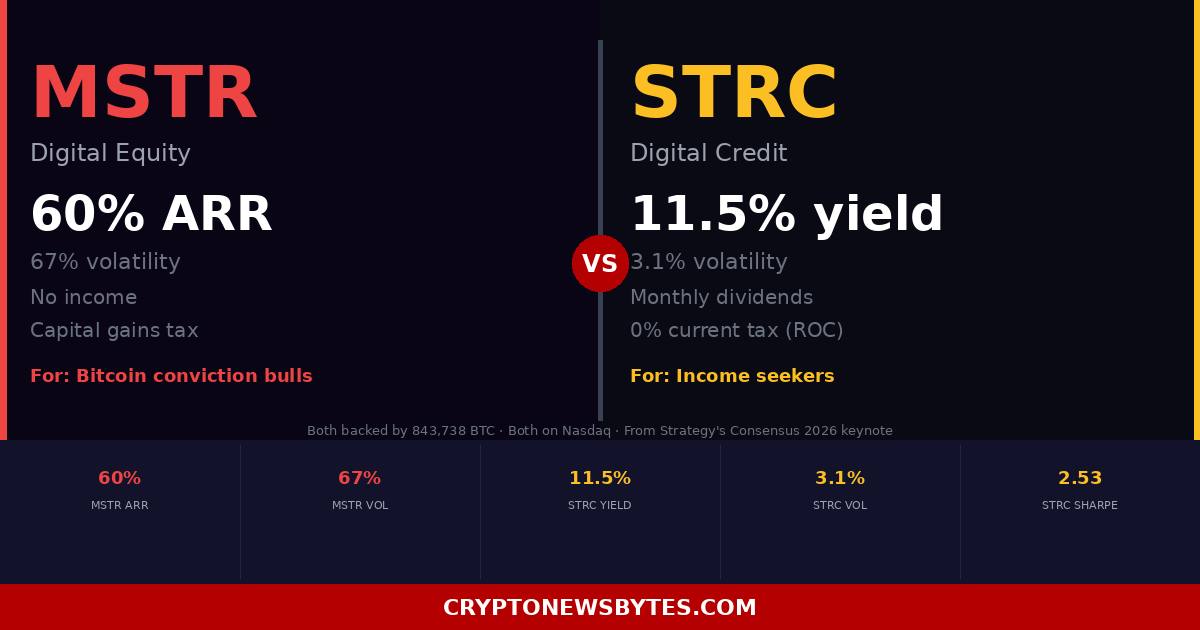
Michael Saylor built two products from the same asset. Both are backed by the same 843,738 Bitcoin sitting on Strategy’s balance sheet. Both are publicly listed on Nasdaq. Both are accessible through every major U.S. brokerage. And they could not be more different in what they offer, who they are designed for, and what happens to your investment when Bitcoin moves.
MSTR is Digital Equity. It amplifies Bitcoin’s return. It has delivered 60% annualized returns since Strategy adopted a Bitcoin standard in August 2020. It also carries 67% 30-day historical volatility. When Bitcoin drops 20%, MSTR typically drops more. When Bitcoin runs, MSTR runs harder. It is a leveraged expression of conviction in Bitcoin’s long-term appreciation.
STRC is Digital Credit. It strips out Bitcoin’s volatility and delivers the yield. It pays 11.5% annually, distributed monthly, with 3.1% 30-day historical volatility. It is designed to trade at par value of $100. It has a 2.53 Sharpe ratio. It pays dividends classified as Return of Capital, meaning 0% current tax for U.S. investors. It is a yield instrument backed by Bitcoin that is specifically engineered not to behave like Bitcoin.
How Saylor Explained the Difference at Consensus 2026
Saylor used a specific framework at Consensus 2026 in Miami to explain the relationship between Bitcoin, MSTR, and STRC. Bitcoin is the base layer: Digital Capital. It has 34% historical volatility and approximately 40% annualized return since August 2020. MSTR sits on top of Bitcoin as Digital Equity: 67% volatility, 60% annualized return. It amplifies both the upside and the downside of the underlying asset through leverage and premium to net asset value. STRC sits alongside as Digital Credit: 3.1% volatility, 11.5% yield. It extracts the first 11% return of Bitcoin’s expected long-term appreciation and delivers it as a stable, predictable cash flow.
The visual Saylor used was a chart showing two lines over 10 years. The Digital Capital line oscillated wildly around a steep upward trend. The Digital Credit line ran almost flat, incrementally climbing at 11.5% per year with minimal deviation from the trend. Same underlying asset. Completely different investor experience. The question of which one is right for you is not a question about which is better. It is a question about what you need your money to do.
MSTR vs STRC: Side by Side
Data from Strategy’s Consensus 2026 keynote slides | @cryptonewsbytes
Source: Strategy keynote slides, Consensus 2026 Miami. As of May 2026. Past performance not indicative of future results. | @cryptonewsbytes
Choose MSTR If: You Believe Bitcoin Goes Significantly Higher
MSTR is the right instrument if your primary conviction is that Bitcoin’s price will be materially higher in three to five years than it is today, and you want amplified exposure to that move. The stock trades at a 1.27x premium to its net asset value, meaning you are paying $1.27 for every $1 of Bitcoin the company holds. That premium exists because the market is pricing in Strategy’s ability to continue issuing equity and preferred stock, acquiring more Bitcoin, and growing BTC per share. When that machine works, MSTR outperforms Bitcoin itself. When Bitcoin falls sharply, MSTR tends to fall more.
The 60% annualized return since August 2020 is real but requires context. That figure includes Bitcoin’s post-COVID rally, the 2021 peak, the 2022 crash where MSTR fell over 80%, and the 2023 to 2026 recovery. The investors who held MSTR through the 2022 drawdown and came out the other side with those returns exist. So do the investors who bought near the 2021 peak and experienced years of underwater positions before recovering. MSTR is a high-conviction, long-horizon instrument. It is not appropriate for capital you cannot afford to see decline 70% to 80% in a Bitcoin bear market.
MSTR also pays no income. There are no dividends. The entire return case is price appreciation. If you need your investment to generate cash flow while you hold it, MSTR does not do that. It is a pure capital appreciation play with leverage and premium-to-NAV amplifying both upside and downside.
Choose STRC If: You Want Bitcoin Exposure With Income and Stability
STRC is the right instrument if you want exposure to the Bitcoin ecosystem without the volatility that makes Bitcoin unsuitable for income-oriented portfolios. The 3.1% 30-day historical volatility is designed to make STRC behave like a preferred security, not like a crypto asset. The $100 par value target gives investors a price anchor. The monthly dividend gives investors cash flow. And the 4.1x BTC coverage ratio means Strategy’s Bitcoin reserve is 4.1 times the total annual dividend obligation, providing a meaningful buffer before any dividend sustainability question arises.
The tax structure is genuinely differentiated. STRC dividends are classified as Return of Capital, reducing the investor’s cost basis rather than being taxed as income in the year received. The effective current dividend tax rate is 0%. For a U.S. investor at the 37% marginal rate, the 11.5% stated yield becomes 18.3% on a tax-equivalent basis. Strategy expects this treatment to continue for ten years or more because the company has negative accumulated Earnings and Profits, a direct result of how unrealized Bitcoin appreciation is treated for tax purposes. No comparable bank preferred instrument offers this tax structure.
STRC’s Sharpe ratio of 2.53 beats every hedge fund strategy, every bank preferred, every credit instrument, and every fixed-income product available to institutional investors. That is not a marketing claim. It is the risk-adjusted return calculation: effective yield minus risk-free rate divided by 30-day historical volatility. STRC earns a lot per unit of volatility it takes on, which is the core of why institutional preferred ETFs at BlackRock and VanEck have made it a top holding.
Which One Is Right for You: Decision Framework
Choose MSTR if you…
Choose STRC if you…
For illustrative purposes only. Not financial advice. Consult a qualified advisor before making investment decisions. | @cryptonewsbytes
Can You Hold Both? The Portfolio Combination Case
The most interesting use case Saylor presented at Consensus 2026 was not choosing one or the other. It was using both together to build a Bitcoin-backed portfolio that generates income while maintaining price upside. A position in STRC provides monthly cash flow at 11.5% yield with low volatility. A position in MSTR provides leveraged Bitcoin appreciation. The STRC dividends can be used to average into MSTR during drawdowns, effectively using Bitcoin’s own yield to accumulate more Bitcoin equity at lower prices.
This combination also addresses the primary criticism of MSTR as a sole holding: it pays nothing while you wait. An investor holding both gets monthly income from STRC that partially offsets the opportunity cost of waiting for MSTR’s next run. The two instruments are designed to complement each other precisely because they extract different things from the same underlying asset.
The risk to both positions is the same: a sustained, severe Bitcoin decline. If Bitcoin’s price falls significantly and stays down, MSTR’s leverage amplifies the drawdown and STRC’s 4.1x BTC coverage ratio could compress. The two instruments have different risk profiles in bull markets and similar risk profiles in a sustained bear market, because both ultimately depend on Bitcoin maintaining value above the level that keeps Strategy’s capital structure solvent. That correlation is not a reason to avoid them. It is the context in which any allocation decision should be made.
Frequently Asked Questions
Is STRC actually safer than MSTR?
STRC has significantly lower day-to-day price volatility than MSTR. Its 3.1% 30-day historical volatility versus MSTR’s 67% means it moves far less in normal market conditions. However, both instruments ultimately depend on Strategy’s Bitcoin reserve maintaining sufficient value to service obligations. In a severe, sustained Bitcoin bear market, both would face pressure. STRC has seniority over MSTR equity, meaning STRC preferred holders get paid before common shareholders in any restructuring scenario, but neither instrument is risk-free.
Why does STRC have a better Sharpe ratio than MSTR?
Sharpe ratio measures return per unit of volatility. STRC delivers 11.5% yield with 3.1% volatility, producing a very high return-to-risk ratio. MSTR delivers higher absolute returns but with 67% volatility, which dilutes the Sharpe calculation significantly. A higher Sharpe ratio means STRC earns more for every percentage point of volatility the investor accepts. This does not make STRC a better investment in absolute return terms. It makes it a more efficient instrument for investors who are optimising for risk-adjusted return rather than maximum possible upside.
What happens to STRC if Bitcoin drops 50%?
STRC has a 4.1x BTC coverage ratio, meaning Strategy’s Bitcoin reserve is currently 4.1 times larger than the total annual dividend obligation. A 50% Bitcoin price decline would reduce that coverage to approximately 2x, which remains above the level where dividend sustainability becomes a concern. Strategy also holds a USD reserve of $2.25 billion and has 18.1 months of USD dividend coverage separate from its Bitcoin holdings. A 75% Bitcoin decline would compress coverage more meaningfully and would likely cause STRC’s market price to fall below its $100 par target, though the dividend obligation itself would remain technically covered.
MSTR vs STRC: Four Key Comparisons
Data from Strategy’s Consensus 2026 keynote slides | @cryptonewsbytes
1. Annualised return vs volatility since Aug 2020
2. Risk-adjusted Sharpe ratio
3. $10,000 invested: simulated 5-year growth
Smooth-line projection based on stated annualised rates. Not a guarantee of returns.
4. Tax-equivalent yield vs competing instruments
Assumes 37% U.S. marginal tax rate. STRC: ROC = 0% current dividend tax.
Source: Strategy keynote slides, Consensus 2026 Miami. Simulated growth for illustration only. Past performance not indicative of future results. Not financial advice. | @cryptonewsbytes
Further Reading
The complete Consensus 2026 keynote breakdown with all 12 HTML slide recreations and full STRC data.
How STRC’s 18.3% tax-equivalent yield compares to bank accounts at 0.4% and bonds at -1% ARR.
The Bitcoin reserve that backs both MSTR and STRC keeps growing. JPMorgan projects $30B in purchases for 2026.
This article is for informational purposes only and does not constitute financial or investment advice. All data sourced from Strategy’s presentation slides at Consensus 2026 by CoinDesk, Miami, May 18, 2026, and Strategy SEC filings. Past performance is not indicative of future results. Consult a qualified financial advisor before making investment decisions.