
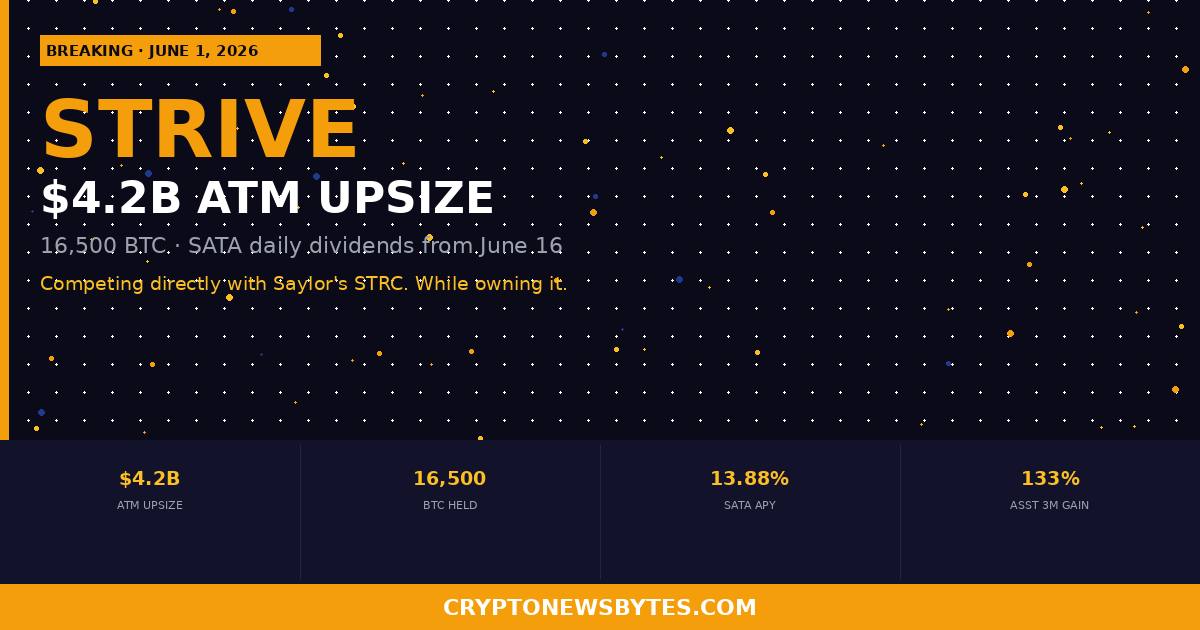
Strive CEO Matthew Cole announced on June 1 that the company will upsize both its ASST common equity and SATA preferred stock at-the-money offering programs by $2.1 billion each, adding $4.2 billion in total new capital-raising capacity. The announcement came alongside confirmation that Strive now holds 16,500 BTC, placing it seventh among publicly traded companies by Bitcoin treasury size, and that SATA will begin paying cash dividends every single business day starting June 16, 2026.
The headline number being shared online is “$5.1 billion.” That figure combines the $4.2 billion ATM upsize with Strive’s existing $900 million in remaining ATM capacity. Either way, the structure is the same one Michael Saylor pioneered at Strategy: issue equity and preferred stock into market demand, use all proceeds to buy Bitcoin, grow Bitcoin per share over time. Strive is not copying Strategy. It is competing with it, including in the product that Strategy invented.
What the ATM Upsize Actually Means
An ATM, or at-the-market offering program, allows a company to issue new shares continuously into the open market at prevailing prices rather than doing a single large underwritten offering at a discount. Strategy used this mechanism to raise over $5.6 billion year-to-date through STRC alone by early May. Strive is expanding the same machinery. The $2.1 billion addition to both ASST and SATA ATM programs reflects what CEO Matthew Cole described as “a sustained increase in liquidity and demand for both securities.” In practical terms, it means Strive now has the legal authorization to raise up to $4.2 billion more than it previously could, deploying all proceeds into Bitcoin.
The ATM upsize arrives on the back of genuine momentum. ASST shares have climbed 133% over the past three months, outperforming other Bitcoin treasury stocks. The stock remains down more than 90% from its 2025 peak following the share collapse that prompted a 1:20 reverse split, but the recent trajectory has attracted institutional attention. State Street disclosed a $17 million stake. Vanguard also bought in. The preferred stock SATA traded at $100.01 par recently with volume nearly seven times its average, signaling genuine institutional demand rather than retail speculation.
SATA Daily Dividends: A First in U.S. Capital Markets
Starting June 16, 2026, SATA becomes the first listed security in U.S. capital markets history to pay cash dividends every single business day. Matthew Cole called it “a true zero-to-one innovation.” The stated annual rate remains 13%, but when that rate is compounded across approximately 250 business-day payment events rather than 12 monthly payments, the effective APY rises to 13.88%, a lift of about 76 basis points. Strive CIO Ben Werkman framed it directly: “No more waiting. This marks a major step forward in aligning dividend-paying securities with the speed of modern markets.”
The practical benefit goes beyond the basis point lift. Monthly ex-dividend dates concentrate buying and selling pressure into single sessions, creating artificial volatility around payment events. Daily dividends spread that activity across 250 sessions per year, potentially stabilizing SATA’s price around its $100 par target more consistently. For structured product desks, ETF teams, and yield allocators matching payment cadence to downstream obligations, daily cash flow events are also materially easier to underwrite than twelve annual step-payments.
The Irony Nobody Is Talking About: Strive Owns STRC
Here is the detail that most coverage of this story is skipping. There is an irony in Strive’s new positioning: the company itself owns STRC. As of March 31, 2026, Strive held $50.5 million in Strategy’s STRC preferred stock on its balance sheet. The company that is now positioning SATA as a higher-yield alternative to STRC simultaneously holds tens of millions of dollars in STRC as a treasury asset.
This is not a contradiction. Some investors hold both STRC and SATA to diversify single-issuer risk while boosting overall yield. Strive’s treasury team apparently reached the same conclusion. STRC offers scale and safety: Strategy holds 55 times more Bitcoin, has a profitable legacy software business generating around $320 million per year, carries $2.25 billion in cash reserves, and trades with much higher liquidity. The lower 11.5% yield reflects this stronger credit profile. SATA offers higher yield for more risk. Strive, by holding STRC, is acknowledging that its own product occupies a different risk tier.
SATA vs STRC: Bitcoin-Backed Preferred Compared
Same structure, different scale and risk profile | @cryptonewsbytes
| Metric | SATA (Strive) | STRC (Strategy) |
|---|---|---|
| Annual dividend rate | 13% (13.88% APY daily) | 11.5% (18.3% tax-eq.) |
| Dividend frequency | Daily from June 16 | Monthly |
| BTC backing | 16,500 BTC (~$1.27B) | 843,738 BTC ($63.87B) |
| BTC coverage ratio | ~2.5x (est.) | 4.1x |
| Debt | Zero (debt free) | $8.2B convertible notes |
| Operating revenue | $2.8M/quarter | ~$320M/year software |
| ATM upsize | $4.2B (announced today) | $51.5B remaining capacity |
| Tax treatment | ROC (0% current) | ROC (0% current, 10+ yrs) |
Sources: Strive SEC filings, Strategy SEC filings, bitbo.io/strc-vs-sata, Bitcoinist | @cryptonewsbytes
The Strive Story Nobody Wants to Tell Alongside the Good News
Strive is genuinely building something. But full context requires the numbers on both sides of the ledger. In Q1 2026, Strive recorded a net loss of $265.9 million, almost entirely from a $295.8 million unrealized loss on its Bitcoin holdings as prices fell. Core operations remain small: total revenue was $2.8 million, with $1.3 million from investment advisory fees and $1.4 million from the medical device business acquired through the Semler Scientific merger. Operating expenses of $20.6 million dwarfed revenue by more than seven times.
The stock is up 133% in three months but remains down more than 90% from its 2025 peak. The reverse split that kept it above $1 is still recent history. The SATA daily dividend innovation is real and structurally interesting. The $4.2 billion ATM upsize reflects genuine market demand. And the Q1 numbers reflect what happens when a company with minimal operating revenue bets its entire identity on Bitcoin price appreciation. The bull and bear cases exist simultaneously, and any article that presents only one of them is doing readers a disservice.
Frequently Asked Questions
What is Strive and how does it compare to Strategy?
Strive (Nasdaq: ASST) is a Bitcoin treasury company and asset manager modelled after Strategy’s playbook: issue equity and preferred stock, use proceeds to buy Bitcoin, grow Bitcoin per share. Strive currently holds 16,500 BTC worth approximately $1.27 billion, making it the seventh-largest publicly traded corporate Bitcoin holder. Strategy holds 843,738 BTC, roughly 51 times more. Strive manages $2.7 billion in client assets through its registered investment adviser subsidiary. It also owns $50.5 million in Strategy’s STRC preferred stock.
What makes SATA different from STRC?
Both are variable-rate perpetual preferred stocks backed by Bitcoin treasuries, paying monthly dividends classified as Return of Capital. The key differences: SATA pays 13% annually versus STRC’s 11.5%, and from June 16 SATA switches to daily dividend payments, the first U.S.-listed security to do so. STRC has significantly more BTC backing (843,738 vs 16,500 BTC), a higher BTC coverage ratio (4.1x vs approximately 2.5x), and a profitable operating business behind it. SATA compensates for lower scale with higher yield.
What does the ATM program upsize mean for investors?
It means Strive now has legal authorization to issue up to $4.2 billion more in ASST common shares and SATA preferred shares than previously permitted, selling into the open market at prevailing prices. All proceeds go to Bitcoin purchases. This is dilutive to existing shareholders in nominal terms but accretive if the Bitcoin acquired per share grows faster than the dilution. Whether it does depends on Bitcoin’s price relative to the premium at which ASST trades to its Bitcoin NAV.
Strive vs Strategy: Key Metrics Compared
Data from SEC filings and company announcements as of June 1, 2026 | @cryptonewsbytes
1. Dividend yield comparison: SATA vs STRC vs traditional instruments
2. Bitcoin treasury size: Strive vs other public companies
3. SATA vs STRC: Structure comparison
Sources: Strive SEC filings, Strategy SEC filings, bitbo.io. Past performance not indicative of future results. Not financial advice. | @cryptonewsbytes
Further Reading
Understanding STRC is essential context for evaluating SATA. Same structure, different scale.
The company Strive is competing with just bought $2B more Bitcoin the same week. The scale gap is the whole story.
Saylor’s full case for STRC at Consensus 2026. The product SATA is directly challenging.
This article is for informational purposes only and does not constitute financial or investment advice. Past performance is not indicative of future results. Consult a qualified financial advisor before making investment decisions. Sources: Strive SEC filings, CoinGape, CoinDesk, Bitcoin Magazine, bitbo.io/strc-vs-sata, Bitcoinist. Published June 1, 2026.