
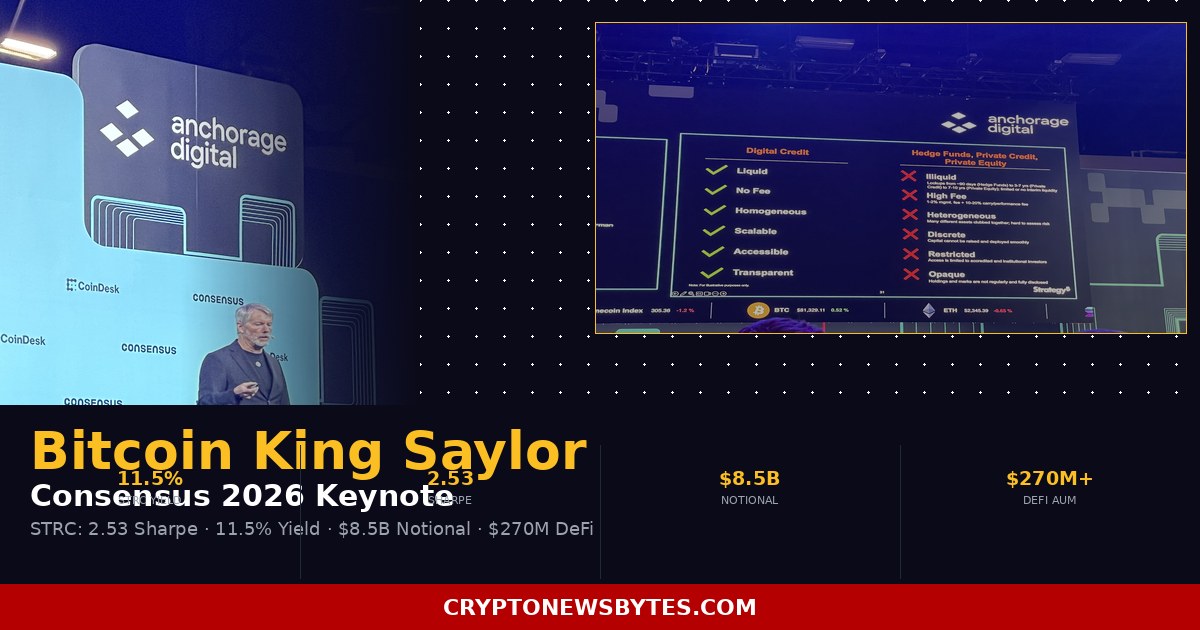
Michael Saylor took the main stage at Consensus 2026 by CoinDesk in Miami on May 18 to deliver what he titled “Creation of Digital Credit.” It was not a Bitcoin price prediction. It was not a victory lap on Strategy’s holdings. It was a 66-slide institutional investment thesis arguing that STRC, Strategy’s Variable Rate Preferred Stock, represents a new asset class: Bitcoin’s volatility stripped out, its yield extracted, and its appreciation potential preserved in a liquid, transparent, fee-free instrument that outperforms every comparable fixed-income product on a risk-adjusted basis.
CryptoNewsBytes was in the room. What follows is the complete breakdown of every material slide, presented in the order Saylor delivered them, with the data exactly as it appeared on screen.
The Opening Argument: Why Bitcoin Is the Superior Collateral Base
Performance of BTC vs Traditional Asset Classes
Annualized asset performance since Bitcoin standard adoption, Aug 10, 2020
Source: Strategy.com as of May 5, 2026. Past performance is not indicative of future results. | Photographed by CryptoNewsBytes
Volatility of BTC vs Traditional Asset Classes
Historic 1-year volatility
Source: Strategy.com as of May 5, 2026 | Photographed by CryptoNewsBytes
Saylor opened with performance data, not sentiment. Since Strategy adopted a Bitcoin standard on August 10, 2020, BTC has returned 40% annualized. QQQ returned 18%. SPY and Gold each returned 15%. VNQ returned 6%. Money markets returned 3%. Bonds returned negative 1%. The slide note was explicit: source is Strategy.com as of May 5, 2026.
The volatility slide that followed was designed to preempt the obvious objection. Bitcoin’s 1-year historic volatility is 41%, compared to Gold at 27%, QQQ at 16%, VNQ at 14%, SPY at 12%, Bonds at 4%, and money markets at 1%. Saylor’s argument is that the volatility is real, but it is the price of the 40% annualized return, and the key insight of the entire presentation is that you do not have to accept all of that volatility to capture yield from Bitcoin’s upward trajectory.
The Theory of Digital Credit slide made the mechanism explicit. Any capital asset can serve as a credit collateral base, but Bitcoin is superior because its expected future annual return is higher than any comparable asset. Bitcoin at 30% expected return can support 11% credit yield. SPY at 12% expected return can support only 6%. Gold at 10% expected return supports 5%. Real estate at 6% supports 3%. Higher long-term capital growth potential stretches what you can offer on the credit side.
Digital Credit: Stripping the First 11% From Bitcoin
Theory of Digital Credit
Any capital asset can serve as credit collateral, but bitcoin is superior
BTC
30% expected return
Yield potential: 11% credit yield
SPY
12% expected return
Yield potential: 6% credit yield
Gold
10% expected return
Yield potential: 5% credit yield
Real Estate
6% expected return
Yield potential: 3% credit yield
Higher long-term capital growth potential stretches credit yield. Bitcoin is the superior collateral base.
Source: Strategy slides, Consensus 2026 Miami | Photographed by CryptoNewsBytes
Strategy Transforms Digital Capital into Digital Credit
Five engineering steps convert Bitcoin volatility into stable yield
Source: Strategy slides, Consensus 2026 Miami | Photographed by CryptoNewsBytes
The clearest slide in the presentation showed two lines over a 10-year timeline. Digital Capital, which is Bitcoin, oscillates with high volatility around a ~30% annualized upward trend. Digital Credit, which is STRC, runs as a flat stable line at 11.5% yield with 3.1% volatility. The framing: STRC strips out the first 11% return of Bitcoin, packages it as a stable yield instrument, and leaves the rest of Bitcoin’s appreciation potential in MSTR.
The transformation slide described what Strategy does to convert Bitcoin into STRC: it removes currency risk by denominating in USD, EUR, and other currencies; reduces credit risk through overcollateralization and seniority; compresses duration risk through monthly cash dividends; damps volatility by targeting par value at $100; and distills yield as a fixed income rate. Five engineering steps that convert a 41% volatility digital commodity into a 3% volatility preferred security paying 11.5%.
Asset Class Performance Since Bitcoin Standard: Aug 10, 2020 to May 5, 2026
Directly from Saylor’s Consensus 2026 slides | Source: Strategy.com | @cryptonewsbytes
| Asset | Annualized Return | 1Y Volatility | Notes |
|---|---|---|---|
| MSTR | 60% | 67% (30D hist.) | Leveraged Bitcoin equity |
| BTC | 40% | 41% | Digital Capital baseline |
| QQQ | 18% | 16% | Nasdaq 100 ETF |
| SPY | 15% | 12% | S&P 500 ETF |
| Gold | 15% | 27% | Traditional safe haven |
| STRC | 11.5% yield | 3.1% | Digital Credit, stable $100 par |
| VNQ | 6% | 14% | Real estate ETF |
| Money Markets | 3% | 1% | Cash equivalent |
| Bonds (PIMCO BOND) | -1% | 4% | Active Bond ETF |
Source: Strategy.com as of May 5, 2026. Past performance is not indicative of future results. Directly from Saylor keynote slides, Consensus 2026 Miami | @cryptonewsbytes
STRC: The Largest Tradeable Preferred in the World
STRC Is the Largest Tradeable Preferred in the World
Tradeable preferreds ranked by market cap
Data as of April 20, 2026. USD billions. Excludes mandatory convertible preferred stock.
Source: Strategy slides, Consensus 2026 Miami | Photographed by CryptoNewsBytes
Saylor’s market structure slides contained numbers that most STRC coverage has not emphasized. At $8.5 billion notional value, STRC is the largest tradeable preferred security in the world by market cap. The next largest is Wells Fargo’s WFC/PL at $4.7 billion, followed by Bank of America’s BAC/PL at $3.7 billion, Fannie Mae at $3.6 billion, and Freddie Mac at $3.0 billion. Every major financial institution’s preferred stock is smaller than STRC.
The liquidity comparison is even more striking. STRC’s 30-day average daily liquidity is $375 million, approximately 25 times the second-largest tradeable preferred and 10 times the next best in turnover as a percentage of market cap. STRC’s daily turnover is 4.4% of its market cap. Wells Fargo preferred trades at 0.3%. Bank of America preferred at 0.4%. Citigroup preferred at 0.2%. JPMorgan’s preferred at 0.2%. These are not competitive instruments in the same liquidity category.
BlackRock’s iShares Preferred and Income Securities ETF, the largest preferred ETF in the world at $14 billion AUM, holds STRC as its second-largest position at $346 million and 2.48% weight, behind only Boeing at 4.11%. VanEck’s PFXF, the sixth-largest preferred ETF at $2 billion AUM, holds STRC as its second-largest position at $137 million and 5.92%. STRC is above Wells Fargo, Oracle, Bank of America, and JPMorgan in both ETFs.
The Sharpe Ratio Argument: STRC Beats Every Hedge Fund Strategy
STRC Sharpe Ratio vs Traditional Credit
With respect to credit and preferred equity instruments
As of May 1, 2026. (Effective Yield – Risk-Free Rate) / Hist. Volatility (30D).
Source: Strategy slides, Consensus 2026 Miami | Photographed by CryptoNewsBytes
STRC Sharpe Ratio vs Hedge Fund Strategies
Higher risk-adjusted returns with zero fees and daily liquidity
Zero fees and daily liquidity. Hedge fund ratios based on 6-year Sharpe ratios through 2024.
Source: Strategy slides, Consensus 2026 Miami | Photographed by CryptoNewsBytes
STRC Tax-Equivalent Yield vs Other Credit Instruments
For illustrative purposes only. Does not constitute investment advice.
Assumes 37% U.S. individual marginal income tax rate. ROC treatment = 0% current tax, deferred until sale.
Source: Strategy slides, Consensus 2026 Miami | Photographed by CryptoNewsBytes
The slides Saylor spent the most time on compared STRC’s Sharpe ratio to every major credit instrument and hedge fund strategy. The numbers from the slides, all verified directly from the screen: STRC 2.53. Junk bonds 0.66. Investment grade 0.26. Bank preferreds 0.22. Mortgage backed 0.15. Treasury bills -0.14.
Against hedge fund strategies: STRC 2.53. Multistrategy 2.18. Macro 1.76. Municipal credit 1.68. Equity 1.43. Arbitrage 1.17. Emerging markets 1.07. Credit and fixed income 1.04. Event driven 0.80. STRC outperforms every category on risk-adjusted returns with zero fees and daily liquidity. The footnote on the slide noted that STRC’s Sharpe ratio was calculated using effective yield minus risk-free rate divided by 30-day historical volatility as of May 1, 2026.
The tax-equivalent yield slide added another dimension. STRC’s 11.5% yield is classified as Return of Capital, not ordinary income or qualified dividends. For a U.S. individual investor with a 37% marginal tax rate, ROC treatment means the tax-equivalent yield is 18.3%. Against the alternatives: private credit at 8.4%, junk bonds at 6.5%, bank preferreds at 6.3%, investment grade at 4.8%, mortgage backed at 4.7%, Treasury bills at 3.7%, money markets at 3.6%, commercial paper at 3.6%, and bank accounts at 0.4%. STRC’s tax-equivalent yield exceeds all of them.
STRC vs Competing Instruments: Sharpe, Yield, and Tax Treatment
Directly from Saylor’s Consensus 2026 slides. Data as of May 1, 2026 | @cryptonewsbytes
| Instrument | 30D Sharpe | Yield (at par) | Tax-Eq. Yield | Tax Type |
|---|---|---|---|---|
| STRC | 2.53 | 11.5% | 18.3% | ROC (0% tax, deferred) |
| Private Credit | N/A | Varies | 8.4% | Ordinary income |
| Junk Bonds | 0.66 | Varies | 6.5% | Ordinary income |
| Bank Preferreds | 0.22 | Varies | 6.3% | Qualified dividend (20-35%) |
| Investment Grade | 0.26 | Varies | 4.8% | Ordinary income |
| Treasury Bills | -0.14 | Varies | 3.7% | Ordinary income |
| Bank Accounts | N/A | ~0.4% | 0.4% | Ordinary income |
Source: Strategy slides, Consensus 2026 Miami. Tax-equivalent yield assumes 37% U.S. marginal income tax rate. Past performance does not guarantee future results. | @cryptonewsbytes
The ROC Tax Advantage: Why Strategy Expects 0% Dividend Tax for 10+ Years
The Return of Capital treatment is one of the least-covered aspects of STRC and one of the most financially significant. ROC distributions reduce the investor’s cost basis rather than being taxed as income in the year received. The tax is deferred until the investor sells the shares. At that point, the reduced cost basis results in a capital gain, taxed at preferential capital gains rates rather than the 37% to 55% that ordinary income attracts.
Why does Strategy qualify for ROC treatment? Because the company has negative accumulated Earnings and Profits. Bitcoin appreciation on the balance sheet does not count as taxable E&P until realized. Strategy holds 843,738 BTC at a cost basis of $63.87 billion. The unrealized gain is enormous, but it does not create E&P that would convert STRC dividends to qualified income. Saylor told the audience that Strategy expects ROC treatment to continue for ten years or more, and that this makes STRC the world’s most scalable, tax-efficient generator of fixed income by his framing.
Strategy’s Balance Sheet: The Digital Fortress
STRC (“Stretch”) Highlights
As of May 1, 2026. Notional value and YTD ATM as of 8-K filed May 4, 2026.
11.5%
Current Yield
18.3% tax-equiv.
3.1%
Hist. Volatility 30D
Stable at $100 par
2.53
30D Sharpe Ratio
Best in class
$8.5B
Notional Value
World’s largest tradeable pref.
$375M
Avg Daily Liquidity
Nasdaq-listed
4.1x
BTC Rating
Dividend coverage ratio
Source: Strategy slides, Consensus 2026 Miami | Photographed by CryptoNewsBytes
Strategy Balance Sheet: The Digital Fortress
Market data as of May 1, 2026. BTC and ATM data as of 8-K filed May 4, 2026.
$82B
Enterprise Value
$64B
BTC Reserve
1.27x mNAV
4.1x
STRC BTC Rating
34%
Amplification
$13.5B pref. equity
9%
Net Leverage
$8.2B convertible debt
44.9 yrs
BTC Div. Coverage
18.1 months USD
Source: Strategy slides, Consensus 2026 Miami | Photographed by CryptoNewsBytes
The balance sheet slide showed the numbers as of early May 2026. Enterprise value: $85.1 billion. BTC Reserve: $66.8 billion. mNAV: 1.27. Preferred equity outstanding: $13.5 billion representing 34% amplification. Convertible debt: $8.2 billion at 9% net leverage. STRC BTC Rating of 4.1x means the Bitcoin reserve covers the STRC dividend obligation 4.1 times. USD Reserve: $2.25 billion. Annual dividends: $1.49 billion. BTC years of dividend coverage: 44.9 years. USD months of dividend coverage: 18.1 months.
The separate dashboard slide showed the live metrics during the presentation: MSTR at $186.90 (+1.69%), market cap $65.59 billion, implied volatility 78%, BTC at $81,669, 818,334 BTC held, mNAV 1.27, net leverage 9%, pref equity $13.54 billion, amplification 33%. The 1Y return at the time of the presentation was -52%, offset by a since-inception return from Strategy’s founding of 1,412%.
The Yieldcoin Ecosystem: 13 Companies Building on STRC
Distribution of STRC in DeFi Industry
STRC adoption in DeFi has scaled rapidly, growing to $270M+
Jul 2025
STRC Launch
STRC launches as Variable Rate Preferred on Nasdaq
Dec 2025
Tokenized on Kraken xStocks
First DeFi integration: Kraken tokenizes STRC as xSTRC
Mar 2026
Apyx + Roxom Launch
Dividend-backed stablecoin and BTC-yield exchange live
Apr 2026
Saturn + Hermetica Launch
Yield-bearing stablecoin and BTC-backed synthetic dollar
May 2026
Ondo Launch + $270M+
STRCon launches on Ondo. Total DeFi AUM crosses $270M
STRC in DeFi AUM as of May 4, 2026. Source: CoinGecko and company websites.
Source: Strategy slides, Consensus 2026 Miami | Photographed by CryptoNewsBytes
Layer 3 Adoption
STRC serves as the building block for innovation across crypto and TradFi ecosystems
Crypto Innovations
TradFi Innovations
STRC held figures if reported. Sources: company websites, CoinGecko, Dune.
Source: Strategy slides, Consensus 2026 Miami | Photographed by CryptoNewsBytes
The section that generated the most discussion in the room was what Saylor called Layer 3 adoption. STRC is not just a preferred stock. It has become the collateral base for a new generation of financial products that Saylor frames as yieldcoins: yield-bearing digital currencies denominated in any currency system. The DeFi distribution slide showed STRC adoption growing from zero at launch in July 2025 to over $270 million in DeFi AUM by May 2026, with the growth curve accelerating sharply after Ondo’s May 2026 launch.
The Layer 3 adoption slide listed 13 companies across crypto and TradFi building products on STRC. On the crypto side: APYX with $130M in STRC held and a Dividend-Backed Stablecoin; Kraken with $81M and tokenized STRC trading as xSTRC; Saturn with $55M and a yield-bearing stablecoin backed by STRC; Hermetica with $5M and a BTC-backed synthetic dollar; Ondo building Tokenized Wrapped STRC (STRCon); Pendle with yield trading on STRC-backed assets; Roxom at $2M with an exchange paying STRC yield in Bitcoin; Spreads building tokenized wSTRC for DeFi; and Strata with risk tranching on STRC yield. On the TradFi side: Castle building a STRC-backed high-yield account; Hope with STRC Enhanced Cash; UTXO with a Dual-Class STRC Income Fund; and 21Shares with $3M and a European STRC ETP.
The yieldcoin vision slide showed the products already built around the STRC engine: APYX’s apyUSD, Kraken’s STRCx, Ondo’s STRCon, Pendle’s PT-sUSDat and YT-sUSDat, Saturn’s USDat and sUSDat, Spreads’ STRC-x, and Hermetica’s hBTC and stUSDh. And the products Saylor identified as still to build: EUR Yieldcoin, JPY Yieldcoin, CNY Yieldcoin, GBP Yieldcoin, and more currency systems. The STRC engine on stage was positioned as the infrastructure layer for a global yieldcoin market spanning every major currency.
Who Holds STRC: 80% Retail, 3 Million Beneficiaries
The distribution slide showed that approximately 80% of STRC is held by retail investors across approximately 3 million estimated beneficiaries. Charles Schwab holds 23% by brokerage. Fidelity holds 17%. Robinhood 5%. Morgan Stanley and E-Trade combined 5%. BlackRock via ETF 4%. JPMorgan 3%. Merrill Lynch 2%. Vanguard 2%. Wells Fargo 2%. SoFi under 1%. VanEck via ETF 2%. Across 120,000 retail accounts accessible through every major U.S. brokerage.
The institutional picture showed BlackRock, Fidelity, and VanEck as institutional investors alongside corporate treasuries at Anchorage Digital, Prevalon, OranjebtC, and Strive. The Digital Credit is designed for every investor class framing was deliberate: STRC sits across retail brokerage accounts, institutional ETFs, crypto-native DeFi protocols, TradFi products, and corporate treasuries simultaneously.
What the Presentation Actually Was
Reading the 66 slides in sequence, the argument Saylor was making was not primarily about Bitcoin’s price or Strategy’s Bitcoin holdings. It was an institutional fixed-income sales pitch. The target audience in that room was portfolio managers, family offices, treasury departments, and DeFi protocols trying to decide where to put capital in a 5.12% 30-year yield environment with inflation re-accelerating and traditional credit instruments posting negative or near-zero risk-adjusted returns.
The structural argument is that STRC gives those investors 11.5% yield with 3.1% volatility, a 2.53 Sharpe ratio that outperforms every hedge fund strategy and every credit instrument, ROC tax treatment that makes the effective yield 18.3% for U.S. investors, daily liquidity 25 times greater than any comparable preferred, and a Bitcoin collateral base with 4.1x dividend coverage. And then a growing ecosystem of 13 companies building financial products on top of it, creating compound demand for the instrument that does not exist for any comparable preferred security.
Whether the market agrees with that framing will show up in STRC’s price, in the DeFi AUM trajectory past $270 million, and in whether the yieldcoin ecosystem Saylor described actually scales to EUR and JPY denominated products by year-end. The data as of Consensus 2026 Miami says the product is working. The question is scale.
Frequently Asked Questions
What is STRC and how does it work?
STRC is Strategy’s Variable Rate Series A Perpetual Preferred Stock, nicknamed “Stretch.” It pays a monthly variable dividend currently yielding 11.5%, is designed to trade at par value of $100, carries 3.1% 30-day historical volatility, and is listed on Nasdaq. The dividend is backed by Strategy’s Bitcoin reserve of 843,738 BTC with a 4.1x BTC coverage ratio. It raises capital through an ATM program, and all proceeds are used to purchase Bitcoin, which supports the next cycle of dividend payments.
What is Return of Capital (ROC) treatment and why does it matter for STRC?
ROC treatment means STRC’s dividend distributions reduce the investor’s cost basis in the shares rather than being taxed as income in the year received. The effective dividend tax rate is 0% during the ROC period. The tax is deferred until the investor sells the shares. Strategy qualifies for ROC because it has negative accumulated Earnings and Profits, which means Bitcoin’s unrealized appreciation on the balance sheet does not convert the preferred dividends to taxable income. Saylor stated at Consensus 2026 that Strategy expects this treatment to continue for ten years or more, making the effective tax-equivalent yield 18.3% for a U.S. investor at the 37% marginal tax rate.
What is the Layer 3 ecosystem Saylor described?
Layer 3 refers to financial products built on top of STRC rather than on Bitcoin directly. Layer 1 is Bitcoin. Layer 2 is Strategy’s capital structure: STRC (Digital Credit at 3% vol, 11.5% yield) and MSTR (Digital Equity at 67% vol, 60% ARR). Layer 3 is the ecosystem of products that use STRC as collateral or yield base: dividend-backed stablecoins from APYX, tokenized STRC trading on Kraken, yield-bearing stablecoins from Saturn, cross-chain STRC products from Spreads and Ondo, and TradFi products like 21Shares’ European ETP. The DeFi AUM in this ecosystem has grown from zero in July 2025 to over $270 million by May 2026.
Further Reading
The same week Saylor delivered this keynote, Strategy announced its latest Bitcoin purchase and updated BTC Yield figure of 12.6% YTD.
Saylor’s Digital Credit thesis and JPMorgan’s JLTXX filing are competing answers to the same question: where does institutional yield-bearing capital live in a post-GENIUS Act world?
The regulatory framework that Strategy’s yieldcoin ecosystem is being built into, and why the institutional IP race around this infrastructure is accelerating.
This article is for informational purposes only and does not constitute financial or investment advice. All data sourced directly from Strategy’s presentation slides at Consensus 2026 by CoinDesk, Miami, May 18, 2026. Past performance is not indicative of future results. Sources: Strategy.com, Strategy STRC 8-K filings, Consensus 2026. CryptoNewsBytes was present at the event.