
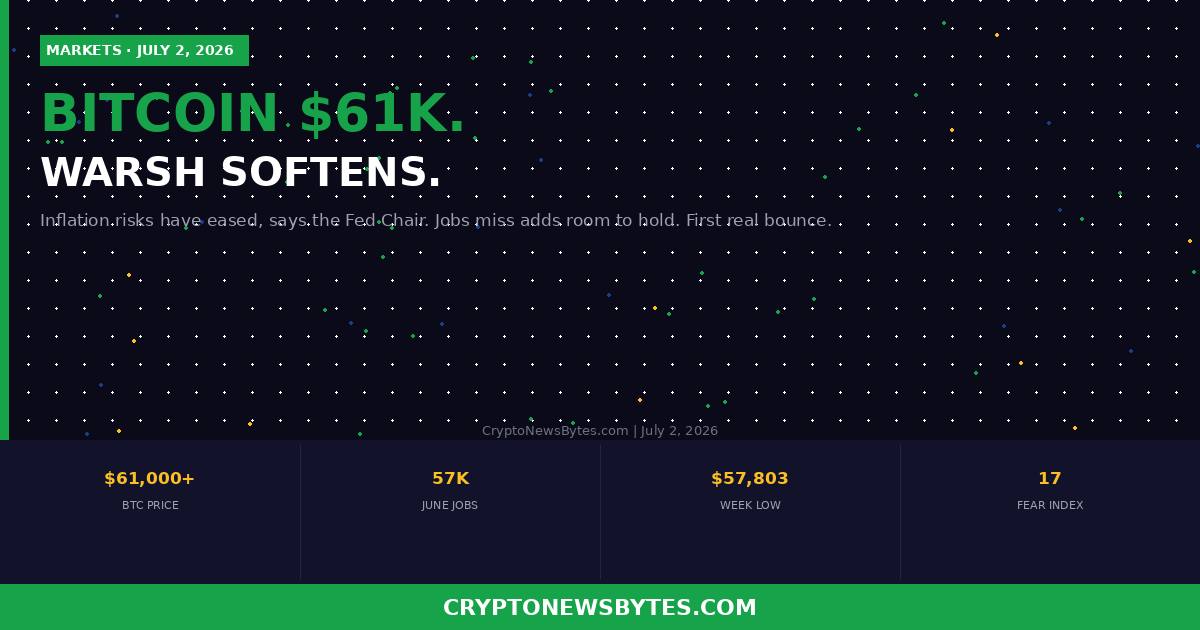
Bitcoin climbed above $61,000 on July 2, 2026, its strongest level in nearly two weeks, after Federal Reserve Chair Kevin Warsh said inflation risks had eased during a panel at the European Central Bank’s annual forum in Sintra, Portugal. Warsh’s comment, describing as his first notably softer public statement since the hawkish June dot plot triggered weeks of ETF outflows, sent the dollar lower, pushed Treasury yields, and gave risk assets including Bitcoin and gold their clearest lift since the US-Iran deal relief rally in mid-June. Bitcoin had briefly touched a 22-month low of $57,803 earlier in the week before reversing.
The June jobs report, released the same morning, added to the shift. US employers added just 57,000 jobs in June, well below the 115,000 economists surveyed by Dow Jones had expected and sharply down from a revised 129,000 in May. The unemployment rate ticked down to 4.2%. The miss is significant because weak jobs data reduces pressure on the Fed to raise rates, giving policymakers more room to hold through the summer without the labor market forcing their hand in either direction. Traders repriced the probability of a September hike lower immediately after the release. Bitcoin rose 4.1% over 24 hours per CoinDesk data, with Ethereum up 6.69% to $1,680 and Solana leading major tokens with roughly 16% gains on the week.
What Warsh Actually Said and Why It Moved Markets
Warsh’s statement was measured, not a pivot. Speaking at Sintra alongside ECB President Christine Lagarde and other global central bankers, Warsh said inflation risks have come down while reaffirming the Fed’s commitment to its 2% target and explicitly refusing to provide forward guidance on the next rate decision. He said he would disappoint anyone expecting loose monetary policy and noted policymakers would debate incoming data at the July 28-29 FOMC meeting. He also cited AI-driven capital expenditures as a potential future supply-side force that could eventually expand the economy’s productive capacity, with implications for how the Fed thinks about long-run neutral rates.
What moved Bitcoin is not what Warsh said but what it implied about trajectory. The June dot plot confirmed no cuts through 2026, and BNP Paribas has forecast rate hikes beginning in December. Warsh describing inflation risks as having come down is the first signal that the most aggressive end of those projections may be less likely than priced. That marginal softening, from a chair who has been uniformly hawkish since his confirmation, is what the market was waiting for. CoinDesk described it as Warsh’s first notably softer comment since the hawkish June dot plot, and the distinction between the substance of what he said, which remains restrictive, and the tone of how he said it, which was fractionally less severe, is where the Bitcoin move lives.
Bitcoin July 2, 2026: The Bounce in Context
From 22-month low to $61K, still below every key resistance | @cryptonewsbytes
Sources: CoinDesk July 2, Investing.com, 24/7 Wall St., Finbold | @cryptonewsbytes. Not financial advice.
Three Things Needed for This Bounce to Become a Trend
Analysts across 24/7 Wall St., CryptoTimes, and Finbold converge on the same framework for whether July becomes a recovery month or another grind lower. First, ETF flows must stabilize and turn positive. June was the worst month for Bitcoin ETF outflows since spot products launched in early 2024, with $4.5 billion in net redemptions turning year-to-date flows negative for the first time. The institutional demand that drove Bitcoin’s rise to $126,080 is in net retreat. One softer day from Warsh does not reverse that. Multiple days of positive ETF flow would be the first confirmation.
Second, the July 28-29 FOMC meeting is the next hard data point. Markets give roughly 70% odds the Fed holds in July. A hold with language that confirms Warsh’s Sintra tone would extend the Bitcoin recovery thesis. A hold with renewed hawkish language, or a surprise hike, hands sellers the trigger for another leg down toward the $53,000 to $56,000 zone Citi’s bear case now flags. Third, the mid-July inflation report. If CPI shows continued progress toward the 2% target, the Warsh Sintra comment transforms from a one-day market event into a policy signal. If it comes in hot, traders will correctly conclude Warsh was describing what he hopes rather than what the data shows.
The honest framing from 24/7 Wall St. is the right one: Bitcoin can still crash again if the July rebound fails near $60K, and the Fed would likely decide which direction it breaks when it meets at the end of the month. What changed on July 2 is that the probability distribution shifted fractionally toward the less bad scenario. The data says July often helps BTC recover after weak June action. But 2026 is different because institutional flows have turned negative, macro conditions remain tight, and the $60,000 level that was supposed to be firm support was lost and only partially recovered.
Frequently Asked Questions
Why did Bitcoin rally on weak jobs data?
Weak jobs numbers reduce pressure on the Federal Reserve to raise rates, since a softening labor market gives policymakers room to hold without needing to tighten further to control demand-side inflation. Lower rate-hike probability reduces the opportunity cost of holding non-yielding assets like Bitcoin. This is the same mechanism that drove Bitcoin higher when the US-Iran deal removed geopolitical risk in June: markets price in whatever reduces the chances of a more restrictive Fed.
What is the Fear and Greed Index and why is it at 17?
The Fear and Greed Index aggregates market sentiment indicators including volatility, momentum, social media sentiment, and survey data to produce a single 0-100 score. 17 is deep in extreme fear. Historically, extreme fear readings have coincided with periods that offer better forward returns than periods of extreme greed, but they are not precise timing signals. The index was at 23 earlier in June before Bitcoin fell to $57,803, so current fear is approximately the same depth as when the decline began.
Further Reading
The last time Bitcoin mounted a sustained recovery. The structure then vs now.
Wall Street’s split read on DeFi resilience is echoed in how analysts are reading this Bitcoin bounce.
This article is for informational purposes only and does not constitute financial advice. Sources: CoinDesk July 2 2026, Investing.com July 2, 24/7 Wall St. July 2, Finbold, CryptoTimes, MEXC News July 2, BLS nonfarm payrolls June 2026, CME FedWatch. Published July 2, 2026.