
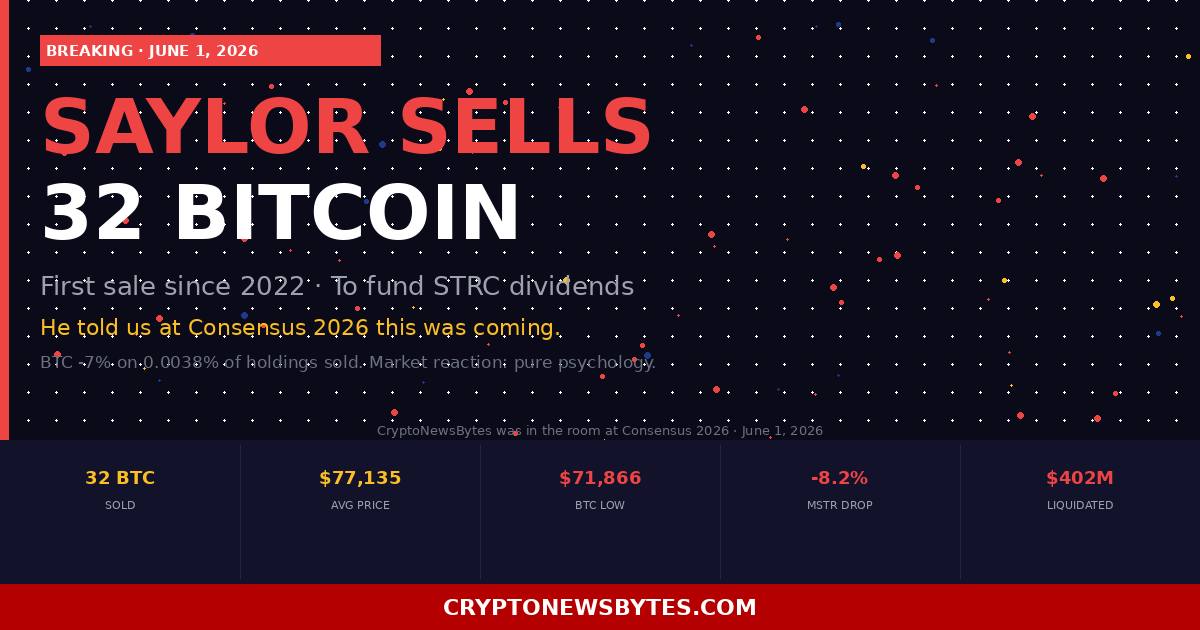
Strategy sold 32 Bitcoin on June 1, 2026. The sale happened between May 26 and May 31 at an average price of $77,135 per coin, generating $2.5 million in proceeds. The 8-K filing is explicit about why: proceeds are expected to be used to fund distributions on preferred stock. Bitcoin fell below $72,000 within hours. MSTR dropped more than 8% in premarket trading. Over $402 million in crypto futures positions were liquidated across 135,585 traders in the 24 hours that followed.
The market treated this as a shock. It was not. Saylor said it was coming on May 5 at Strategy’s Q1 earnings call. Then he laid out exactly how the mechanism works at Consensus 2026 in Miami on May 18, where CryptoNewsBytes was in the room. The model was telegraphed twice in 13 days. Nobody listened.
Saylor Telegraphed This Twice. Nobody Was Listening.
The first signal came on May 5, during Strategy’s Q1 2026 earnings call. Saylor told analysts directly: “We’ll probably sell some Bitcoin to fund a dividend just to inoculate the market, just to send the message that we did it.” That quote is not ambiguous. It is a CEO telling investors, on a recorded earnings call, that a Bitcoin sale is coming, and explaining exactly why. The market reacted briefly and then forgot about it.
The second signal came thirteen days later. CryptoNewsBytes was in the room at Consensus 2026 in Miami on May 18 when Saylor presented his full Digital Credit thesis to institutional investors. The entire architecture he described, Bitcoin as collateral, STRC as the yield layer, Bitcoin sales as the mechanism to fund preferred dividends, was laid out across 66 slides. The model was not hidden. It was the centrepiece of his keynote. Saylor said explicitly: “You buy bitcoin with credit, you let it appreciate, and then you sell bitcoin to pay the dividend.” That is the system. June 1 is the system working as designed.
The inoculation framing is deliberate and important. An inoculation trade is a small, controlled exposure designed to demonstrate capability without causing harm. Saylor’s logic: sell a tiny amount of Bitcoin to fund a dividend payment, prove to the market that Strategy can use Bitcoin as a cash flow source without disrupting the price, and remove the psychological unknown of “what happens when Saylor sells.” Now the market knows. The answer is: 32 Bitcoin, $2.5 million, and a panic that sent Bitcoin down 7% on a 0.0038% portfolio adjustment. CEO Phong Le added at the Q1 call: “We want to be net aggregators of bitcoin, increasing our bitcoin per share because we think that is what is going to be most accretive long term.” The 32 BTC sale is not a strategic retreat. It is the first operational proof that the model works.
The Price Before, During, and After the Sale
The timing of the sale matters for context. The 32 BTC were sold between May 26 and May 31, a period when Bitcoin was trading in the $76,000 to $78,000 range. The average sale price of $77,135 was above Strategy’s blended cost basis of $75,699 per coin, meaning every Bitcoin sold was sold at a profit in nominal terms. The sale price was also above where Bitcoin was trading on the day the 8-K was filed, June 1, when BTC had already slipped to around $73,400 before the filing was released.
After the filing hit, Bitcoin dropped below $72,000 to an intraday low of $71,866. Over $90 million in Bitcoin-tracked futures positions were liquidated in a single hour, with 95% long positions. The 24-hour total reached $402 million across 135,585 traders. Bitcoin analyst BitQuant had predicted this dynamic in January 2026: “Saylor buys 2,000 to 20,000 bitcoin a week and no one cares. One day he’ll sell just 200 Bitcoin, and the entire market will crash on that news.” He was directionally correct but even conservative on the reaction to 32 coins.
Bitcoin Price: Before, During and After the Sale
May 18 to June 1, 2026 | @cryptonewsbytes
MAY 18 (Consensus keynote)
~$81,000
BTC price day Saylor telegraphed the sale
MAY 26-31 (Sale window)
$77,135
Avg sale price. Above $75,699 cost basis.
JUNE 1 (Filing released)
$71,866
Intraday low. Down 7% on 32 BTC sold.
Sources: CoinDesk, Strategy 8-K filing June 1, 2026 | @cryptonewsbytes
How the Sale Funds STRC and Why the Math Works
Strategy’s preferred stock complex spans five series: STRK, STRF, STRD, STRC, and a euro-denominated series, each carrying distinct dividend obligations payable June 30, 2026. STRC alone has $8.5 billion in notional value at 11.5% annual yield, implying roughly $977 million in annual dividend obligations. Combined across all preferred series, the total annual preferred dividend bill runs into the billions.
So how does $2.5 million from 32 Bitcoin cover that? It does not, directly. The sale is one component of a multi-layered funding mechanism. Strategy also raised $128.3 million the same week through its MSTR at-the-market common stock program, selling 801,994 shares. The company’s USD Reserve stands at $900 million, specifically designated to cover preferred dividends and debt interest. And the ATM programs for STRC and other preferred series continue to raise capital continuously. The Bitcoin sale is the marginal piece of a system designed to fund dividends without ever being dependent on any single source.
The strategic logic Saylor articulated at Consensus is that Bitcoin needs to appreciate at just 2.3% per year for the existing holdings to generate enough value to cover STRC dividends in perpetuity, without selling common stock. If Bitcoin appreciates at its historical annualized rate of 40%, selling 32 coins to fund a dividend is essentially giving investors a fraction of the appreciation as income while the other 843,674 coins continue compounding. The math is designed to be net accumulative. For every 1 Bitcoin sold to fund a dividend, the capital raised through STRC issuance buys back many more.
How Strategy Funds STRC Dividends: Multi-Layer System
Same week as the 32 BTC sale | @cryptonewsbytes
Bitcoin sale (32 BTC)
First BTC sale since Dec 2022. Sold at $77,135 avg, above $75,699 cost basis.
MSTR ATM stock sales (same week)
801,994 MSTR shares sold. $26.1B remaining ATM capacity.
USD Reserve (as of May 31)
Management-designated pool specifically for preferred dividends and debt interest.
Total remaining ATM capacity
Across MSTR, STRC, and all preferred series. The machine keeps running.
Sources: Strategy 8-K filing June 1, 2026 | @cryptonewsbytes
The Market Reaction: Rational or Overblown?
Strategy sold 0.0038% of its Bitcoin holdings. Bitcoin dropped 7%. By any mathematical standard, this is a wildly disproportionate reaction. The entire sale amounted to $2.5 million against a $63.87 billion position. The daily trading volume of Bitcoin on any major exchange exceeds $2.5 million in approximately four seconds. The sale itself had zero market impact. The psychological impact of the announcement was everything.
What the market was actually pricing was not the 32 Bitcoin. It was the permission structure. For years, the implicit assumption baked into Bitcoin’s price was that Strategy would never sell. Strategy’s accumulation pace of roughly 1,036 BTC per day absorbed more than twice annual new supply. If that accumulation reverses, even partially, the demand math that supports Bitcoin’s price changes. The market’s 7% response to a $2.5 million sale was a stress test of what happens when that assumption breaks. The answer: significant panic, fast.
Whether the panic was warranted depends on whether you believe Saylor’s inoculation framing or whether you think this is the beginning of a structural shift. The 8-K is unambiguous that proceeds fund preferred dividends, not a general liquidity need. The $900 million USD Reserve was already designated for that purpose and still stands. The $128.3 million raised through MSTR stock sales the same week dwarfs the Bitcoin sale 51 times over. The narrative that Saylor is abandoning his Bitcoin thesis is not supported by the filing. The narrative that the psychological barrier is now gone, and that future sales will generate less panic because this one happened, is exactly what Saylor said he wanted to achieve.
32 BTC in Context: The Scale That Makes the Reaction Irrational
All figures from Strategy SEC filings | @cryptonewsbytes
Source: Strategy 8-K June 1, 2026. Weekly buy rate based on JPMorgan $30B annualized projection. | @cryptonewsbytes
Frequently Asked Questions
Why did Strategy sell Bitcoin if it has $900 million in cash reserves?
The $900 million USD Reserve is designated specifically for preferred dividends and debt interest. Saylor’s stated goal was to demonstrate operationally that Bitcoin can fund preferred dividends directly, not just through the cash reserve. The inoculation framing from Q1 earnings suggests the sale was intentional signalling rather than a liquidity necessity: prove the mechanism works with a tiny amount, normalize it for markets, and preserve the option to use Bitcoin sales as a routine dividend-funding tool going forward. The $2.5 million sale alongside $128.3 million raised through MSTR stock sales the same week puts the Bitcoin component in perspective.
Does this mean Strategy will sell more Bitcoin regularly?
CEO Phong Le said at Q1 earnings that Strategy will sell Bitcoin “when it’s advantageous to the company.” Saylor’s framing suggests any sales will be structured to be net accumulative: for every Bitcoin sold, the proceeds from ongoing STRC and MSTR ATM programs buy back multiples more. The December 2022 sale involved 704 BTC sold for tax harvesting, followed by repurchase of 810 BTC two days later. If that precedent holds, the 32 BTC sale may be followed by a purchase announcement. The company still has $51 billion in ATM capacity and BTC Yield of 12.6% YTD.
Was the market reaction justified?
Mathematically, no. Strategy sold 0.0038% of its holdings for $2.5 million. Bitcoin’s daily trading volume exceeds $2.5 million in seconds. The sale had no market impact. The announcement triggered $402 million in futures liquidations because the market had priced in a permanent non-sell assumption. When that assumption was tested, even at a trivially small scale, leveraged long positions unwound. Bitcoin analyst BitQuant predicted this exact dynamic in January 2026. The reaction is a function of positioning and psychology, not of any fundamental change in Strategy’s Bitcoin thesis.
Further Reading
The full Consensus 2026 keynote where Saylor told us exactly what happened today. CryptoNewsBytes was in the room.
STRC is the product this Bitcoin sale is funding. Understanding it is essential context for today’s announcement.
The same week Strategy sold 32 BTC, it also announced this $2 billion purchase. The direction of travel has not changed.
This article is for informational purposes only and does not constitute financial or investment advice. Past performance is not indicative of future results. Sources: CoinDesk, Bitcoin Magazine, CryptoTimes, CNBC, Strategy 8-K filing June 1, 2026. Published June 1, 2026.