
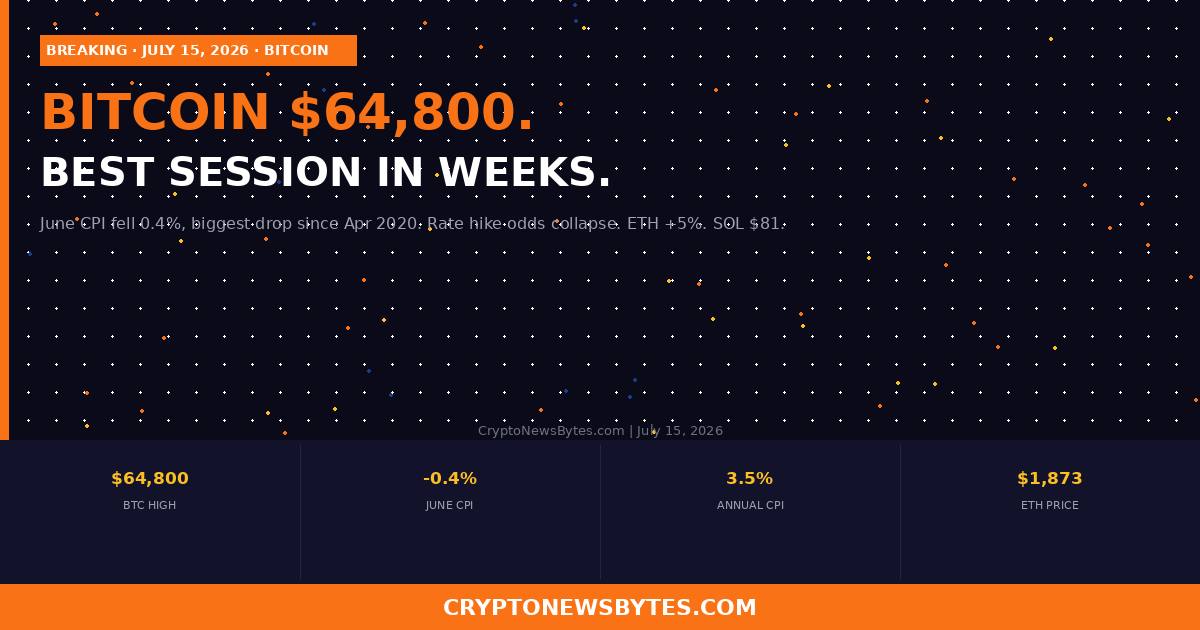
Bitcoin climbed to $64,800 on Wednesday July 15, 2026, up 3.6% in 24 hours, after the US Bureau of Labor Statistics reported that headline consumer prices fell 0.4% in June, the largest single-month decline since April 2020. Annual inflation slowed to 3.5%, down from May’s 4.2% reading, and core inflation eased to 2.6% year-on-year from 2.9% in May. Fed futures immediately repriced toward a near-zero probability of a rate hike at the July 28 to 29 FOMC meeting. Bitcoin, which had touched a 21-month low of $57,803 in late June, recorded its best session in weeks.
Ethereum outpaced Bitcoin on the day, rising 5% to $1,873, its highest level since June 2. Solana moved to approximately $81. The S&P 500 rose 0.36% and the Nasdaq gained 1.12%, with South Korea’s Kospi jumping 8.2% on SK Hynix strength. The Crypto Fear and Greed Index rose to 25, still deep in extreme fear territory, though the pace of panic appears to be slowing. Approximately $1.1 billion in positions were liquidated on crypto exchanges in the 24 hours following the CPI print, the majority short positions being forcibly covered as the market moved against them.
The honest read on the day’s move: Bitcoin remains a rate-sensitive risk asset, not a macro hedge. The CPI print reduced immediate downside pressure. It did not build a durable breakout. Core inflation at 2.6% is still above the Fed’s 2% target. And the same report that cooled inflation fears contains a structural complication. June’s improvement was driven largely by lower oil prices as US-Iran ceasefire tensions eased. With fighting resumed and Brent crude climbing back above $85 a barrel, July’s CPI could reverse some of the progress that just moved markets.
BTCUSDT Daily
$64,700 ▲ +3.6%
50 EMA $65,160
Support $61,000
$69K
$66K
$63K
$60K
$57K
50 EMA
Support
$64,700
Jun 1
Jun 10
Jun 20
Jun 30
Jul 10
Jul 15 ▲
Vol
TradingView-style chart | Data: BLS, Yahoo Finance, CoinDesk Jul 15 2026 | @cryptonewsbytes
Not financial advice
What the CPI Print Actually Changes
June headline CPI declining 0.4% was the print that gutted the Fed rate-hike trade. Before the release, Polymarket gave roughly 34% odds to a July hike. After, those odds collapsed toward near-zero. Fed Chair Kevin Warsh, responding to the data, said one favorable inflation report was not enough to declare victory and kept the central bank’s next move tied to incoming data. CoinDesk reported Warsh as saying: “If we get policy right, and we will, the inflation surge of the last five years will be a thing of the past.” That is not a pivot. It is a hold with cautious language.
The mechanism behind Bitcoin’s reaction is straightforward. Higher rate expectations put upward pressure on real yields and the dollar, both reducing the attractiveness of non-yielding assets. When rate-hike odds fall sharply, those pressures reverse. Traders who had positioned short were caught offside, and the $1.1 billion in liquidations, predominantly shorts, amplified the upward move through forced buying. Jeff Ko, chief analyst at CoinEx, described the print as reducing immediate downside pressure without building a durable breakout. The setup before the print was bearish. The CPI improved it. Improving the setup is not the same as changing the trend.
The technical picture supports that measured reading. The 50-day EMA sits at $65,160, the key resistance Bitcoin approached but had not yet cleanly cleared as of the Wednesday session. A sustained close above $65,160 would be the first meaningful technical confirmation of a trend shift. Without it, the move from $57,803 to $64,800 is a relief rally in a bear market. The distinction matters for positioning into the July 28-29 FOMC meeting, which is now the next hard catalyst. The CLARITY Act stablecoin yield deal reached in March 2026 removed a category of headline regulatory risk that had weighed on institutional Bitcoin positioning, providing a cleaner macro setup for institutional re-entry if the CPI trend holds.
Bitcoin Price Recovery: From June Low to July 15, 2026
Key levels and what they mean | Sources: CoinGecko, FXStreet, Bitcoin Foundation Jul 15 2026 | @cryptonewsbytes
Sources: CoinGecko Jul 15, FXStreet Jul 15, Bitcoin Foundation Jul 15, Blockhead Jul 15 | @cryptonewsbytes. Not financial advice.
Three Things That Happen Next
The next month’s price action depends on three variables. First: June PPI data due later today. Producer prices lead consumer prices. A hot PPI print would partially undercut the CPI relief and reintroduce rate-hike odds before the FOMC meeting. A soft PPI would confirm the disinflation trend. Second: ETF flow direction in the week following the CPI. June was the worst month for Bitcoin ETF outflows since spot products launched in January 2024, with institutional demand net negative for weeks. The CPI print gives institutional buyers a narrative reason to return. Sustained positive ETF inflows would be the demand signal that separates a durable recovery from a short-squeeze bounce.
Third: whether the oil price reversal persists. Brent crude above $85 is the inflation risk the CPI data does not fully account for. June inflation fell partly because US-Iran ceasefire reduced energy prices. With fighting resumed and the Strait of Hormuz blockaded, July energy prices are running higher. If July CPI comes in hot due to the oil reversal, the Fed rate-hike scenario returns for September. Whales accumulated more than 270,000 BTC over roughly two weeks around the June lows, worth well over $16 billion, most moved through private desks. That accumulation is the on-chain bull case. The oil price trajectory is the macro bear case. Wednesday’s CPI print put those two forces closer to balance than they have been since April.
Glassnode analysts noted after Wednesday’s session that despite the rally, most market metrics do not yet confirm a trend reversal, pointing to falling spot and futures trading volumes and low blockchain activity as signs of accumulation rather than active buying. The Polymarket regulatory story this year reflects the same macro-sensitivity theme: prediction market odds are the cleanest real-time signal for rate decisions, and those markets moved faster on the CPI print than any analyst commentary could.
Frequently Asked Questions
Why did Bitcoin go up on lower inflation?
Lower inflation reduces pressure on the Federal Reserve to raise interest rates. Higher rates increase the opportunity cost of holding non-yielding assets like Bitcoin. When June CPI fell 0.4%, the largest monthly drop since April 2020, fed futures priced out a July hike almost entirely, triggering a risk-on rotation. Traders who had positioned short were forced to buy to cover losses, amplifying the move.
Is $64,800 the start of a Bitcoin recovery?
The CPI print improved the near-term setup but did not confirm a trend reversal. Bitcoin’s 50-day EMA at $65,160 has not been cleared on a sustained close. The June lows at $57,803 established a floor. Whether this becomes a recovery or a relief rally depends on ETF inflows sustaining, PPI and next month’s CPI remaining soft, and the Fed confirming a hold at the July 28-29 FOMC meeting.
What could send Bitcoin back down after this rally?
Three specific risks. June PPI data due July 15 coming in hot would partially reverse the CPI narrative before the FOMC. A resumption of heavy Bitcoin ETF outflows would remove institutional demand support. And Brent crude above $85 driven by US-Iran tensions could push July CPI higher, reviving rate-hike expectations for September. Warsh explicitly said one good report was not enough to declare victory.
Further Reading
The legislative backdrop supporting institutional Bitcoin confidence. Stablecoin clarity reduces the regulatory risk premium that had weighed on institutional crypto demand.
Prediction market odds collapsed from 34% to near-zero on the CPI print. Polymarket’s regulatory journey is the parallel story to crypto’s macro sensitivity.
This article is for informational purposes only and does not constitute financial advice. Sources: CoinDesk Jul 15 2026, FXStreet Jul 15 2026, Bitcoin Foundation Jul 15 2026, Blockhead Jul 15 2026, Yahoo Finance Jul 15 2026, CoinDesk Daybook Jul 15 2026, crypto.news Bitcoin prediction July 2026, Forbes Jul 4 2026. Published July 15, 2026.