
JPMorgan Chase is the largest bank in the United States with over $3.9 trillion in assets. Its preferred stock, JPM/PC, is a serious institutional instrument. It trades on the NYSE. It offers a fixed dividend. It is held by every major preferred ETF. And its 30-day Sharpe ratio, as of May 1, 2026, is 0.22. Strategy’s STRC preferred, backed by Bitcoin, earns a 2.53 Sharpe ratio on the same measure. The gap between 0.22 and 2.53 is not a rounding difference. It is a structural difference in what the two instruments are actually built on.
Michael Saylor presented this comparison directly at Consensus 2026 in Miami, using Bloomberg data on preferred securities as of April 2026. He did not bury it in a footnote. He put it on a full slide and held on it. The comparison across every major bank preferred stock tells the same story: STRC 2.53 vs Wells Fargo 0.3 vs Bank of America 0.26 vs Citigroup 0.22 vs JPMorgan 0.22. Every bank preferred within one basis point of each other, and STRC more than ten times any of them.
What the Sharpe Ratio Actually Measures Here
The Sharpe ratio measures return per unit of risk taken. Specifically, for preferred securities, Saylor’s team calculated it as effective yield minus risk-free rate divided by 30-day historical volatility. A higher Sharpe means you are receiving more return for each percentage point of volatility you accept. A Sharpe of 0.22 for JPMorgan preferred means the instrument offers a thin premium above the risk-free rate relative to how much its price moves. A 2.53 Sharpe for STRC means it offers a large premium relative to its price movement.
The structural reason the gap exists is in what backs the two instruments. JPMorgan preferred is backed by JPMorgan’s balance sheet: loans, deposits, derivatives exposure, counterparty risk concentrated across a single regulated institution. STRC is backed by 843,738 Bitcoin held in custody. Bitcoin has no counterparty. It cannot be inflated, diluted, or subject to regulatory seizure in the way a bank’s assets can. The credit quality of JPMorgan depends on decisions made by thousands of bankers across hundreds of business lines. The credit quality of STRC’s collateral depends on the Bitcoin protocol continuing to operate, which it has done without interruption since January 2009.
STRC also has a 4.1x BTC coverage ratio, meaning Strategy’s Bitcoin reserve is 4.1 times larger than the total STRC dividend obligation. JPMorgan’s preferred dividends are covered by earnings from its banking operations, which are subject to credit cycles, regulatory capital requirements, and interest rate sensitivity. The overcollateralization of STRC is structural, not discretionary.
The Liquidity Gap Is Just as Striking as the Sharpe Gap
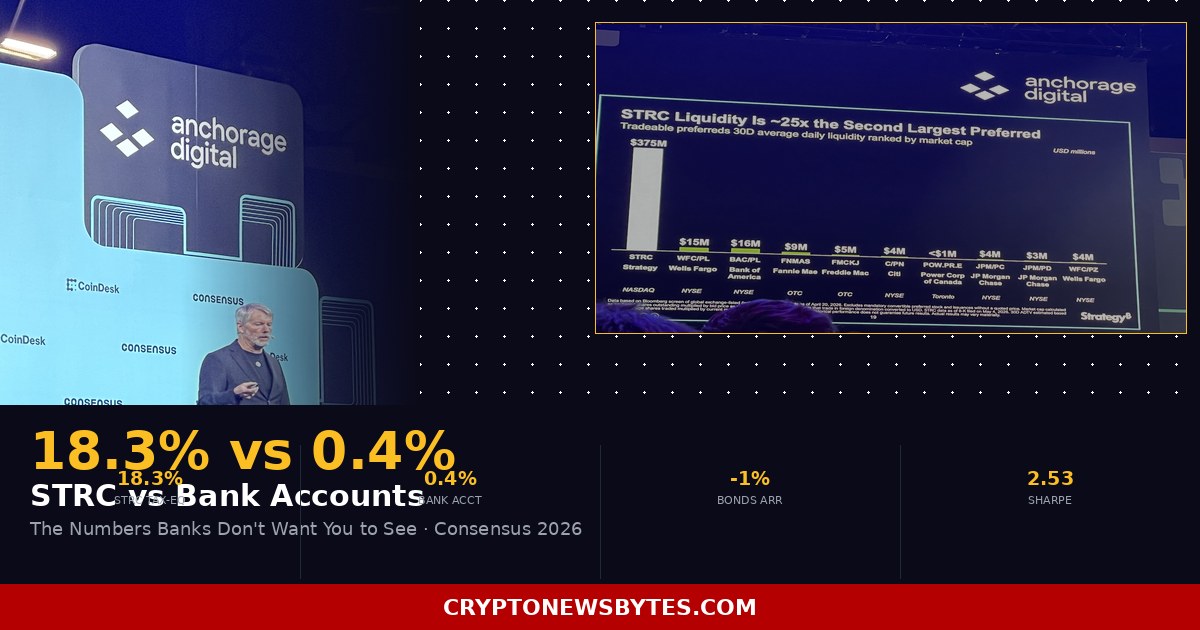
JPMorgan’s preferred stock trades $4 million per day. STRC trades $375 million per day. That is not a modest advantage in liquidity. It means a large institutional investor who needs to exit a significant preferred position can do so in STRC without moving the market in the way they would if trying to exit a JPMorgan preferred position of comparable size. For a family office or sovereign wealth fund allocating hundreds of millions, the liquidity difference is a practical portfolio constraint, not a theoretical one.
The turnover rate comparison is even starker. STRC’s daily trading volume as a percentage of its market cap is 4.4%. JPMorgan preferred turns over at 0.2% per day. Wells Fargo at 0.3%. Bank of America at 0.4%. STRC has 10 times the turnover rate of the next most liquid preferred. Institutional investors who value the ability to rebalance, hedge, or exit positions without price impact will find a meaningful difference in the practical usability of the two instruments.
STRC vs Every Bank Preferred: Sharpe Ratio Comparison
As of May 1, 2026. (Effective Yield – Risk-Free Rate) / Hist. Volatility 30D
Source: Strategy slides, Consensus 2026 Miami | Bloomberg preferred data | @cryptonewsbytes
The Tax Dimension Banks Cannot Match
JPMorgan preferred stock dividends are taxed as qualified dividends at a preferential rate of 20% to 35% depending on the investor’s bracket. STRC dividends are classified as Return of Capital, which reduces the investor’s cost basis and defers any tax until the shares are sold. The effective current dividend tax rate on STRC is 0%. Strategy expects this treatment to continue for ten years or more because the company has negative accumulated Earnings and Profits, a direct result of how Bitcoin appreciation is treated for tax purposes.
For a U.S. institutional investor at the 37% marginal tax rate, STRC’s 11.5% stated yield becomes an 18.3% tax-equivalent yield when the ROC treatment is factored in. JPMorgan preferred’s yield, after qualified dividend tax, is materially lower than its stated coupon. The tax structure alone, without touching the Sharpe ratio comparison or the liquidity differential, changes the competitive picture between the two instruments significantly.
Whether these advantages persist depends on things that can change: the tax code, Bitcoin’s price relative to STRC’s par value, and whether the 4.1x coverage ratio holds under stress. What does not change is the structural logic: a preferred instrument backed by an asset with 30% expected long-term growth can offer better risk-adjusted yield than a preferred backed by an institution with mid-single-digit return on equity. That relationship holds as long as the collateral maintains its growth properties. JPMorgan has been one of the best-run banks in history. Bitcoin has been the best-performing asset in history over the same measurement window.
Bitcoin vs Traditional Assets: Four Key Comparisons
All data from Strategy’s Consensus 2026 keynote slides. Source: Strategy.com, Bloomberg, FRED as of May 5, 2026 | @cryptonewsbytes
1. Annualised returns since Aug 10, 2020
2. Return vs volatility (bubble size = relative Sharpe)
3. Sharpe ratio: STRC vs banks, hedge funds, bonds
4. Tax-equivalent yield: STRC vs traditional instruments
Source: Strategy keynote slides, Consensus 2026 Miami. Past performance is not indicative of future results. Not financial advice. CryptoNewsBytes was in the room. | @cryptonewsbytes
Further Reading
The complete 12-slide keynote breakdown including the yieldcoin ecosystem and Layer 3 adoption data.
JPMorgan’s response to the Bitcoin-backed competition is not to argue with it. It is to build blockchain infrastructure of its own.
The broader performance comparison: BTC at 40% ARR vs bonds at -1%, and why the volatility argument is weaker than banks claim.
This article is for informational purposes only and does not constitute financial advice. All Sharpe ratio and performance data sourced directly from Strategy’s presentation slides at Consensus 2026 by CoinDesk, Miami, May 18, 2026. Past performance is not indicative of future results.