
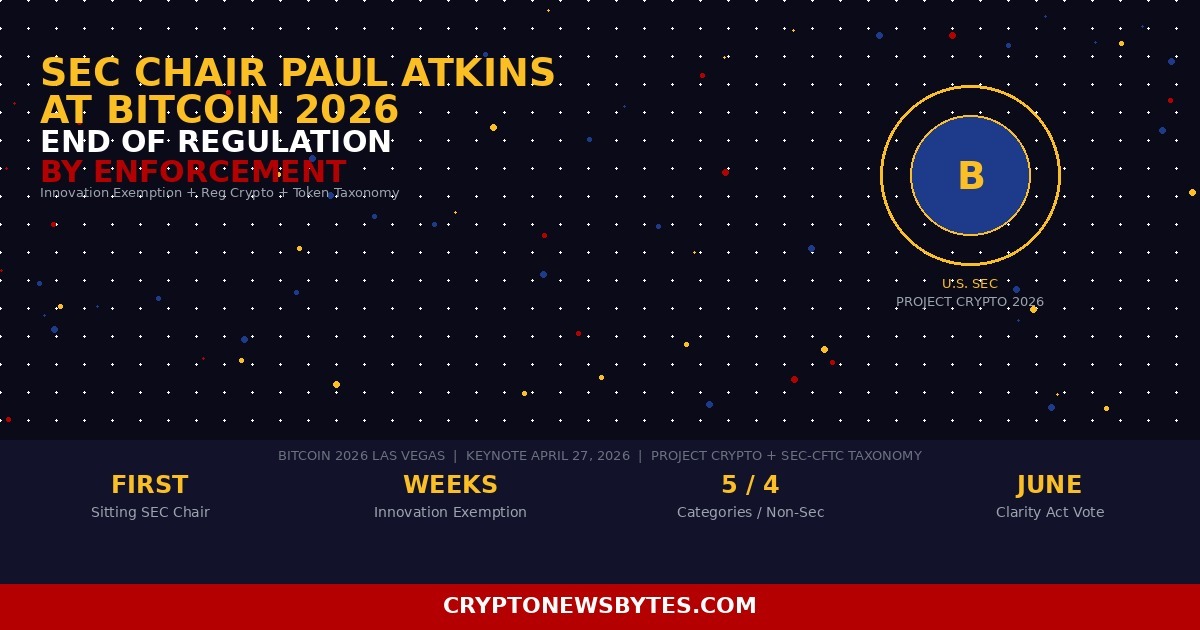
Paul Atkins walked onto the Nakamoto stage at Bitcoin 2026 in Las Vegas on Monday, April 27, and made history before he said a word. He is the first sitting Chairman of the U.S. Securities and Exchange Commission to address the conference. For an industry that spent the prior administration absorbing enforcement actions in lieu of rulemaking, the symbolism was the point. The substance came next. Atkins, in a sit-down with Chamber of Digital Commerce founder Perianne Boring, told the audience the SEC will release an innovation exemption “within weeks” allowing firms to build and trade tokenized securities on-chain inside the United States, that Reg Crypto is now at the White House Office of Information and Regulatory Affairs awaiting final clearance, and that the agency’s prior posture toward digital assets had failed.
The keynote was the public-facing component of what Atkins formally launched in July 2025 as Project Crypto, a Commission-wide initiative to modernize securities regulation in support of the Trump administration’s stated goal of positioning the United States as the global capital for digital assets. The mechanics of the pivot are now visible. The SEC and CFTC published a joint Token Taxonomy at the DC Blockchain Summit in April 2026, distinguishing five categories of digital assets with four falling outside the definition of a security under federal law. The agency has issued a Regulation Crypto Assets safe harbor framework. Atkins’s keynote signaled that the operational rollout of these initiatives is now days, not quarters, away.
From Ostrich Posture to Onshoring: Atkins’s Critique of the Prior SEC
Atkins did not soften his characterization of the SEC’s previous approach. He described the agency’s history with digital assets as a progression from an “ostrich with its head in the sand” position into an enforcement-driven regime that used litigation to provide the guidance the rules failed to articulate. The legal substance of that critique matters because it identifies the core problem the new framework is designed to solve. Under prior leadership, crypto firms were invited to “come in and register,” but the registration pathway pointed them at Form S-1, the document designed for traditional Initial Public Offerings. Atkins called it a “square peg in a round hole” for tokenized ecosystems. Firms that attempted to register often spent years in regulatory limbo without final orders. Firms that did not register faced enforcement actions for the same conduct.
The result, in Atkins’s framing, was capital flight. Token issuance moved offshore. Major DeFi development concentrated in jurisdictions with looser oversight. American developers and investors were progressively excluded from products that should have been built on U.S. infrastructure. The current administration’s mandate, Atkins told the audience, is to reverse that flow. “We will not stand idly by and watch innovations develop overseas while our capital markets remain stagnant,” he said at The Economic Club of Washington on April 21. The Bitcoin 2026 keynote was the public restatement of that thesis with operational specifics attached.
Atkins also addressed the question of permanence. The SEC under his leadership has “a large ambit of maneuver,” he said, but the agency’s authority still rests on 1930s-era statutes. Executive policy can be reversed by a future administration. “Nothing future-proofs things like a statute,” Atkins noted, throwing his support behind the Digital Asset Market Clarity Act now moving through the Senate. Senator Cynthia Lummis told the same Bitcoin 2026 audience earlier on Monday that the Senate will mark up the Clarity Act in May, with a full Senate vote possible by June. Atkins’s endorsement of the legislation as the durable foundation for his reforms is significant: it is the SEC Chairman explicitly telling Congress that without statutory backing, his policy gains can be unwound.
The “Orange Grove” Reinterpretation: Howey Decoupled from the Token
The most consequential intellectual move in the keynote was Atkins’s reframing of the Howey Test, the 1946 Supreme Court standard that has been the legal backbone of every major SEC enforcement action against crypto firms for a decade. The original case, SEC v. W.J. Howey Co., involved a Florida orange grove. Buyers purchased land parcels and signed companion service contracts under which Howey would cultivate, harvest, and market the oranges, sharing the proceeds with the buyers. The Supreme Court ruled that the combination of the land purchase plus the management contract constituted an “investment contract” subject to securities regulation.
For more than a decade, SEC enforcement applied that framework to crypto by treating the token itself as the investment contract. Atkins decoupled them. “The investment contract wasn’t the orange itself,” he told the audience. “It’s not about the orange itself, but about the promises around it.” The token, by analogy, is the orange. The investment contract is the ecosystem of promises that the issuer makes to token holders about future development, returns, governance, or service delivery. By drawing the line at the contractual ecosystem rather than the token, the SEC creates legal space for tokens to exist as digital commodities or other non-security categories even when issued through fundraising activity. The token can be a security at the moment of distribution and become a non-security as the issuing organization decentralizes and the contractual promises dissolve.
This is not just rhetoric. The April 2026 joint SEC-CFTC Token Taxonomy operationalized the framework. It identifies five categories of digital assets: tokenized securities, digital commodities, digital tools, digital collectibles, and stablecoins. Four of the five fall outside the federal definition of a security. The taxonomy is principles-based rather than a fixed list, but it has already moved markets. Atkins noted that Asian markets have been pricing premiums for tokens listed on the digital commodities side of the taxonomy. The reclassification is creating measurable cross-border capital flow effects before the framework has even been formally codified.
The SEC-CFTC Token Taxonomy: Five Categories, Four Non-Securities
Source: SEC-CFTC joint release at DC Blockchain Summit (April 2026), Securities Docket, Atkins Bitcoin 2026 keynote | @cryptonewsbytes
| Category | Definition | Securities Law? |
|---|---|---|
| Tokenized Securities | Stocks, bonds, fund shares represented on-chain. Investment contracts with ecosystem of promises. | YES, SEC |
| Digital Commodities | Bitcoin, decentralized network tokens. Sufficient decentralization, no ongoing managerial promises. | NO, CFTC |
| Digital Tools | Utility tokens for protocol access, gas fees, staking. Functional rather than investment intent. | NO |
| Digital Collectibles | NFTs and unique on-chain assets without expected returns from common enterprise. | NO |
| Stablecoins | Payment instruments pegged to fiat. Governed by GENIUS Act framework signed in 2025. | NO, GENIUS Act |
The taxonomy is principles-based, not a fixed list. Atkins on classification: “It’s not about the orange itself, but about the promises around it.” Asian markets have been pricing premiums for tokens listed in the digital commodities category. | @cryptonewsbytes
The Innovation Exemption and Reg Crypto: What’s Coming and When
Atkins outlined three near-term regulatory deliverables. The first, and most concrete in timing, is the innovation exemption. The SEC will release a rule allowing firms to build and trade tokenized securities on-chain inside a defined safe harbor, “within weeks.” This will give institutional issuers, exchanges, and infrastructure providers an immediate compliant pathway to begin facilitating on-chain securities trading without the full S-1 burden, while the Commission works toward long-term rules. The exemption was originally targeted for January 2026 release but slipped because of the U.S. government shutdown that ran through October and into November 2025. The April 27 Bitcoin 2026 commitment puts the release window at May or early June.
The second deliverable is Regulation Crypto Assets (Reg Crypto), the comprehensive framework for on-chain fundraising through token sales. As of April 7, 2026, Atkins confirmed at a Vanderbilt University and Blockchain Association event that Reg Crypto is at the White House Office of Information and Regulatory Affairs, the final review step before formal publication. The framework, anchored on the Securities Act of 1933, addresses fundraising and includes a fit-for-purpose startup exemption: a time-limited registration exemption for offerings of investment contracts involving certain crypto assets. The proposed structure allows up to four years of regulatory runway and up to $5 million raised under the exemption, with notice filings to the Commission. Atkins’s March 17 speech laid out the contours; the OIRA review is the last gate before publication.
The third deliverable is the long-term modernization of SEC custody rules and broker-dealer frameworks to accommodate crypto assets. This is the slowest of the three but structurally the most significant. Custody rule modernization is what unlocks broker-dealers, investment advisers, and registered investment companies to hold crypto assets within the same regulated framework that governs traditional securities. Atkins described self-custody as “a core American value” while acknowledging that many investors will continue to rely on SEC-registered intermediaries. The work is ongoing under SEC staff direction.
Project Crypto Regulatory Pipeline: From Atkins’s Desk to Live Rules
Source: SEC.gov speeches, CoinDesk Vanderbilt event coverage (April 7, 2026), Bitcoin 2026 keynote, WilmerHale Project Crypto analysis | @cryptonewsbytes
✓ DONE: Project Crypto launched (July 31, 2025) Commission-wide initiative announced at America First Policy Institute. Onshoring directive issued to staff. |
| ↓ |
✓ DONE: Atkins Reg Crypto Safe Harbor Speech (March 17, 2026) Detailed startup exemption proposal: 4-year runway, $5M cap, fit-for-purpose registration exemption. |
| ↓ |
✓ DONE: SEC-CFTC Token Taxonomy released (April 2026) Joint guidance at DC Blockchain Summit. 5 categories, 4 outside SEC jurisdiction. Already moving Asian markets. |
| ↓ |
⇳ IN OIRA REVIEW: Reg Crypto fundraising framework As of April 7, at White House Office of Information and Regulatory Affairs. One step from publication. Securities Act of 1933 framework for on-chain fundraising and startup exemption. |
| ↓ |
⌚ “WITHIN WEEKS”: Innovation Exemption for tokenized securities Atkins commitment from Bitcoin 2026 keynote. Compliant safe harbor for on-chain trading of tokenized securities. Originally targeted January 2026; delayed by government shutdown. |
| ↓ |
☆ FUTURE-PROOFING: Clarity Act Senate passage (target June 2026) Lummis announced May markup; vote possible by June. “Nothing future-proofs things like a statute” — Atkins. |
Custody rule modernization and broker-dealer framework updates are running on a slower parallel track. Atkins on self-custody: “a core American value.” | @cryptonewsbytes
SEC-CFTC Collaboration: Ending the “Two Fortresses” Era
The other major operational shift Atkins emphasized was the SEC-CFTC working relationship. Historically the two agencies operated, in his words, “like two fortresses with no man’s land in between,” with crypto firms caught in the jurisdictional crossfire. The April 2026 joint Token Taxonomy was the first significant deliverable from the rebuilt collaboration. CFTC Chairman Michael Selig, who also spoke at Bitcoin 2026, has been working alongside Atkins on the framework. The CFTC has taken primary jurisdiction over digital commodities under the taxonomy, while the SEC retains authority over tokenized securities. The carved-out categories of digital tools, digital collectibles, and stablecoins all fall outside primary SEC oversight.
This jurisdictional architecture is what the Clarity Act would codify into permanent law. The bill assigns primary jurisdiction over most non-stablecoin digital assets to the CFTC as digital commodities while narrowing the SEC’s reach to tokenized securities. The legislative version mirrors the operational version that Atkins and Selig have already built through joint guidance. The vote sequencing matters: if the Clarity Act passes by June, the agency-level framework that Atkins has constructed becomes statutory and difficult to reverse. If it does not pass, a future SEC Chair could rescind the joint taxonomy, withdraw the innovation exemption, and retreat to enforcement-driven regulation, all without legislative action.
T+0 Settlement: The Argument Atkins Got Most Animated About
The keynote’s most personally invested passage came when Atkins addressed distributed ledger technology and instantaneous settlement. “The blockchain, the distributed ledger technology, is the most exciting aspect about all this,” he said. The argument is operationally specific. U.S. equities settle T+1 currently, meaning the buyer’s payment and the seller’s delivery are reconciled one business day after the trade. Until 2024, the standard was T+2. The remaining gap, even at T+1, represents systemic risk: between the transaction and the clearance, both parties bear counterparty exposure on assets that have already been priced in the market. That exposure aggregates across the financial system and requires collateral, central counterparty buffers, and risk-management infrastructure to absorb.
T+0 settlement, native to most blockchain transactions, eliminates that gap. “Every second that you have a difference between the transaction time and the clearance and settlement is a risk that the investor and both parties bear,” Atkins told the audience. By moving settlement on-chain, the SEC believes it can de-risk the entire financial system, reducing the collateral requirements at central counterparties, freeing up capital that currently sits in margin accounts, and removing the failure modes associated with intra-day exposure to broker-dealer creditworthiness. SWIFT’s blockchain ledger initiative is explicitly designed around this T+0 settlement architecture for tokenized deposits. The SEC’s innovation exemption is the regulatory enabler for U.S. equity markets to begin testing the same model.
Atkins explicitly welcomed traditional exchanges and incumbent broker-dealers into this future. The intent is not to replace existing market infrastructure but to upgrade it. NYSE, Nasdaq, and DTCC have all been engaging with on-chain settlement experimentation, and the innovation exemption is structured to allow that experimentation to take place within a defined U.S. regulatory framework rather than offshore.
Settlement Times: Why Atkins Wants On-Chain T+0
Source: DTCC, SEC settlement standards, Atkins Bitcoin 2026 keynote, SWIFT MVP design specs | @cryptonewsbytes
| U.S. Equities pre-2024 (T+2) | |
| U.S. Equities current (T+1) | |
| FX Spot (T+2) | |
| U.S. Treasuries (T+1) | |
| On-chain (T+0 atomic) |
Atkins: “Every second that you have a difference between the transaction time and the clearance and settlement is a risk that the investor and both parties bear.” On-chain settlement is atomic: payment and asset delivery occur in the same blockchain transaction or both fail. The SEC innovation exemption is the regulatory enabler for U.S. equity markets to begin testing this architecture. | @cryptonewsbytes
What This Means for the Industry: Three Practical Takeaways
First, for crypto firms currently operating in regulatory limbo, the innovation exemption release in May or June is the first compliant pathway to begin facilitating on-chain securities trading inside the U.S. without filing an S-1. For exchanges including Coinbase, Kraken, and Gemini, this opens a direct route to launching tokenized equity products under defined safe harbor terms. For institutional issuers exploring tokenized fund structures, the exemption removes the primary regulatory barrier to U.S. distribution.
Second, for token issuers and DeFi protocol developers, the Token Taxonomy framework provides a working classification system even before formal codification. Tokens that fall into digital commodities, digital tools, or digital collectibles categories operate primarily outside SEC jurisdiction. Combined with the OCC trust bank charter framework that has approved Circle, Ripple, BitGo, and Coinbase, the U.S. now has functional regulatory architecture for crypto custody, exchange operation, and token issuance. The pieces interlock.
Third, the structural risk that Atkins explicitly flagged remains real. The framework he is building is operationally durable but legally provisional. Without Clarity Act passage, every initiative he has launched can be reversed by a future Commission. Senator Lummis’s May markup commitment and the June floor vote target are not abstract legislative timeline questions. They are the difference between Atkins’s reforms persisting and Atkins’s reforms being a four-year interlude. The SEC Chairman is, in effect, asking Congress to make his policy permanent before he finishes his own term.
Frequently Asked Questions
When will the SEC innovation exemption be released?
SEC Chairman Paul Atkins confirmed at Bitcoin 2026 in Las Vegas on April 27 that the innovation exemption will be released “within weeks.” This puts the expected publication window at May or early June 2026. The exemption was originally targeted for January 2026 but was delayed by the U.S. government shutdown that ran from October to November 2025. The exemption will allow firms to build and trade tokenized securities on-chain inside the United States within a defined safe harbor framework.
What is Reg Crypto and when will it be published?
Regulation Crypto Assets, known as Reg Crypto, is the SEC’s comprehensive framework for on-chain fundraising through token sales, anchored on the Securities Act of 1933. As of April 7, 2026, Atkins confirmed at a Vanderbilt University and Blockchain Association event that Reg Crypto is at the White House Office of Information and Regulatory Affairs (OIRA), the final review step before formal publication. The framework includes a fit-for-purpose startup exemption with a 4-year regulatory runway and a $5 million fundraising cap.
What is the SEC-CFTC Token Taxonomy?
The Token Taxonomy is a joint SEC-CFTC release published at the DC Blockchain Summit in April 2026 that classifies digital assets into five categories: tokenized securities, digital commodities, digital tools, digital collectibles, and stablecoins. Four of the five categories fall outside the federal definition of a security under federal law. The framework is principles-based rather than a fixed list and is the operational version of the jurisdictional split that the Clarity Act would codify into permanent statute.
Why is Atkins reframing the Howey Test?
Atkins’s reinterpretation of the 1946 Supreme Court Howey decision draws a critical distinction between the digital asset itself (the orange) and the ecosystem of contractual promises surrounding it (the investment contract). Under prior SEC enforcement, the token itself was often treated as the security. Under the new interpretation, the security is the ecosystem of promises, allowing tokens to exist as digital commodities or other non-security categories even when issued through fundraising. This creates legal space for protocols to decentralize over time and have their tokens transition from security to non-security classification as the issuing organization’s contractual promises dissolve.
Further Reading
The legislative companion to Atkins’s regulatory pivot. Why the May markup is the future-proofing mechanism for everything Atkins is building.
The custody infrastructure being built in parallel with the SEC’s Project Crypto. Together they form the U.S. institutional crypto framework.
The traditional finance T+0 settlement architecture that Atkins’s innovation exemption is designed to enable on U.S. soil.
The federal cybersecurity infrastructure being extended to crypto firms alongside the SEC’s regulatory pivot.
This article is for informational purposes only and does not constitute financial or legal advice. Sources: SEC.gov Atkins remarks on Regulation Crypto Assets, CoinDesk Vanderbilt event coverage, Securities Docket, GNCrypto Bitcoin 2026 keynote coverage. Published April 28, 2026.