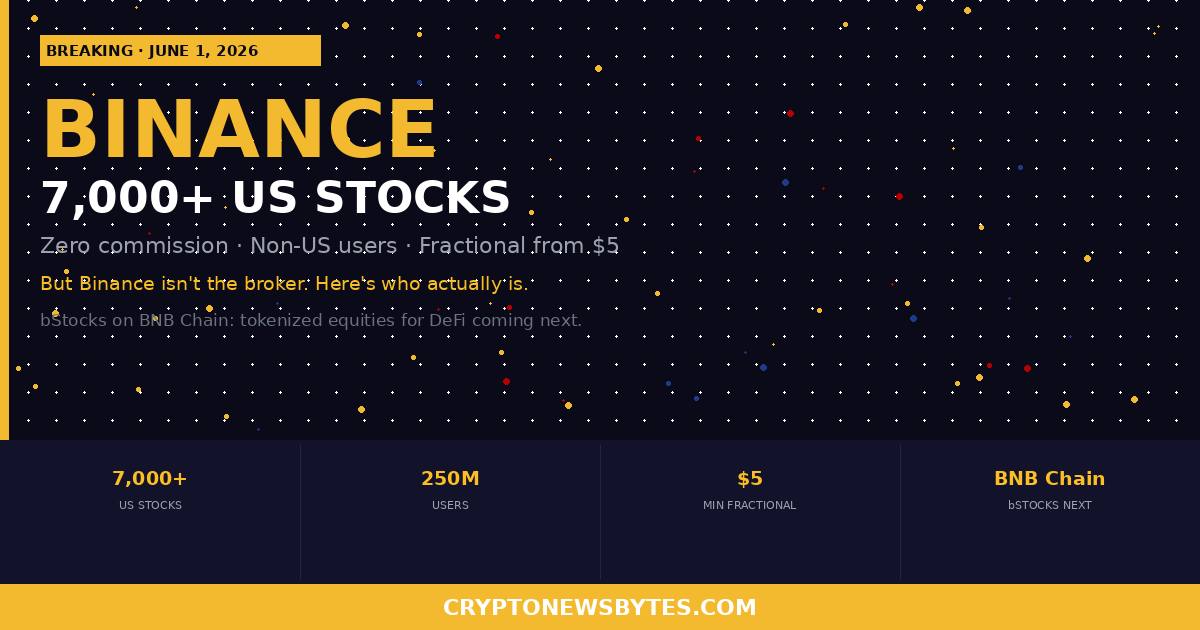
Binance launched zero-commission trading for more than 7,000 U.S. stocks and ETFs on June 1, 2026, opening access to non-U.S. users across its 250 million-strong global customer base. Users can buy fractional shares starting at $5, fund purchases with USDC, USDT, or BNB, and trade within the Binance app without leaving for a separate brokerage. Co-CEO Richard Teng called it part of Binance’s push to become a “multi-asset financial super app.”
The headline is real. But the structure behind it is the part worth understanding. Binance is not the broker. It is not executing your trades, holding your shares, or processing your dividends. It is the front end. Every stock order placed on Binance goes to Abu Dhabi-regulated Nest Trading, which acts as the actual broker-dealer routing and executing orders. New York-based Alpaca handles custody, dividend payments, and corporate actions. Binance provides the 250 million users. The two partners provide the regulated financial infrastructure.
The Infrastructure Stack: Who Actually Does What
Understanding the partnership structure is essential for any user thinking about how this differs from opening a brokerage account. Nest Trading is regulated by Abu Dhabi’s financial authority and acts as the licensed broker-dealer, meaning it is the entity legally responsible for routing your order to U.S. exchanges and executing it. Alpaca, the New York-based fintech, provides the custody layer: it holds the shares in your name, processes dividend payments when companies distribute them, and handles corporate actions like stock splits and rights offerings.
Binance’s role is distribution and UI. It provides the account, the wallet integration, the stablecoin funding rails, and the interface. This is not a criticism of the model. It is actually the correct way to build regulated financial infrastructure when you are a crypto exchange that is barred from U.S. operations and operating under a global compliance framework that varies by jurisdiction. Partnering with regulated specialists rather than trying to become a licensed broker in every country is faster and legally cleaner. But users should understand that “Binance stock trading” involves three separate companies, two of which most users have never heard of.
Why This Launch Is Happening Now
Richard Teng’s “super app” framing is deliberate. Crypto exchanges are in a race to capture wallet share that goes beyond crypto. Robinhood moved in the opposite direction, adding crypto to a stock platform. Binance is now moving to add stocks to a crypto platform. The end state both companies are targeting is the same: a single app where users hold, trade, earn yield on, and transfer every financial asset they own, denominated in whatever currency they prefer.
For non-U.S. users specifically, the access problem Teng describes is real. U.S. equities represent over half of global stock market capitalization, but for investors in Southeast Asia, the Middle East, Africa, and Latin America, buying an S&P 500 ETF or a share of NVIDIA involves international wire transfers, foreign brokerage accounts, currency conversion costs, and minimum deposit requirements that price out retail participants. Binance’s model uses stablecoins to eliminate the currency conversion layer entirely. You hold USDT, you buy fractional Apple stock, you receive dividends in USDT. No bank transfer. No conversion fee.
bStocks: The More Interesting Announcement Nobody Is Leading With
The stock trading launch is the news. The more consequential announcement is bStocks, coming within weeks. bStocks will allow users to convert their traditional equity holdings into tokenized securities directly on BNB Chain. The shares you bought through Binance’s stock trading service can be converted into on-chain digital tokens that can then be used in DeFi: as collateral for loans, as inputs to liquidity pools, as yield-generating assets in lending protocols. Programmable equity. Available 24 hours a day, 7 days a week, not just during NYSE and Nasdaq trading hours.
This is the convergence trade that every major institution has been talking about since BlackRock launched BUIDL in 2024. The idea that a share of Microsoft can settle on a blockchain in seconds, be pledged as DeFi collateral without a prime broker, earn lending yield overnight, and be returned to the holder by morning without a clearing house processing the settlement two days later. NYSE and Nasdaq are exploring the same direction. The difference is that Binance has 250 million users already on-platform and is moving in weeks, not years.
How Binance Stock Trading Actually Works
Three companies. One interface. | @cryptonewsbytes
Binance
App interface, accounts, wallet funding via USDC/USDT/BNB, 250M user distribution
Nest Trading (Abu Dhabi)
Licensed broker-dealer. Routes and executes all U.S. stock and ETF orders
Alpaca (New York)
Custody of shares, dividend processing, corporate actions (splits, rights)
Coming next: bStocks on BNB Chain
Convert traditional equities into tokenized on-chain assets. Use in DeFi for lending, collateral, and liquidity. Settle at blockchain speed. Trade 24/7.
Sources: Fortune exclusive, BanklessTimes, CryptoTimes, Binance official announcement | @cryptonewsbytes
What This Means for the Broader Market
The Binance launch is not an isolated event. It confirms what CryptoTimes described as “the dominant strategic pattern of 2026 among major crypto exchanges: every venue is becoming a brokerage, and every brokerage is becoming a tokenization platform.” Robinhood added crypto to stocks. Coinbase launched in India with direct INR rails today. Binance added stocks to crypto globally. The convergence is happening across all directions simultaneously.
For traditional brokerages, the competitive pressure is not theoretical. Charles Schwab, Fidelity, and Interactive Brokers charge non-U.S. users varying fees and have minimum deposit requirements that make them inaccessible to retail investors in emerging markets. Binance is offering zero commissions, $5 fractional minimums, and stablecoin funding to 250 million existing users. That is not a niche product. It is a direct assault on the international retail brokerage market, launched simultaneously in every non-U.S. jurisdiction where Binance operates.
Frequently Asked Questions
Can U.S. users access Binance stock trading?
No. The service is restricted to non-U.S. customers due to American securities regulations. Binance.US, the separate U.S.-facing entity, is not part of this launch. Users in the United States remain blocked from the new stock trading feature.
Who actually holds your shares when you buy stocks on Binance?
Alpaca, a New York-based fintech, acts as custodian and holds shares on behalf of users. Alpaca also processes dividend payments and handles corporate actions. Nest Trading, regulated in Abu Dhabi, executes the actual stock orders. Binance provides the interface and account infrastructure. This three-party structure is standard in embedded finance; it is how many fintech apps offer brokerage services without holding their own securities licenses.
What is bStocks and when does it launch?
bStocks is an upcoming feature that will allow users to convert their traditional equity holdings into tokenized securities on BNB Chain. According to Binance’s announcement, it will be available within weeks of the June 1 stock trading launch. Once converted, bStock tokens can be used in DeFi applications including lending, liquidity provision, and yield generation, enabling blockchain-speed settlement and 24/7 trading of what are currently exchange-hours-only instruments.
Binance Stock Launch: The Numbers Behind the Story
Data from Binance announcement, Fortune exclusive, June 1, 2026 | @cryptonewsbytes
1. Crypto exchange user base: who has the distribution
2. Binance three-company structure: who does what
3. US equities share of global stock market vs retail access friction
Sources: Fortune, BanklessTimes, CryptoTimes, Binance official announcement. Not financial advice. | @cryptonewsbytes
Further Reading
Same day Binance goes global with US stocks, Coinbase goes live in India with direct bank rails. The convergence is happening everywhere simultaneously.
JPMorgan tokenizing Treasuries on Ethereum. Binance tokenizing stocks on BNB Chain. Both heading to the same place from different directions.
The institutional tokenization race Binance just entered from the crypto side.
This article is for informational purposes only and does not constitute financial or investment advice. Sources: Fortune, BanklessTimes, CryptoTimes, CoinDesk. Published June 1, 2026.