
Key Points
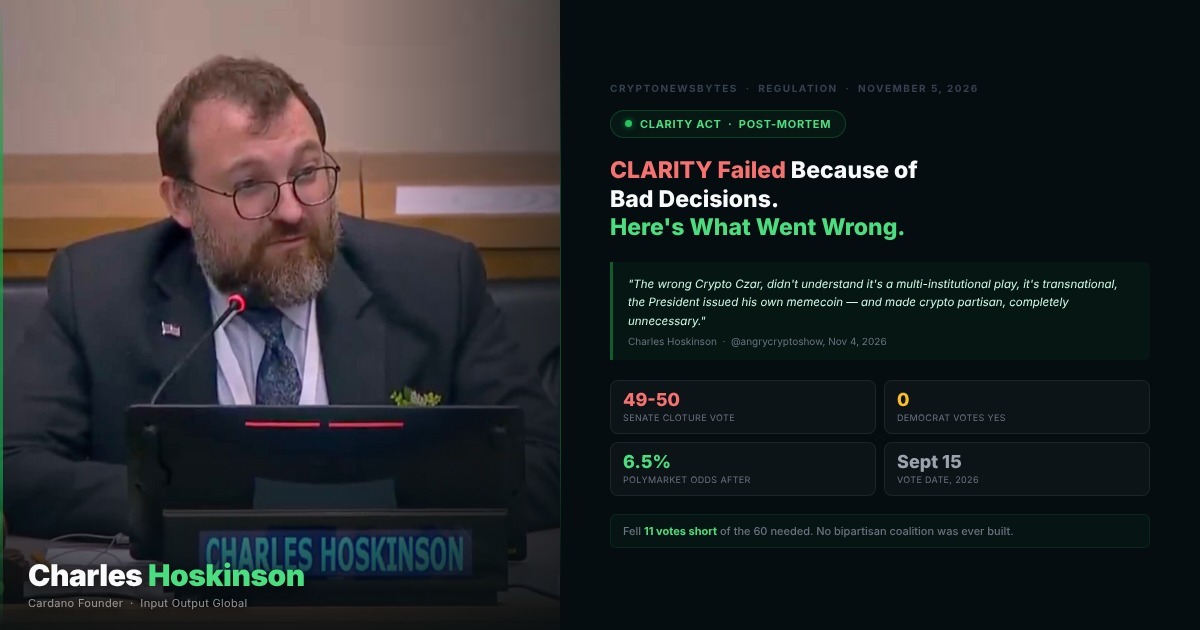
- Charles Hoskinson said CLARITY failed due to “a collection of bad decisions” — appointing the wrong Crypto Czar, failing to treat crypto as a multi-institutional and transnational framework, and the President issuing his own memecoin, which made the entire issue unnecessarily partisan.
- The Digital Asset Market Clarity Act was voted down 49-50 in the Senate on September 15, 2026, falling 11 votes short of the 60 needed to advance. All 49 yes votes came from Republicans. Not a single Democrat voted to proceed.
- David Sacks, Trump’s Crypto Czar, had already left the White House role in March 2026 after hitting the 130-day service limit for special government employees. CLARITY was left without its primary champion at the administration level during the critical final stretch.
- Hoskinson had predicted the bill’s failure before the vote in his Devs versus Builders livestream, arguing that memecoins and celebrity crypto tied to the administration had poisoned bipartisan support. After the vote he posted simply: “As predicted.”
- Polymarket cut odds of CLARITY becoming law this year from 29.5% to 6.5% after the Senate vote. After the November 4 midterms, the odds of any crypto legislation advancing this Congress have fallen further.
What Hoskinson Said
Speaking in an appearance clipped by the Angry Crypto Show on November 4, 2026, Hoskinson laid out what he sees as the chain of decisions that doomed the Digital Asset Market Clarity Act before it ever reached a floor vote that could actually pass.
“CLARITY failed because of a collection of bad decisions — the wrong Crypto Czar, they didn’t understand it’s a multi-institutional play, it’s transnational, the President issued his own memecoin — and made crypto partisan, completely unnecessary.”
Charles Hoskinson · via @angrycryptoshow, November 4, 2026
It is worth noting that Hoskinson had been making versions of this argument for months. Before the September 15 Senate vote, he said on his Devs versus Builders livestream that the industry had weakened its own political standing through memecoins and celebrity crypto tied to the administration. After the bill fell 49-50, he posted one line on X: “As predicted.”
Breaking Down the Four Arguments
1. The wrong Crypto Czar. David Sacks was appointed White House AI and Crypto Czar in late 2024. He was the administration’s main bridge between the White House and the crypto industry and the person most responsible for pushing CLARITY toward a Senate floor vote. He left the role in March 2026, after reaching the 130-day service limit for special government employees. His departure left the bill without its chief executive branch advocate during the months before the September vote. Hoskinson had called for Sacks to resign before the vote — not because he disliked him personally but because, he argued, the results simply were not there: falling prices, no major legislative wins, and no regulatory clarity after a year of promises.
2. Failing to treat it as a multi-institutional play. Hoskinson’s consistent critique of US crypto legislation is that it treats regulation as a single-agency project when the actual infrastructure is spread across dozens of types of institutions — banks, exchanges, custodians, protocols, stablecoin issuers, DeFi platforms — each with different risk profiles and different regulatory needs. CLARITY tried to address most of this in one bill. His view is that you have to build consensus across all those stakeholders before writing the law, not while it is on the Senate floor.
3. It is transnational. Hoskinson has argued repeatedly that there is no such thing as “American crypto” at the protocol level — only American crypto companies. The EU’s MiCA framework, Japan’s FSA rules, the Abu Dhabi Global Market’s regime, and others already exist and are functioning. His argument is that US legislators drafted CLARITY largely without studying how those frameworks interact with domestic markets, leaving interoperability and international business unresolved. That made the bill harder to sell to Democrats who wanted to know how it compared to international standards.
4. The memecoin made it partisan. This is the most direct critique. The Trump memecoin, launched in January 2025 days before the inauguration, generated hundreds of millions of dollars in fees for entities connected to the President and his family. It became a recurring talking point for Democrats — most prominently Elizabeth Warren — who argued it was impossible to write neutral crypto rules while the President was personally profiting from the absence of them. Hoskinson’s point is not that the memecoin was necessarily illegal, but that it was a political own-goal that handed opponents a reason to vote no that had nothing to do with the bill’s merits. Zero Democrats voted to advance CLARITY on September 15. Eleven Republican votes short of 60. The math of making a partisan issue bipartisan does not work.
What the Vote Looked Like
On September 15, 2026, the Senate voted on cloture — the procedural step needed to bring the bill to a full floor debate and vote. The result was 49-50. Every yes vote came from a Republican. Zero Democrats crossed over. Four Republicans — Susan Collins, Josh Hawley, Jerry Moran, and Thom Tillis — voted no, though Tillis filed a motion to reconsider within a minute of the result, preserving a procedural path to retry. The bill needed 60. It got 49. That is not a close vote on the substance; it is a structural failure to build any bipartisan coalition at all.
CLARITY Act — Key Timeline
| Date | Event |
|---|---|
| Jan 2025 | Trump memecoin launched days before inauguration. Democrats cite conflict of interest throughout the legislative process. |
| Late 2024 | David Sacks named White House AI and Crypto Czar. Signals CLARITY Act markup in January 2025. |
| Mar 2026 | Sacks hits 130-day service limit, departs White House role. No replacement named. CLARITY loses its chief executive champion. |
| Sep 2026 | Hoskinson predicts CLARITY failure on Devs versus Builders livestream. Bill made 126 concessions and still had no Democratic support. |
| Sep 15, 2026 | Senate votes 49-50. CLARITY fails cloture. Zero Democrats vote yes. Polymarket odds fall from 29.5% to 6.5%. |
| Sep 15, 2026 | Hoskinson posts “As predicted” on X. |
| Nov 4, 2026 | Hoskinson gives full post-mortem: wrong Crypto Czar, multi-institutional play missed, transnational nature ignored, memecoin made it partisan. |
What Comes Next
Senator Tillis’s motion to reconsider preserves a narrow procedural path to retry, but no vote has been scheduled. With the November 4 midterms now concluded, the composition of the next Congress will determine whether a new attempt at crypto legislation can be built from scratch with the kind of bipartisan groundwork Hoskinson says the first attempt skipped. His prescription has been consistent throughout: separate the bill into its component parts — stablecoins, digital securities, commodities, custody, DeFi — and build consensus issue by issue rather than in one comprehensive push. Whether that approach gets traction in the new Congress remains to be seen.
Frequently Asked Questions
What was the CLARITY Act?
The Digital Asset Market Clarity Act (H.R. 3633) was the main Republican-led attempt to create a comprehensive regulatory framework for digital assets in the US. It aimed to establish clearer jurisdictional lines between the CFTC and the SEC, define which digital assets are commodities vs. securities, and set rules for exchanges, custodians, and stablecoin issuers. After more than 126 amendments and months of negotiations, it still failed to attract a single Democratic vote in the Senate.
Why did zero Democrats vote for it?
Democrats consistently cited concerns about crypto activities involving administration members — specifically the Trump memecoin and family crypto ventures — as making it impossible to write neutral rules while the President was personally profiting from regulatory uncertainty. Beyond the conflict-of-interest argument, Democrats also raised concerns about consumer protections, stablecoin reserve requirements, and the speed of the process. No bipartisan consensus was built before the bill went to the floor.
Is CLARITY completely dead?
Not technically. Senator Tillis filed a motion to reconsider immediately after the vote, preserving a procedural path. But with no Democratic support and four Republicans having voted no, a retry under the current Congress faces the same math. The more likely path is a new bill in the next Congress, potentially split into separate components as Hoskinson and others have suggested.
What is Hoskinson’s alternative?
He has argued that the US should study existing international frameworks — the EU’s MiCA, Japan’s FSA rules, the Abu Dhabi Global Market’s regime — rather than writing from scratch. He wants crypto treated as a transnational, multi-institutional issue that requires coordination across jurisdictions, not a domestic policy fight. And he wants the bill split: stablecoins first, then digital securities, then commodities, then DeFi — building bipartisan consensus at each step rather than attempting one comprehensive law.
Does Hoskinson have a stake in this?
Yes. Hoskinson is the founder of Cardano and Input Output Global, and has been one of the most vocal crypto founders in US policy debates. He has met with lawmakers, testified before congressional committees, and publicly backed — and criticized — various versions of crypto legislation. His critics, some of whom appeared in the replies to the November 4 clip, noted that he has at times tried to build relationships with the same administration he is now criticizing, and that Cardano’s ADA token is itself a speculative asset.
Further Reading
What US regulators managed to approve even as the broader legislative push stalled.
State-level enforcement has been unwinding even as federal legislation failed to advance.
Published November 5, 2026