
- House Democrats are discussing a broader bill that would expand Maxine Waters’ proposal and give the SEC more oversight.
- Stand With Crypto endorsed 45 candidates with 27 wins 12 losses and six races still live.
- Analysts said the Clarity Act is harder to pass now but is not considered finished.
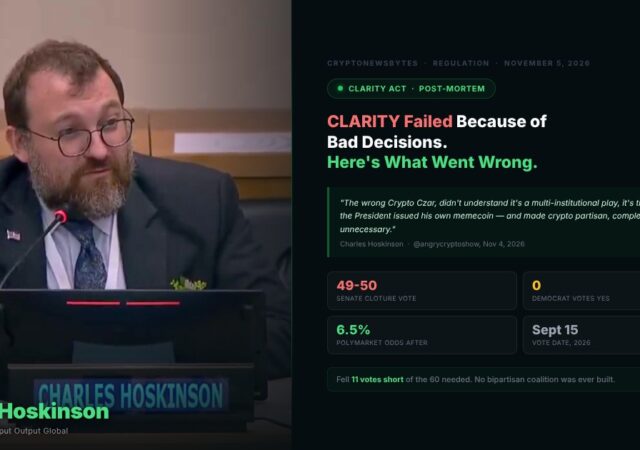
House Democrats are reportedly preparing to move forward on crypto legislation after sweeping the U.S. midterms, with discussions focused on a broader crypto market bill for the next Congress. The reported plan would expand the Crypto Investor Consumer Bill of Rights, a 2025 amendment to the Clarity Act led by Maxine Waters, into wider market structure legislation. Sources cited by journalist Eleanor Terrett said the proposal would give the SEC more authority to supervise crypto markets while limiting the CFTC’s role. Analysts and advocacy groups also pointed to a shifting political picture, as candidates backed by crypto-focused groups won races across both parties even while the Clarity Act appeared to face a tougher path.
Democrats discuss crypto market bill plans
House Democrats are reportedly considering an expansion of the Crypto Investor Consumer Bill of Rights into a broader crypto market bill. The idea would take Maxine Waters’ amendment to the Clarity Act and turn it into a larger market structure proposal for the next Congress.
According to sources cited by Eleanor Terrett, the reported proposal would increase SEC oversight of crypto markets and reduce the CFTC’s role. That would place more of the market structure debate under the SEC while incorporating Democratic priorities into a broader legislative framework.
Midterm results change the crypto debate
At first glance, the midterm result looked like a setback for crypto policy because President Donald Trump’s Republican administration had been widely seen as the more pro-crypto side, while Democrats were often viewed as more skeptical. Even so, experts told Decrypt that crypto policy may be becoming a more bipartisan issue.
Stand With Crypto said it endorsed 45 candidates in the midterms. Its election tracker showed 27 wins, 12 losses, and six races still live at the time of writing. Nearly half of those endorsed candidates were Democrats, and executive director Mason Lynaugh said the group was proud that a majority of its picks won their elections.
Crypto market bill meets a harder Clarity path
James Butterfill, head of research at CoinShares, described the loss of Republican Bryan Steil as a meaningful setback for crypto policy. Steil had chaired the House digital assets subcommittee and had been closely involved in efforts to move the Clarity Act forward before it stalled in the Senate earlier in the year.
Butterfill also pointed to winners including Democrats Chris Pappas of New Hampshire and James Talarico of Texas, along with Wyoming Republican Harriet Hageman, as lawmakers who have supported crypto policy. He said the central challenge now is turning that support into legislation, especially as the route for the Clarity Act has become more difficult.
Carlos Guzman, vice president of research at GSR, said it is not game over for the Clarity Act, but passing it has become tougher. He said some Democrats support clearer crypto rules, though he would not expect the issue to rank high on their agenda, and he added that any deal would likely need stronger consumer protection and conflict-of-interest provisions.
Crypto market bill and agency oversight
Democrats have pushed back on the Clarity Act in part because of concerns around Trump’s crypto conflicts of interest. Senator Elizabeth Warren has argued that the bill should prevent officials and their families from profiting from the sector, adding another point of friction in the debate over digital asset legislation.
Guzman said the election does not automatically replace SEC or CFTC leadership or stop those agencies from continuing their rulemaking. However, he said congressional oversight does change after an election, which could mean more scrutiny of regulatory decisions as Democrats also influence agency funding and future appointments.
Butterfill added that crypto may be becoming less dependent on the Clarity Act because the SEC and CFTC are already pushing for more regulatory clarity without waiting for Congress. He also said AI regulation may pull attention away from crypto policy, potentially slowing progress even if a crypto market bill remains under discussion.
Conclusion
The reported Democratic push for a broader crypto market bill suggests that U.S. crypto legislation may now develop through a different path than many expected before the midterms. Instead of relying only on the Clarity Act, House Democrats are said to be considering a market structure approach built from Maxine Waters’ earlier amendment and centered on stronger SEC oversight. At the same time, election results showed that support for crypto policy is not limited to one party, with endorsed candidates winning on both sides. Analysts still see a tougher road ahead for the Clarity Act, but they do not consider the effort finished as oversight, funding, and future appointments remain important.
Disclaimer
The information provided in this article is for informational purposes only and should not be considered financial advice. The article does not offer sufficient information to make investment decisions, nor does it constitute an offer, recommendation, or solicitation to buy or sell any financial instrument. The content is opinion of the author and does not reflect any view or suggestion or any kind of advise from CryptoNewsBytes.com. The author declares he does not hold any of the above mentioned tokens or received any incentive from any company.
Featured image created by AI