Key Points
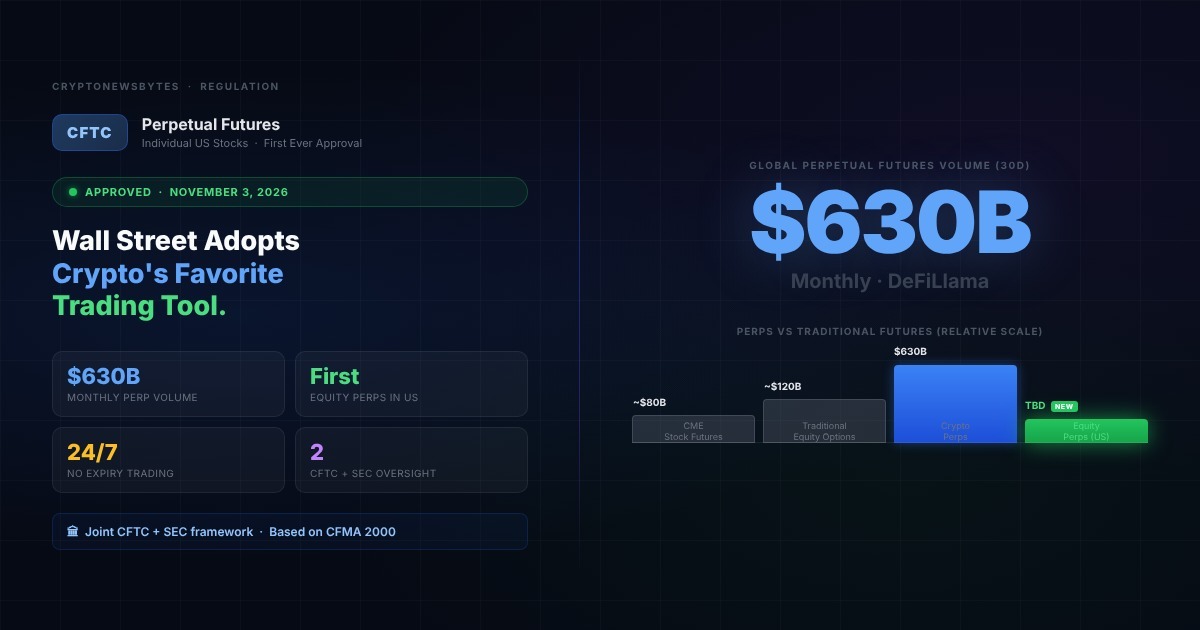
- The CFTC approved perpetual futures on individual US stocks on November 3, 2026, the first time equity perps have been cleared for regulated US exchanges. Both the CFTC and SEC will oversee the contracts under a coordinated framework.
- Perpetual futures have no expiration date. Instead of rolling contracts, longs and shorts exchange periodic funding payments to keep the contract price anchored to spot. The product was invented by crypto exchanges and now does over $630 billion in monthly trading volume globally.
- CFTC Chairman Michael Selig framed the move as pulling Americans away from “offshore, and often unregulated, venues.” President Trump said in August he wanted the CFTC to bring platforms like Hyperliquid inside US rules. SEC Chairman Paul Atkins had previously called security futures an area of regulatory “no man’s land.”
- No launch date has been set and no specific stocks or exchanges have been named in the approval. Exchanges must hold both a CFTC designated contract market registration and an SEC notice registration for security futures. Coinbase, Kalshi, and Kraken are reported to be racing to list first.
- CME Group sued the CFTC in June over its earlier bitcoin perp approval, arguing funding-rate contracts are swaps under Dodd-Frank, not futures. That case is still pending and could affect equity perps too.
What a Perpetual Future Actually Is
A standard futures contract has an expiry date. When it expires, traders either settle in cash or roll into the next contract, paying a spread each time. A perpetual future has no expiry. It never settles unless the trader closes it. The mechanism that keeps the contract price in line with spot is a funding rate: if longs are paying more than shorts, the contract price is drifting above spot, and longs pay a periodic fee to shorts to bring it back. If shorts dominate, the direction reverses. This simple mechanism, invented by crypto exchanges over a decade ago, is now the dominant derivatives product in global markets by volume.
For traders, the benefits are real: no roll costs, continuous exposure, no gap risk at expiry, and the ability to trade around the clock. For traditional risk managers, the absence of a settlement horizon makes hedging more complex, margin requirements harder to model, and systemic exposure harder to calculate across a portfolio.
Perps vs Traditional Futures
| Traditional Futures | Perpetual Futures | |
|---|---|---|
| Expiry | Fixed date (monthly/quarterly) | None |
| Price anchor | Convergence at expiry | Funding rate (periodic) |
| Roll cost | Yes (bid-ask spread each roll) | No rolling needed |
| Trading hours | Exchange hours | 24/7 (on crypto venues) |
| Origin | Traditional finance (CME, CBOT) | Crypto (BitMEX, 2016) |
How We Got Here
The path to equity perps in the US ran through bitcoin. In May 2026, the CFTC approved the first bitcoin perpetual futures contract on a regulated US exchange, with Kalshi’s BTCPERP going first. Kalshi later added gold and silver perps. In June, the CFTC requested public comment on crude oil perpetuals and 24/7 trading more broadly.
The political tailwind matters. In August 2026, President Trump publicly said he wanted the CFTC to bring Hyperliquid, the dominant offshore perp exchange by volume, inside US regulatory rules. Intercontinental Exchange, the parent of the NYSE, invested in tradeXYZ, a perpetual futures platform built on the Hyperliquid network, signaling that traditional market infrastructure was moving toward the product.
The regulatory blocker for equity specifically was jurisdiction. Stock-linked derivatives sit at the boundary between the CFTC (commodities and futures) and the SEC (securities). The Commodity Futures Modernization Act of 2000 created a framework for security futures products, but it was never used for perpetuals. Today’s approval relies on that same 2000 framework, with both agencies agreeing to coordinate oversight.
“This marks a significant step towards allowing US market participants to access these products, consistent with applicable law, rather than turning to offshore, and often unregulated, venues.”
CFTC Chairman Michael Selig · November 3, 2026
The Complication: CME’s Pending Lawsuit
CME Group, the world’s largest derivatives exchange, sued the CFTC in June 2026 over the Kalshi bitcoin perp approval. CME’s argument: a contract where longs and shorts exchange funding payments is a swap under the Dodd-Frank Act, not a futures contract. Swaps face stricter rules and clearing requirements. If CME wins, all CFTC-approved perps, including today’s equity approvals, could face a legal challenge. The case is still pending and no ruling has been issued.
The SEC’s involvement in equity perps may also draw objections from securities-side participants who see funding-rate contracts as incompatible with existing securities market structure rules. Neither agency has addressed this publicly beyond today’s joint framework announcement.
What This Means for Crypto
Perpetual futures were invented by crypto. BitMEX launched the first perp in 2016. The product is now the highest-volume derivatives instrument in global finance, with over $630 billion traded in the past month alone. The approval that just happened is traditional finance formally borrowing a crypto-native tool and bringing it into regulated markets for stocks.
For exchanges like Coinbase, which already runs a perp business offshore and received no-action relief to route US clients there, this opens a path to doing it onshore with full regulatory standing. Kalshi, which listed the first US bitcoin perp, and Kraken are also reported to be working on equity perp listings.
Frequently Asked Questions
What is a perpetual future?
A futures contract with no expiry date. Traders can hold it indefinitely. A funding rate mechanism keeps the contract price close to the spot price by transferring periodic payments between longs and shorts depending on which side is more dominant. The product was invented by the crypto exchange BitMEX in 2016 and is now the world’s most-traded derivatives product by volume.
When can I trade stock perps in the US?
The CFTC has approved the framework but set no launch date. No exchange has announced which stocks will be available or when trading opens. Exchanges need both CFTC and SEC registrations to list the products. Coinbase, Kalshi, and Kraken are reported to be preparing to list, but no dates have been confirmed.
Why did this take so long?
Stock-linked derivatives straddle two regulators. The CFTC oversees futures and commodities; the SEC oversees securities. Equity perps sit in both jurisdictions simultaneously. SEC Chairman Atkins described security futures as a regulatory “no man’s land.” Today’s approval uses the Commodity Futures Modernization Act of 2000 framework, with both agencies agreeing to jointly oversee the products.
Could CME’s lawsuit block this?
Potentially. CME sued the CFTC in June 2026 arguing that funding-rate contracts are swaps, not futures, under Dodd-Frank. If a court agrees, CFTC-approved perps including equity perps could face a legal challenge or be forced to restructure. The case has not been decided. Exchanges will likely proceed cautiously pending the outcome.
What does this mean for Hyperliquid?
Hyperliquid is the dominant offshore perp exchange by volume and has operated outside US regulation. President Trump said in August he wanted the CFTC to bring Hyperliquid under US rules. Intercontinental Exchange, parent of the NYSE, invested in tradeXYZ, a perpetual futures platform built on Hyperliquid. Today’s approval creates a path for that to happen through CFTC-regulated exchanges, rather than forcing US users to go offshore.
Further Reading
The same regulatory shift that cleared the staking cases is now clearing the path for equity perps. California, Maryland and Wisconsin are next.
The hack that forced global crypto into compliance conversations is now a chapter in why the US brought its biggest exchanges back onshore.
Published November 3, 2026