A Complete Pi Coin vs BTC Comparison — Mining, Scarcity, Energy Efficiency, Consensus Technology, and Investment Potential
Updated: February 2026
Pi Network vs Bitcoin: The Definitive 2026 Comparison Guide
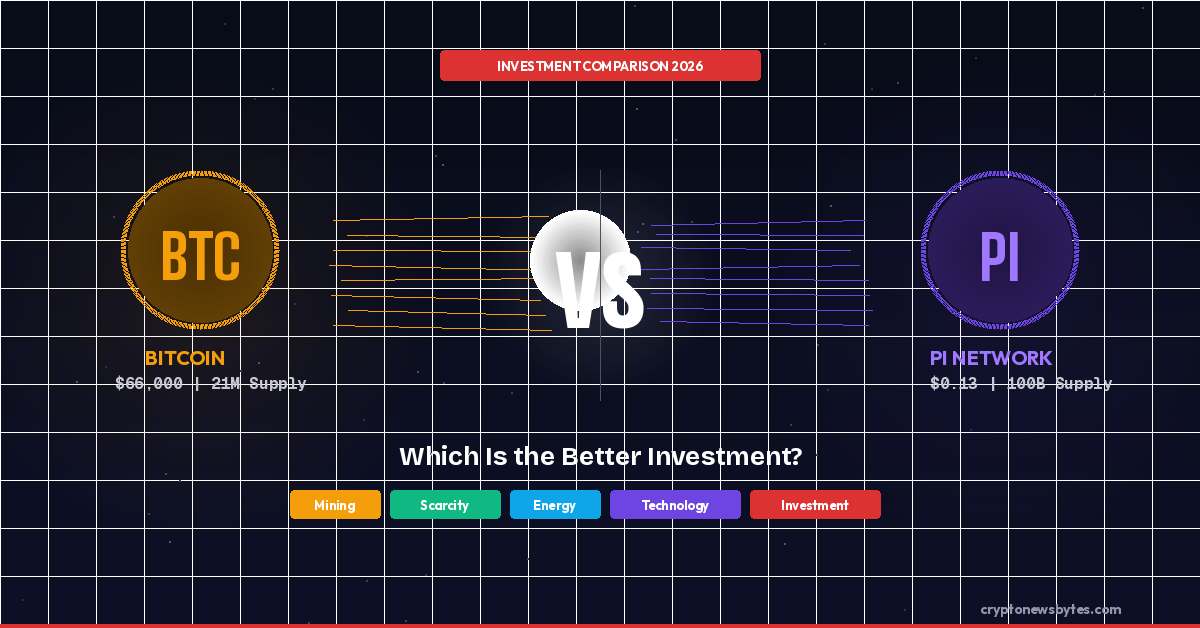
The cryptocurrency market in 2026 is a tale of two vastly different worlds. On one side sits Bitcoin, the undisputed king of digital assets, which peaked above $126,000 in October 2025 before entering a sharp correction that has brought it down to the $66,000-$70,000 range by mid-February 2026 — a decline of roughly 47% from its all-time high. On the other side stands Pi Network, which launched its Open Mainnet on February 20, 2025, hit an ATH of $2.99 within days, and has since plummeted over 95% to approximately $0.13.
For anyone searching ‘Pi Network vs Bitcoin‘ or ‘Pi coin vs BTC comparison‘, the goal is usually to answer one critical question: which of these two cryptocurrencies deserves your attention, your time, and potentially your money? This is a legitimate question, and it deserves a thorough, data-backed answer rather than hype-driven speculation.
This article provides an exhaustive comparison across every dimension that matters: technology, mining, energy efficiency, scarcity, market performance, institutional adoption, use cases, and investment potential. Whether you are a complete beginner asking ‘Pi Network vs Bitcoin for beginners‘ or a seasoned investor weighing ‘Bitcoin vs Pi Network investment‘ allocations, this guide will give you the information you need.
For additional context on Pi Network’s price trajectory since mainnet, our companion article on Pi Network price prediction 2024-2030 provides detailed forecasts and analysis.
Pi Network vs Bitcoin at a Glance: Side-by-Side Comparison
Before we dive into the detailed analysis, here is a comprehensive side-by-side snapshot of both cryptocurrencies as of February 2026. This table alone answers many of the most common Pi coin vs BTC comparison questions:
| Feature | Bitcoin (BTC) | Pi Network (PI) |
| Launch Year | 2009 | 2019 (Mainnet Feb 2025) |
| Creator | Satoshi Nakamoto | Stanford PhDs (Kokkalis, Fan) |
| Consensus Mechanism | Proof of Work (PoW) | Stellar Consensus Protocol (SCP) |
| Max Supply | 21 million | 100 billion |
| Circulating Supply | ~19.8 million | ~9 billion |
| Price (Feb 2026) | ~$66,000 | ~$0.13 |
| Market Cap | ~$1.3 trillion | ~$1.2 billion |
| ATH Price | $126,000+ (Oct 2025) | $2.99 (Feb 2025) |
| Mining Method | ASIC hardware rigs | Mobile phone app |
| Energy Usage | ~173 TWh/year | Minimal (phone battery) |
| Smart Contracts | No (via L2s like Stacks) | Yes (native) |
| Transaction Speed | ~10 min per block | ~5 seconds |
| Transaction Cost | $1-$50+ (variable) | Near zero (fractions of a cent) |
| TPS Capacity | ~7 TPS | ~70+ TPS (theoretical) |
| Exchange Listings | All major exchanges | OKX, Bitget, MEXC |
| Institutional Adoption | ETFs, corporate treasuries | None currently |
| Regulatory Status | Recognized commodity (US) | Unclassified |
The Origin Story: How Bitcoin and Pi Network Were Born
Bitcoin was created in 2008 when an anonymous person or group using the pseudonym Satoshi Nakamoto published the now-legendary white paper titled ‘Bitcoin: A Peer-to-Peer Electronic Cash System.’ The Bitcoin network went live on January 3, 2009, when Nakamoto mined the genesis block. Bitcoin was born from the 2008 financial crisis, designed as a trustless, decentralized alternative to the banking system. Over 16 years later, it has grown from a niche experiment among cryptography enthusiasts to a $1.3 trillion asset class with spot ETFs, corporate treasuries, and sovereign interest.
Pi Network was founded in 2019 by Dr. Nicolas Kokkalis and Dr. Chengdiao Fan, both Stanford University PhDs. Their vision was different from Bitcoin’s: rather than creating a deflationary store of value, they wanted to build a cryptocurrency that ordinary people could mine from their phones without expensive hardware or electricity costs. The app-based mining attracted tens of millions of users during its enclosed mainnet phase (2019-2025). The Open Mainnet launched on February 20, 2025, at 8:00 AM UTC, enabling real trading for the first time. Our analysis of Pi Network’s roadmap delays documents the long journey to that launch.
The philosophical difference is fundamental. Bitcoin was designed to be hard money — scarce, deflationary, and resistant to censorship. Pi Network was designed to be accessible money — inclusive, low-barrier, and community-driven. These different founding visions explain virtually every difference between the two projects.
Pi Network Consensus vs Bitcoin Proof of Work: A Technical Deep Dive
The consensus mechanism is the heart of any blockchain. It determines how transactions are validated, how new blocks are created, and ultimately how secure the network is. The Pi Network consensus vs Bitcoin Proof of Work comparison reveals fundamentally different design philosophies.
How Bitcoin’s Proof of Work Operates
Bitcoin’s Proof of Work (PoW) is the original and most battle-tested consensus mechanism in cryptocurrency. Here is how it works: miners around the world compete to solve a computationally intensive cryptographic puzzle. The puzzle involves finding a hash value that meets a specific difficulty target. The first miner to find a valid hash gets to add the next block of transactions to the blockchain and receives a block reward.
As of 2026, the block reward is 3.125 BTC following the April 2024 halving event. This reward is cut in half approximately every four years, which is the mechanism that enforces Bitcoin’s deflationary supply schedule. The difficulty of the puzzle adjusts every 2,016 blocks (roughly two weeks) to maintain an average block time of 10 minutes, regardless of how much computing power joins or leaves the network.
The security of PoW comes from its cost. To attack Bitcoin’s network (a ‘51% attack’), an adversary would need to control more than half of the network’s total hash rate. With the current hash rate exceeding 750 EH/s (exahashes per second), this would require billions of dollars in hardware and electricity, making such an attack economically irrational. This physical cost is what gives Bitcoin its security guarantee, and it is why institutions like BlackRock and Fidelity trust it with billions of dollars through Bitcoin ETFs.
How Pi Network’s Stellar Consensus Protocol Works
Pi Network uses a modified version of the Stellar Consensus Protocol (SCP), which is a Federated Byzantine Agreement (FBA) system. Instead of competing with computational power, nodes on the Pi network reach consensus through a voting process based on trust relationships.
Users create ‘Security Circles’ by selecting 3 to 5 trusted contacts from their network. These trust relationships collectively form a ‘Trust Graph’ that determines which nodes are considered reliable validators. The protocol reaches consensus when a sufficient number of trusted nodes agree on the state of the ledger. This process requires no significant computing power, which is what enables mobile phone mining.
The advantage of SCP is speed and efficiency: Pi can achieve consensus in approximately 5 seconds versus Bitcoin’s 10 minutes. The disadvantage is that the security model relies on social trust rather than physical cost. If a coordinated group of bad actors infiltrated enough Security Circles, they could theoretically compromise the consensus. However, the Stellar protocol that Pi derives from has operated reliably since 2015 without a major security incident.
Our earlier report on Pi Network scam alerts highlighted the importance of users understanding how to protect themselves within this trust-based system.
Consensus Comparison Verdict
Bitcoin’s PoW is objectively more secure and decentralized. It has been tested by nation-state-level adversaries and remained impregnable. Pi’s SCP is faster, cheaper, and more energy-efficient, but it is less proven and relies on centralized trust assumptions during its current development phase. For security-conscious investors, Bitcoin’s consensus is the clear winner. For users who prioritize speed and accessibility, Pi’s approach has genuine advantages.
Pros & Cons
| Pros & Cons | Bitcoin | Pi Network |
|---|---|---|
| Pros | Scarce, secure, trusted | Free mining, fast, eco-friendly |
| Cons | High energy, slow | Huge supply, risky, unproven |
🔥 Quick Verdict
| If you want… | Choose |
|---|---|
| Safety & stability | Bitcoin |
| Long-term store of value | Bitcoin |
| Free mining | Pi |
| High-risk/high-reward | Pi |
| Beginner onboarding | Pi |
| Institutional trust | Bitcoin |
Energy Efficiency: Bitcoin vs Pi Network — The Environmental Debate
Energy consumption is one of the most contentious topics in cryptocurrency, and it represents perhaps the starkest contrast in the Bitcoin vs Pi Network debate.
Bitcoin’s Energy Footprint: The Numbers
Bitcoin’s energy consumption is enormous by any measure. According to the Cambridge Bitcoin Electricity Consumption Index (CBECI), Bitcoin’s estimated annual electricity consumption reached approximately 173 TWh in 2025. The Digiconomist Bitcoin Energy Consumption Index estimates the figure at approximately 176 TWh, comparable to the annual electricity usage of countries like Poland or Argentina.
To put this in perspective: each Bitcoin transaction consumes an estimated 1,135,000 Wh of electricity. The network’s carbon footprint is estimated at roughly 98 million tonnes of CO2 annually. Bitcoin mining now accounts for approximately 0.7% of global CO2 emissions, and the International Monetary Fund has warned that US crypto and AI operations could consume 2% of global electricity by 2027.
However, the picture is evolving. As of 2025, over 52% of Bitcoin’s electricity comes from renewable sources, according to the Cambridge Centre for Alternative Finance. Major mining operations in Norway run on 99%+ renewables, and companies like Marathon Digital and Riot Platforms are actively investing in wind, solar, and flare gas capture. The counter-argument from Bitcoin maximalists is that mining actually incentivizes renewable energy development by providing a buyer of last resort for stranded energy assets.
Pi Network’s Minimal Energy Usage
Pi Network’s energy consumption is negligible by comparison. The ‘mining’ process on a smartphone is essentially a lightweight authentication action — pressing a button once every 24 hours to confirm you are an active participant. There is no continuous computation, no heat generation, and no significant battery drain. A Pi mining session consumes roughly the same energy as keeping a basic messaging app running in the background.
This makes Pi Network vastly more accessible in developing nations where electricity is expensive or unreliable. Users in sub-Saharan Africa, Southeast Asia, and South America can participate without any infrastructure requirements beyond a smartphone and basic internet connectivity. In terms of pure environmental impact, Pi Network is orders of magnitude cleaner than Bitcoin.
Energy Efficiency Verdict: Context Matters
Pi Network wins the energy efficiency comparison decisively. However, energy consumption alone does not determine a cryptocurrency’s value or quality. Bitcoin’s energy expenditure is the mechanism that provides its security guarantee. The massive cost of attacking the network is precisely what makes it trustworthy enough for trillion-dollar institutional adoption. Pi’s low-energy model trades physical security for accessibility — a valid trade-off for different use cases, but not an unambiguous improvement.
Pi Network vs Bitcoin Scarcity: The 21 Million vs 100 Billion Supply Debate
Scarcity is the single most important factor in Bitcoin’s value proposition, and it is where the Pi Network vs Bitcoin scarcity comparison reveals the most dramatic difference.
Bitcoin’s Mathematically Guaranteed Scarcity
Bitcoin’s 21 million hard cap is perhaps the most famous number in all of finance. There will never be more than 21 million BTC in existence — this is enforced by the protocol’s code and cannot be changed without consensus from the entire network. As of February 2026, approximately 19.8 million BTC have been mined, with the remaining 1.2 million to be released through progressively smaller block rewards until approximately 2140.
The 2024 halving reduced the block reward from 6.25 BTC to 3.125 BTC, cutting the rate of new supply by 50%. This programmatic scarcity, combined with growing demand from institutional investors, ETFs, and sovereign funds, is the foundation of Bitcoin’s ‘digital gold’ narrative. Our Bitcoin price prediction for 2026 explored how this supply dynamic supports long-term price appreciation.
Bitcoin’s scarcity is also enhanced by the estimated 3-4 million BTC that are permanently lost (forgotten wallets, lost keys, Satoshi’s unmoved coins), effectively reducing the available supply to roughly 16-17 million tokens.
Pi Network’s Abundant Supply Model
Pi Network has a maximum supply of 100 billion tokens — nearly 5,000 times Bitcoin’s cap. Of these, approximately 9 billion are currently in circulation, with the remaining 91 billion set to be released over time through mining rewards, ecosystem development funds, Foundation allocations, and community incentives.
This massive supply is the primary reason why PI cannot realistically reach price levels anywhere near Bitcoin’s. For PI to reach even $1 per token at current circulating supply, the market cap would need to exceed $9 billion. For PI to match Bitcoin’s current market cap of $1.3 trillion, each token would need to trade at approximately $144 — a scenario that would require Pi Network to become one of the most valuable financial assets on Earth.
The Pi team has implemented token lockup incentives to manage sell pressure, encouraging users to lock portions of their mined PI for 6 months to 3 years in exchange for higher mining rates. However, the fundamental tokenomics challenge remains: with 91 billion tokens still to be released, continuous dilution pressure will weigh on the price unless demand grows proportionally.
Scarcity Verdict
Bitcoin wins the scarcity comparison overwhelmingly. Its 21 million hard cap, combined with the halving mechanism and lost coins, makes it one of the scarcest assets in human history. Pi’s 100 billion supply is designed for mass distribution rather than value concentration. These are fundamentally different economic models: Bitcoin is designed to appreciate through scarcity, while Pi must generate massive utility and transaction volume to support meaningful per-token value.
Market Performance and Price History: Bitcoin vs Pi Network
Bitcoin’s 16-Year Track Record
Bitcoin has the longest and most impressive price history of any cryptocurrency. From effectively zero in 2009 to a peak above $126,000 in October 2025, BTC has delivered returns that dwarf every other asset class in history. Even including the current bear market correction to ~$66,000, anyone who bought Bitcoin before January 2024 is still in profit.
Bitcoin has survived and recovered from multiple devastating crashes: the 2011 crash from $32 to $2, the 2014 Mt. Gox collapse from $1,100 to $200, the 2018 crypto winter from $20,000 to $3,200, the 2022 crash from $69,000 to $15,500, and the current 2026 correction from $126,000 to $60,000. Each time, Bitcoin has recovered to new all-time highs. This resilience, combined with increasing institutional adoption through spot Bitcoin ETFs, gives long-term investors confidence in BTC’s staying power.
Pi Network’s Brief and Volatile History
Pi Network’s tradeable price history spans less than one year. The token launched on exchanges on February 20, 2025, quickly hit an ATH of $2.99 on February 27, 2025, driven by launch hype and limited initial sell-side liquidity. However, as token unlocks began flooding the market with new supply, the price collapsed rapidly.
By October 2025, PI had fallen to approximately $0.16. By February 2026, it hit an all-time low near $0.13. The 95%+ decline from ATH has shaken confidence among the Pi community, though supporters argue that this pattern is common for new token launches where early miners rush to sell. The question for PI holders is whether the token can find a bottom, build utility, and begin a recovery — or whether the ongoing token unlocks will suppress any meaningful price recovery for years.
Bitcoin vs Pi Network Investment: A Detailed Risk-Reward Analysis
This is the question at the heart of every ‘Bitcoin vs Pi Network investment‘ search query. Let us break down the investment case for each.
The Case for Investing in Bitcoin
Bitcoin is the most established, liquid, and institutionally-backed cryptocurrency in existence. The investment case rests on several pillars: finite supply of 21 million creating a deflationary asset, increasing institutional adoption through ETFs managed by BlackRock, Fidelity, and others, regulatory clarity with BTC classified as a commodity in the US, historical pattern of recovery from bear markets to new highs within 2-4 year cycles, and growing recognition as a hedge against monetary debasement.
The current price of ~$66,000, down 47% from ATH, represents what some analysts view as a buying opportunity within the typical four-year halving cycle. Steven McClurg of Canary Capital suggested BTC could fall as low as $50,000 during the summer before recovering, while other firms target $200,000+ by late 2026 or 2027. Our analysis of Bitcoin’s key support at $68K-$72K examined these critical price levels in detail.
The Case for Investing in Pi Network
Pi Network’s investment case is entirely speculative but not without merit. The bullish argument centers on: a massive user base of 60+ million (17.5M KYC-verified), which dwarfs most crypto projects; the possibility of tier-one exchange listings on Binance, Coinbase, or Kraken providing a liquidity catalyst; the potential for the ecosystem to develop real utility through 100+ dApps being built on the platform; and the extreme asymmetric upside — a move from $0.13 to just $1.30 represents a 10x gain.
The bearish case is equally compelling: 95% decline from ATH with no signs of bottoming, continuous token unlock pressure from 91 billion unmined tokens, absence of institutional interest, limited exchange availability, and no proven real-world use case at scale. For a thorough analysis of Pi’s price outlook, see our detailed Pi Network price prediction 2024-2030.
Growth Potential Comparison Table
| Metric | BTC Bull Case | BTC Bear Case | PI Bull Case | PI Bear Case |
| Current Price | ~$66,000 | ~$66,000 | ~$0.13 | ~$0.13 |
| End 2026 | $120,000 | $40,000 | $0.75 | $0.05 |
| 2027 Target | $200,000 | $50,000 | $1.50 | $0.08 |
| 2030 Target | $300,000+ | $80,000 | $5-$10 | $0.10 |
| Potential Return | 2-5x | -40% | 38-77x | -25% |
| Risk Level | Medium | Medium | Extreme | Extreme |
| Time Horizon | 2-4 years | 1-2 years | 3-5 years | 1-3 years |
Pi Network vs Bitcoin for Beginners: Your Complete Starting Guide
If you are new to cryptocurrency and searching for ‘Pi Network vs Bitcoin for beginners‘, here is a practical guide to getting started with each.
Starting with Bitcoin
Bitcoin is the best starting point for understanding cryptocurrency fundamentals. It introduced every foundational concept: blockchain, decentralization, mining, digital scarcity, private keys, and wallets. You can buy fractional amounts of BTC (called ‘satoshis’) on any major exchange — Coinbase, Binance, Kraken, or through approved spot ETFs in a standard brokerage account — for as little as $10. The ecosystem is mature with well-documented wallets (Ledger, Trezor for hardware; Electrum, BlueWallet for software), institutional custody options, and extensive educational resources.
For beginners, the simplest approach is to dollar-cost average (DCA) into Bitcoin: buy a fixed amount at regular intervals regardless of price. This strategy removes the pressure of trying to ‘time the market’ and has historically outperformed most active trading strategies over multi-year periods.
Starting with Pi Network
Pi Network is arguably more accessible in one specific way: you can start ‘mining’ for free using just your phone. Download the Pi Network app, create an account, complete KYC verification, and press the lightning bolt button once every 24 hours. There is zero financial risk and zero technical complexity. This is why Pi has attracted over 60 million users globally, many of whom had never interacted with cryptocurrency before.
However, new users should understand critical differences. Pi mining is not equivalent to Bitcoin mining — you are not performing computational work. You are participating in a network-building exercise. The tokens you mine have uncertain value and limited liquidity. The app experience is simple, but the path from mining PI to converting it to real money involves completing KYC, migrating tokens to mainnet, and finding a buyer on one of the limited exchanges that list PI.
For beginners, our recommendation is: learn about Bitcoin first to build your foundational understanding of crypto, then explore Pi Network if the community-driven, zero-cost mining model appeals to you. The two are complementary, not competing.
Should I Mine Pi or Buy Bitcoin? The Practical Answer
This question — ‘should I mine Pi or buy Bitcoin‘ — frames the decision as an either/or choice, but in reality, these are not competing activities.
Mining Pi costs nothing except a few seconds per day. There is no financial risk, no hardware requirement, and no electricity cost. If Pi Network succeeds in building a functioning economy and securing major exchange listings, those mined tokens could appreciate significantly. If the project fails, you have lost nothing but a few minutes of cumulative time.
Buying Bitcoin requires real capital. You are putting money at risk in a volatile market. However, you are buying the most liquid, most battle-tested, most institutionally-backed cryptocurrency in existence. Even after the current 47% drawdown from ATH, Bitcoin’s long-term trajectory has been consistently upward over every 4-year cycle in its history.
The optimal strategy is to do both. Mine Pi as a free speculative play with zero downside risk. Invest in Bitcoin (if you have capital to deploy) as a long-term store of value position. These strategies are complementary. The time you spend pressing a button on the Pi app does not prevent you from also investing in Bitcoin through an exchange or ETF. Our coverage of Mark Yusko’s Bitcoin insights offers additional perspective on long-term BTC investment thesis.
Technical Architecture: A Deeper Pi Coin vs BTC Comparison
Beyond price and investment considerations, the underlying technology reveals what each project is fundamentally trying to achieve. Here is a detailed technical comparison:
| Technical Feature | Bitcoin | Pi Network |
| Block Time | ~10 minutes | ~5 seconds |
| TPS (Transactions/sec) | ~7 TPS on-chain | ~70+ TPS (theoretical) |
| Transaction Cost | $1-$50+ (network-dependent) | Near zero (< $0.01) |
| Smart Contracts | Via L2s: Stacks, RSK, Lightning | Native support (Wasm-based) |
| Scripting Language | Bitcoin Script (limited) | Multiple (WebAssembly) |
| Node Requirements | Dedicated server/hardware | Smartphone or basic desktop |
| Protocol Upgrades | Conservative, slow BIPs | Agile, Core Team-managed |
| Layer-2 Solutions | Lightning Network, Liquid | Not yet developed |
| DApp Ecosystem | Growing via Ordinals, Stacks | 100+ dApps in development |
| Network Uptime | 99.99%+ since 2009 | < 1 year mainnet history |
Bitcoin’s conservative approach to upgrades is both its greatest strength and limitation. The protocol changes slowly and deliberately, which provides stability and predictability — essential qualities for a $1.3 trillion store of value. However, this means Bitcoin cannot natively support the smart contracts, fast transactions, or low fees that many use cases require. Solutions like the Lightning Network address some of these limitations, but add complexity.
Pi Network’s agile development cycle allows faster innovation and more expressive smart contract capabilities. Over 100 dApps are being built on the Pi platform, ranging from marketplaces to social applications. However, the centralized nature of the Core Team’s control over protocol decisions raises concerns about true decentralization. For a look at how Bitcoin’s technology is evolving, our article on Bitcoin Ordinals and traceable NFTs explores one of the most significant recent innovations.
Real-World Use Cases: How Bitcoin and Pi Network Are Actually Used
Bitcoin’s Established Use Cases
Bitcoin has evolved primarily into a store of value and investment asset, often called ‘digital gold.’ Its main use cases include: portfolio diversification and inflation hedging for both retail and institutional investors, cross-border remittances (particularly in corridors with expensive traditional services), a savings vehicle in countries with unstable currencies (Turkey, Argentina, Nigeria, Lebanon), corporate treasury reserves (Strategy/MicroStrategy holds 478,000+ BTC), and the foundation asset for the growing Bitcoin ETF market.
What Bitcoin is not commonly used for is everyday payments. Its 10-minute block time, variable transaction fees ($1-$50+), and limited throughput (~7 TPS) make it impractical for buying coffee or groceries. The Lightning Network partially addresses this, but adoption remains limited compared to traditional payment rails.
Pi Network’s Emerging Use Cases
Pi Network is attempting to build a peer-to-peer digital economy where users transact PI for goods and services. The Pi ecosystem includes a growing number of dApps, peer-to-peer marketplace features, and community-driven commerce. Some Pi community merchants have begun accepting PI for products, though this activity remains small-scale.
The key advantage Pi has is transaction speed (~5 seconds) and near-zero fees, which make it technically suitable for everyday payments. The challenge is adoption: merchants need confidence that PI has stable value before accepting it, and consumers need places to spend it. This chicken-and-egg problem is common to all new payment tokens, and Pi has not yet solved it at meaningful scale. The comparison with other community-driven tokens is instructive — our article on Dogecoin’s evolution in the crypto space shows how community alone is not sufficient for sustained value.
Is Pi Network Better Than Bitcoin? The Honest Answer
The answer to ‘is Pi Network better than Bitcoin‘ depends entirely on what you mean by ‘better.’
Bitcoin is better as: a store of value, an investment vehicle, a hedge against inflation, an institutionally-adopted asset, a secure and decentralized network, and a proven long-term performer. In these dimensions, no cryptocurrency — let alone one trading at $0.13 after a 95% decline — can credibly claim superiority over Bitcoin.
Pi Network is better for: accessibility and inclusivity (anyone with a phone can participate), energy efficiency (negligible environmental impact), transaction speed and cost (5 seconds, near-zero fees), native smart contract capabilities, and as a zero-cost entry point into cryptocurrency for beginners in developing nations.
The two projects serve fundamentally different purposes. Bitcoin is digital gold — a scarce, hard asset designed to preserve and grow wealth over time. Pi Network is attempting to be digital cash for the masses — an inclusive, fast, cheap medium of exchange. Historically, both gold and cash have essential roles in an economy. The question is not which is ‘better,’ but which role each can credibly fill.
Which Crypto Is Better to Buy: Pi or Bitcoin?
For the majority of investors, Bitcoin is the more rational purchase. It has institutional backing through spot ETFs from BlackRock, Fidelity, Invesco, and others. It has survived and recovered from every major crash in its 16-year history. It has the deepest liquidity and widest exchange availability of any cryptocurrency. As our analysis of Bitcoin ETF outflow patterns demonstrated, even during sell-offs, institutional infrastructure provides structural price support.
Pi Network could merit a small speculative allocation if you understand and accept the risks: the token may never recover, the project may fail to deliver utility, and the massive token unlocks could suppress price for years. But the zero-cost mining option means you can accumulate PI without risking a single dollar.
The balanced approach: Invest in Bitcoin as your core cryptocurrency holding (appropriate percentage depends on your overall portfolio and risk tolerance). Mine Pi Network on the side as a free option on the project’s success. This gives you exposure to Bitcoin’s proven track record while maintaining optionality on Pi’s speculative upside. Never invest money in PI that you cannot afford to lose entirely.
Pi Network vs Bitcoin Potential: Where Could Each Go?
Bitcoin’s potential is more constrained in percentage terms because of its already-massive $1.3 trillion market cap. A 3x move to $200,000 would require an additional $2.6 trillion of market value — achievable within a halving cycle, but representing ‘merely’ a 3x return from current prices. The long-term upside to $300,000-$500,000 represents 5-8x, which is exceptional for an established asset but modest compared to early-stage altcoins.
Pi Network’s potential is dramatically higher in percentage terms. From $0.13, a move to $1.30 (10x) requires only a $12 billion market cap — well within the range of established altcoins like Cardano or Avalanche. A move to $5 (38x) would require roughly $45 billion, comparable to Dogecoin’s peak market cap. These are aggressive but not impossible targets if the project delivers. However, the downside risk is equally extreme: PI could decline to near zero if the ecosystem fails to materialize.
The risk-reward profile is fundamentally different: Bitcoin offers moderate upside with relatively moderate downside risk. Pi offers extreme upside potential with equally extreme downside risk. Your allocation should reflect your personal risk tolerance and investment horizon.
Frequently Asked Questions: Pi Network vs Bitcoin
Is Pi Network better than Bitcoin?
Not as a store of value, investment, or proven cryptocurrency. Bitcoin has 16+ years of track record, a $1.3 trillion market cap, institutional ETF adoption, and unmatched security. Pi Network is better for accessibility, energy efficiency, and transaction speed, but it is an unproven project trading at $0.13 after a 95% decline.
Which crypto is better to buy, Pi or Bitcoin?
For most investors, Bitcoin is the safer and more rational choice due to its proven track record, deep liquidity, and institutional backing. Pi can be mined for free with zero financial risk. The best strategy is to do both: invest in BTC as a core holding and mine PI as a free speculative position.
Should I mine Pi or buy Bitcoin?
Both. Mining Pi is free and takes seconds per day, requiring no financial investment. Buying Bitcoin requires capital but gives exposure to the most established cryptocurrency. These are complementary strategies: mine PI for asymmetric speculative upside, invest in BTC for long-term value appreciation.
How does Pi Network consensus compare to Bitcoin Proof of Work?
Bitcoin uses Proof of Work (PoW), requiring massive computational power and ~173 TWh of electricity annually. Pi uses a Stellar Consensus Protocol variant, relying on trust relationships between users with minimal energy usage. Bitcoin’s PoW is more battle-tested and physically secure. Pi’s SCP is faster (5 seconds vs 10 minutes) and more energy-efficient.
What about energy efficiency: Bitcoin vs Pi Network?
Pi Network is vastly more energy efficient. Bitcoin mining consumes roughly 173 TWh annually, comparable to countries like Poland. Each BTC transaction uses approximately 1,135,000 Wh. Pi mining uses negligible energy, equivalent to running a basic smartphone app. However, Bitcoin’s energy expenditure is what provides its trillion-dollar security guarantee.
How does Pi Network vs Bitcoin scarcity compare?
Bitcoin has a hard cap of 21 million tokens — one of the scarcest assets ever created. Pi Network has a maximum supply of 100 billion tokens, nearly 5,000 times Bitcoin’s cap. This fundamental difference in scarcity explains why BTC trades at $66,000+ while PI trades at $0.13. Bitcoin is designed to appreciate through scarcity; PI must generate massive utility to support its token price.
Is Pi Network a good investment compared to Bitcoin?
Pi is a much higher risk proposition. It could deliver 10-77x returns if the project succeeds, but it could also go to zero. Bitcoin is lower risk with 2-5x upside potential from current prices, backed by 16 years of recovery from every bear market. Your choice depends entirely on your risk tolerance and time horizon.
Is Pi Network vs Bitcoin a fair comparison for beginners?
Yes, with important context. Bitcoin is the gold standard for learning about cryptocurrency. Pi Network is useful as a zero-cost entry point because mining is free. Beginners should learn Bitcoin fundamentals first, then explore Pi if the community model appeals to them. Both can coexist in a diversified crypto education and portfolio.
Can Pi Network ever overtake Bitcoin?
In market cap terms, this is extremely unlikely in any foreseeable timeframe. Bitcoin has a $1.3 trillion market cap, 16 years of institutional adoption, and regulatory clarity. Pi Network would need to grow over 1,000x from its current $1.2 billion market cap to match BTC. In terms of daily transaction usage, Pi has theoretical advantages in speed and cost, but it would need massive real-world adoption to challenge Bitcoin’s dominance.
What is the Pi Network vs Bitcoin potential for long-term growth?
Bitcoin’s long-term potential is 2-5x from current levels ($130K-$330K) based on halving cycles and institutional adoption. Pi Network’s potential ranges from near zero (if the project fails) to 38-77x ($5-$10) if the ecosystem delivers real utility. Bitcoin offers more reliable returns; Pi offers more extreme asymmetric upside with correspondingly extreme risk.
Final Verdict: Pi Network vs Bitcoin in 2026
The Pi Network vs Bitcoin comparison is ultimately a comparison between a proven heavyweight and a speculative newcomer. They serve different purposes, target different audiences, and carry vastly different risk profiles.
Choose Bitcoin if: you want a proven store of value with institutional backing, you have investment capital to deploy, you prefer lower risk with moderate but reliable upside, and you value security and decentralization above all else.
Choose Pi Network if: you want zero-cost exposure to a speculative project, you believe in the power of community-driven adoption, you are comfortable with extreme risk for potentially extreme reward, and you want to participate in building a new digital economy from the ground floor.
Choose both if: you understand that diversification applies within crypto just as it does in traditional finance. Mine Pi for free. Invest in Bitcoin with capital you can afford to risk. This balanced approach gives you the best of both worlds: Bitcoin’s proven track record as your foundation, and Pi Network’s asymmetric upside as your speculative play.
Sources and Further Reading
External Sources: CoinMarketCap — Bitcoin | CoinMarketCap — Pi | CoinGecko — Pi Network | CoinDesk | CNBC | CoinDCX Comparison | BSC News | Bankless Times | Cambridge CBECI | Digiconomist | Pi Network Blog | BeInCrypto
CryptoNewsBytes.com Articles: Pi Network Price Prediction 2024-2030 | Pi Network Roadmap Delay | Pi Network Scam Alert | Bitcoin Price Prediction 2026 | Bitcoin ETFs at $616M | Bitcoin $68K-$72K Analysis | Bitcoin ETF Outflows | Bitcoin Ordinals | Dogecoin Evolution | Mark Yusko BTC Insights | Blockchain Next Gen
Suggested Reading – Pi Network Price Prediction 2024, 2025, 2026, and 2030: Complete Pi Coin Price Forecast – https://cryptonewsbytes.com/pi-network-price-prediction-2024-2025-2030/
Disclaimer
This article is for informational and educational purposes only and should not be considered financial or investment advice. Cryptocurrency markets are highly volatile, and past performance does not guarantee future results. The comparisons and analysis discussed here are based on publicly available data and market conditions as of February 2026. Always do your own research (DYOR) and consult with a qualified financial advisor before making any investment decisions. CryptoNewsBytes.com is not responsible for any losses incurred based on the information presented in this article.