⚡ Key Highlights
- The global cyber insurance market hit $16 to $20 billion in 2025 and is projected to reach $30 to $50 billion by 2030, yet only 10.8% of crypto holders globally have any insurance policy
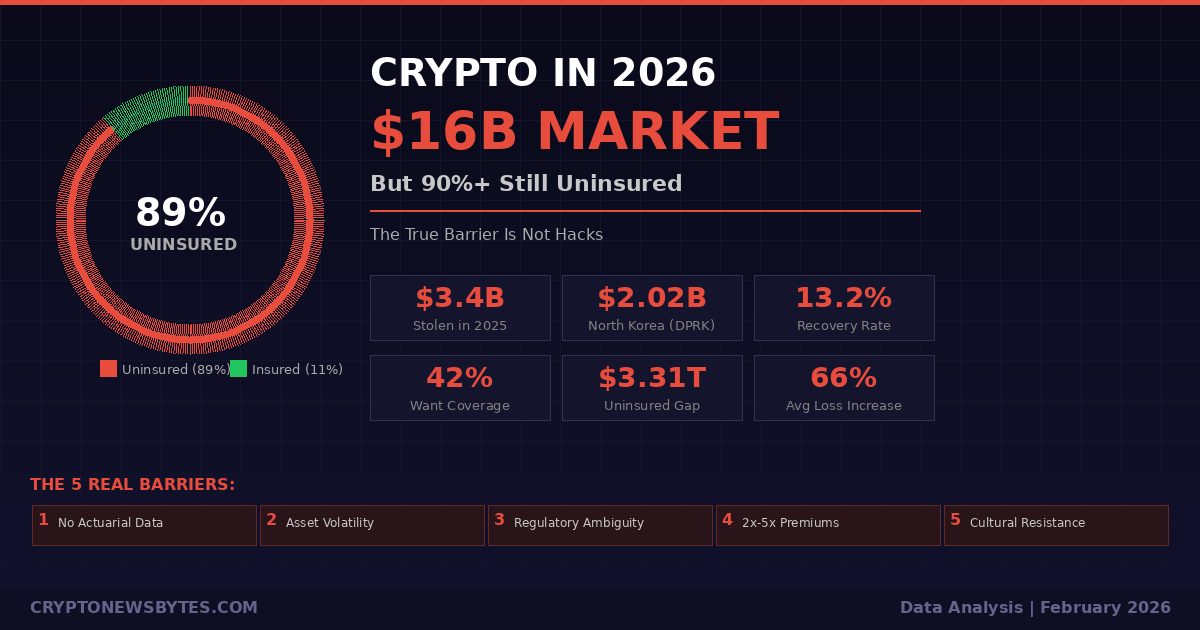
- Crypto theft reached $3.4 billion in 2025 (Chainalysis), with the Bybit hack alone accounting for 44% of the total. Despite this, 89% of the industry remains completely uninsured
- The true barriers to crypto insurance adoption are not hacks themselves. They are: no actuarial data, asset volatility, regulatory ambiguity, premium costs 2x to 5x higher than traditional finance, and a cultural resistance rooted in crypto’s anti-institutional DNA
- 42% of uninsured crypto holders say they would buy insurance if it existed in a form they understood, revealing a $3.31 trillion uninsured market gap
- North Korea’s Lazarus Group stole $2.02 billion in crypto in 2025 alone, a 51% increase over 2024, pushing their all-time total to $6.75 billion
- The attack surface has fundamentally shifted: in 2025, zero of the three largest incidents (Bybit, Step Finance, Figure Technology) involved a smart contract exploit. All targeted people and operational infrastructure
The $16 Billion Question Nobody Is Answering
The crypto insurance market sits at the center of a paradox that should alarm every founder, investor, and regulator in the digital asset industry. The cyber insurance market reached somewhere between $16 billion and $20 billion in 2025, according to Gallagher’s 2026 Cyber Insurance Market Outlook. It is projected to grow to $30 to $50 billion by 2030. Traditional insurers like Munich Re, Lloyd’s, AIG, and Chubb are expanding into digital asset coverage. The infrastructure is being built.[Insurance Business]
And almost nobody in crypto is buying it.
According to GlobalData’s 2024 Emerging Trends Insurance Consumer Survey, only 10.8% of crypto holders globally have any form of insurance policy. AM Best estimates the uninsured crypto market represents a $3.31 trillion gap. Only 35% of centralized exchanges carry coverage. For decentralized protocols, the number is 12%.[Risk & Insurance]
The instinct is to blame hackers. After all, $3.4 billion was stolen in 2025. The Bybit hack alone was $1.5 billion. But here is the uncomfortable truth: hacks are not the barrier to crypto insurance adoption. The barriers are structural, cultural, and in many cases, self-inflicted.
The Data: What $3.4 Billion in Losses Actually Tells Us
Before we can understand why the crypto industry remains uninsured, we need to understand what is actually happening on the ground.
2025 Losses by the Numbers
| Metric | Figure | Source |
|---|---|---|
| Total crypto theft (2025) | $3.4 billion | Chainalysis |
| Biggest single hack | $1.5 billion (Bybit) | CNBC |
| Total incidents (2025) | ~200 (down from 410 in 2024) | CryptoSlate / SlowMist |
| Average loss per attack | $5.3 million (up 66% from 2024) | CertiK / Phemex |
| North Korea (DPRK) share | $2.02 billion (76% of service compromises) | The Block / Chainalysis |
| Funds recovered | $387 million (13.2% recovery rate) | CryptoSlate / SlowMist |
| Total scams and fraud (2025) | $17 billion | CoinDesk / Chainalysis |
The Real Barriers: Five Reasons 89% of Crypto Remains Uninsured
If insurers are building crypto insurance products and crypto companies are losing billions, why is adoption so low? The answer is not what most people expect. The barriers to crypto insurance adoption are not primarily about hacks. They are about the fundamental mismatch between how the crypto industry works and how the insurance industry works.
Barrier #1: No Historical Data to Price Risk
Insurance is a data business. Actuaries build pricing models based on decades of claims history. The crypto industry is 15 years old. Institutional-grade custody and exchange infrastructure is perhaps 7 to 8 years old. There is simply not enough loss data to build the actuarial models that underwriters need to price policies confidently.
As AM Best’s Edin Imsirovic put it, insurers face difficulty because crypto assets are vulnerable to hacking, and private keys are vulnerable to theft and fraud, in an environment with limited claims history to draw from. The result is conservative pricing that makes coverage expensive, which reduces uptake, which further limits the data available. It is a vicious cycle.[Risk & Insurance]
Barrier #2: Asset Volatility Makes Claims Valuation a Nightmare
A policy covering 10,000 ETH is worth a different amount every hour. When Bybit lost 401,000 ETH in February 2025, the value at the time of theft was $1.5 billion. Within days, Ethereum’s price had dropped further. If that loss had been insured, when do you value the claim? At the moment of theft? At the time of filing? At the time of settlement?
This is not an abstract problem. Traditional insurance deals with assets that have stable, verifiable values: buildings, inventory, revenue streams. Crypto’s price volatility means that even after a policy is written, the insured amount can become meaninglessly small (if crypto rises) or dangerously large (if it falls) within weeks. Insurers have not developed standard frameworks for handling this.
Barrier #3: Regulatory Ambiguity Creates Underwriting Paralysis
Insurance is one of the most heavily regulated industries in the world. Underwriters need to know: is this asset a security? A commodity? A currency? Is this company operating legally? Will regulators come after our policyholders?
Until mid-2025, most of those questions had no clear answer in the United States. The SEC was actively suing major crypto companies for operating as unregistered securities platforms. The passage of the GENIUS Act in July 2025 (establishing a stablecoin regulatory framework) and shifting SEC enforcement priorities have begun to improve clarity, but the effects are still working through the insurance market. Several Lloyd’s syndicates and traditional insurers including AXA, AIG, Chubb, and Beazley have started underwriting crypto risks. Marsh recently launched a digital asset custodian insurance facility with capacity reaching $825 million. But these are early steps, not market saturation.[Woodruff Sawyer]
Barrier #4: Premiums Are 2x to 5x Traditional Finance
When crypto companies do find insurers willing to write policies, the cost is staggering. Crypto insurance premiums are typically two to five times higher than equivalent coverage for traditional financial services companies. This reflects the elevated perceived risk, limited actuarial data, concentrated underwriter pool (approximately 90% of crypto insurance policies are underwritten by Lloyd’s syndicates), and limited competition.[CoinLaw]
For a startup with $10 million in assets under custody, the math often does not work. The annual premium for meaningful crime/specie coverage could represent a significant percentage of operating revenue. Many founders make the rational (if dangerous) calculation that self-insuring is cheaper, at least until something goes wrong.
Barrier #5: The Cultural Problem Nobody Talks About
This is the barrier that no industry report quantifies, but it may be the most powerful of all.
Crypto was born as a rebellion against institutional finance. “Be your own bank” is not just a slogan. It is an ideology. And insurance is one of the most institutional products in existence. It requires trusting a centralized intermediary to pay claims. It requires disclosing your security architecture to underwriters. It requires accepting that you cannot fully control your own risk.
For many crypto-native founders, buying insurance feels like an admission of failure: an acknowledgment that their protocol, their security, their team is not enough. This cultural resistance is real, and it is contributing to the gap. The irony is that the incidents destroying companies in 2025 and 2026 are precisely the kind that insurance was designed to cover: human error, social engineering, operational compromise, insider threats.
🔍 The Paradox in One Sentence
The crypto industry’s anti-institutional DNA is the reason it needs institutional protection the most. The companies that refuse to buy insurance on principle are the same companies most likely to die when an attack succeeds.
The Attack Surface Has Shifted, and Crypto Insurance Has Not Caught Up
There is a dangerous misconception in the crypto industry that security spending on smart contract audits, formal verification, and code review is sufficient protection. In 2025, that assumption was demolished.
As our analysis of the top 10 cybersecurity trends in crypto and blockchain for 2025 documented, the attack surface has shifted from code to people. CoinDesk reported that on-chain security is actually improving, and DeFi protocol hacks have declined even as total value locked has recovered. The problem is no longer buggy smart contracts. It is compromised humans.
The Evidence From 2025’s Biggest Incidents
| Incident | Loss | Attack Vector | Smart Contract Exploit? |
|---|---|---|---|
| Bybit (Feb 2025) | $1.5B | Third-party wallet UI compromise (Safe developer machine) | No |
| Step Finance (Jan 2026) | $40M | Executive device compromise | No |
| Figure Technology (Feb 2026) | 2.5GB data | Social engineering (employee phishing via Okta SSO) | No |
As Immunefi founder Mitchell Amador told CoinDesk: “With the code becoming less exploitable, the main attack surface in 2026 will be people. The human factor is now the weak link that on-chain security experts and Web3 players must prioritize.”[CoinDesk]
This matters for insurance because human-vector attacks are exactly what traditional cyber and crime insurance policies were designed to cover. Social engineering, insider fraud, phishing, device compromise: these are not exotic crypto-specific risks. They are the same risks that banks, hospitals, and retailers have been insuring against for decades. The products exist. The underwriting frameworks exist. The crypto industry is simply not buying them.
The Crypto Insurance Market Is Moving. Is Crypto Paying Attention?
While the crypto industry has been slow to adopt crypto insurance, the insurance industry itself has been accelerating its entry into digital asset coverage. Here is what has changed in the last 12 months:
The supply side of crypto insurance is expanding. The demand side is not keeping up. That gap is the real story of crypto insurance in 2026.
The North Korea Problem: Why State Actors Make Crypto Insurance Essential
One data point from 2025 should concern every crypto company that does not carry insurance: North Korea’s Lazarus Group stole $2.02 billion in cryptocurrency in 2025, a 51% increase over 2024. Their all-time total now stands at $6.75 billion. DPRK-linked actors were responsible for 76% of all service compromises by value.[Chainalysis]
This is not random criminal activity. It is systematic, state-funded cyber warfare targeting the crypto industry specifically. Lazarus Group’s tactics have evolved from direct protocol exploits to embedding IT workers inside crypto companies as employees, using social engineering to compromise executives, and attacking third-party infrastructure providers.
What Happens When Crypto Companies Do Not Have Insurance: Two Case Studies
✅ Survived: Bybit ($1.5B hack)
No insurance. Survived through sheer financial depth: $20B+ in daily trading volume, bridge loans from Galaxy Digital, FalconX, and Wintermute, reserves replenished within 72 hours. Never halted withdrawals. CEO immediately went public with full transparency.
Lesson: Self-insurance works if you are one of the largest exchanges in the world. Most companies are not.
❌ Died: Step Finance ($40M hack)
No insurance. Lost $40M from treasury wallets via executive device compromise. Recovered only $4.7M. Token collapsed 97%. No investor or acquirer would step in. Platform, along with SolanaFloor and Remora Markets, shut down permanently on February 23, 2026.
Lesson: Without insurance or massive reserves, a single operational security failure is fatal. [Full report]
The difference between these outcomes was not security quality. Both companies were compromised through operational (not code) vulnerabilities. The difference was financial capacity to absorb the loss. Insurance exists to give companies that capacity without needing to be a billion-dollar exchange first.
The Bottom Line: The True Barrier Is Not Hacks
The crypto industry lost $3.4 billion to theft in 2025 and an estimated $17 billion to scams and fraud. These numbers are alarming, but they are not the reason 89% of the industry is uninsured. Companies do not avoid insurance because they think hacks will not happen. They avoid it because:
1️⃣ The insurance industry cannot price crypto risk accurately without more data, and it will not get more data until more companies buy policies.
2️⃣ Premiums are priced for maximum uncertainty, making coverage feel unaffordable for the companies that need it most.
3️⃣ Regulatory ambiguity has kept major insurers on the sidelines, though the GENIUS Act and shifting SEC posture are beginning to change this.
4️⃣ Crypto’s anti-institutional culture treats insurance as an admission of vulnerability rather than a sign of maturity.
5️⃣ The products that exist do not always cover the risks that matter: most cyber policies exclude private key theft, and war exclusions may void coverage for the most common attacker (North Korea).
These are solvable problems. They require crypto companies to engage with the crypto insurance industry rather than ignore it, insurers to invest in crypto-specific actuarial modeling, and regulators to provide the clarity that makes underwriting possible. The crypto insurance market is moving. The question is whether adoption will catch up before the next $1.5 billion incident hits a company that cannot absorb it.
For a complete breakdown of coverage types, providers, costs, and a practical checklist for getting insured, read our companion guide: Crypto Insurance in 2026: Why the Industry’s Biggest Problem Is Not Hackers, It Is Having No Safety Net.
Frequently Asked Questions
📰 More on CryptoNewsBytes
- Crypto Insurance in 2026: Why the Industry’s Biggest Problem Is Not Hackers, It Is Having No Safety Net
- Top 10 Cybersecurity Trends in Crypto & Blockchain 2025: The $1.46B Hack That Changed Everything
- Figure Technology Data Breach: Hackers Dump 2.5GB Stolen Records
- Step Finance Hack: $40M Stolen, Platform Shuts Down Permanently
- Jane Street Terra Insider Trading Allegations: $40 Billion Collapse
Sources: Chainalysis | AM Best / Risk & Insurance | Insurance Business / Gallagher | Woodruff Sawyer | CryptoSlate / SlowMist | The Block | CoinDesk | CoinLaw | CertiK / Phemex | CNBC
Disclaimer: This article is for informational purposes only and does not constitute insurance, financial, or legal advice. Consult a licensed insurance broker with crypto-specific expertise for advice tailored to your business.