3 Key Takeaways
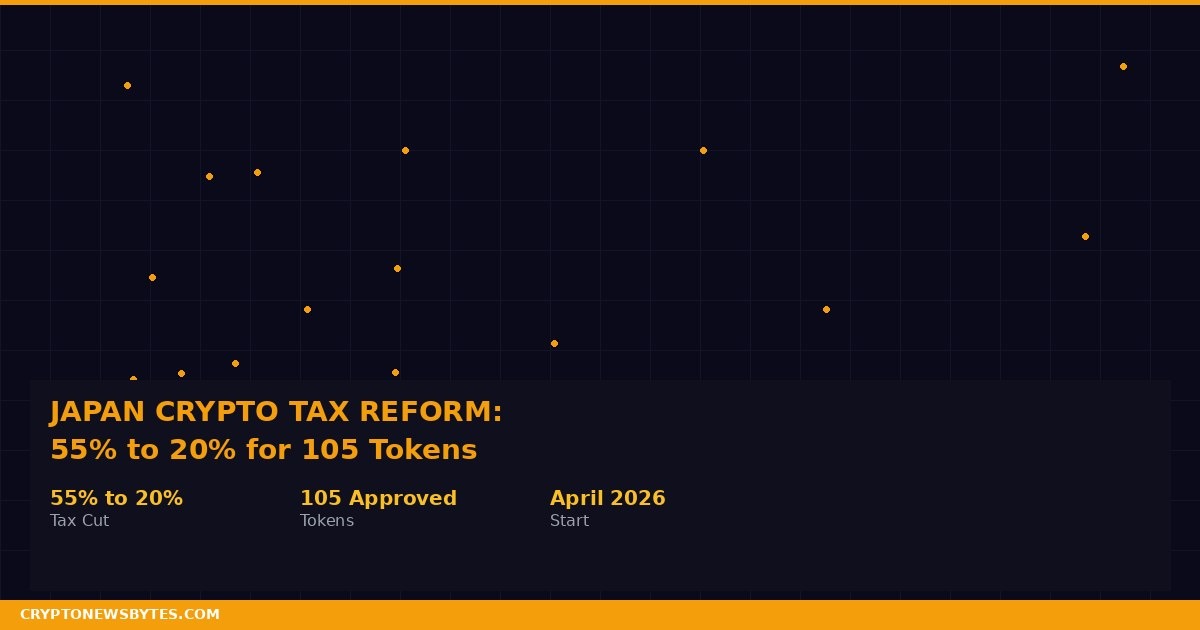
- Japan’s FSA will slash crypto tax from 55% to a flat 20% for 105 approved cryptocurrencies beginning April 2026, aligning digital assets with stock market taxation and removing one of the biggest barriers to domestic crypto adoption
- The 105 tokens (including BTC and ETH) will be reclassified as “financial products” under FIEA, bringing mandatory disclosures, insider trading bans, AI-powered market surveillance, and securities-grade investor protections to crypto for the first time
- Banks may eventually be allowed to register as licensed crypto exchanges and hold approved tokens on their balance sheets, potentially opening Japan’s institutional market in the most significant way since 2017
Japan Crypto Tax Reform 2026: The Biggest Regulatory Shift in Asia
The Japan crypto tax overhaul taking effect in April 2026 represents the most ambitious regulatory reset any major economy has attempted for digital assets. Japan’s Financial Services Agency (FSA) is simultaneously cutting the tax rate from a punishing 55% maximum to a flat 20%, reclassifying 105 cryptocurrencies as regulated financial instruments, introducing insider trading laws for crypto, and potentially opening the door for banks to offer crypto services directly.
For years, Japan’s crypto tax regime was considered one of the harshest in the developed world. Crypto gains were classified as “miscellaneous income” and taxed at the same progressive rates as salary income, reaching 55% at the highest bracket (including local taxes). This pushed active traders to foreign platforms and discouraged institutional participation. The new flat 20% rate aligns crypto with stock trading and includes a three-year loss carry-forward provision, matching the treatment available to equity investors.
The reform is not just a tax cut. It is a comprehensive reimagining of how Japan treats digital assets, moving them from a payments-oriented regime to a full capital markets framework. For global investors, this makes Japan one of the most attractive regulated crypto markets in the world. For the industry, it creates both opportunity and significant new compliance obligations.
The 105-Token Whitelist: Japan’s Two-Tier Crypto System
At the center of the Japan crypto tax reform is a carefully curated list of 105 cryptocurrencies that will receive “financial product” classification under the Financial Instruments and Exchange Act (FIEA). This list includes Bitcoin, Ethereum, and approximately 100 other tokens selected based on project transparency, issuer financial stability, technology soundness, and price fluctuation risk.
Only tokens on this approved list qualify for the 20% flat rate. Smaller-cap tokens, memecoins, and assets that fail to meet the FSA’s standards will remain under the old miscellaneous income classification at up to 55%. This creates a two-tier ecosystem: approved tokens with institutional-grade regulatory status, and everything else operating under legacy rules with limited exchange access.
A broader whitelist of approximately 150 assets is being prepared to determine which tokens receive privileged regulatory status. Approved tokens will benefit from bank custody, clearer compliance frameworks, and simplified institutional accounting. Assets outside the whitelist face potential delistings as exchanges adapt to the new regime.
The Japan Virtual Currency Exchange Association (JVCEA), the self-regulatory body comprising Japan’s top exchanges, maintains a “green list” of 30 highly trusted tokens. The FSA’s expanded 105-token list significantly broadens institutional access while maintaining strict quality standards.
Japan Crypto Tax Reform: What Changes for Investors
The practical impact of the Japan crypto tax cut is substantial for both retail and institutional participants:
Tax rate reduction: From up to 55% to a flat 20% on gains from 105 approved tokens. A trader who earned 10 million yen ($65,000) in crypto gains previously owed up to 5.5 million yen in taxes. Under the new rate, the liability drops to 2 million yen. That is a 63% reduction in tax burden.
Loss carry-forward: For the first time, Japanese crypto investors can deduct losses from future gains over a three-year period. This mirrors the treatment available for stock investors and dramatically improves portfolio management in volatile markets.
Insider trading rules: The 105 approved tokens will fall under Japan’s existing insider trading and market manipulation laws. Anyone trading on material nonpublic information faces fines up to 10 million yen (~$65,000) and potential prison terms. This connects directly to cases like Jane Street’s alleged insider trading during the Terra collapse and demonstrates how global crypto markets are moving toward TradFi-grade enforcement.
Mandatory disclosures: Exchanges must publish detailed information on each approved token, including issuer identification, blockchain architecture, volatility profiles, market risks, and material factors affecting investor decisions. This level of transparency exceeds what most global crypto markets require.
Can Japanese Banks Trade Crypto? The Institutional Opening
Perhaps the most significant long-term element of the Japan crypto tax reform is the signal that banks may eventually enter the crypto market directly. Currently, Japanese banks are barred from selling cryptocurrency to consumers. Under the new framework, the FSA has indicated it will revisit these restrictions, potentially allowing banks to register as licensed crypto exchanges, offer trading and custody services, and hold approved tokens on their balance sheets through securities subsidiaries.
If implemented, this would represent the most significant institutional opening in Japan’s crypto market since the original exchange licensing framework was established in 2017. Japanese megabanks (MUFG, SMBC, Mizuho) managing trillions in assets could enter the market, bringing unprecedented liquidity and institutional credibility.
This aligns with global trends. In the U.S., Kraken’s Federal Reserve master account approval is bridging crypto and banking infrastructure from the exchange side. Japan’s approach comes from the banking side, potentially allowing traditional institutions to absorb crypto into their existing service offerings. Bank of America’s warning about $6 trillion in deposit flight to stablecoins takes on a different dimension when banks can participate in crypto markets directly rather than competing against them.
Japan’s Reform in Global Context: How It Compares
The Japan crypto tax reform positions the country alongside the EU’s MiCA framework and the U.S. Clarity Act as one of the three most comprehensive regulatory overhauls of 2026. But Japan’s approach is distinct in several ways:
Japan combines a significant tax incentive (55% to 20%) with stricter operational requirements. The EU’s MiCA focuses on licensing and consumer protection without directly addressing tax rates. The U.S. Clarity Act addresses market structure and agency jurisdiction but leaves tax treatment to separate legislation. Japan is doing both simultaneously, which creates a more complete framework but demands faster adaptation from market participants.
The DMM Bitcoin hack ($305 million in May 2024) directly influenced the reform. The FSA’s new requirement for exchanges to maintain liability reserves ranging from $12.7 million to $255 million (modeled on securities firms) was born from that incident. Additionally, the FSA will now require third-party infrastructure providers (custody, wallet management, transaction processing) to register and operate under supervision, addressing vulnerabilities exposed by the DMM hack’s connection to a third-party service provider.
For global operators considering crypto licensing across jurisdictions, Japan’s reform creates one of the most attractive regulated environments in Asia, particularly for institutional-focused businesses.
What Happens Next: Timeline and Implementation
The Japan crypto tax reform package is expected to follow this timeline:
The bill was submitted during Japan’s 2026 ordinary Diet (parliamentary) session. Committee debates, public comment periods, and revisions are ongoing. Implementation is targeted for April 2026, though transitional rules will apply as exchanges adapt to new disclosure standards. The FSA will publish detailed guidance on token classification, exchange obligations, and insider trading enforcement as the framework takes effect.
Market participants should monitor FSA releases, draft bill publications, and updates from the Financial System Council’s working group. Exchanges listing any of the 105 approved tokens will need to prepare disclosure workflows, issuer coordination, and compliance infrastructure well ahead of implementation.
For investors, the key action is straightforward: if you hold any of the 105 approved tokens and are subject to Japanese tax law, your effective rate drops dramatically in April 2026. If you hold tokens outside the approved list, your tax treatment does not change. Understanding which category your holdings fall into is the immediate priority.
Related Reading
Sources: Finance Magnates | BeInCrypto | CCN | DL News | Coin Edition
Disclaimer: This article is for informational and educational purposes only and does not constitute financial, investment, tax, or legal advice. Tax laws vary by jurisdiction and individual circumstances. Consult a qualified tax professional for advice specific to your situation. The Japan FSA reform is subject to parliamentary approval and implementation details may change.