The Numbers
- FTX collapsed in November 2022 in the largest crypto fraud in history. Its investment portfolio at the time was worth approximately $4.7 billion
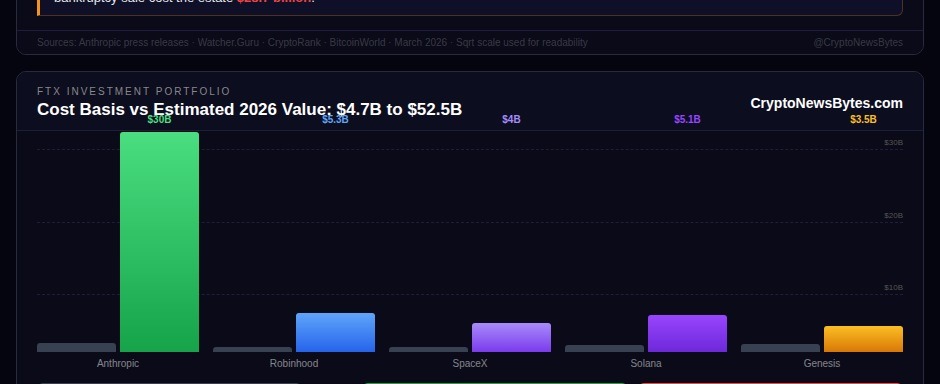
- That same portfolio, held to today, would be worth an estimated $52.5 billion. A $47.8 billion gain sitting inside a crime scene
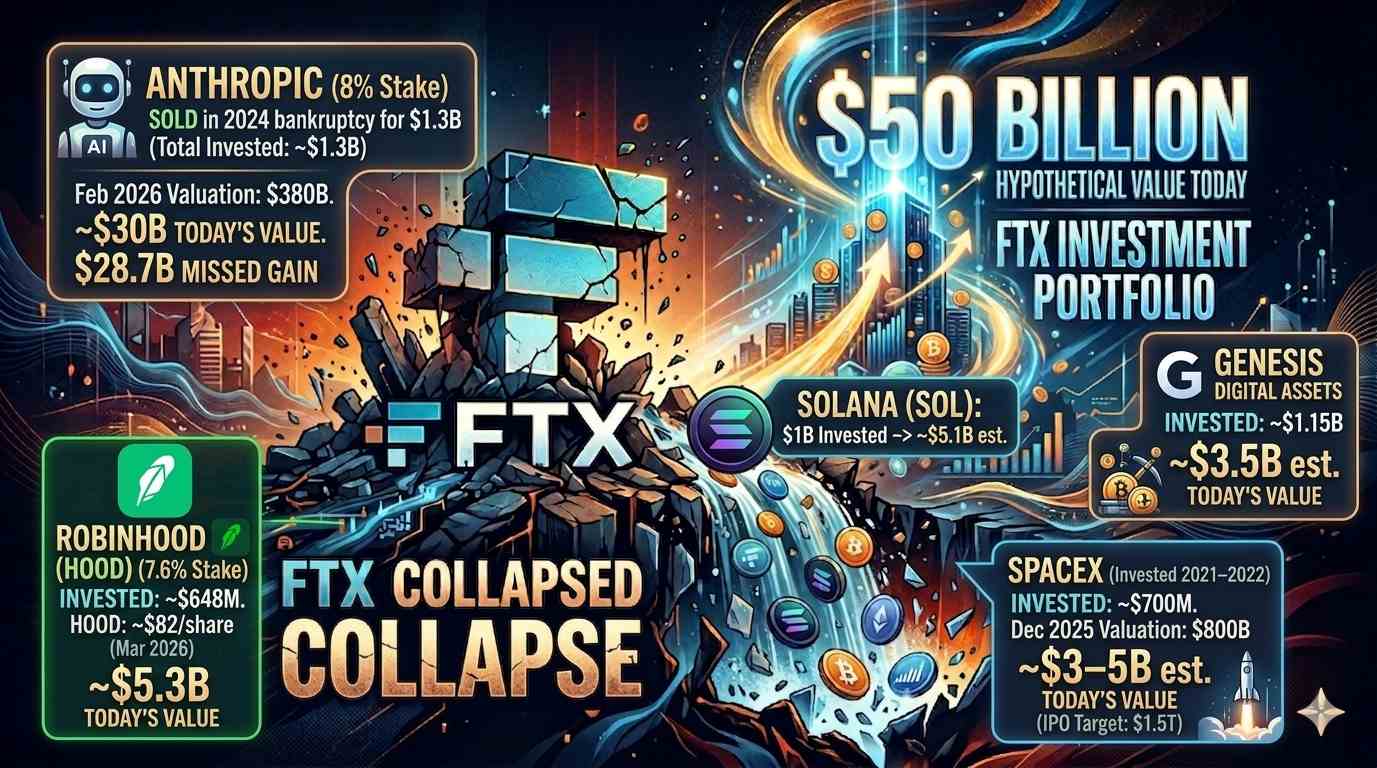
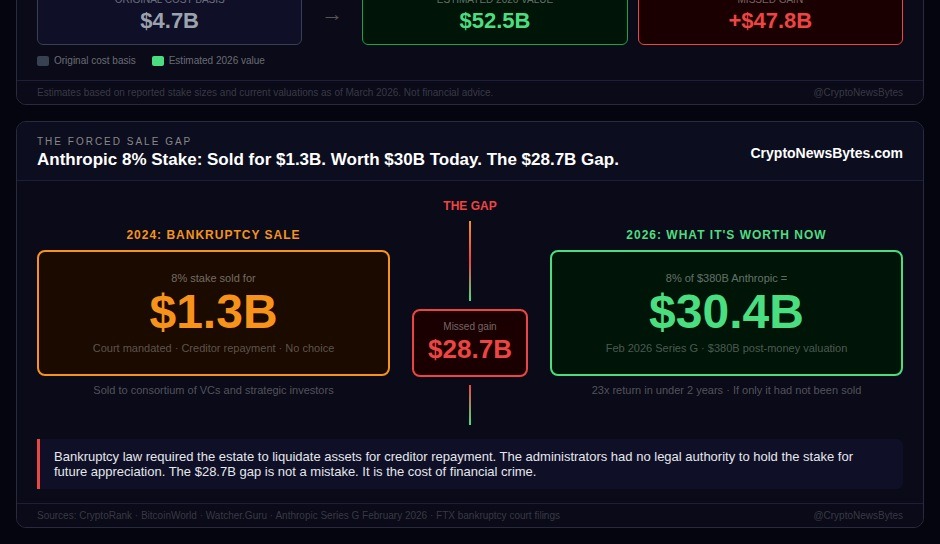
- Anthropic alone tells the story. FTX held an 8% stake in Anthropic, built for $1.3 billion total. It was sold in 2024 bankruptcy proceedings for $1.3 billion to repay creditors. That same 8% stake is now worth approximately $30 billion at Anthropic’s February 2026 valuation of $380 billion. A $28.7 billion gain from a forced sale.
- SpaceX reached an $800 billion valuation in December 2025 and is targeting a $1.5 trillion IPO in mid-2026. FTX’s $700M position would have compounded dramatically
- The thesis is devastating in its simplicity: the picks were right. Everything else was catastrophically wrong.
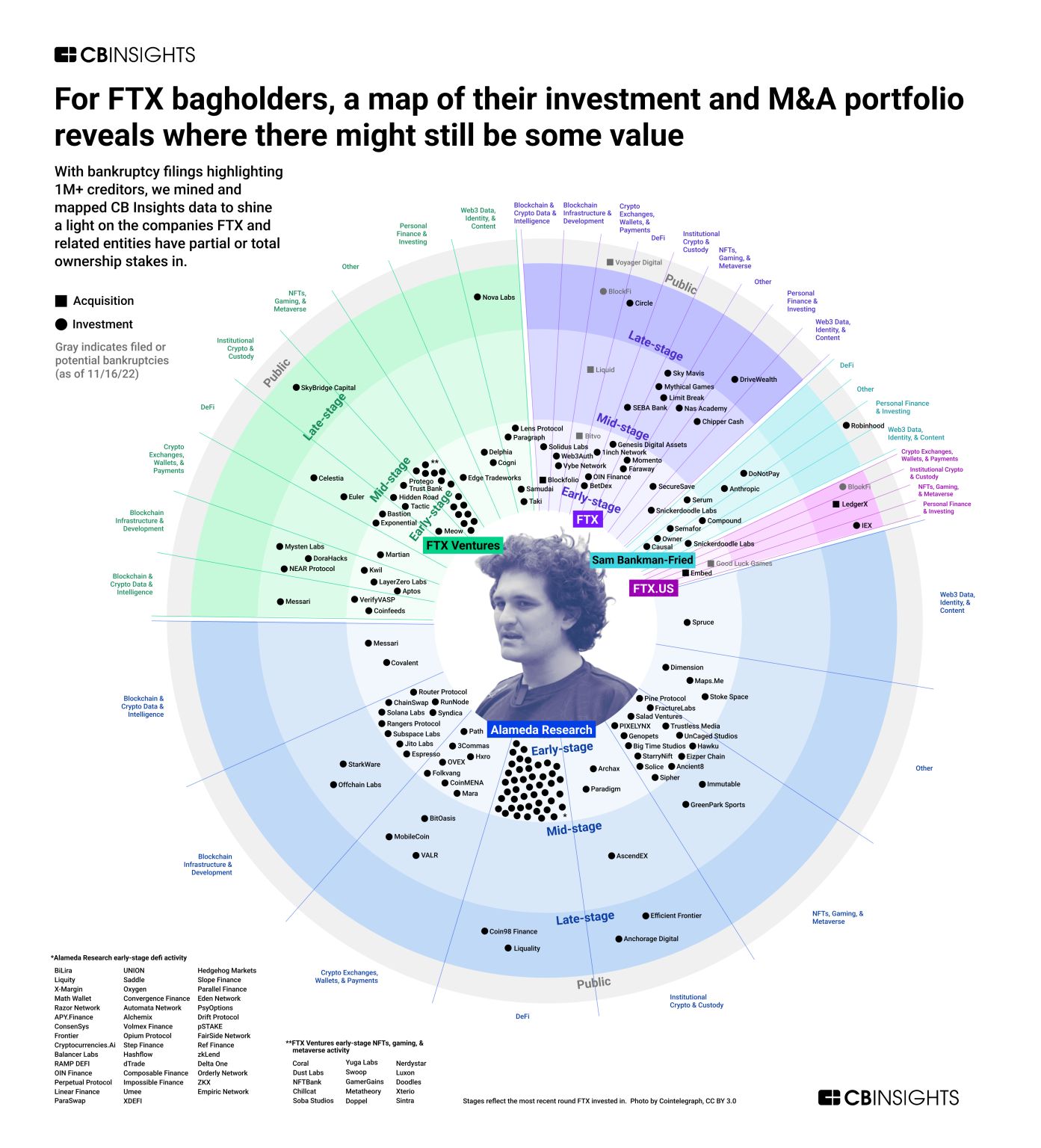
FTX portfolio 2026 is one of the most haunting thought experiments in financial history. Sam Bankman-Fried and his team at FTX Ventures and Alameda Research were, by any objective measure, exceptional venture investors. They identified Anthropic before it became a $380 billion AI giant. They backed Solana early. They took positions in SpaceX, Robinhood, and Genesis Digital Assets. The portfolio they assembled between 2020 and 2022 would, if held intact to today, be worth approximately $52.5 billion, up from $4.7 billion at the time of collapse.
Instead, that portfolio was liquidated under court order during bankruptcy proceedings. The Anthropic stake alone tells the story: FTX held an 8% stake in Anthropic, which bankruptcy administrators were forced to sell in 2024 for $1.3 billion to repay creditors. That same stake is now valued at $30 billion. A $28.7 billion gain evaporated in a single forced sale. The investment thesis was sound. The governance, the ethics, the basic financial controls were not. The result is one of the most expensive cautionary tales in the history of financial markets.
The Portfolio: What Each Bet Would Be Worth Today
FTX Key Investments: Cost vs 2026 Estimated Value
The Anthropic Bet: A $1.3 Billion Sale Now Worth $30 Billion
The single most striking entry in the FTX portfolio is Anthropic. FTX held an 8% stake in the AI safety company, built through investments in 2021 and 2022 totalling approximately $1.3 billion, when Anthropic was a relatively early-stage startup spun out of OpenAI. At the time, AI safety research was niche, underfunded, and largely misunderstood by mainstream finance.
During the 2024 bankruptcy proceedings, court-appointed administrators were forced to liquidate the Anthropic stake to repay FTX creditors. The sale generated $1.3 billion, a significant cash injection for the estate at the time. The stake was sold to a consortium of venture capital firms and strategic investors. The bankruptcy process followed four structured steps: asset identification, independent valuation assessment, bankruptcy court approval, and transaction execution. The mandate was to generate cash for creditors, not to hold for future appreciation.
What happened next is one of the most striking missed returns in financial history. Anthropic’s valuation trajectory since the FTX sale has been extraordinary.
| Date | Anthropic Valuation | Growth from FTX Sale |
|---|---|---|
| 2024 (FTX sale date) | ~$15–18B | Baseline |
| 2025 | $30B+ | ~2x |
| February 2026 (Series G) | $380B | ~25x in under 2 years |
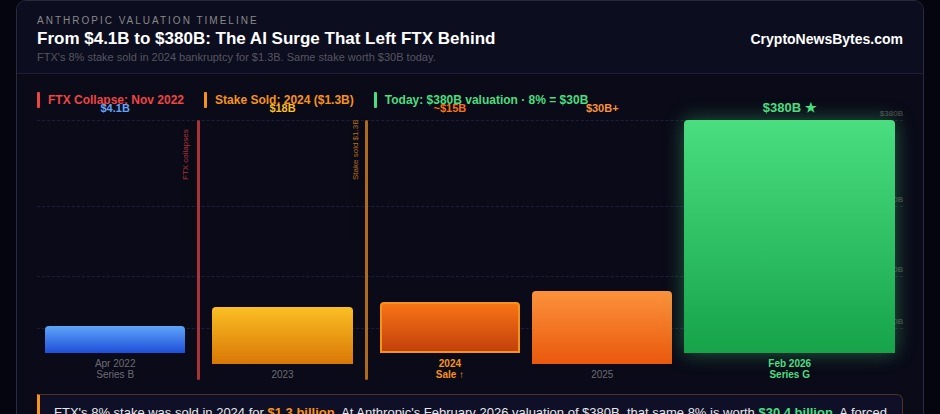
The 8% stake sold for $1.3 billion in 2024 is now valued at approximately $30 billion based on Anthropic’s February 2026 post-money valuation of $380 billion. That is a $28.7 billion gain on a single forced sale, evaporated by the constraints of bankruptcy law rather than bad investment judgment.
The AI Sector Context: FTX Was Early Across the Board
FTX’s Anthropic bet was not a lucky outlier. It reflected a broader conviction in foundational AI that most of Wall Street missed entirely. The AI valuation surge that made the Anthropic stake so valuable has been sector-wide.
| Company | 2023 Valuation | 2025 Valuation | Growth |
|---|---|---|---|
| Anthropic | $18B | $30B+ | ~1.7x (now $380B in 2026) |
| OpenAI | $29B | $80B+ | ~2.75x |
| Inflection AI | $4B | Acquired by Microsoft | N/A |
SpaceX and Robinhood: Two More Bets That Paid Off
FTX’s approximately $700 million position in SpaceX, taken when the company was valued at roughly $100 billion, has appreciated enormously. SpaceX reached an $800 billion valuation in December 2025 through an insider share sale at $421 per share, and is targeting a $1.5 trillion IPO in mid-2026. On a proportional basis, FTX’s stake would be worth an estimated $3 to $5 billion at current private market prices.
The Robinhood position is the most straightforward to calculate because Robinhood is publicly traded. FTX held approximately 56 million shares, representing roughly 7.6% of Robinhood’s outstanding equity at the time of the collapse. Robinhood stock has been volatile: it hit an all-time high of $152 in October 2025 and currently trades around $82 per share. At $82, FTX’s original Robinhood stake would be worth approximately $4.6 billion. The position is also notable for a different reason: in 2022, FTX tried to acquire Robinhood outright. Regulators blocked the move. Had it succeeded, the combined entity would have been one of the most powerful retail financial platforms in the world.
Solana: The Investment and the Controversy
FTX and Alameda Research’s relationship with Solana is complex and deserves its own analysis. FTX was one of Solana’s earliest and most significant backers, investing approximately $1 billion across various positions when SOL was trading in the single digits. Solana’s rise to become one of the top five cryptocurrencies by market cap, trading around $120 in early 2026, means that position would be worth multiples of the original investment.
But the Solana relationship also illustrates the conflicts of interest that defined FTX’s business model. Solana’s rapid ascent was partly driven by the massive promotional support FTX provided, including making SOL a primary trading pair on the exchange. When FTX collapsed, Solana’s price crashed more than 60% in days as the market processed the implications of losing one of its biggest institutional backers. It has since recovered and surpassed its pre-collapse levels, but the episode remains a case study in how centralised exchange power can distort decentralised protocol markets.
The Lesson That Money Cannot Buy
The FTX portfolio valuation exercise is not just a financial curiosity. It is a precise illustration of why governance, ethics, and institutional discipline matter as much as analytical skill.
The commentary that circulated on LinkedIn when this story broke in March 2026 was remarkably consistent. Strong investment instincts mean little without governance and discipline. Right picks do not save you from wrong principles. Even the best bets cannot save a foundation built on fraud.
Sam Bankman-Fried was sentenced in March 2024 to 25 years in federal prison for fraud, conspiracy, and money laundering. The FTX estate has been distributing assets to creditors at roughly 100 cents on the dollar for the cash claims, thanks in part to asset appreciation during the bankruptcy proceedings. But the opportunity cost, the $47.8 billion in gains that evaporated with the fraud, is a number that will define the FTX story long after the legal proceedings are forgotten.