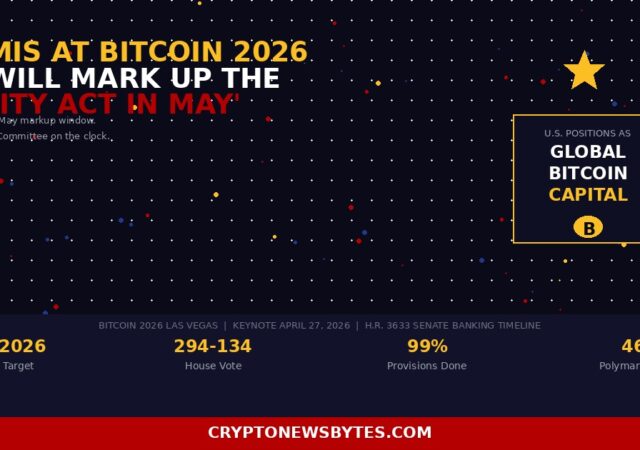

Senator Cynthia Lummis took the Nakamoto stage at Bitcoin 2026 in Las Vegas on Monday, April 27, and delivered the line the U.S. crypto industry has been waiting eight months to hear. The Senate, she told the conference floor, “will mark up the Clarity Act in May.” It was a commitment with a deadline behind it. The Wyoming Republican, who chairs the Senate Banking Subcommittee on Digital Assets and announced last December that she will not seek reelection, has roughly 14 weeks of legislative runway before the 2026 midterm cycle effectively closes Washington’s window for major bills. She is using every one of them.
The keynote was both biography and policy. Lummis opened with the personal story that put her on the path to becoming the Senate’s loudest Bitcoin advocate: the sudden death of her husband, the discovery that she had been legally locked out of their joint bank accounts during a transition between institutions, and a son-in-law’s suggestion that there might be a way to hold value without depending on a trusted third party. She bought three Bitcoin at roughly $300 each in 2013 and 2014. At today’s price of approximately $78,020, those three coins are worth about $234,060. The personal arc framed the policy push that closed the speech: she wants the Clarity Act on her record before she leaves the Senate, and she wants the United States positioned as the global capital for Bitcoin.
The Personal Story That Became Policy
The opening passage of the keynote was unexpectedly intimate for a Senate floor leader on digital asset legislation. Lummis described the period after her husband’s sudden passing, when she went to access their joint bank accounts and discovered that the transition to a new institution had not yet been completed with her name added. She was, in effect, locked out of her own money during the days she needed it most: to pay funeral expenses, to handle the immediate household bills, to begin the practical work of grief. The experience, she told the audience, sent her looking for a different model. Something that did not require a trusted third party to validate her access to her own assets. Her son-in-law suggested Bitcoin. She bought three coins at around $300 each.
The story is not just biography. It is the philosophical argument that has anchored Lummis’s entire legislative approach. Self-custody, the ability to hold one’s own keys without intermediation, is not a libertarian abstraction in this telling. It is the answer to a specific failure mode of the existing financial system: institutional process delays that can leave individuals without legal access to their own funds at moments of acute personal need. Lummis pointed to other examples during the speech: women leaving dysfunctional marriages who were able to walk away with Bitcoin as an asset that was uniquely theirs, individuals in war-torn countries who were able to transfer value across borders quickly and cheaply, citizens of jurisdictions with disrupted monetary systems who used Bitcoin as a refuge from inflation and capital controls.
“Bitcoin comes with a culture that could’ve written the U.S. Declaration of Independence that we celebrate today,” Lummis said. “This is freedom money. That all people are created equal, and that this asset guarantees it.” It is rhetorical territory most senators do not enter. Lummis has been working it for nearly five years.
From $300 to the Senate Floor: Lummis’s Bitcoin Arc
Source: Bitcoin Magazine keynote coverage, Senator Lummis statements, Disruption Banking | @cryptonewsbytes
| 2013-2014 | Buys 3 Bitcoin at roughly $300 each after her husband’s death and a banking transition leaves her locked out of joint accounts. Son-in-law introduces her to self-custody. |
| January 2021 | Sworn into the U.S. Senate as Wyoming’s junior Republican senator. Becomes the chamber’s primary Bitcoin advocate from her first term. |
| 2021-2022 | Leads the fight against the IRS broker definition that would have classified software developers, validators, and miners as “brokers” subject to KYC reporting requirements. |
| 2024 | Introduces the BITCOIN Act, authorizing Treasury to acquire up to 1 million BTC over 5 years for a strategic reserve, with mandatory 20-year hold and quarterly proof-of-reserves disclosures. |
| January 2025 | Appointed Chair of the Senate Banking Subcommittee on Digital Assets, the first dedicated digital asset leadership position in the Senate. |
| July 2025 | Co-sponsors the GENIUS Act stablecoin framework, signed into law later that year. House passes the Clarity Act 294-134 with bipartisan backing on July 30. |
| December 2025 | Announces she will not seek reelection in 2026. Frames the Clarity Act as her final-term legislative legacy. |
| April 27, 2026 | Bitcoin 2026 keynote. Confirms Senate Banking Committee will mark up Clarity Act in May. States 99% of stablecoin and market structure language is resolved. |
Lummis has publicly held Bitcoin since 2013 and disclosed BITCOIN purchases in Senate financial disclosures. Wyoming was the first U.S. state to pass comprehensive digital asset legislation, providing the policy testing ground that informed her federal approach. | @cryptonewsbytes
The Clarity Act in May: What the Markup Actually Means
The Clarity Act, formally the Digital Asset Market Clarity Act of 2025 (H.R. 3633), passed the U.S. House of Representatives on July 30, 2025, by a 294-134 bipartisan vote. The bill establishes the regulatory framework that would assign primary jurisdiction over most non-stablecoin digital assets to the CFTC as digital commodities, while narrowing the SEC’s reach to tokenized securities. It creates safe harbors for non-custodial DeFi protocol developers, validators, and node operators. It is, in effect, the architecture decision the U.S. has been trying to make since the SEC began bringing enforcement actions against crypto firms in 2018.
The bill has been waiting in the Senate Banking Committee for more than eight months. Lummis told the Bitcoin 2026 audience that the substantive disputes are largely resolved. The stablecoin yield language, which had been the central friction point, now reflects the Tillis-Alsobrooks compromise: passive yield on stablecoin balances is prohibited, while activity-based rewards for behaviors that benefit the broader economy are permitted. DeFi protocol provisions are finalized. Market structure language is, by Lummis’s count, 99% complete. The remaining friction is procedural and political. Senate Banking Committee Chairman Tim Scott has not announced a markup date. Senator Thom Tillis is pushing for a slower timeline. Senator Bernie Moreno has been blunt about the deadline: if the bill does not clear committee and reach the Senate floor by end of May, “digital asset legislation will not pass for the foreseeable future.”
Galaxy Research analyst Alex Thorn has framed the math directly. With 18 working weeks remaining before the October midterm recess, every week of Senate delay shrinks the floor consideration window to the point where 2026 passage becomes structurally implausible without immediate Banking Committee clearance. The Senate is on recess this week. The earliest the committee could mark up is the week of May 11. After Banking Committee clearance, the bill still needs a Senate floor vote requiring 60 votes, reconciliation with the Senate Agriculture Committee version, reconciliation with the House version, and presidential signature. The timeline measures in weeks. Lummis’s keynote was, in part, an attempt to compress them.
Clarity Act Path to Law: From Bitcoin 2026 Keynote to Presidential Signature
Source: Crypto in America newsletter, FinTech Weekly, Disruption Banking, Galaxy Research | @cryptonewsbytes
✓ Step 1: House Passage (DONE) July 30, 2025: H.R. 3633 cleared the U.S. House 294-134 with bipartisan support. |
| ↓ |
2 Step 2: Senate Banking Committee Markup (TARGET: WEEK OF MAY 11) Chairman Tim Scott has not yet set the date. Lummis confirmed May at Bitcoin 2026. Tillis pushing slower; Moreno set hard end-of-May deadline. |
| ↓ |
3 Step 3: Senate Floor Vote (60-vote threshold) Requires 60 votes to overcome filibuster. Bipartisan support assumed but not guaranteed at the threshold needed. |
| ↓ |
4 Step 4: Reconciliation (House + Senate Ag Committee) Senate Banking version must be reconciled with both the House passage and any Senate Agriculture Committee version. Conference committee process. |
| ↓ |
5 Step 5: Presidential Signature Trump administration has indicated support. Signing window market observers place around June if all upstream steps stay on schedule. |
If markup slips past mid-May, Galaxy Research notes 2026 enactment becomes structurally implausible. Polymarket currently prices passage at 46%. Senator Bernie Moreno: “If we don’t get the Clarity Act passed by May, digital asset legislation will not pass for the foreseeable future.” | @cryptonewsbytes
The IRS Broker Fight: How the Industry Shaped Policy
A central thread of the keynote was Lummis’s account of the early Senate battles over the IRS broker definition, a fight that pre-dated the current Clarity Act framework but established the political coalition behind it. The IRS, working under Treasury guidance, had drafted broker definitions broad enough to potentially classify software developers, hardware manufacturers, mining operators, and validators as “brokers” required to collect KYC information from users they had no commercial relationship with. The technical absurdity was clear to anyone familiar with how Bitcoin actually works: a Lightning Network channel operator does not know the legal identity of every payment routing through them, nor could they realistically obtain it without breaking the protocol’s core privacy and decentralization properties.
Lummis credited the Bitcoin industry’s mobilized response with reshaping the policy conversation. The political reframing eventually narrowed the broker definition to entities that actually function as brokers (intermediaries handling customer-facing transactions), excluding the technical infrastructure layer. The episode became, in her telling, a template for how subsequent legislation including the Clarity Act has been negotiated: industry technical input feeding directly into provision drafting, with safe harbors for non-custodial actors written into the bill text rather than left to regulator discretion. The Clarity Act preserves these protections explicitly, providing developers, validators, and node operators with what Lummis previously described as “the legal certainty they deserve.”
The Macro Backdrop: Why This Window Matters
The Bitcoin 2026 keynote landed against a macro backdrop that adds urgency to the May markup. Bitcoin is trading near $78,020 as of April 28, recovering from the $67,000 lows of early April. Tether’s USDT market cap hit a fresh all-time high of $189 billion last week. Morgan Stanley launched its Stablecoin Reserves Portfolio for institutional issuers. Japan’s Financial Services Agency reclassified crypto as a financial instrument in April, with the tax rate dropping from 55% to 20% for licensed exchange trades by 2027. The U.S. Treasury extended bank-level cybersecurity intelligence to digital asset firms. The Federal Reserve is expected to hold rates steady this week at 3.5% to 3.75%, and Powell’s term ends May 15 with Kevin Warsh nominated as successor.
The institutional infrastructure being built in parallel makes the regulatory architecture decision more consequential, not less. The OCC has approved conditional crypto trust bank charters for Circle, Ripple, BitGo, Coinbase, and others. Multi-asset basket ETFs are awaiting SEC decisions in Q2. Strategy and BlackRock’s IBIT are in a public race to one million BTC, with both holding around 794,000 to 797,000 BTC as of mid-April. Polymarket prices Clarity Act passage at 46%. That number is the market’s honest assessment of a coin flip on whether U.S. crypto policy is actually finished.
Clarity Act Passage Odds vs. Other 2026 Crypto Catalysts
Source: Polymarket as of April 26, 2026, SpotedCrypto analysis | @cryptonewsbytes
| Clarity Act passes 2026 | |
| Senate markup by end of May | |
| BTC ATH this year | |
| Strategy hits 1M BTC by EOY | |
| Glamsterdam ships in June |
Polymarket Clarity Act passage odds have ranged between 38% and 52% throughout April. The number is sensitive to procedural news including markup date announcements, Tillis-Lummis statements, and stablecoin yield amendment text leaks. | @cryptonewsbytes
What Bitcoin 2026 Reveals About the Final-Term Push
Lummis is not seeking reelection. She announced that decision in December 2025, and the Bitcoin 2026 keynote was, in significant part, a closing argument from a senator who knows her remaining floor time is finite. Her appearance came on the conference’s first day, alongside Acting Attorney General Todd Blanche, CFTC Chairman Michael Selig, and SEC Chair Paul Atkins. The lineup itself signaled Bitcoin 2026 is functioning less as an industry conference and more as the public-facing component of the U.S. crypto policy push. Three federal regulatory leadership figures and the Senate’s primary digital asset legislator on a single conference day is not a coincidence of programming.
The substantive question Lummis was answering, more than the “is Clarity Act happening” question, was the “is Lummis still pushing” question. The answer she delivered was unambiguous. The bill is going to markup in May. The provisions are 99% resolved. The Senate is on recess this week. The earliest Banking Committee window opens May 11. After that, the schedule is week-by-week through June. Lummis closed by thanking the Bitcoin community for the opportunity to serve and lead on these issues, framing the moment as one she could not have anticipated when she bought three Bitcoin at $300 in 2013 because her bank had locked her out of her own accounts. Whether the Clarity Act becomes law in 2026 is not in her direct control. Whether she is still trying is not in question.
Frequently Asked Questions
When will the Senate Banking Committee mark up the Clarity Act?
Senator Cynthia Lummis confirmed at the Bitcoin 2026 conference on April 27, 2026 that the Senate will mark up the Clarity Act in May. The Senate is on recess for one week and the earliest the Banking Committee could schedule the markup is the week of May 11. Chairman Tim Scott has not yet announced an official date. Senator Bernie Moreno has stated that if the bill does not pass by end of May, it likely will not pass before the 2026 midterm cycle.
What is the Clarity Act and why does it matter?
The Clarity Act, formally the Digital Asset Market Clarity Act of 2025 (H.R. 3633), is the comprehensive U.S. crypto market structure legislation. It assigns primary jurisdiction over most non-stablecoin digital assets to the CFTC as digital commodities, narrows the SEC’s reach to tokenized securities, and creates safe harbors for non-custodial DeFi protocol developers, validators, and node operators. The U.S. House passed it 294-134 with bipartisan support on July 30, 2025. It has been waiting in the Senate Banking Committee for more than eight months while stablecoin yield language and DeFi provisions were negotiated.
How many Bitcoin does Senator Lummis own?
Senator Lummis described purchasing three Bitcoin at approximately $300 each in 2013 and 2014 during her keynote at Bitcoin 2026. At the current market price of approximately $78,020 per Bitcoin (April 28, 2026), those three coins would be worth roughly $234,060. Lummis has disclosed Bitcoin holdings in her Senate financial disclosure filings throughout her tenure and has been a consistent self-custody advocate.
Why is Senator Lummis retiring and what happens to her crypto legislation?
Senator Lummis announced in December 2025 that she will not seek reelection in 2026, concluding her single Senate term that began in January 2021. Her two primary legislative efforts, the BITCOIN Act establishing a 1 million BTC strategic reserve and the Clarity Act for market structure, both have paths to passage if action is taken in 2026. The Clarity Act faces the May markup deadline. The BITCOIN Act has received less procedural traction. After her departure, Senate Banking Subcommittee on Digital Assets leadership will pass to a successor whose identity remains to be determined by the new Senate composition following the November 2026 elections.
Further Reading
The institutional custody infrastructure being built in parallel with the Clarity Act push.
How Japan’s parallel approach to crypto regulation compares to the U.S. trajectory.
The federal cybersecurity infrastructure being extended to crypto firms alongside the Clarity Act push.
The traditional finance infrastructure migration that depends on the regulatory clarity Lummis is pushing for.
This article is for informational purposes only and does not constitute financial or legal advice. Sources: Bitcoin Magazine keynote coverage, CryptoTimes, Crypto in America newsletter, Disruption Banking. Published April 28, 2026.