
Key Facts
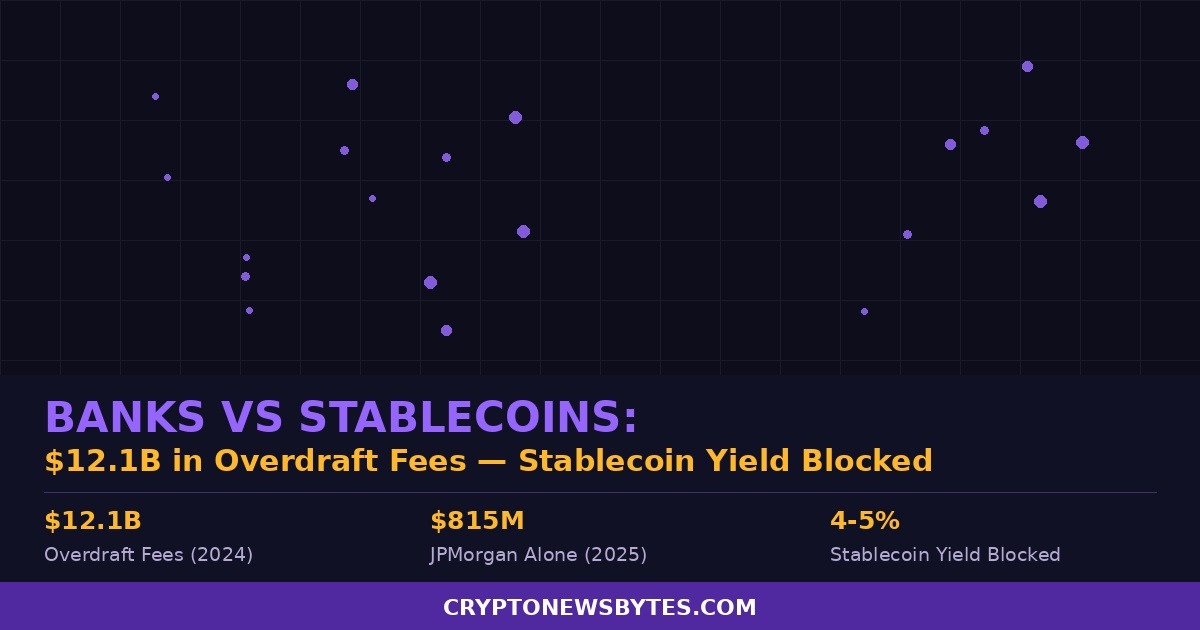
- U.S. banks and credit unions collected $12.1 billion in overdraft and NSF fees in 2024, according to revised estimates from the Financial Health Network — a figure understated by $3.8 billion in prior CFPB reporting. The 2025 trend is moving higher: fourteen of the twenty largest banks posted year-over-year increases in the first nine months of 2025, collectively collecting $2.99 billion in that period, per Reuters analysis of FFIEC data.
- JPMorgan Chase’s overdraft income rose 8% in the first three quarters of 2025 to $815 million, per American Banker’s analysis of call reports. Citizens Bank posted the largest jump at 17%. TD Bank was up 14%. PNC was up 7.6%. U.S. Bank was up 6.6%.
- On March 5, 2026, the American Bankers Association formally rejected a White House compromise on the CLARITY Act. The core dispute: a provision letting stablecoin platforms offer 4 to 5% yield to ordinary Americans on dollar-backed tokens, backed by U.S. Treasuries.
There is a number that does not get nearly enough attention in the debate over stablecoin yield and the CLARITY Act: $12.1 billion.
That is what U.S. banks and credit unions collected in overdraft and non-sufficient funds fees in 2024, according to revised estimates from the Financial Health Network — a figure that had been understated by approximately $3.8 billion in prior CFPB reporting, which failed to fully account for credit union fee revenue. And 2025 data from Reuters and American Banker shows the trend is moving higher, not lower: fourteen of the twenty largest U.S. retail banks posted year-over-year increases in overdraft income in the first nine months of 2025, with the group collectively collecting $2.99 billion in that period alone.
This is happening after years of promised reform, after Congressional Republicans repealed the CFPB’s $5 overdraft cap rule in May 2025, and after the Trump administration effectively defanged the agency tasked with policing these fees.
And the same banking industry collecting those fees is the one lobbying hardest to make sure Americans cannot earn 4 to 5% yield on a dollar-pegged stablecoin.
That is the story the CLARITY Act fight is really about.
1. The 2025 Overdraft Data: Bank by Bank
Reuters analyzed call report data filed with the Federal Financial Institutions Examination Council covering the 20 largest U.S. retail banks, representing roughly half of all deposits at insured U.S. institutions. The headline number for January through September 2025: $2.99 billion in overdraft and NSF fee income across the group, up 2% year-over-year.
American Banker’s parallel analysis of the same call report data, published in January 2026, captured individual bank figures. JPMorgan Chase led the group with $815 million in overdraft income for the first three quarters of 2025, up from $757 million in the same period of 2024. PNC Bank rose from $191 million to $205 million. TD Bank climbed from $167 million to $190 million. U.S. Bank moved from $166 million to $178 million. Citizens Bank jumped from $77 million to $90 million, the largest percentage increase in the group at 17%.
Several large U.S. banks collected more overdraft-fee revenue in the first three quarters of 2025 than in the same period a year ago. Source: Bank call reports via FFIEC | American Banker (Jan 2026) | Reuters (Dec 2025)
| Bank | Q1–Q3 2024 | Q1–Q3 2025 | Change | Visual |
|---|---|---|---|---|
| JPMorgan Chase | $757M | $815M | +7.7% | |
| PNC Bank | $191M | $205M | +7.6% | |
| TD Bank | $167M | $190M | +14% | |
| U.S. Bank | $166M | $178M | +6.6% | |
| Citizens Bank | $77M | $90M | +17% | |
| Wells Fargo | ~$750M | ~$675M | -10% | |
| Truist | ~$130M | ~$101M | -22% |
Sources: American Banker (Jan 2026), Reuters (Dec 2025), FFIEC call reports | Chart: CryptoNewsBytes.com
Wells Fargo and Truist were the notable exceptions, each posting declines. Both had made significant policy changes in prior years. The banks posting increases largely said they had not altered their overdraft policies, attributing the uptick to more customer accounts and higher consumer usage driven by inflationary pressure.
Jennifer Tescher, founder and CEO of the Financial Health Network, told American Banker the exact cause was “not 100% obvious,” but that with affordability challenges mounting, higher usage of overdraft services “would not be surprising.” What is not ambiguous is the direction: fees are rising again after years of decline, and the consumer protection rule that would have capped them at $5 was killed by Congress in May 2025 before it ever took effect.
2. Who Actually Pays These Fees
The CFPB’s own research has found that roughly 9% of bank accountholders generate approximately 79% of all overdraft and NSF fee revenue. These are people overdrafting more than 10 times per year — consumers living paycheck to paycheck, people with irregular income, people who cannot absorb a $35 charge when a direct deposit arrives a day late.
The FDIC’s Survey of Unbanked and Underbanked Households consistently finds that fear of surprise overdraft fees is one of the primary reasons consumers avoid having a bank account altogether. The overdraft fee is not an inconvenience for most of the people paying it most frequently. For a segment of the population, it functions as a recurring tax on having too little money.
Banks earned this revenue while also collecting 3.50 to 3.75% from the Federal Reserve on their own reserve balances — money funded in large part by those same depositors. The average national savings rate banks paid depositors in 2025 was approximately 0.41% APY, according to FDIC rate data. The spread between what banks earn from the Fed and what they pay depositors is one of the most reliable profit mechanisms in American finance. The overdraft fee is an additional layer on top of it.
3. What Stablecoin Yield Is — and Why It Threatens This Model
A stablecoin is a digital token pegged 1:1 to the U.S. dollar. Under the GENIUS Act, passed in July 2025, issuers must back every token with U.S. Treasury bills, cash, or equivalent high-quality liquid assets. They cannot lend out reserves. They cannot take on credit risk. The structure sits closer to a money market fund than a bank deposit.
Stablecoin yield works because the underlying Treasuries earn approximately 4 to 5% at current rates. An issuer holding $10 billion in T-bills earns $400 to $500 million per year. Passing a portion of that through to token holders is mechanically straightforward. Coinbase reported $355 million in stablecoin-related revenue in Q3 2025 alone, per Fortune, and already offers yield to USDC holders in supported jurisdictions. The product exists. Americans are already using it. The CLARITY Act fight is not about whether stablecoin yield should exist — it already does. It is about whether it gets a proper legal framework.
Standard Chartered has estimated that if stablecoin yield becomes fully normalized in the U.S., up to $500 billion in deposits could migrate from traditional banks to stablecoins by 2028. The ABA’s internal research, cited in its letter to Congress, put the potential long-term exposure at $6.6 trillion. Whether that figure is realistic, it reveals precisely what the banking lobby is protecting: a captive depositor base earning close to nothing, while the bank earns the full Fed rate on those same funds. As covered in the CryptoNewsBytes analysis of Dimon’s stablecoin position, the core argument is not consumer protection. It is competitive protection.
4. The CLARITY Act Standoff: A Complete Timeline
The Digital Asset Market Clarity Act passed the House on July 17, 2025, by 294 to 134 — a strong bipartisan majority. The bill establishes which federal regulator covers which type of digital asset and creates a legal foundation for stablecoin yield products. The full legislative structure is in the CLARITY Act complete guide on CryptoNewsBytes.
The Senate Banking Committee delayed its markup indefinitely in January 2026. The White House set a March 1 deadline for compromise language. That deadline passed without published text.
On March 3, President Trump posted on Truth Social accusing banks of holding the bill hostage and warning that delay would push the crypto industry toward China and Europe. Two days later, on March 5, the ABA formally rejected the White House compromise anyway, joined by 52 state banking associations. The White House had proposed allowing yield only on transaction-linked activity, such as payments and merchant settlements, while prohibiting interest on idle stablecoin balances. Coinbase withdrew support from the bill after that language appeared in the Senate draft. The banks rejected it regardless, meaning neither side got what it wanted.
As the Trump vs. banks Senate update on CryptoNewsBytes documents, the result is a full stalemate, with the banks benefiting most from the delay. JPMorgan CEO Jamie Dimon told CNBC that stablecoin issuers offering yield should face bank-equivalent regulation. White House crypto adviser Patrick Witt rejected that framing, pointing to the GENIUS Act’s prohibition on reserve lending as the structural distinction. Banks profit from the spread between deposit costs and lending returns. Stablecoin issuers, under current law, cannot do that — their yield comes from Treasuries, not credit risk.
Coinbase CEO Brian Armstrong called the banking sector’s approach “holding American innovation hostage to protect an antiquated business model.” At Davos in January, Dimon reportedly told Armstrong he was “full of s—” during a chance encounter, according to CNBC.
5. The Dimon Paradox
It is worth pausing on the arithmetic. JPMorgan Chase collected $815 million in overdraft fees in just the first three quarters of 2025. It paid depositors an average savings rate well under 1%. It earned 3.50 to 3.75% on its Fed reserves. And its CEO is arguing, with considerable lobbying support, that allowing Americans to earn 4 to 5% on a Treasury-backed digital dollar would be dangerous to the financial system.
The CFPB calculated that the cost to a bank of actually processing an overdraft transaction is between $3 and $14. The standard fee charged to consumers is $35. The profit margin on a product that charges people who have no money is exceptional by almost any industry measure.
Federal regulators have documented the industry’s record on this point. Wells Fargo, Regions Bank, and Atlantic Union collectively paid over $346 million in consumer refunds for illegal overdraft practices, per CFPB enforcement records. Navy Federal Credit Union paid $95 million for charging surprise overdraft fees on transactions where consumers actually had sufficient funds at the moment of purchase. These were not isolated incidents. They were standard practices that regulators eventually rolled back through enforcement action.
The argument that banks are protecting consumers by blocking stablecoin yield is difficult to reconcile with that record.
6. The Real Competitive Threat Is Accessibility, Not Yield
The ABA’s stated concern is that deposit flight toward stablecoins would reduce the banking system’s capacity to fund loans, ultimately hurting consumers and the broader economy. This is not a frivolous argument. Banks use deposits to fund mortgages, small business credit, and consumer lending. A large deposit migration would have real effects on credit availability.
But the argument has a precedent problem. Banks have been losing deposits to money market funds for two years, with assets in those funds exceeding $7 trillion in 2025 while banks paid under 1%. That shift happened without collapsing the credit system. Banks adapted by raising rates on selected products and competing on convenience.
The difference with stablecoins is not yield. It is accessibility. A money market fund requires an account application, a minimum balance, and usually a brokerage relationship. A stablecoin wallet works on a phone, requires no credit check, has no minimum balance, operates around the clock, and carries no overdraft risk. You cannot spend more than you hold. There is no $35 charge when your balance hits zero.
That accessibility is the genuine competitive threat, and it is a threat specifically to a business model that depends partly on the financial inertia and limited options of lower-income customers. The SEC’s new token taxonomy framework under Paul Atkins and the broader regulatory direction signal that Washington’s trajectory is toward more crypto access. The banks are fighting the direction of the tide.
7. What Happens Next: Three Scenarios
Scenario A: The CLARITY Act passes with yield provisions intact. Stablecoin issuers get a legal basis to offer yield. Banks face pressure to raise savings rates to retain customers. Low-income Americans gain access to a 4 to 5% return product without a brokerage account or minimum balance. Overdraft revenue faces structural pressure as consumers maintain higher stablecoin balances. This is the outcome the ABA is spending to prevent.
Scenario B: The bill passes without yield provisions. Crypto gets regulatory clarity on market structure but loses the yield tool. The stablecoin interest question moves to future rulemaking, where the banking lobby can fight it again. As the Senate Banking Committee markup analysis on CryptoNewsBytes shows, this path likely extends the impasse into the next Congress.
Scenario C: The bill stalls past the midterms. The legislative calendar expires. The CLARITY Act waits for a new Congress. The OCC charter and state money transmitter licenses become the default framework. Stablecoin yield continues in regulatory limbo — available through existing platforms but without statutory protection. The banks win by running out the clock. The people who would benefit most remain underserved.
As of March 10, 2026, Scenario C looks most probable. The Senate Banking Committee has not announced a rescheduled markup. The banks have rejected one compromise. There is no public text for a second.
8. The Fairness Question
A straightforward question sits at the center of this fight: why can a bank earn 3.75% from the Federal Reserve on your deposited money, pay you 0.41% in savings interest, charge you $35 when your balance goes negative, collect $2.99 billion in fees from that practice in nine months, and then use its lobbying infrastructure to block a competing product that would pay you 4 to 5% on the same dollars?
The Hoskinson vs. Garlinghouse debate on the CLARITY Act, covered at CryptoNewsBytes, touched on exactly this tension. The banking lobby’s position is that it serves financial stability. The overdraft data argues otherwise.
Nine percent of accountholders generate 79% of all overdraft revenue. Those are not wealthy customers. Those are the people for whom a stablecoin earning 4 to 5% with no overdraft mechanism would be a materially better product than what the bank currently offers them.
The banking industry has $25.3 trillion in assets and employs lobbyists in every state capital and Senate office building. The people paying most of those overdraft fees do not have lobbyists.
That asymmetry is not new. What is new is that a competing technology now exists that could meaningfully change the math — and the fight to stop it is playing out in public, with receipts.
Related Reading on CryptoNewsBytes
- CLARITY Act Complete Guide: What the Bill Does and Who It Affects
- Trump vs. Banks: The 137 Amendments and the Senate Battle
- Dimon, Stablecoin Yield and the Battle for the American Deposit
- Hoskinson vs. Garlinghouse: Why Two Crypto Leaders Disagree on the CLARITY Act
- Senate Banking Committee Markup: What Happened and What It Means
- World Liberty Financial USD1: The Stablecoin at the Center of the Political Storm
- SEC Under Atkins: The New Token Taxonomy and What It Changes
- CLARITY Act March 2026 Update: Senate Status and What Comes Next
Frequently Asked Questions
How much did U.S. banks collect in overdraft fees in 2025?
The 20 largest U.S. retail banks collectively collected $2.99 billion in overdraft and NSF fees in the first nine months of 2025, a 2% increase year-over-year, according to a Reuters analysis of FFIEC call report data published in December 2025. Fourteen of the twenty banks posted increases. JPMorgan Chase led the group with $815 million in Q1 through Q3 2025 alone.
Which bank had the biggest overdraft fee increase in 2025?
Citizens Bank posted the largest percentage increase at 17%, rising from $77 million to $90 million in the first three quarters of 2025, per American Banker’s call report analysis. TD Bank was up 14%, PNC up 7.6%, JPMorgan up approximately 8%, and U.S. Bank up 6.6% over the same period. Wells Fargo was the notable exception, posting a 10% decline.
Why are banks opposing stablecoin yield in the CLARITY Act?
Banks argue that stablecoin issuers offering yield on stored balances should face bank-equivalent regulation, since they effectively perform a deposit-like function. The deeper concern, per ABA research, is that competitive yield products could drive a migration of deposits out of the banking system. Standard Chartered has estimated up to $500 billion in potential deposit outflows by 2028 if stablecoin yield becomes legally normalized.
What is the current status of the CLARITY Act as of March 2026?
As of March 10, 2026, the CLARITY Act remains stalled in the Senate. The ABA rejected a White House compromise on March 5, 2026. The Senate Banking Committee has not announced a rescheduled markup. Full details are in the CLARITY Act March 2026 update on CryptoNewsBytes.
How does stablecoin yield work and how is it different from a bank deposit?
Under the GENIUS Act framework, stablecoin issuers must back every token with U.S. Treasuries and cash equivalents and cannot lend out reserves. The yield offered to holders comes from interest earned on those Treasuries, currently around 4 to 5% annually. Because there is no lending component, there is no credit risk equivalent to a bank’s loan portfolio, and no mechanism for an overdraft fee — you cannot spend more than you hold.
Sources: Reuters (Dec 16, 2025) | American Banker (Jan 2026) | Consumer Federation of America | CFPB | FDIC National Rate Data | Fortune | CoinDesk
Disclaimer: This article is for informational and educational purposes only and does not constitute financial, legal, or investment advice. Overdraft fee data is sourced from publicly available bank call reports filed with the FFIEC. Legislative status is current as of March 10, 2026, and is subject to change. Always conduct your own research before making financial decisions.