⚡ What You Need to Know
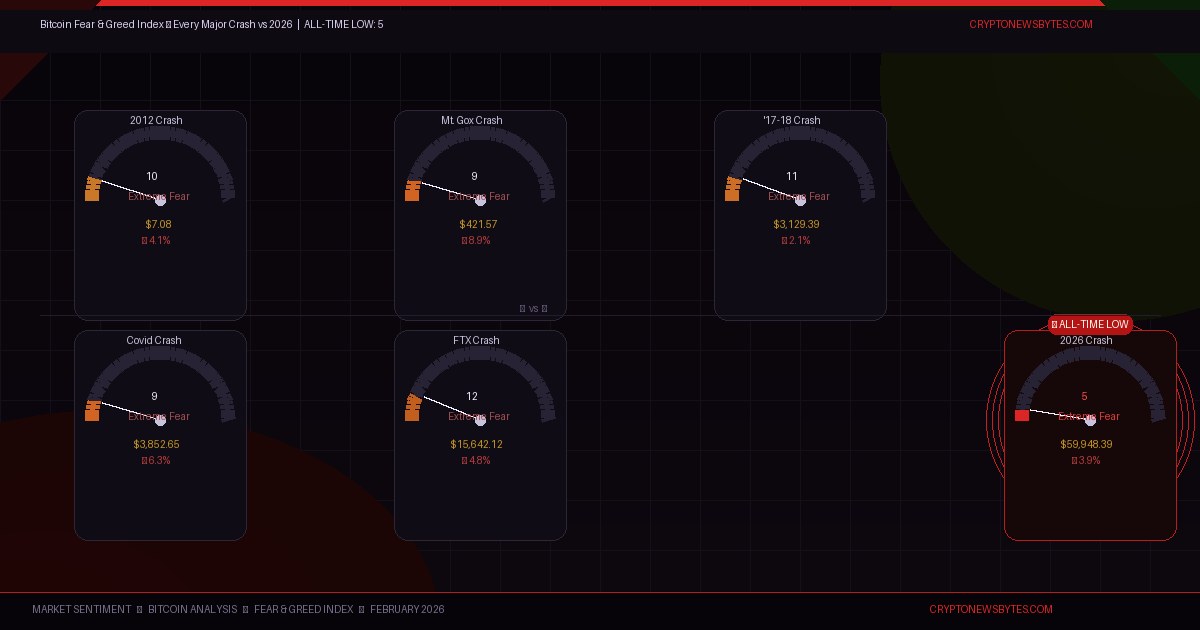
- The Bitcoin Fear & Greed Index hit 5 on February 6, 2026 — the lowest reading in the index’s recorded history, lower than FTX (12), Covid (9), Mt. Gox (9), and the 2017–18 crash (11)
- Bitcoin was priced at $59,948 at peak fear — the highest crash floor ever recorded at extreme fear levels, having fallen 52% from its $126,000 all-time high
- $2.6 billion in leveraged positions were liquidated in 24 hours; Open Interest collapsed from $103B to $61B; ETF outflows exceeded $816M in two days
- On-chain data tells a different story: Glassnode’s Accumulation Trend Score hit 0.68 — wallets holding 10–100 BTC were the most aggressive dip buyers, and 66,940 BTC moved into accumulation wallets on February 6 alone
- Every prior extreme fear reading (below 12) was followed by gains of 806% to 15,400% in the next cycle — but recovery timelines ranged from 13 months to 24 months
- Key risk: unlike previous crashes, this one has no single trigger, and institutions are net sellers — breaking the pattern seen at every prior major bottom
Bitcoin Fear & Greed Index Hits All-Time Low of 5 in 2026 — The Complete Data-Driven Analysis
On February 6, 2026, something that had never happened before in Bitcoin’s 17-year history occurred: the Crypto Fear & Greed Index dropped to 5 out of 100.[CCN] Not 12, like during the FTX collapse. Not 9, like during the Covid crash. Not 6, like during the Terra/Luna meltdown. Five. The single lowest reading since the index was created — in the same week Bitcoin was still trading near $60,000.
A viral Reddit post showing side-by-side Fear & Greed gauge readings from every major Bitcoin crash crystallised what the raw data shows: the 2026 crash has produced deeper fear than any event in crypto history, at a price floor that would have been an all-time high just three years ago.
But sentiment data is only one layer of this story. Underneath the fear readings sits a body of on-chain evidence — from Glassnode, CryptoQuant, and Santiment — that paints a more nuanced picture of who is actually buying, who is selling, and what has historically come next. This is the complete analysis.
Every Major Bitcoin Crash: Fear & Greed Index Compared
The index has only recorded single-digit readings on a handful of occasions across Bitcoin’s entire history. Here is every major crash event with its corresponding fear reading and Bitcoin price at the moment of maximum fear:
The pattern is stark. Every previous crash floor hit a lower price with a higher fear reading. The 2026 reading of 5 arrived with Bitcoin near $60,000 — a price that represented a cycle all-time high just three years prior. This is the defining data point of the current market moment: maximum fear at a historically unprecedented price floor.
| Crash | Fear Index | BTC at Fear Low | Next Cycle Peak | Max Gain | Recovery Time |
|---|---|---|---|---|---|
| 2012 | 10 | $7.08 | $1,100 | +15,400% | ~18 months |
| Mt. Gox 2014 | 9 | $421.57 | $19,500 | +4,526% | ~36 months |
| 2017–18 Bear | 11 | $3,129.39 | $69,000 | +2,104% | ~24 months |
| Covid Mar 2020 | 9 | $3,852.65 | $69,000 | +1,691% | ~13 months |
| FTX Nov 2022 | 12 | $15,642.12 | $126,000 | +806% | ~18 months |
| ⚡ 2026 (Feb 6) | 5 — Record | $59,948.39 | ??? | TBD | TBD |
What Caused the Fear Index to Hit 5 in February 2026?
Unlike previous crashes that had single identifiable triggers — FTX’s fraud, Covid-19 panic, the Mt. Gox hack — the 2026 crash is the result of multiple headwinds converging simultaneously. Understanding what drove fear to its historic low is essential to assessing whether the usual historical playbook applies.
The 7-Day Crash Timeline
What On-Chain Data Shows — The Signal Behind the Fear
Sentiment indices measure how people feel. On-chain data measures what they do. In February 2026, those two signals pointed in dramatically different directions — and historically, on-chain behaviour has been the more reliable predictor of what comes next.
📊 Key On-Chain Signals — February 2026
Glassnode Accumulation Trend Score: 0.68 — The highest reading since November 2025, signalling coordinated buying across wallet cohorts, not isolated large purchases. A score above 0.5 indicates broad-based accumulation.[Coinmonks]
66,940 BTC moved into accumulation wallets on February 6 — the same day fear hit 5. Wallets holding 10,000–100,000 BTC accumulated over 70,000 BTC in early February. At ~$67,000 per BTC, that equals $4.6 billion in fresh exposure from large capital allocators.
SOPR (Spent Output Profit Ratio) below 1.0 — Since mid-January 2026, SOPR has hovered at or below 1, meaning sellers are realising losses. This phase is known as capitulation — it historically marks structural exhaustion of sellers, not the start of further decline. The same SOPR pattern appeared before the 2018, 2020, and 2022 recoveries.[Coinmonks]
MVRV Adaptive Z-Score: -2.66 — CryptoQuant contributor GugaOnChain described this as “consistent with persistent capitulation” and noted the indicator suggests “approaching the historical accumulation phase.” This Z-Score level has coincided with major market lows in previous cycles.[Bitbo]
Bitcoin daily RSI: 15.64 — Below March 2020’s Covid crash reading. Below every comparable panic event in Bitcoin’s history. An RSI this low has never been sustained for more than a few weeks before a significant mean-reversion bounce.
The divergence between record-low sentiment and record-high accumulation activity is significant. As on-chain analysts have repeatedly identified at major Bitcoin turning points, when retail panic and whale accumulation diverge this sharply, the historical resolution has consistently favoured the accumulators over the panic sellers — though the timeline for that resolution has varied considerably.
Crash-by-Crash History: What Came After Each Extreme Fear Reading
2012 Crash — Index: 10 | BTC: $7.08 → Next Peak: $1,100 (+15,400%)
Bitcoin’s first major fear event came amid regulatory uncertainty and exchange collapses. The index hitting 10 with Bitcoin at $7.08 looked like the end of a failed experiment to most observers. By late 2013, Bitcoin had reached $1,100. The lesson: early-cycle extreme fear at low prices produced the most asymmetric return profile in Bitcoin’s history — but required a patient hold of 12–18 months.
Mt. Gox Crash — Index: 9 | BTC: $421.57 → Next Peak: $19,500 (+4,526%)
The Mt. Gox collapse in 2014 wiped out the world’s largest Bitcoin exchange, losing 850,000 BTC to hackers. The index hit 9 as investors feared Bitcoin could not survive the reputational damage. It did — and went on to produce a 4,526% return from the crash floor to the 2017 peak. Recovery took approximately 36 months, making this the slowest post-crash recovery in Bitcoin’s history.
2017–18 Bear Market — Index: 11 | BTC: $3,129 → Next Peak: $69,000 (+2,104%)
The ICO mania of 2017 drove Bitcoin to $19,500 before a 12-month bear market brought it to $3,129 in December 2018. The Fear & Greed Index held at 11 through weeks of sustained fear. Technical support levels formed during this crash shaped Bitcoin’s price structure for years. Recovery was slow — two full years to reclaim prior highs — but the eventual peak of $69,000 represented a 2,104% gain from the fear bottom.
Covid Crash — Index: 9 | BTC: $3,852 → Next Peak: $69,000 (+1,691%)
On March 12, 2020 — Black Thursday — Bitcoin crashed over 50% in a single day as Covid-19 triggered global market panic. The index hit 9. The recovery was Bitcoin’s fastest: a V-shaped rebound that took BTC from $3,852 to over $60,000 by April 2021 — a 1,691% gain in just 13 months. The key difference that enabled such rapid recovery: the Federal Reserve deployed unlimited quantitative easing, flooding markets with liquidity. That stimulus tailwind does not exist in 2026.
FTX Crash — Index: 12 | BTC: $15,642 → Next Peak: $126,000 (+806%)
The FTX collapse in November 2022 was Bitcoin’s most structurally damaging crisis — a $32 billion exchange imploded overnight due to fraud. Remarkably, the index only reached 12, reflecting extensive prior selling. As even Bitcoin’s most prominent critics had by this point acknowledged Bitcoin’s structural resilience, the FTX crash did not break the network — it reset positioning. By October 2025, Bitcoin reached $126,000: an 806% gain from the FTX crash floor. Recovery took approximately 18 months.[24/7 Wall St.]
What Major Analysts Are Saying About the 2026 Crash
With the Fear & Greed Index at its lowest ever and Bitcoin down 52% from its all-time high, the analytical community is sharply divided. Here are the key forecasts:
Why 2026 Is Different — And Why That Matters for Investors
Every previous extreme fear reading had a single, identifiable crisis at its centre that eventually resolved: a hack, a fraud, a pandemic, regulatory panic. The 2026 crash has no single villain. That makes the traditional “buy the fear” thesis simultaneously more compelling on historical grounds and more uncertain in terms of timeline.
The Three Key Differences
1. No single catalyst, no clear resolution. Unlike the FTX collapse, which was definitively resolved when the fraud was exposed and proceedings began, or Covid, which resolved when vaccines emerged, the 2026 crash stems from multiple converging headwinds: Federal Reserve rate uncertainty, shifting institutional behaviour, geopolitical risk, and Bitcoin’s increasing correlation with risk-off equity selling. None of these have a clear endpoint.
2. Institutions are net sellers, not buyers. At every previous major bottom — 2018, 2020, 2022 — institutional buying eventually provided the floor. In 2026, even large Bitcoin ETFs have been net sellers. The Coinbase Premium Gap turned deeply negative, indicating US institutional selling pressure. Bitcoin’s production cost of approximately $77,000 means miners are operating at a loss, adding forced selling pressure from an unexpected direction.[Genfinity]
3. No Fed liquidity backstop. The Covid crash produced a V-shaped recovery partly because the Federal Reserve deployed unprecedented quantitative easing. The FTX recovery was supported by gradually loosening monetary conditions. In 2026, fading rate cut expectations and a strengthening dollar have removed this support. Bitcoin has increasingly moved like a leveraged tech stock — falling with NVIDIA and Palantir rather than acting as an uncorrelated hedge.
“The current Fear & Greed reading matches the exact capitulation zones that launched the last two major bull cycles. On the most fearful day in recorded crypto sentiment history, the largest Bitcoin holders bought aggressively — not modestly, aggressively.”
— Blockzeit analysis, February 2026, citing Glassnode accumulation data[Blockzeit]🐂 Bull Case
Index of 5 is the generational bottom. On-chain accumulation by whales at historic levels. Every prior reading below 12 preceded 806%–15,400% gains. The crash floor of $60K with ETF infrastructure and 50M+ long-term holders is structurally stronger than any previous bottom.
If macro stabilises: $150,000–$175,000 by late 2026 (Bernstein, JPMorgan).
🐻 Bear Case
No single catalyst means no clear resolution. Institutional selling breaks prior pattern. Macro headwinds — no Fed pivot, dollar strength, geopolitical risk — could extend pain. Miner forced selling adds structural downward pressure.
Downside risk: $39,000–$53,000 before recovery (Citi, Standard Chartered).
How to Navigate Extreme Fear: Evidence-Based Strategies
The Fear & Greed Index at 5 is not a buy signal — it is a context signal. It tells you the market is in maximum panic. What you do with that information depends on your time horizon, risk tolerance, and understanding of what has historically followed.
📈 The Dollar-Cost Averaging (DCA) Framework
Historical data from all five previous extreme fear readings supports one consistent strategy: buying fixed amounts at regular intervals rather than attempting to time the exact bottom. In every previous cycle, catching the precise low mattered less than staying consistently invested through the recovery phase.
The investor who bought $500 per week from the FTX crash low in November 2022 to June 2023 accumulated approximately 0.18 BTC at an average cost of ~$21,000. That position was worth over $22,000 when Bitcoin hit $126,000 in October 2025 — a gain of over 1,040%.
The key risk: This strategy requires the conviction to hold through further potential downside of 20–40% before recovery begins. Position sizing accordingly — never allocate more than you can afford to hold through extended volatility.
For investors considering how to position in Bitcoin through market fear, the most important variable is not the entry price — it is the holding period. Every extreme fear bottom in Bitcoin’s history has produced significant returns for investors with a minimum 24-month horizon. The Covid crash was the exception at 13 months; the Mt. Gox recovery took 36. Plan accordingly.[Yahoo Finance / 24/7 Wall St.]
Frequently Asked Questions
Conclusion: Reading the Most Fearful Moment in Bitcoin’s History
Five crashes. Five extreme fear readings. Five recoveries. And now a sixth — with deeper fear than any of them, at a price floor higher than all of them.
The on-chain data from February 6, 2026 tells two stories simultaneously. One story is told by the Fear & Greed Index: panic at historic extremes, sentiment collapsed, retail investors fleeing. The other is told by Glassnode, CryptoQuant, and Santiment: the largest Bitcoin holders bought $4.6 billion of BTC in the week of maximum fear, accumulation scores hit multi-month highs, and capitulation metrics matched those seen at every major cycle low.
The 2026 crash is genuinely different from its predecessors in important ways — no single catalyst, institutional selling, no Fed liquidity backstop. These are real risks that could extend the recovery timeline significantly compared to the V-shaped Covid rebound. The broader 2026 crypto ecosystem is far more institutionally complex than any previous cycle, which cuts both ways.
But the core historical signal has never failed. A reading of 5 — the lowest in Bitcoin’s history — has been matched by the most aggressive accumulation from the largest holders since the 2022 cycle low. That divergence between what the crowd feels and what the whales do has resolved in favour of the whales every single time. The question is not whether. The question is when — and whether you have the time horizon and conviction to wait for the answer.
CryptoNewsBytes Editorial Team
Bitcoin & On-Chain Market Analysis · CryptoNewsBytes.comCryptoNewsBytes covers Bitcoin, Ethereum, crypto regulations, and market sentiment with on-chain data analysis. For daily Bitcoin updates, visit CryptoNewsBytes.com →
📰 More Bitcoin Analysis on CryptoNewsBytes