

- Ethereum trades in a bear pennant below key moving averages, with support near $1,950 and a pattern target around $1,200 if it breaks.
- A $543M ETH transfer to Binance by a labeled whale and mostly negative Ethereum spot ETF flows point to softer demand and added downside risk.
Ethereum is under renewed pressure as technical signals, whale activity, and exchange-traded fund flows all tilt in a bearish direction. Its native asset, Ether (ETH), is trading inside a tightening pattern on the daily chart, while a large holder has moved hundreds of millions of dollars’ worth of tokens to Binance. At the same time, spot ETF data points to sustained outflows, raising questions about institutional demand and the ability of the market to absorb additional supply.
Bearish chart pattern keeps $1,200 Ethereum target in view
Ether’s price structure has deteriorated since a sharp drop in February pulled it down from above $2,800 into the $1,900–$2,000 range. That decline formed the “flagpole” of a bearish continuation pattern, with subsequent trading compressing into a narrowing shape on the daily chart. The token has carved out lower highs along the top of this structure and slightly higher lows at the bottom, a configuration that analysts describe as a bear pennant.
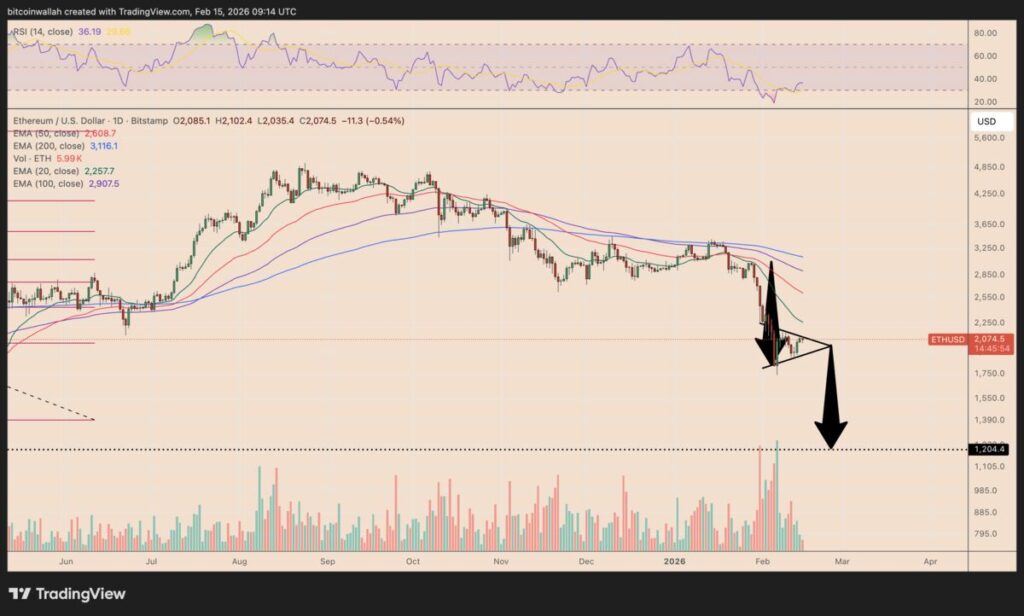
In many cases, these patterns resolve in the same direction as the move that preceded them. For Ethereum, that prior move was downward, leaving traders focused on the risk of another leg lower if the formation breaks. The broader trend context does little to offset these concerns. The price sits beneath both the 50-day and 200-day exponential moving averages, turning those levels into layers of overhead resistance rather than support. Until Ether can reclaim those lines, momentum remains tilted to the downside.
Momentum indicators echo this picture. The relative strength index has rebounded from its recent trough but still holds below the neutral 50 mark. That reading indicates that buying interest has improved only marginally and that sellers continue to maintain the upper hand. Market participants are watching the lower boundary of the pennant, currently near $1,950, as the key level. A decisive break below that line would be interpreted as confirmation of a continuation of the prior downtrend.
If that breakdown occurs, technicians point to a measured-move projection derived from the height of the original flagpole. Applying that distance to the point of the expected breakout yields an approximate target at $1,200. From current prices, that would represent about 40% additional downside. The pattern is not guaranteed to play out, however. A sustained move above the upper boundary of the pennant would invalidate the setup and force traders to reassess the near-term outlook.
Massive ETH transfer to Binance adds to selling concerns
While chart signals lean negative, on-chain activity has introduced another source of potential pressure for Ethereum. Data from Arkham shows that addresses labeled as belonging to “Garrett Jin” have sent 261,024 ETH to Binance in several large transfers executed over a period of minutes. At recent prices, that haul is valued at around $543 million, making it one of the larger single-entity inflows to a centralized exchange in recent weeks.
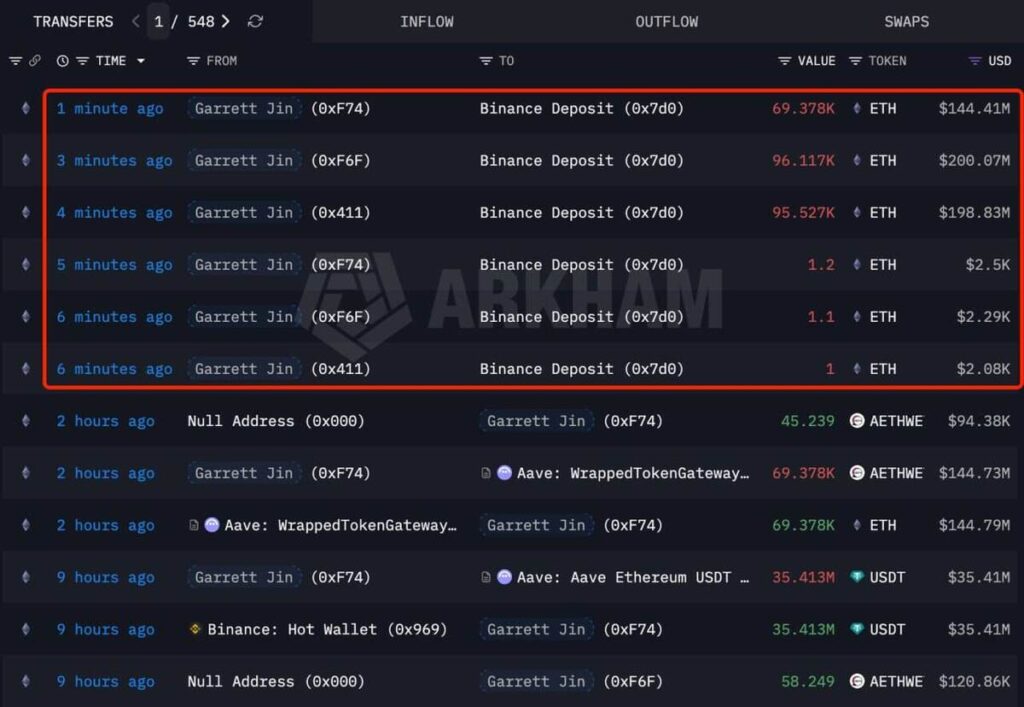
Arkham’s labeling system does not verify the real-world identity of the wallet owner. Instead, it groups a set of addresses that the analytics platform believes are controlled by the same entity and assigns them a name for tracking purposes. Even without a confirmed identity, the size of the deposits is drawing attention across trading desks, as such movements often precede or accompany significant selling.
Moving that amount of Ether onto a centralized exchange increases the immediate availability of tokens at the spot market. Historically, transfers of this magnitude have been associated with rising sell pressure, even if the owner does not begin offloading coins right away. Traders are therefore monitoring Binance’s internal flows to see whether the deposited ETH starts to spread across different exchange wallets, which could signal preparations for distribution.
If visible selling emerges from these holdings, it would arrive at a time when the technical backdrop for Ethereum is already fragile, potentially accelerating any downside move implied by the bear pennant. Conversely, if the coins remain largely stationary on the exchange and no meaningful sell orders appear, the market impact could be limited. In that scenario, short sellers positioned aggressively for a breakdown might be forced to cover if prices stabilize or bounce, creating a countertrend move.
Ethereum ETF outflows signal weaker institutional demand
Alongside the chart pattern and the whale transfer, data from Ethereum spot exchange-traded funds presents another headwind. According to Glassnode, the 30-day moving average of net flows into these ETFs has been negative for most of the past 90 days. That means that, on a rolling basis, more funds have been leaving these products than entering them, and there has been little sign of a sustained shift back into positive territory.
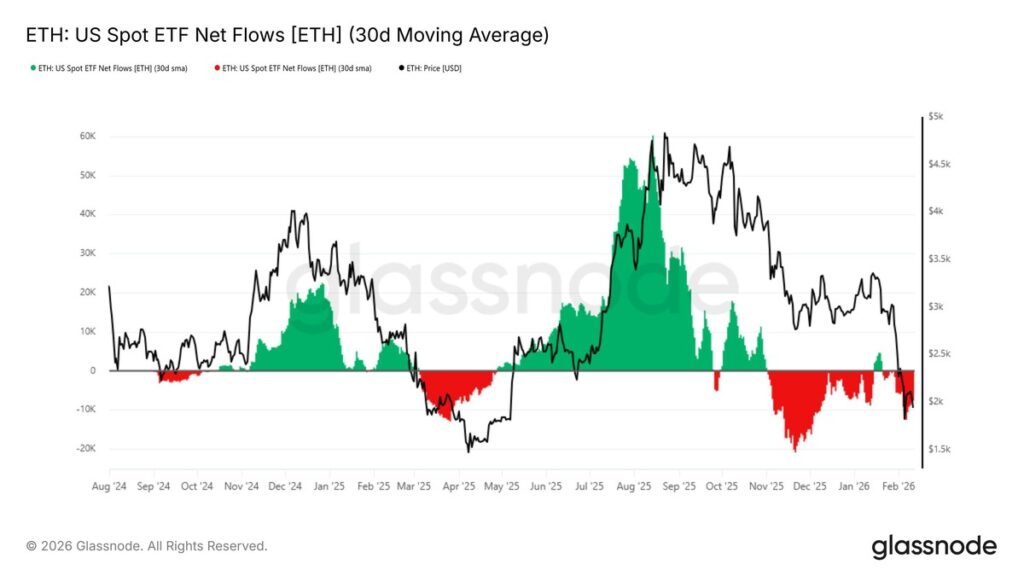
These outflows do not automatically translate into immediate selling of Ether itself. ETF providers can manage redemptions in various ways, and the timing of any associated on-chain transactions can vary. However, a prolonged period of net withdrawals does indicate that institutional and larger-scale investors are, on balance, pulling back exposure rather than adding to it.
For the Ethereum market, this trend matters because it affects the depth of the bid available to absorb shocks. When ETF flows are strongly positive, they can offset or even outweigh selling from large holders moving coins to exchanges. In the current environment, with the net flow measure below zero for an extended stretch, that buffer appears thinner. This weakness in demand makes it more difficult for the market to digest heavy exchange deposits such as the $543 million transfer linked to “Garrett Jin.”
It also complicates any attempt by Ether to stage a durable recovery from current levels. A rebound off pennant support would normally need sustained buying to carry price back above key moving averages and invalidate the bearish pattern. With ETF flows subdued and institutional interest muted by the Glassnode data, the probability of such a follow-through is reduced, at least in the near term.
Conclusion
Ethereum is confronting multiple layers of pressure at once. The daily chart shows a bear pennant formed after February’s drop from above $2,800 to the $1,900–$2,000 zone, with a potential measured move pointing toward $1,200 if support near $1,950 fails. At the same time, Arkham has flagged 261,024 ETH, worth about $543 million, flowing from wallets labeled “Garrett Jin” to Binance, a shift that could increase available supply on the market. Compounding these issues, Glassnode’s data on Ethereum spot ETFs reveals mostly negative 30-day net flows over the past 90 days, suggesting a lack of strong institutional demand. Together, these factors leave Ether in a vulnerable position, with traders watching closely for either confirmation of a deeper decline or signs that selling pressure may ease.
Disclaimer
The information provided in this article is for informational purposes only and should not be considered financial advice. The article does not offer sufficient information to make investment decisions, nor does it constitute an offer, recommendation, or solicitation to buy or sell any financial instrument. The content is opinion of the author and does not reflect any view or suggestion or any kind of advise from CryptoNewsBytes.com. The author declares he does not hold any of the above mentioned tokens or received any incentive from any company.
Featured image created by AI