
TL;DR
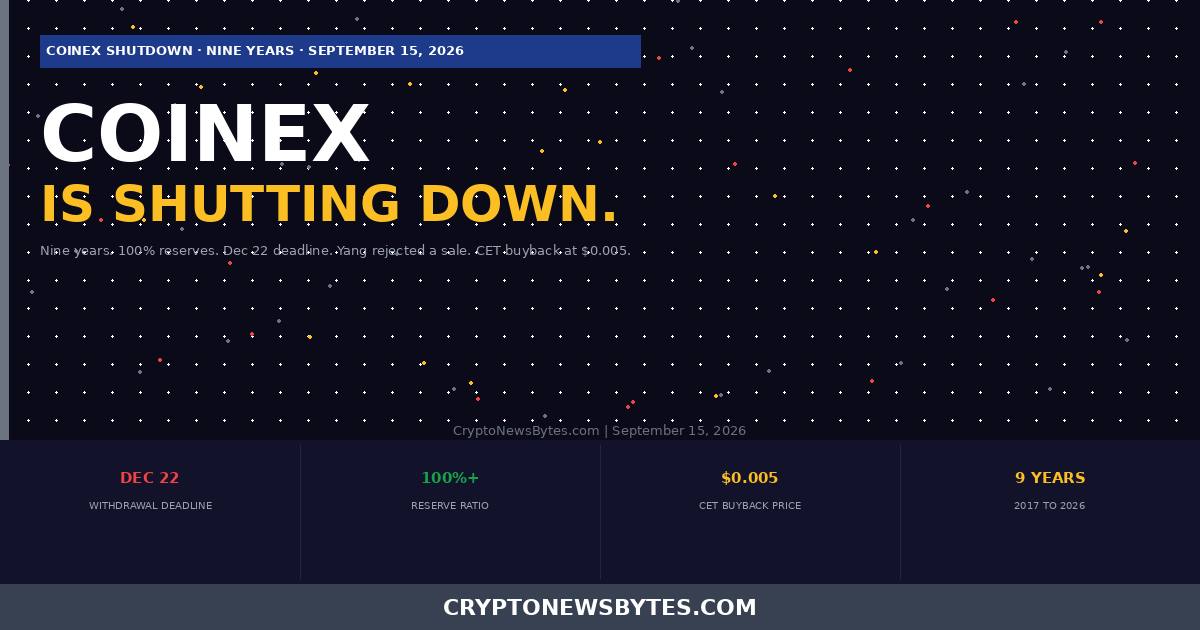
▶ CoinEx founder Haipo Yang announced on September 15, 2026 that CoinEx will cease operations in an orderly wind-down. Withdrawals open until December 22, 2026.
▶ Reason: prolonged crypto market downturn, collapsing trading volumes, and compliance costs that have exceeded reasonable boundaries. The same factors closing BitMart, BitMEX, and AscendEX.
▶ Reserve ratio is above 100%. Every user asset is fully backed. CoinEx Wallet and CoinEx Vault are unaffected and remain operational.
▶ CET will be bought back at its initial listing price of $0.005 per token, no quantity cap, from September 15 to September 29. After September 29, unsold CET is auto-bought at the same price.
▶ Yang rejected selling the exchange: users trusted CoinEx because they trusted him personally. Handing that trust to a new owner was not the right ending.
▶ Unclaimed USDT after December 22 moves to independent custody with a 5% monthly fee through August 22, 2028. Withdraw early.
CoinEx is shutting down. On September 15, 2026, founder and CEO Haipo Yang posted a letter to users confirming the exchange will cease operations and begin an orderly wind-down, with all withdrawals remaining open until December 22, 2026. Exactly nine years after CoinEx launched on December 22, 2017, it will formally close.
The shutdown is not a collapse. CoinEx’s reserve ratio exceeds 100%. Every user asset is fully backed. The exchange is not insolvent, and it is not being shut down by regulators. Yang described the decision as a rational economic one: the security and compliance risks of running a crypto exchange have become increasingly difficult to contain, revenues have declined, and carrying unlimited risk for limited revenue is no longer rational. His letter explicitly says: “We are leaving intact, and with dignity.”
CoinEx joins BitMart, BitMEX, and AscendEX in a wave of mid-tier exchange closures in 2026, as a prolonged market downturn, shrinking trading volumes, and rising compliance costs across multiple jurisdictions have compressed margins to the point where continued operation no longer makes commercial sense for exchanges that never reached top-tier scale. Binance founder Changpeng Zhao (CZ) responded to the announcement on X, noting that this cycle’s business closures have at least allowed users to withdraw their crypto, which was not always the case in previous cycles.
Why CoinEx Is Shutting Down: The Full Explanation
The official CoinEx announcement cites four specific factors that made continued operation untenable: a prolonged downturn in the cryptocurrency market; a significant contraction in overall industry trading volume and liquidity; continuously rising regulatory requirements across major jurisdictions; and compliance costs and operational uncertainties that have exceeded reasonable boundaries.
Yang’s personal letter to users adds context the formal announcement does not. He acknowledges directly that CoinEx did not become one of the industry’s leading exchanges, which matters because the economics of crypto exchanges are highly concentrated. The top three or four exchanges by volume, Binance, Coinbase, OKX, and Bybit, capture the vast majority of trading fees. Mid-tier exchanges compete for the remaining fraction of volume with infrastructure costs comparable to the majors. The margin compression is structural, not temporary.
CoinEx was also hacked in September 2023, when attackers drained approximately $70 million from its hot wallets in one of the largest exchange hacks of that year. Yang pledged at the time that user funds would not be impacted and the team covered the losses. That incident, while resolved, likely accelerated the security risk calculus Yang describes in his shutdown letter. Running a crypto exchange means carrying the operational risk of another hack at any time, with no insurance backstop and the full liability sitting on the operator.
What happened to CoinEx in 2023?
In September 2023, CoinEx suffered a hot wallet hack estimated at $70 million, attributed at the time to the Lazarus Group, the North Korean state-sponsored hacking operation responsible for billions in crypto thefts. CoinEx covered the losses from its own funds and pledged no user assets were affected. Yang cited the incident in his shutdown letter indirectly when he described the security risks of running an exchange as becoming increasingly difficult to contain. A $70M loss from one attack, absorbed entirely by the operator with no insurance, is precisely the unlimited risk he references.
The Full CoinEx Shutdown Timeline: What Stops and When
CoinEx Wind-Down Schedule: September 15 to December 22, 2026
Sept 15, 2026
New user registration ceases. Referral commissions and all rewards stop. Futures contracts enter Reduce-Only Mode. No new orders or subscriptions accepted for fiat, margin trading, lending, Earn, staking, or strategic trading. CET buyback begins at $0.005 per CET, no quantity cap.
Sept 22, 2026
All non-spot services discontinued. On-chain deposits end (except CET deposits). CoinEx Smart Chain and OneSwap services cease.
Sept 29, 2026
All spot trading services discontinued. Non-USDT assets converted or processed. CET buyback window closes. Any remaining CET automatically bought at $0.005 and credited to spot accounts as USDT.
Sept 29 onwards
Platform converts liquid assets to USDT externally. Assets with no external liquidity may be delisted. Withdrawals remain open. Platform no longer accepts new custody responsibility for delisted assets.
Dec 22, 2026
Withdrawal window closes. Exchange platform ceases all operations. Any unclaimed USDT transfers to independent custody.
Dec 22, 2026 onward
Unclaimed USDT held in independent custody. 5% monthly fee applied to the original balance from the transfer date. Claimable until August 22, 2028.
Aug 22, 2028
Final deadline for claiming any remaining unclaimed USDT from independent custody. After this date no further claims are possible.
Sources: CoinEx official announcement coinex.com/en/announcements/detail/53539656293908, CryptoTimes September 15 2026, TechNext24 September 15 2026 | @cryptonewsbytes
What Happens to CET: The Buyback Explained
CoinEx Token (CET) is the platform’s native utility token, issued at an initial listing price of $0.005 per token in 2018. CoinEx announced it will buy back all CET at that same price, with no cap on quantity and no additional conditions. Trading fees on the CET/USDT pair are waived during the buyback window.
The buyback window runs from September 15 to September 29, 2026. During this period CoinEx places buy orders at $0.005 on the CET/USDT pair. Any CET holder can sell into those orders at any time during the window. After September 29, any CET remaining in user accounts is automatically bought at $0.005 and the corresponding USDT is credited to each user’s spot account. No action is required from users who hold CET in their CoinEx accounts, but selling during the window gives users control over timing.
The buyback price of $0.005 represents a significant discount to CET’s all-time high but returns holders to the initial value at which the token was offered. For CET holders who bought above $0.005, the buyback represents a loss. For those who received CET through staking or other platform rewards, it represents recovery of value that might otherwise go to zero as the platform winds down. Yang explicitly acknowledged this in his letter: “I am sorry that we were not able to create the long-term value we once hoped CET would deliver.”
What Is Safe and What Is Not: CoinEx Wallet and CoinEx Vault
CoinEx Wallet and Vault are NOT affected
CoinEx Wallet and CoinEx Vault are described in the official announcement as operating separately from the exchange and remaining unaffected by the shutdown. Both products will continue normal operation. Users who hold assets in CoinEx Wallet or CoinEx Vault do not need to take action related to the exchange wind-down. The shutdown applies only to the exchange platform: trading, earning, staking, lending, and custody services operated under the exchange.
The distinction matters because CoinEx’s product ecosystem extends beyond the exchange. CoinEx Wallet is a non-custodial wallet application. CoinEx Vault is a separate custody product. Assets in these products are not part of the exchange’s balance sheet and are therefore not affected by the wind-down process. Users should verify through official CoinEx channels which product their assets are held under if they are uncertain.
Why Yang Rejected Selling CoinEx
One of the most significant disclosures in Yang’s letter is that he seriously considered selling CoinEx and ultimately decided against it. His reasoning, stated directly: users entrusted their assets to CoinEx because they trusted the platform and, in many cases, trusted him personally. Handing the platform and that trust to a new owner was not the right way to end the journey.
This decision has real financial consequences. A sale, even at a distressed valuation, would have generated proceeds for Yang and any equity holders. An orderly wind-down with a CET buyback at a below-market-cap price and full user asset return generates none. Yang chose the outcome that maximises user protection over the outcome that maximises his personal financial recovery from nine years of building the platform.
The contrast with other exchange collapses is intentional and worth noting. FTX collapsed in fraud with an $8.7 billion hole in customer assets. Celsius classified customer earn deposits as estate property and paid back cents on the dollar. Voyager wound down with initial distributions of 35 cents per dollar. CoinEx is shutting down with 100% of user assets available for withdrawal and a 99-day window to claim them. The mechanics are different in kind, not just degree.
What CoinEx Users Must Do Before December 22
CoinEx User Action Checklist
Withdraw all assets before December 22, 2026
The withdrawal window closes at 02:00 UTC on December 22, 2026. Any assets not withdrawn by this deadline move to independent custody with a 5% monthly fee. Do not wait until the last week. Network congestion and fee spikes are likely as the deadline approaches. Withdraw early.
Sell or hold CET before September 29
The CET buyback window closes September 29. During the window you can sell CET at $0.005 with no trading fees. After September 29, remaining CET is auto-bought at the same price and credited as USDT. If you want to hold CET beyond September 29 you cannot do so through CoinEx. Any CET on the platform after the 29th will be converted to USDT automatically.
Convert non-USDT assets before September 29
From September 29, all spot trading stops. Non-USDT assets will be processed and converted by the platform, but you have more control over pricing and timing if you convert yourself during the trading window. Assets with no external liquidity may be delisted with no redemption value.
Watch for scams impersonating CoinEx
Exchange shutdowns attract scammers who send fake emails, Telegram messages, and social media posts claiming to offer special withdrawal processes or bonus recovery programmes. The official CoinEx announcement and withdrawal process are at coinex.com only. Treat any other channel as a potential scam.
Verify CoinEx Wallet and Vault separately
If you use CoinEx Wallet or CoinEx Vault, verify through the official app or website that your assets are under the product structure you believe them to be. The exchange shutdown does not affect Wallet or Vault products, but confirming the product holding your assets is worth doing.
Source: CoinEx official announcement, TechNext24 September 15 2026 | @cryptonewsbytes. Not financial advice.
What CoinEx’s Shutdown Tells Us About the Crypto Exchange Market in 2026
CoinEx is the fourth notable exchange to shut down in 2026 alongside BitMart, BitMEX, and AscendEX. The pattern is consistent across all four: mid-tier exchanges, never among the top five by volume, facing the same structural pressure. Compliance costs scale with the number of jurisdictions served. Revenue scales with trading volume. When volume contracts across an entire market cycle, compliance costs become disproportionate to revenue, and the break-even point for continued operation shifts upward.
The compliance dimension Yang describes is distinct from the volume problem. Exchanges now face licensing requirements in the EU under MiCA, in the UK under the FCA, in Singapore under MAS, in Dubai under VARA, and in the US under frameworks that remain partially unsettled even after the CLARITY Act advanced toward a Senate vote in July 2026. Each jurisdiction requires local compliance infrastructure: legal counsel, reporting systems, local banking relationships, and sometimes local incorporation. A mid-tier exchange serving global users faces a near-linear scaling of compliance cost as regulatory perimeters expand globally.
The exchanges that survive this consolidation wave share one characteristic: scale large enough that compliance costs are a manageable percentage of revenue. Binance, Coinbase, OKX, and Bybit have the volume to absorb those costs. Exchanges that processed a fraction of that volume do not. Yang’s statement that “carrying unlimited risk for limited revenue is no longer a rational choice” is the clearest summary of the structural economics that will continue to pressure mid-tier exchanges through the remainder of 2026.
Frequently Asked Questions
Is CoinEx shutting down?
Yes. CoinEx founder and CEO Haipo Yang announced on September 15, 2026 that CoinEx will cease operations and begin an orderly wind-down. The exchange will formally close on December 22, 2026, exactly nine years after it launched on December 22, 2017.
When is the CoinEx withdrawal deadline?
Withdrawals remain open until 02:00 UTC on December 22, 2026. Any assets not withdrawn by this deadline transfer to independent custody with a 5% monthly fee applied to the original balance. Unclaimed assets can be recovered from independent custody until August 22, 2028. CoinEx strongly advises withdrawing early to avoid network congestion near the deadline.
Are CoinEx user funds safe?
Yes. CoinEx’s reserve ratio exceeds 100%, meaning every user asset is fully backed and available for withdrawal. The shutdown is not a collapse or insolvency. The exchange is closing because trading volumes and compliance economics no longer support continued operation, not because of a financial shortfall.
What happens to CET tokens?
CoinEx will buy back all CET at its initial listing price of $0.005 per token, with no quantity cap and no additional conditions. The buyback window runs from September 15 to September 29, 2026, with trading fees waived on the CET/USDT pair. Any CET remaining in accounts after September 29 is automatically converted to USDT at the same price. No further CET repurchase or redemption will be offered after that date.
Are CoinEx Wallet and Vault affected?
No. CoinEx Wallet and CoinEx Vault operate separately from the exchange and are unaffected by the shutdown. Both products will continue normal operation. The shutdown applies only to the exchange platform including trading, staking, lending, Earn, and custody services.
Why did CoinEx shut down instead of selling?
Founder Haipo Yang said he seriously considered selling CoinEx but decided against it. His stated reason: users trusted CoinEx because they trusted the platform and him personally. Selling the platform and handing that trust to a new owner was not the right ending. He chose an orderly wind-down that returns all user assets in full as the responsible conclusion.
Why did CoinEx close?
CoinEx cited four factors: a prolonged downturn in the cryptocurrency market, significant contraction in industry trading volume and liquidity, continuously rising regulatory requirements across major jurisdictions, and compliance costs and operational uncertainties that exceeded reasonable boundaries. Yang also noted that CoinEx never reached top-tier exchange status, making the compliance cost burden disproportionate to its revenue base.
Further Reading
CoinEx’s orderly wind-down with 100% reserves is the opposite of a bankruptcy. This guide covers what happens when exchanges don’t have the reserves to return user funds: the Celsius, FTX, and Voyager outcomes.
The US regulatory framework Yang cited as part of the compliance pressure on exchanges. The CLARITY Act was advancing toward a Senate vote in July 2026, adding another layer of regulatory requirement to exchanges serving US customers.
The enforcement environment that makes compliance costs real. Active DOJ crypto enforcement means exchanges that cut corners on AML and KYC face existential legal risk, not just fines.
Sources: CoinEx official announcement September 15 2026 (primary: coinex.com/en/announcements/detail/53539656293908), Haipo Yang X post September 15 2026 (primary: x.com/yhaiyang), Cointelegraph September 15 2026 (market context and BitMart BitMEX AscendEX comparison), CryptoTimes September 15 2026 (timeline detail and CET terms), TechNext24 September 15 2026 (custody and wallet separation detail), Gokhshtein Media September 15 2026 (Yang sale rejection detail), bitcoinethereumnews.com September 15 2026 (CZ reaction), FX News Group September 15 2026 (Hong Kong Shenzhen operational context) | Published September 15, 2026 | CryptoNewsBytes.com | Not financial advice.