
⚡ Key Highlights
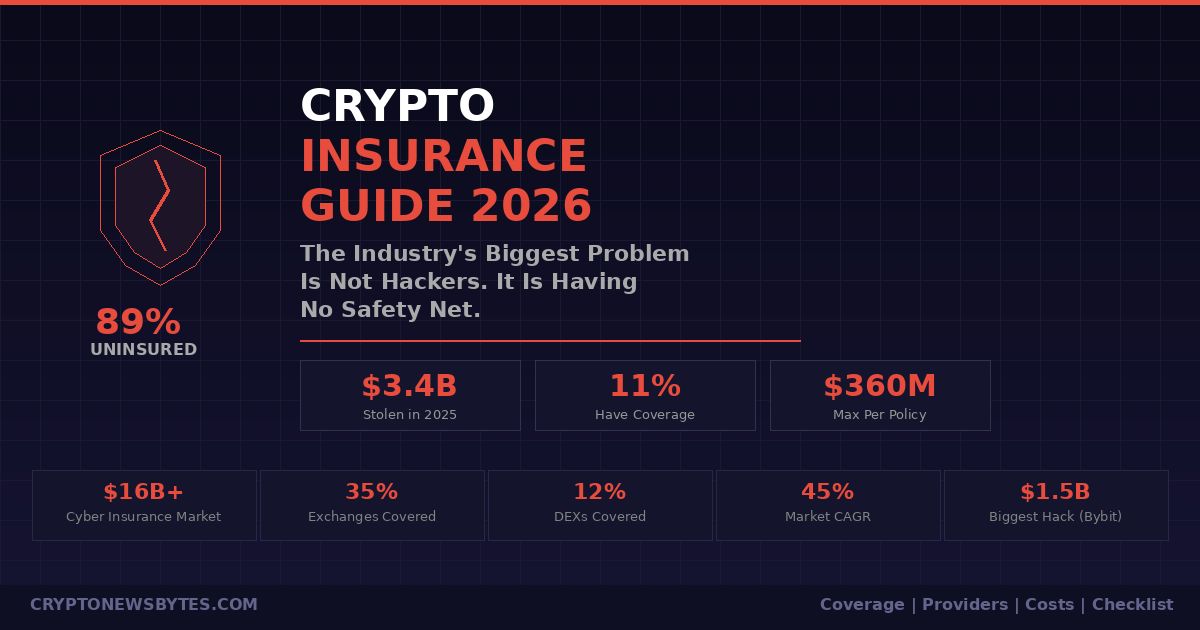
- The crypto industry lost over $3.4 billion to hacks and theft in 2025, yet only 35% of centralized exchanges and 12% of DEXs carry any form of insurance coverage
- The Bybit hack ($1.5 billion), Step Finance hack ($40 million), and Figure Technology data breach all occurred within a 12-month window, none involved smart contract exploits, and all targeted people and operational infrastructure
- Crypto insurance includes several distinct coverage types: crime/specie insurance (private key theft), cyber liability (data breaches), D&O insurance (director liability), and professional indemnity (technology errors)
- The global cyber insurance market reached $16 to $20 billion in 2025 and is projected to grow to $30 to $50 billion by 2030, with crypto-related policies accounting for 18% of all cyber insurance premiums
- Evertas, backed by Lloyd’s of London, is the first company dedicated exclusively to crypto insurance, offering coverage up to $360 million per policy
- Only 11% of global cryptocurrency holders have insurance coverage, despite 42% of uninsured holders expressing willingness to purchase it, revealing a $3.31 trillion market opportunity
- Munich Re, Lloyd’s of London, and Aon are expanding dedicated digital asset coverage products, signaling that traditional insurers are entering the crypto insurance market at scale
Crypto Insurance in 2026: Why the Industry’s Biggest Problem Is Not Hackers, It Is Having No Safety Net
Crypto insurance has become the most urgent gap in the digital asset industry. In a 12-month stretch between February 2025 and February 2026, the crypto sector watched $1.5 billion vanish from Bybit in the largest exchange hack in history, $40 million drained from Step Finance through a compromised executive laptop, and 2.5 gigabytes of customer data leaked from Figure Technology after a single employee was tricked by a social engineering attack. None of these incidents exploited a smart contract bug. All of them targeted people, devices, and operational infrastructure.
The pattern is clear. The attack surface has shifted from code to people. But the insurance infrastructure has not caught up. As our analysis of the top 10 cybersecurity trends in crypto for 2025 documented, social engineering and operational compromises have overtaken smart contract exploits as the primary attack vector. According to AM Best, only 11% of global cryptocurrency holders have any form of insurance protection. Only 35% of centralized exchanges carry coverage. For decentralized protocols, that number drops to 12%. The industry is building trillion-dollar financial infrastructure on foundations that have almost no safety net when things go wrong.[Risk & Insurance]
This guide breaks down what crypto insurance actually covers, why most crypto companies still do not have it, what cyber insurance means specifically for digital asset businesses, and what the landscape looks like heading into 2026 and beyond.
Why Crypto Insurance Matters Now: The Incidents That Changed the Conversation
The need for crypto insurance was always theoretically important. In 2025 and 2026, it became existentially urgent. Three recent incidents illustrate why.
What Is Crypto Insurance? The Complete Breakdown
Crypto insurance is not a single product. It is a collection of coverage types adapted from traditional insurance to address the specific risks faced by digital asset businesses. Understanding which types apply to your operation is critical, because the wrong policy (or no policy) can leave the most damaging scenarios completely uncovered.
The Core Coverage Types
| Coverage Type | What It Covers | Who Needs It | Key Providers |
|---|---|---|---|
| Crime / Specie Insurance | Theft of private keys, unauthorized transactions, insider theft, social engineering leading to asset loss | Exchanges, custodians, funds, wallet providers | Evertas, Munich Re, Lloyd’s syndicates |
| Cyber Liability Insurance | Data breaches, ransomware, denial-of-service attacks, regulatory fines, notification costs, forensic investigation | Any company holding customer data (exchanges, lenders, DeFi front-ends) | Chubb, AIG, Allianz, Beazley |
| Directors & Officers (D&O) | Personal liability of executives for management decisions, regulatory actions, investor lawsuits | Any crypto company with a board, especially publicly listed ones | Beazley, Relm Insurance, Superscript |
| Professional Indemnity (E&O) | Claims from clients arising from errors, omissions, or failures in your technology or professional services | DeFi protocols, infrastructure providers, auditing firms, wallet developers | Superscript, Embroker, Relm |
| Smart Contract Cover | Asset loss from smart contract bugs, exploits, or manipulation by external parties | DeFi protocols, DAOs, liquidity providers | Nexus Mutual, InsurAce, Munich Re (new product) |
| Staking Risk Insurance | Slashing penalties in Proof-of-Stake networks caused by validator errors or network rule violations | Institutional stakers, staking-as-a-service providers | Munich Re, Evertas |
🔍 Critical Distinction: Cyber Insurance vs. Crime Insurance for Crypto
Many crypto companies assume their cyber insurance covers private key theft. It usually does not. Standard cyber liability policies cover data breaches, ransomware, and system outages. They typically exclude the theft of digital assets via compromised private keys. That risk falls under crime or specie insurance, which is a separate and more specialized product.
This distinction matters enormously. The Bybit hack ($1.5B stolen via compromised wallet interface) and Step Finance hack ($40M drained via executive device compromise) would both require crime/specie coverage, not standard cyber liability. The Figure Technology breach (customer data stolen) would fall under cyber liability. Different incidents, different policies. Getting this wrong means paying premiums for coverage that does not protect against your actual risk.
Why Most Crypto Companies Still Do Not Have Insurance
If the risks are this clear, why is coverage so low? Several structural factors explain the gap.
Lack of actuarial data. Insurance pricing relies on historical loss data. The crypto industry is barely 15 years old, and institutional-grade custody and exchange infrastructure is even younger. Insurers struggle to model risk frequency and severity for an asset class with limited claims history.
Volatility of the underlying assets. A policy covering 10,000 BTC is worth a different amount every day. Traditional insurance products are not designed for assets whose value can swing 20% in a week. This creates pricing and claims valuation challenges that most carriers have not solved.
Regulatory uncertainty. Until recently, the regulatory status of most digital assets was unclear in the United States and many other jurisdictions. Insurers operating in heavily regulated industries were reluctant to provide coverage for businesses whose legal status was ambiguous. The passage of the GENIUS Act (stablecoin regulation) in July 2025 and shifting SEC enforcement priorities under the current administration have begun to improve this, but the effects are still working through the system.[Woodruff Sawyer]
Premium costs. Crypto insurance premiums are significantly higher than equivalent coverage for traditional financial services companies. Insurers price in the perceived elevated risk, the lack of historical data, and the limited pool of underwriters willing to take on the exposure. For startups and early-stage projects, the cost can be prohibitive.
Limited supply of underwriters. The market is concentrated. Approximately 90% of crypto insurance policies are underwritten by Lloyd’s syndicates. Only a handful of dedicated providers (Evertas, Relm, Superscript, Embroker) have deep expertise in digital asset risk. The result is limited competition and higher premiums.[CoinLaw]
Cyber Insurance for Crypto Companies: What You Need to Know
Cyber insurance is the most accessible entry point for crypto companies looking to build an insurance program. While it does not cover private key theft (that requires crime/specie coverage), it addresses a critical set of risks that apply to every company in the digital asset ecosystem.
What Cyber Insurance Covers for Crypto Businesses
- Data breach response: Forensic investigation, customer notification, credit monitoring (exactly what Figure Technology needed after the ShinyHunters attack)
- Ransomware and extortion: Ransom payments, negotiation costs, and business interruption during an attack
- Business interruption: Lost revenue when systems are taken offline by a cyberattack or third-party outage
- Regulatory defense: Legal costs and fines resulting from data protection violations (GDPR, CCPA, and emerging crypto-specific regulations)
- Third-party liability: Claims from customers or partners who suffer losses because of a breach at your company
What Cyber Insurance Typically Does NOT Cover for Crypto Companies
- Theft of digital assets via private key compromise (requires crime/specie insurance)
- Smart contract exploits or DeFi protocol failures (requires specialized smart contract cover)
- Market losses from token price declines (not insurable)
- Losses from sanctions violations or dealings with sanctioned entities
- War and state-sponsored attacks (increasingly relevant given North Korea’s Lazarus Group targeting of crypto, which was responsible for the Bybit hack)
The Crypto Insurance Market: Key Players and What They Offer
Crypto Insurance Market: The Numbers That Matter
📊 Market Statistics at a Glance
Sources: Fortune Business Insights | AM Best / Risk & Insurance | CoinLaw
Key trends shaping the crypto insurance market in 2026:
- Premiums stabilizing: After years of sharp increases, cyber insurance premiums dropped approximately 11% in 2025 as the market matured and competition increased among underwriters
- Regulatory clarity improving: The GENIUS Act (stablecoin regulation) and shifting SEC enforcement priorities have reduced regulatory uncertainty, making insurers more willing to underwrite crypto companies
- Traditional insurers entering: Munich Re, Lloyd’s, Aon, and Gallagher are all expanding digital asset coverage products, bringing institutional capacity to a market previously served by a handful of specialist firms
- Underwriting standards tightening: Insurers are moving beyond questionnaire-based assessments to demand telemetry, real-time security monitoring data, and evidence of operational controls before issuing policies
- DeFi-native insurance growing: Protocols like Nexus Mutual and InsurAce continue to develop on-chain insurance products, though coverage limits remain lower than traditional options
How to Get Crypto Insurance: A Practical Checklist
If you operate a crypto business and are considering purchasing insurance for the first time, here is what the process typically looks like and what you can do to improve your chances of getting favorable terms.
🛡️ Pre-Application Checklist: What Insurers Want to See
- Cold storage ratios: What percentage of assets are held offline? Higher cold storage = lower premiums
- Multi-signature or MPC wallet architecture: Treasury operations requiring multiple independent signers significantly reduce risk
- Endpoint detection and response (EDR): AI-powered monitoring on all devices with treasury access is increasingly a baseline requirement
- Multi-factor authentication (MFA): Phishing-resistant MFA (hardware keys, not SMS) across all employee accounts
- Incident response plan: Documented, tested procedures for detecting, containing, and recovering from a security incident
- Regular penetration testing: Independent security audits and pen-tests conducted at least annually
- Smart contract audits: For DeFi protocols, third-party audits of all deployed contracts are typically required
- Regulatory compliance: Demonstrable compliance with applicable regulations (VASP licensing, AML/KYC, data protection)
- Employee training: Regular social engineering awareness training for all staff, especially those with privileged access
Timeline: Start the process at least six to eight weeks before you need coverage to begin. The limited number of underwriters in the crypto space means the process takes longer than traditional insurance placement.
Broker selection: Work with a broker who has specific experience placing crypto insurance. Generalist brokers often struggle to translate crypto business models into language that underwriters understand, resulting in higher premiums or coverage gaps. Specialist brokers like Superscript, Embroker, and Woodruff Sawyer have dedicated crypto practices.
Lessons From the Frontline: What Recent Hacks Teach Us About Crypto Insurance Gaps
📊 2025 to 2026 Incidents and Their Insurance Implications
| Incident | Loss | Attack Type | Insurance Needed | Survived? |
|---|---|---|---|---|
| Bybit (Feb 2025) | $1.5B | Third-party wallet UI compromise | Crime/Specie | Yes (self-funded) |
| Step Finance (Jan 2026) | $40M | Executive device compromise | Crime/Specie + D&O | No (shut down) |
| Figure Tech (Feb 2026) | 2.5GB data | Social engineering / Okta SSO | Cyber Liability | Yes (ongoing) |
| Terra/Jane Street (May 2022) | $40B | Alleged insider trading / market manipulation | D&O + Crime | No (bankruptcy) |
The pattern is clear: companies that survive major security incidents either have massive balance sheets (Bybit) or adequate insurance coverage. Companies without either go dark.
Frequently Asked Questions
Conclusion
The crypto industry has spent years building sophisticated on-chain security: multi-signature wallets, cold storage, smart contract audits, formal verification. All of it is important. None of it prevented the biggest losses of 2025 and 2026, because the attacks that are actually destroying companies right now target people, not code.
Crypto insurance is the missing layer. It does not prevent attacks. It ensures that when an attack succeeds, the company, its customers, and its executives have a financial safety net that can absorb the damage and keep the operation alive. Step Finance did not have it and died. Bybit did not need it and survived on sheer financial depth. Most companies in the crypto industry are not Bybit. They are closer to Step Finance. The difference between survival and shutdown is increasingly going to come down to whether you have the right coverage in place before the worst day arrives.
This guide will be updated as the crypto insurance market evolves. Coverage options, market statistics, and regulatory requirements are changing rapidly.
📰 More on CryptoNewsBytes
- Figure Technology Data Breach: Hackers Dump 2.5GB Stolen Records
- Step Finance Hack: $40M Stolen, Platform Shuts Down Permanently
- Jane Street Terra Insider Trading Allegations: $40 Billion Collapse
- Top 10 Cybersecurity Trends in Crypto & Blockchain 2025: The $1.46B Hack That Changed Everything
- Ledger Data Breach: 270,000 Customer Records Leaked
- Best Crypto Conferences and Events in 2026
Sources: AM Best / Risk & Insurance | CoinLaw | Fortune Business Insights | Evertas | Munich Re | Woodruff Sawyer | Founder Shield | Superscript | Relm Insurance | Chainalysis
Disclaimer: This article is for informational purposes only and does not constitute insurance, financial, or legal advice. Insurance products, terms, coverage limits, and availability vary by jurisdiction and provider. Consult a licensed insurance broker with crypto-specific expertise for advice tailored to your business.