
⚡ Key Highlights
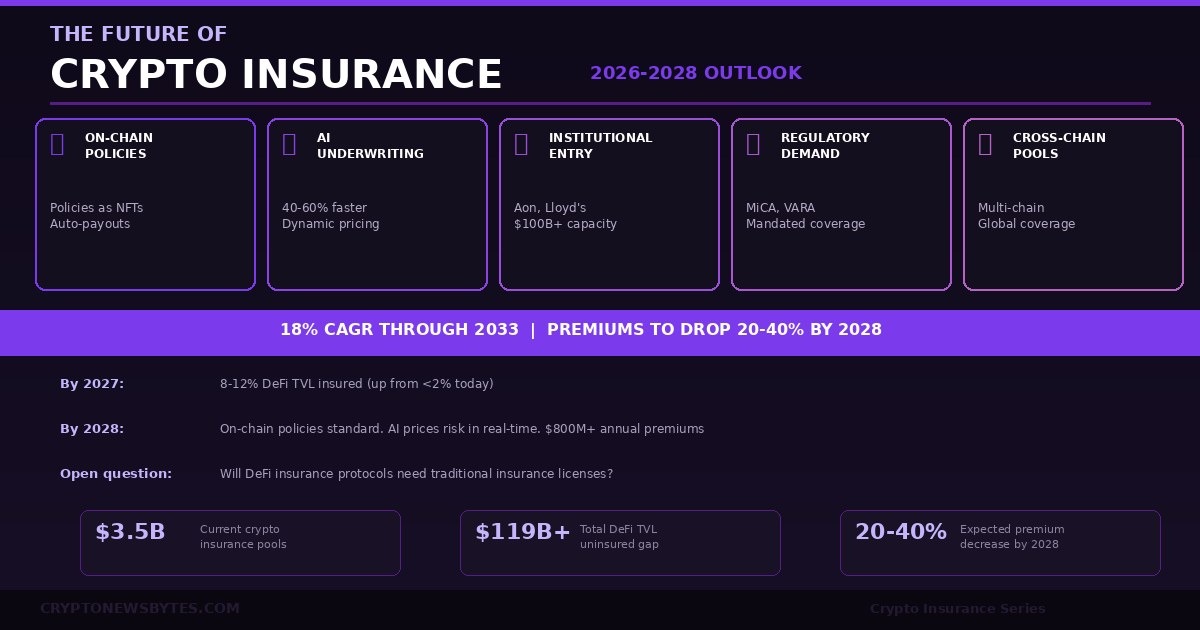
- The future of crypto insurance is being shaped by five converging trends: on-chain policy issuance, AI-powered underwriting, regulatory mandates creating demand, institutional entry expanding capacity, and cross-chain interoperability enabling global coverage pools
- The crypto insurance market is projected to grow at 18% CAGR through 2033, driven by regulatory frameworks like MiCA and the GENIUS Act that require or incentivize insurance coverage
- On-chain policies are the next frontier: insurance contracts issued as NFTs on blockchain, with premiums paid in stablecoins, coverage terms enforced by smart contracts, and claims settled automatically via oracles. Etherisc and Nexus Mutual are pioneering this model
- AI underwriting is reducing costs. Machine learning models analyzing on-chain data (transaction patterns, wallet behaviors, protocol risk scores) can price risk 40-60% faster than manual underwriting, potentially lowering premiums
- Traditional insurers (Aon, Mapfre, Lloyd’s syndicates) are entering crypto insurance, bringing $100B+ in capacity that dwarfs current crypto-native pools. This institutional supply will transform pricing and availability
- The biggest open question: DeFi insurance regulation. As regulators in the EU and US develop frameworks for on-chain insurance, these products may need to comply with traditional insurance licensing, potentially changing the decentralized model fundamentally
The Future of Crypto Insurance: What Changes by 2028
The crypto insurance industry is at an inflection point. Today, fewer than 20% of cryptocurrency holders have any insurance coverage, and less than 2% of DeFi TVL is insured. But five forces are converging to transform this market: regulatory mandates, institutional entry, technological innovation, market maturation, and the simple reality that $2.72 billion in 2025 losses have made the case for insurance undeniable.
This article looks ahead at the technologies, business models, and regulatory shifts that will define the future of crypto insurance through 2028 and beyond.
Trend 1: On-Chain Policy Issuance
The most fundamental shift is moving insurance policies themselves onto blockchain. Instead of PDF contracts and manual claims, on-chain policies are smart contracts that encode coverage terms, collect premiums in stablecoins, and execute payouts automatically when trigger conditions are confirmed by oracles.
Etherisc has already facilitated over $13 million in on-chain parametric payouts, primarily for flight delay insurance but increasingly for DeFi risks. The model eliminates claims adjusters, reduces administrative overhead by 60-80%, and provides transparent, auditable coverage records. For DeFi protocols, this means insurance that is as composable and programmable as the protocols it protects.
By 2028, expect to see insurance policies issued as soulbound tokens (non-transferable NFTs) that attach coverage directly to wallets or protocols. Coverage can be verified on-chain by any counterparty, meaning regulators and exchanges can instantly verify that a company holds adequate insurance.
Trend 2: AI-Powered Underwriting and Risk Scoring
Traditional underwriting for crypto risks involves weeks of manual assessment: reviewing audit reports, evaluating security architectures, assessing governance structures. AI is compressing this dramatically. Machine learning models trained on on-chain data can analyze protocol risk in real-time: transaction patterns, TVL changes, governance voting behavior, code commit history, and past exploit patterns.
Companies like Chainproof and Nayms are building AI underwriting platforms that can price smart contract risk 40-60% faster than human underwriters. This means faster policy issuance, more accurate pricing (lower premiums for genuinely safe protocols, higher for risky ones), and the ability to offer dynamic coverage that adjusts in real-time as a protocol’s risk profile changes.
Trend 3: Institutional Entry and Capacity Expansion
The single biggest constraint on crypto insurance has been capacity: not enough underwriting capital to cover the industry’s risk. Current crypto-native insurance pools hold approximately $3.5 billion total. The entire DeFi ecosystem has $119+ billion in TVL. The math does not work.
Traditional insurers are now solving this. Aon and Mapfre have launched blockchain pilot programs settling claims on-chain. Lloyd’s of London syndicates are underwriting crypto custody and exchange risks. These institutions bring capacity measured in hundreds of billions, dwarfing crypto-native pools. As regulatory clarity improves (MiCA, CLARITY Act, GENIUS Act), more traditional capital will flow into crypto insurance.
The result by 2028: premiums should decrease 20-40% from current levels as competition and capacity increase.
Trend 4: Regulatory-Driven Demand
Regulation is the most powerful driver of crypto insurance adoption. MiCA requires CASPs to maintain adequate safeguards for client assets. VARA mandates professional indemnity insurance. Hong Kong’s SFC requires insurance for custodial operations. As crypto licensing expands globally, insurance mandates follow.
This creates a virtuous cycle: regulatory mandates create demand, demand attracts insurer capacity, capacity improves pricing, better pricing enables broader adoption. The CARF/DAC8 tax reporting framework also drives demand for E&O coverage as exchanges take on new compliance obligations.
Trend 5: Cross-Chain and Global Coverage Pools
Current DeFi insurance is fragmented by chain. Coverage purchased on Ethereum does not protect assets bridged to Arbitrum or Solana. As multi-chain strategies become standard, insurance must follow. Cross-chain insurance pools that can cover assets across multiple blockchains simultaneously are emerging, enabled by protocols like Chainlink’s CCIP for cross-chain messaging.
By 2028, expect unified coverage that follows assets across chains, priced dynamically based on the risk profile of each destination chain and bridge. This mirrors how traditional insurance covers assets regardless of their physical location.
The Open Question: Regulating On-Chain Insurance
The elephant in the room is whether on-chain insurance protocols will need traditional insurance licenses. Today, protocols like Nexus Mutual operate as discretionary mutual funds rather than regulated insurance companies. But as these products grow in scale and importance, regulators may require licensing.
In the EU, EIOPA (European Insurance and Occupational Pensions Authority) has begun examining whether DeFi insurance products fall within existing insurance directives. In the US, state insurance commissioners have not yet taken formal positions, but the NAIC has flagged crypto insurance as a priority topic. If on-chain insurance must comply with traditional solvency requirements, capital adequacy ratios, and consumer protection rules, the decentralized model may need significant adaptation.
Frequently Asked Questions
📰 Crypto Insurance & Security Series
- Crypto Insurance in 2026: Why the Industry’s Biggest Problem Is Not Hackers
- Best Crypto Insurance Providers in 2026 Compared
- $2.72B Stolen in 2025: Crypto Insurance Lessons Every Founder Needs
- Smart Contract Insurance: How to Protect Your DeFi Protocol
- Does Your Crypto Exchange Need Insurance? Regulatory Requirements
- NFT Insurance: Can You Insure Digital Art and Collectibles?
- Crypto Insurance Claims: What Gets Paid and What Gets Denied
- You are here: The Future of Crypto Insurance: On-Chain, AI, and What’s Next
- Will Parametric Insurance for DeFi Replace Traditional Policies?
Sources: Relm Insurance | Founder Shield | Journal of Banking & Finance | NAIC | Woodruff Sawyer
Disclaimer: This article contains forward-looking projections based on current industry trends and publicly available data. Actual market developments may differ materially. This is not insurance, financial, or investment advice.