- Ethereum Foundation staked 45,034 ETH in multiple deposits, bringing its total staked position close to 70,000 ETH as previously planned
- Current staking yields of 2.7% to 3.8% APY could generate between $3.9 million and $5.4 million in annual rewards for the foundation
The ethereum foundation has moved closer to a major staking milestone, locking tens of thousands of ETH into Ethereum’s proof-of-stake infrastructure as part of a broader shift in how it manages its on-chain treasury. The latest deposits highlight the organization’s growing reliance on staking yields and long-term network value rather than holding idle ETH or prioritizing other capital uses.
Ethereum Foundation ramps up ETH staking strategy
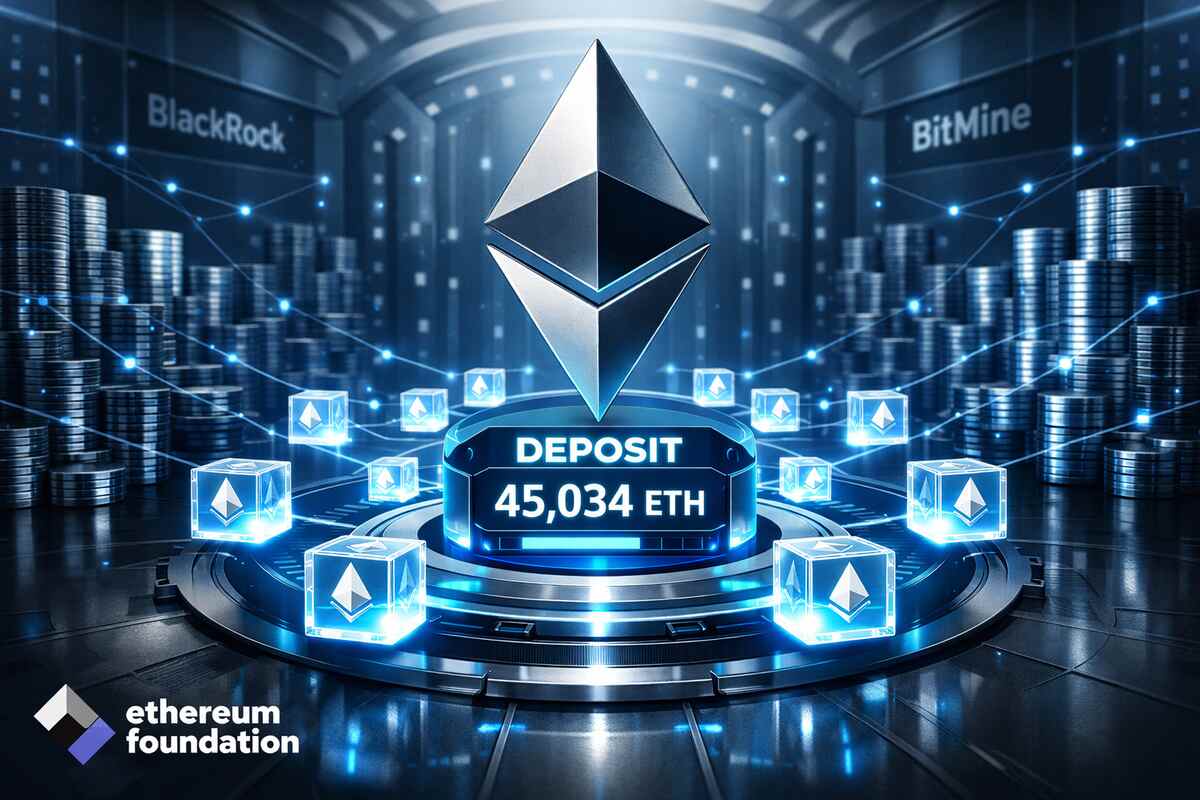
On Friday morning, the Ethereum Foundation staked 45,034 ETH, valued at roughly $93 million, in a series of deposits of 2,047 ETH each to the Eth2 Beacon Chain deposit contract. These allocations follow a strategic plan announced in February to stake 70,000 ETH from the foundation’s treasury.
With Thursday’s and Friday’s deposits combined, the foundation now has around 69,500 ETH locked for validation, worth about $143 million at current prices. This positions the organization just shy of its 70,000 ETH target and marks one of the largest institutional commitments to Ethereum’s proof-of-stake consensus among ecosystem-native entities.
The staking follows a revised treasury approach first outlined in June of last year, with the foundation beginning to actively stake treasury ETH in February. As of last week, the organization had already surpassed $50 million in staked assets before this latest acceleration. The broader network backdrop also includes rising activity, as seen in Ethereum transactions reach record levels on the network.
Treasury management and projected staking returns
The ethereum foundation’s staking push is reshaping how it allocates its holdings. According to Arkham-tracked data, the foundation’s treasury spans 14 addresses and totals $270.9 million in assets. Of that, 102,413 ETH—valued at $209.7 million—sits within these wallets. The new staking activity now commits the majority of that ETH to securing the network and generating on-chain yield.
Current institutional staking yields for Ethereum validators range between 2.7% and 3.8% annual percentage yield. At approximately 69,500 ETH staked, those rates translate into an estimated $3.9 million to $5.4 million in annual rewards if conditions remain stable. Earlier estimates for the full 70,000 ETH target suggested yearly rewards in the $4–5 million range. That outlook comes as market participants also track shifts in fund demand, including bitcoin and ethereum ETFs shift to inflows will prices rise and Ethereum posts 4.2B net inflows in 2025 as L2 funds shift.
Dr. Lena Schmidt, a blockchain economist at the Digital Asset Research Institute, framed the move as a clear preference for staking yield and long-term ETH value over alternative uses of capital such as grants or operating costs. She described the decision as a strong signal of confidence in Ethereum’s economic durability and the sustainability of its proof-of-stake model.
Institutional context and broader Ethereum roadmap
The ethereum foundation’s strategy comes as Ethereum-related institutional products and treasuries gain momentum. BlackRock has launched a staked ETH fund, while Tom Lee’s BitMine reportedly holds an ETH treasury valued at $10 billion, underscoring growing institutional exposure to the asset and its staking ecosystem. Related institutional developments are also reflected in will Fidelity digital dollar go live on Ethereum in 2026 and how are US banks integrating Bitcoin into daily finance.
By committing such a significant share of its ETH to validators, the foundation reinforces Ethereum’s status as a yield-bearing digital asset at the protocol layer. It also aligns the foundation’s financial health more directly with network performance, validator economics, and on-chain activity.
Beyond treasury management, the foundation is pursuing longer-term technical and economic initiatives intended to strengthen the Ethereum ecosystem. One focus is an “Economic Zone” project designed to address fragmentation across Layer-2 networks, a key concern as rollups and scaling solutions proliferate. In parallel, developers are working from a seven-fork roadmap that stretches through 2029, signaling a multi-year commitment to protocol upgrades and ecosystem coordination. Regulatory debates around digital assets are also evolving in parallel, including how clarity act crypto could reshape tokenization and DeFi rules and can US crypto regulation move stablecoins into finance.
These efforts position the foundation not only as a large staker but also as a central architect of Ethereum’s future design, from core protocol changes to how value flows across Layer-2 environments.
Conclusion
By staking nearly 70,000 ETH, the ethereum foundation is turning a significant portion of its treasury into an active validator position, targeting several million dollars per year in staking rewards while deepening its alignment with the network’s proof-of-stake economics. The move sits within a broader context of rising institutional interest in Ethereum and is paired with long-term initiatives such as the Economic Zone and a multi-fork roadmap through 2029, underscoring the foundation’s dual role as both a major capital allocator and a primary steward of the protocol’s evolution. For readers following the wider market setting, related coverage includes JPMorgan forecasts higher digital asset inflows this year, spot crypto ETF trading volume reaches 2 trillion level, and Bitcoin ETFs.
Disclaimer
The information provided in this article is for informational purposes only and should not be considered financial advice. The article does not offer sufficient information to make investment decisions, nor does it constitute an offer, recommendation, or solicitation to buy or sell any financial instrument. The content is opinion of the author and does not reflect any view or suggestion or any kind of advise from CryptoNewsBytes.com. The author declares he does not hold any of the above mentioned tokens or received any incentive from any company.
Featured image created by AI