
⚡ Key Highlights
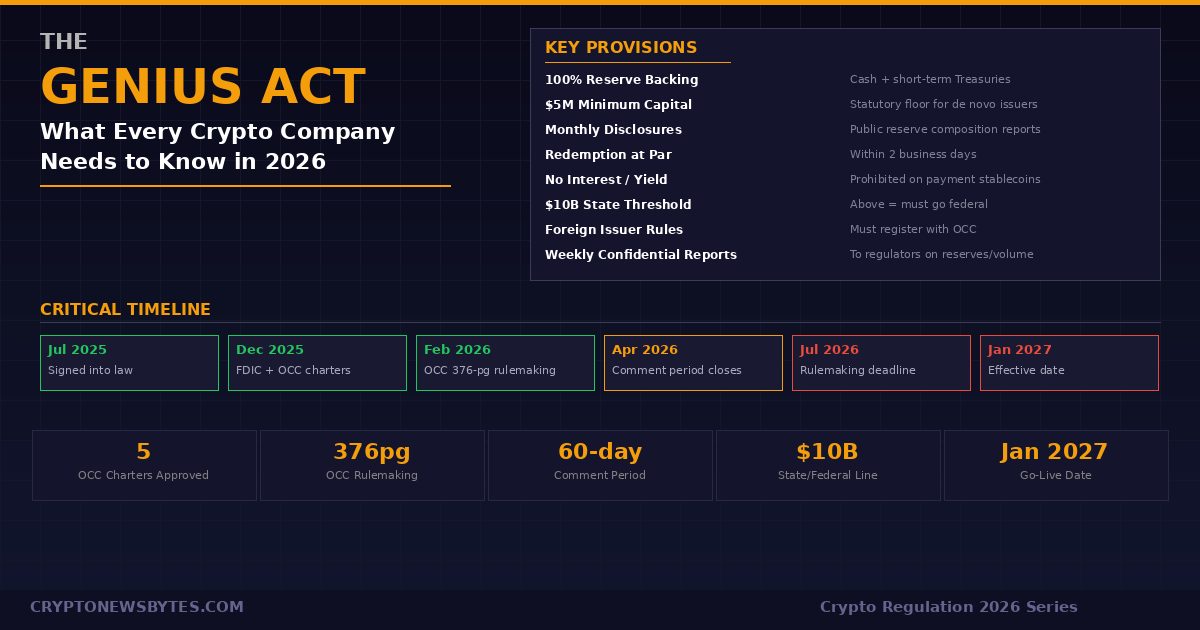
- The GENIUS Act was signed into law on July 18, 2025, creating the first comprehensive federal framework for payment stablecoins in the United States
- All payment stablecoin issuers must maintain 100% reserve backing with high-quality liquid assets (cash, short-term U.S. Treasuries), provide monthly public disclosures, and guarantee redemption at par value
- The OCC published a 376-page proposed rulemaking on February 25, 2026, creating a new 12 CFR Part 15 with detailed capital, reserve, custody, and licensing requirements. The 60-day comment period is now open
- De novo federal stablecoin issuers face a minimum $5 million capital requirement at inception (a statutory floor, not a ceiling). Capital is separate from reserves
- State-regulated issuers with under $10 billion in outstanding stablecoins may opt for state-level regulation, provided their state regime is certified as “substantially similar” to the federal framework
- Issuers above $10 billion must transition to federal oversight within 360 days of crossing the threshold
- The GENIUS Act explicitly prohibits paying interest or yield on payment stablecoins, a provision banks demanded but crypto firms are actively fighting
- Key deadlines: July 18, 2026 (rulemaking deadline for most regulations) and January 18, 2027 (statutory effective date, or 120 days after final rules, whichever comes first)
The GENIUS Act Crypto Framework: What It Is and Why It Matters
The GENIUS Act (Guiding and Establishing National Innovation for U.S. Stablecoins Act) is the first comprehensive federal law regulating stablecoins in the United States. Signed by President Trump on July 18, 2025, the GENIUS Act crypto framework establishes clear rules for who can issue payment stablecoins, how reserves must be held, what disclosures are required, and which regulators oversee the market.[Gibson Dunn]
Before the GENIUS Act, crypto stablecoins existed in a regulatory gray zone. The SEC, CFTC, state regulators, and banking agencies all claimed partial jurisdiction, creating uncertainty that drove companies offshore and left consumers unprotected. The GENIUS Act crypto law resolves this by creating a dedicated regulatory category: payment stablecoins are explicitly not securities, not commodities, and not deposits. They sit in their own framework, administered primarily by the OCC alongside the FDIC, Federal Reserve, and state banking regulators.
This matters for every company in crypto, not just stablecoin issuers. Exchanges must ensure they only list compliant stablecoins. DeFi protocols that integrate stablecoins face new compliance considerations. Custodians handling stablecoin reserves are subject to new custody standards. And the GENIUS Act crypto model is rapidly becoming the global template, with Canada, Hong Kong, and others building similar frameworks.
GENIUS Act Crypto: Who Can Issue Payment Stablecoins
The GENIUS Act restricts stablecoin issuance to three categories of “permitted payment stablecoin issuers”:
| Issuer Type | Primary Regulator | Key Requirements |
|---|---|---|
| Bank subsidiaries | OCC (national banks), FDIC (state nonmember), Federal Reserve (state member) | Apply through parent bank’s primary regulator. Full bank-like supervisory regime |
| Federal qualified issuers | OCC | New OCC national trust bank charter. $5M minimum capital. Full federal oversight |
| State qualified issuers | State regulator (with federal backstop) | Under $10B in outstanding stablecoins. State regime must be certified as “substantially similar” to federal framework |
The GENIUS Act bars any entity that is not a permitted payment stablecoin issuer from issuing stablecoins in the U.S. It also prohibits digital asset service providers from offering non-compliant stablecoins to U.S. users. This effectively means that any stablecoin available on U.S. exchanges must be issued by a licensed entity under this framework.[CoinMarketCap]
Since the GENIUS Act’s passage, the OCC has conditionally approved five new national trust bank charter applications specifically for stablecoin issuance, signaling strong market interest in the federal licensing pathway.[K&L Gates]
GENIUS Act Crypto Reserve and Redemption Requirements
The reserve requirements are the most operationally significant provisions of the GENIUS Act crypto framework:
💰 Reserve Rules at a Glance
100% backing. Every payment stablecoin must be backed 1:1 by high-quality liquid assets at all times. There is no fractional reserve option.
Permitted reserve assets: U.S. dollars, demand deposits at insured depository institutions, short-term U.S. Treasury bills (93 days or less for repo purposes), and other assets specified by regulators. The emphasis is on cash and cash equivalents.
No rehypothecation. Reserve assets cannot be pledged, rehypothecated, or reused except for three narrow purposes: satisfying margin obligations on permitted reserve investments, standard custodial service obligations, and creating liquidity through repo agreements with Treasury bills (cleared by a registered clearing agency or with OCC prior approval).
Redemption at par. Issuers must redeem stablecoins at par value (1 stablecoin = 1 dollar). The OCC’s proposed rules specify redemption generally within two business days.
Monthly public disclosures. Issuers must publish the composition and value of their reserve assets monthly. The OCC also proposes confidential weekly reporting on issuance, redemption, trading volume, and reserve composition.
GENIUS Act Crypto: Capital Requirements Beyond Reserves
One of the most important distinctions in the GENIUS Act crypto framework is the separation between reserves and capital. Reserves back the stablecoins. Capital protects the issuer itself.
The OCC’s February 25, 2026 proposed rulemaking sets a minimum $5 million capital floor for de novo federal qualified payment stablecoin issuers. However, the OCC explicitly states this is a statutory floor, not a safe harbor. The agency retains discretion to require higher capital levels based on projected transaction volume, redemption exposure, complexity of reserve management, reliance on third-party service providers, cross-border footprint, and operational risk profile.[Cadwalader]
Capital must be sufficient to absorb operational losses, legal liabilities, fraud events, technology failures, and liquidity mismatches during redemption stress. This requirement means stablecoin issuers are structurally more solvent than traditional banks operating on 10% to 20% capital ratios, a point that stablecoin advocates have emphasized in regulatory debates.
The Yield Ban: The Most Controversial Provision
The GENIUS Act explicitly prohibits issuers from paying interest or any form of yield tied solely to holding payment stablecoins. This provision has become the most contentious element of the entire framework.
⚔️ The Yield Standoff
Banks want it expanded. The banking industry is lobbying for even broader restrictions, including prohibiting affiliates or third parties from offering rewards on stablecoins. Banks fear that yield-bearing stablecoins will draw deposits away from the traditional banking system.
Crypto firms want it narrowed. The Blockchain Association has warned that these proposals “risk undermining a carefully negotiated compromise, reduce consumer choice, suppress competition, and inject uncertainty into the implementation of a new law.” Crypto companies argue that rewards and loyalty programs (distinct from “interest”) are essential for stablecoin adoption.[DL News]
The White House hosted closed-door meetings in early February 2026 between banks, crypto firms, and regulators to attempt to resolve this standoff. The outcome of these negotiations will significantly shape how stablecoins compete with bank deposits in the coming years.
GENIUS Act Crypto: The State vs Federal Pathway
The GENIUS Act creates a dual regulatory track:
| State Pathway | Federal Pathway | |
|---|---|---|
| Eligibility | Under $10B outstanding stablecoins | Any size |
| Regulator | State banking regulator | OCC / FDIC / Federal Reserve |
| Certification | State regime must be certified “substantially similar” | Direct federal licensing |
| Scaling trigger | Must transition to federal within 360 days if exceeding $10B | N/A |
| Federal backstop | Federal Reserve and OCC can enforce in “unusual and exigent circumstances” | Full federal supervision |
The Stablecoin Certification Review Committee (SCRC) must unanimously approve or deny state regime certifications within 30 days. States that already had digital asset regulatory regimes in effect within 180 days of the GENIUS Act’s enactment qualify for an expedited certification timeline. The Treasury Secretary will set the broad-based principles for determining “substantially similar.”
GENIUS Act Crypto and Foreign Issuers: Global Reach
The GENIUS Act extends its reach beyond U.S. borders. Foreign payment stablecoin issuers seeking to serve U.S. customers must register with the OCC and hold sufficient reserves at a U.S. financial institution to meet domestic liquidity demands.
This requirement is significant for global stablecoins like Tether (USDT) and for EU-based issuers already operating under MiCA. Legal analysis by Latham & Watkins has noted that this provision will draw scrutiny from regulators in the EU, UK, and Asia, where separate stablecoin regimes are already in effect. The interplay between the GENIUS Act crypto framework and MiCA will be one of the defining compliance challenges for global stablecoin issuers in 2026 and 2027.[Payment Expert]
GENIUS Act Crypto: Critical Deadlines and Timeline
| Date | Event | Status |
|---|---|---|
| Jul 18, 2025 | GENIUS Act signed into law | ✅ Done |
| Dec 16, 2025 | FDIC proposed rules for bank subsidiary issuers | ✅ Done |
| Dec 12, 2025 | OCC conditionally approved 5 national trust bank charter applications | ✅ Done |
| Jan 18, 2026 | 180-day report due from federal banking agencies to Congress | ✅ Done |
| Feb 11, 2026 | NCUA proposed rules for credit union subsidiaries | ✅ Done |
| Feb 25, 2026 | OCC published 376-page proposed rulemaking (12 CFR Part 15) | ✅ Done |
| Apr 2026 (est.) | 60-day comment period closes on OCC proposed rules | ⏳ Upcoming |
| May 18, 2026 | FDIC extended comment period closes | ⏳ Upcoming |
| Jul 18, 2026 | Statutory deadline for most implementing regulations | 🔴 Critical |
| Jan 18, 2027 | GENIUS Act effective date (18 months after enactment, or 120 days after final rules) | 🔴 Critical |
The Federal Reserve has not yet published a formal proposal, making it a notable absence in the rulemaking process. With July 18 approaching, pressure is mounting for all federal agencies to finalize their rules on time.
What This Framework Means for Different Companies
For stablecoin issuers (Tether, Circle, new entrants): Compliance is no longer optional. Every issuer serving U.S. users must be licensed, maintain 100% reserves, report weekly to regulators, and publish monthly disclosures. Foreign issuers must register with the OCC and hold U.S.-based reserves. The $10 billion threshold creates a clear fork: stay under $10B and use state regulation, or go federal from the start.
For crypto exchanges: You can only list compliant stablecoins. Any non-compliant stablecoin offered to U.S. users violates the GENIUS Act. Exchanges need to audit their stablecoin listings and prepare for potential delistings of non-compliant tokens. Regulatory compliance also affects your security posture and insurance eligibility, as incidents like the Figure Technology data breach demonstrate.
For DeFi protocols: If your protocol integrates stablecoins as collateral, liquidity, or trading pairs, the compliance status of those stablecoins now matters. Protocols may need to implement filtering for GENIUS Act-compliant stablecoins, particularly for U.S.-facing interfaces. The Step Finance shutdown after a $40M hack shows what happens when regulatory and insurance planning are absent.
For banks: The GENIUS Act opens a new business line: stablecoin issuance through subsidiaries. Five OCC trust bank charters have already been conditionally approved. Banks that move early gain first-mover advantage in institutional stablecoin adoption. But the yield ban creates competitive tension. Banks lobbied for it to protect deposits, yet it limits the product’s appeal.
For investors: The GENIUS Act crypto framework provides regulatory clarity that institutional investors have demanded. Pension funds, endowments, and asset managers now have a clear legal basis for holding and transacting in compliant stablecoins. This is expected to accelerate institutional adoption significantly. Insurance implications are significant too, as the new regulatory framework directly affects what crypto insurance providers will underwrite.
How the GENIUS Act Compares to MiCA
The U.S. and EU are building parallel stablecoin frameworks at the same time. Companies operating globally need to understand where the GENIUS Act crypto rules align with MiCA and where they diverge:
| Provision | GENIUS Act (US) | MiCA (EU) |
|---|---|---|
| Scope | Payment stablecoins only | All crypto assets and service providers |
| Stablecoin reserves | 1:1 backing required | 1:1 backing required |
| Licensing | OCC charter, bank subsidiary, or state license | CASP license from national authority |
| Passporting | No (U.S. only, state/federal split) | Yes (27 EU states + EEA) |
| Yield/interest | Banned for issuers | Not explicitly banned |
| Capital (min) | $5M (de novo federal issuers) | $50K-$150K (by service type) |
| Max fine | TBD (rulemaking in progress) | 12.5% of turnover |
| Hard deadline | January 18, 2027 | July 1, 2026 |
| Mutual recognition | None. Dual compliance required for companies operating in both jurisdictions | |
The bottom line for global operators: there is no shortcut. Companies serving both U.S. and EU customers must build and maintain two separate compliance programs, two reserve structures, and two licensing relationships. For a full breakdown of the EU framework, see our complete MiCA regulation guide.
GENIUS Act Crypto: Frequently Asked Questions
📰 Crypto Regulation 2026 Series
- You are here: The GENIUS Act Explained: What Every Crypto Company Needs to Know
- MiCA Regulation 2026: The Complete Compliance Guide for Crypto Companies
- GENIUS Act vs MiCA: The Complete Comparison for Crypto Companies
- Coming soon: SEC vs CFTC: Who Regulates What in Crypto After the CLARITY Act
🔒 Security & Insurance Series
- Crypto Insurance in 2026: Why the Industry’s Biggest Problem Is Not Hackers
- Crypto in 2026: $16B Insurance Market Coming, But 90%+ Still Uninsured
- Cyber Insurance for Crypto Firms: What’s Covered, What’s Not
- Best Crypto Insurance Providers in 2026 Compared
- $2.72B Stolen in 2025: The Crypto Insurance Lessons Every Founder Needs
- Will On-Chain Parametric Insurance Replace Traditional Policies for DeFi?
- Figure Technology Data Breach: Hackers Dump 2.5GB Stolen Records
- Step Finance Hack: $40M Stolen, Platform Shuts Down Permanently
- Top 10 Cybersecurity Trends in Crypto & Blockchain 2025
Sources: OCC | Gibson Dunn | Cadwalader | K&L Gates | The Block | DL News | Payment Expert | CoinMarketCap | Congress.gov | FDIC | Cleary Gottlieb
Disclaimer: This article is for informational purposes only and does not constitute legal, financial, or regulatory advice. All information is based on publicly available sources at the time of writing (February 28, 2026). Regulatory frameworks are evolving rapidly. Consult qualified legal counsel for advice specific to your business. CryptoNewsBytes has no affiliation with any regulatory agency or stablecoin issuer mentioned.