LIVE APRIL 10, 2026 · 8:30 AM ET: March CPI drops this morning. This article will be updated with the actual print as soon as BLS publishes. Consensus: 3.3-3.4% headline, 2.7% core. Refresh for reaction.
Bitcoin is trading around $71,500 this morning as markets digest two developments that landed within hours of each other on April 8: a two-week U.S.-Iran ceasefire that cracked open the Strait of Hormuz, and a Financial Times report that Iran is demanding payment in Bitcoin, at $1 per barrel of oil, for ships seeking transit. The price moved from an intraday low of $67,769 on April 7 to a high above $72,500 after ceasefire news broke. The $4,700 jump in eight hours liquidated an estimated $400 million in short positions. It is one of the sharpest single-session moves of 2026.
Wall Street is not buying the euphoria. JPMorgan, UBS, Morgan Stanley, and U.S. government energy forecasters are all saying the same thing in different words: reopening and normalization are not the same event. The ceasefire is two weeks long, conditionally structured, and already showing cracks. Iran halted vessel traffic again within hours of the deal after an Israeli attack in Lebanon. The White House press secretary said the strait must open “without limitation, including tolls” on the same day Iran was demanding Bitcoin tolls. This morning at 8:30 a.m. ET, the Bureau of Labor Statistics releases the March CPI report, the first print that will fully capture the oil price shock since the Hormuz closure began in late February. JPMorgan’s consensus forecast calls for headline inflation to jump to 3.4% from 2.4% in February. That is the pin.
Iran’s Bitcoin Toll Is Real Adoption News. The Window It Operates In Is Not.
The Financial Times, citing Hamid Hosseini, a spokesperson for Iran’s Oil, Gas and Petrochemical Products Exporters’ Union, reported on April 8 that Iran is requiring ships carrying oil to pay $1 per barrel in Bitcoin for Strait of Hormuz transit rights. The mechanics are specific: a tanker operator emails Iranian authorities with full cargo details, receives an assessment, and is then given a few seconds to pay in Bitcoin. Hosseini was direct about why: “ensuring they can’t be traced or confiscated due to sanctions.” Iran’s National Security Committee has approved a bill formalizing the fee structure into law. Earlier Bloomberg reporting, confirmed by multiple sources, noted the same system had been accepting Chinese yuan and stablecoins alongside Bitcoin, with the IRGC managing compliance and issuing routing instructions to approved vessels.
This is genuinely significant for the Bitcoin narrative. It is the first time a sovereign government has codified Bitcoin as a payment instrument for a physical commodity traded through a critical global chokepoint. The digital gold argument has been contested throughout the Iran war, with Bitcoin losing ground as oil spiked through March. The toll system inverts that framing: Bitcoin is being used as digital oil money, sanctions-resistant by design, trusted over USDT or USDC precisely because Circle and Tether can freeze wallets on government instruction. Bitcoin cannot.
But the context matters. The toll operates inside a 14-day ceasefire that was already showing violations within hours of being announced. Iran halted vessel traffic again after an Israeli attack in Lebanon on April 8, the same day the FT published the toll story. The White House position, stated directly by press secretary Karoline Leavitt, is that the Hormuz must open “without limitation, including tolls,” putting Washington explicitly in opposition to the very mechanism the market was rallying around. Only two vessels, both bulk carriers carrying dry cargo rather than oil, had transited the strait since the ceasefire was announced as of Wednesday morning. Between 100 and 120 commercial vessels passed through the strait daily before the war, according to Kpler data. S&P Global reported tanker transits had fallen 97% during the conflict.
The Hormuz Timeline: From Closure to Ceasefire to Bitcoin Toll
Source: Financial Times, Bloomberg, CNBC, CoinDesk, Kpler data | April 2026.
| Late Feb 2026 | U.S. and Israel launch strikes on Iran. IRGC effectively closes Strait of Hormuz. Tanker transits fall 97%. Brent crude surges toward $113. | CLOSED |
| Early Apr 2026 | Bloomberg reports IRGC is charging yuan and stablecoins for transit. Iran’s National Security Committee formalizes fee structure into law. Select Pakistan-flagged ships begin transiting. | TOLLBOOTH |
| Apr 7, 2026 | Trump’s 8 PM ET deadline expires. Hours later, ceasefire announced. BTC spikes from $67,769 to $72,500+ – $400M in shorts liquidated. Oil falls from $113+ toward $97. | CEASEFIRE |
| Apr 8, 2026 | FT reports Iran demanding $1/barrel in Bitcoin for transit. Only 2 dry cargo ships (no oil tankers) have passed. Iran halts again after Israeli attack in Lebanon. White House demands “no tolls.” | FRAGILE |
| Apr 10, 2026 | March CPI released at 8:30 AM ET. First print capturing full Iran war oil shock. JPMorgan forecast: 3.4% headline (vs 2.4% in Feb). This is Bitcoin’s next macro test. | THE PIN |
Pre-war Hormuz traffic: 100-120 commercial vessels per day (Kpler). As of April 8 ceasefire morning: 2 vessels total, no oil tankers. Oil at ~$97/barrel after ceasefire rally from $113+.
BTC’s Rebound in Numbers: What Moved and What It Tells You
The price action has been clean: Bitcoin hit $67,769 intraday on April 7 as oil broke above $113, the dollar firmed, and Treasury yields rose on inflation expectations. Since the ceasefire, it has retraced to the upper end of the $65,000 to $73,000 range that has contained it since the start of the Iran war. Spot Bitcoin ETFs recorded $471 million in net inflows on April 6, the strongest single-day demand since February, led by BlackRock’s IBIT at $181.89 million. The 98% correlation with the S&P 500 on this move confirms this was a risk-on rotation, not a safe-haven bid. Leveraged longs were caught short going into the ceasefire news, amplifying the move: $222.6 million in BTC short positions were liquidated in 24 hours, a 183% spike. Open interest rose 11% on the move.
The technical picture is not comfortable for bulls holding above $70,000. The $72,000 level has capped every significant rally since October 2025’s $126,000 all-time high. Fibonacci analysis places the 38.2% retracement of the full drawdown at $71,780. Funding rates on perpetual futures are turning positive, signaling leveraged long rebuilding after the short squeeze, which historically precedes corrective moves. The New York Fed’s April 7 survey showed one-year inflation expectations jumped to 3.4%, the largest one-month increase since April 2025. Michigan final March sentiment fell to 53.3, the lowest reading of 2026. Neither of those surveys is consistent with a market that has priced out inflation risk.
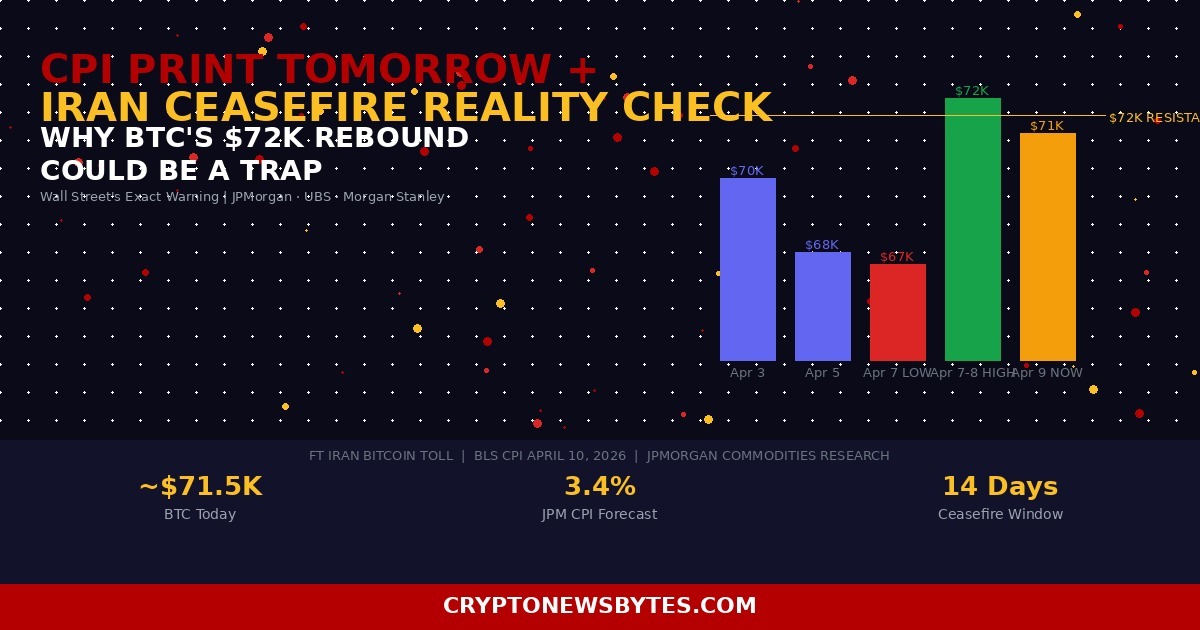
Bitcoin Price: The Relief Rally in Context (Apr 3–9, 2026)
Source: CoinMarketCap, Fortune, The Block price data | April 2026.
| Thu Apr 3 | |
| Fri Apr 4 | |
| Sat Apr 5 | |
| Mon Apr 7 LOW | |
| Tue Apr 7–8 | |
| Wed Apr 9 (now) |
Key resistance: $72,000 (38.2% Fibonacci retracement, $71,780). Support: $69,000 then $67,000. $400M in short liquidations amplified the ceasefire move. Leveraged longs rebuilding – funding rates turning positive.
Wall Street’s Exact Warning: Reopening Is Not Normalization
JPMorgan’s commodities team published research on April 2 via Reuters warning that Brent crude could “overshoot toward $150 per barrel” if Hormuz disruptions persist into mid-May. Their base case still keeps oil elevated above $100 through the second quarter. The ceasefire does not change JPMorgan’s base case, it removes the tail risk of immediate escalation. As their Private Bank research put it: “Reopening it would unlock lower oil prices, relief in the equity markets and reduced inflation expectations.” The critical word is “would.” It hasn’t happened yet. Two dry cargo ships is not an oil market reopening.
Morgan Stanley’s consumer math is unambiguous: a 10% rise in oil prices from a supply shock lifts U.S. headline consumer prices by roughly 0.35% over the next three months, with real consumption staying depressed for five to six months after the shock. The EIA’s April 2026 outlook puts U.S. gasoline averaging above $3.70 for 2026, with diesel peaking above $5.80 and averaging $4.80. If Iran retains even partial structural control over cargo flows in a “nominal reopening” scenario, Morgan Stanley warns that oil markets can keep trading a higher risk premium for months. The ceasefire headline is one thing. The physical shipping market, tanker insurance rates, and supply route normalization are another.
UBS commodity analyst Giovanni Staunovo put the supply picture bluntly: even a full Hormuz reopening leaves months of recovery ahead because infrastructure damage means restoring production to pre-conflict levels “will take considerably longer.” The IEA has classified the current oil shock as the largest supply disruption in the history of the global crude market. UBS pushed its Fed rate cut expectations back from June and September. CryptoSlate published a synthesis of this research on April 8 with the direct conclusion: “Bitcoin’s trade still goes through oil, then inflation, then Fed policy, then risk appetite. The difference after the ceasefire is that the chain has loosened. It has not broken.”
How Hormuz Disruption Transmits to Bitcoin (The Four-Step Chain)
Source: Morgan Stanley research, JPMorgan Private Bank, CryptoSlate, UBS via CNBC | April 2026.
1 Hormuz Disruption Persists Oil above $100 through Q2. EIA: gasoline averaging $3.70+, diesel $4.80 avg. 20% of global supply still constrained. JPMorgan: crude could spike to $150 if ceasefire collapses before mid-May. |
| ↓ |
2 Sticky Headline Inflation March CPI expected 3.4% headline (JPMorgan), up from 2.4% in Feb. Morgan Stanley: a 10% oil rise adds 0.35% to headline CPI over 3 months. NY Fed survey: 1-yr expectations jumped to 3.4% in April, largest monthly jump since April 2025. |
| ↓ |
3 Fed Stays on Hold, Rate Cuts Pushed Back Bond markets pricing 77% probability of Fed unchanged by December 2026 (pre-ceasefire: 86% no-cut odds). Post-ceasefire cut odds jumped to 43%, but that’s entirely conditional on shipping normalization that has not happened. UBS pushed cut timeline from June-September. Evercore ISI: market pricing one cut “assuming a flawed deal.” |
| ↓ |
4 Bitcoin Trades as Macro Risk Asset, Not Safe Haven 98% correlation with S&P 500 on ceasefire day confirms BTC is pricing macro risk appetite, not Bitcoin fundamentals. If inflation stays hot and rate cuts stay priced out, the relief bid fades. Dallas Fed: WTI $115 in Q3 under two-quarter closure scenario. That is still JPMorgan’s tail risk, not the base case. |
Chain loosened by ceasefire. Not broken. The path from Step 2 to Step 4 runs directly through this morning’s 8:30 AM ET CPI print.
Today’s CPI Print: The Numbers That Matter and the History That Warns You
The Bureau of Labor Statistics releases March 2026 CPI data today, Friday April 10, at 8:30 a.m. ET. This is the first CPI print that fully captures the energy price shock since Iran closed the strait in late February. The prior two readings, January at 2.4% and February at 2.4%, predated the oil spike. March is different.
JPMorgan forecasts headline CPI to jump to 3.4% year-over-year driven by an 11% rise in the CPI’s energy component. Core CPI, which excludes food and energy, is expected at 2.7%, up from 2.5% in February. Morningstar’s chief U.S. economist Preston Caldwell now projects the PCE index, the Fed’s preferred inflation gauge, at 3.6% for full-year 2026. XTech’s machine learning model published April 6 projects headline CPI at 3.2% YoY with a “below-consensus” core at 2.5%, noting that used car price softness provides a partial offset. The Wells Fargo consensus compiled for the week calls for 0.9% month-over-month and 3.4% year-over-year. If the print lands at or above 3.4%, the ceasefire relief is immediately complicated by a Fed that cannot cut into that number. If core surprises above 2.7%, the inflation story becomes about second-order effects, not just oil.
March CPI April 10 2026: Forecasts vs. Prior Readings + BTC Historical Reaction
Source: bls.gov, JPMorgan via Morningstar, Wells Fargo consensus, XTech ML model, BLS Feb 2026 release | April 2026.
| Measure | Feb 2026 (Actual) | Mar 2026 (Consensus) | JPMorgan Forecast |
|---|---|---|---|
| Headline CPI (YoY) | 2.4% | 3.3–3.4% | 3.4% |
| Core CPI (YoY, ex food/energy) | 2.5% | 2.7% | 2.7% |
| Headline CPI (MoM) | +0.3% | +0.9% | High |
| Energy component (MoM) | Flat | +11% est. | Primary driver |
How BTC Has Historically Reacted to CPI Surprises
| Scenario | BTC Typical Reaction (24h) | Fed Rate Implication |
|---|---|---|
| In-line print (3.3–3.4%) | Muted, range-hold | Hold confirmed; limited rate cut odds |
| Hot surprise (above 3.5%) | Sell-off, -3% to -6% | Rate cut odds collapse; hike risk resurfaces |
| Core surprise above 2.8% | Meaningful correction, -4% to -8% | Signals second-order inflation; worst case |
| Cool surprise (below 3.0%) | Rally extension, +3% to +5% | Rate cut odds spike; bullish for risk assets |
Historical BTC CPI reactions based on 2023-2025 data compiled from CoinDesk and CoinMarketCap post-print analysis. March 2026 is the first print where energy is the primary driver rather than shelter or services.
Three Reasons This Setup Has Bear-Market Fakeout Written All Over It
Relief rallies in bearish macro environments are a feature, not a surprise. The S&P 500 saw multiple 5-8% relief bounces during its 2022 drawdown before resuming lower. Each one was triggered by a real catalyst: softer inflation reading, dovish Fed comments, geopolitical de-escalation. The difference between a relief rally that holds and one that fails is whether the underlying condition driving the bearish trend has actually resolved. The condition driving Bitcoin’s 45% drawdown from its October 2025 all-time high of $126,000 is the inflation-driven compression of Fed rate cut expectations. That condition has loosened in the past 48 hours. It has not resolved.
Three structural problems remain intact. First, the geopolitical trigger is temporary and already breaking down. The ceasefire is 14 days, conditional, and Iran halted vessels again within hours due to separate hostilities. Trump’s “joint venture” idea for Hormuz tolls, floated publicly on April 8, has no implementation framework and no allied support. Saudi Arabia, the UAE, and Qatar all depend on Hormuz as sovereign maritime passage and would strongly oppose Iranian control over it continuing under any formalization. Second, the macro damage from the oil shock is already embedded. The energy component of March CPI jumped an estimated 11% month-over-month. That is not reversed by a two-week ceasefire. Bitcoin’s correlation to macro risk assets has strengthened throughout 2026, which means the inflation damage that has already accrued through Q1 is still in the data.
Third, the technical picture has not changed. Bitcoin has failed to close above $72,000 on multiple attempts since October’s all-time high. The current test comes off a short squeeze that liquidated $400 million in bearish positions, which is an artificial demand event rather than organic buying. Once that forced buying exhaust, the next marginal buyers have to be genuine longs willing to hold above $72,000 into a hot CPI print. Funding rates suggest leveraged longs are rebuilding, which typically precedes a correction when the macro catalyst disappoints. Altcoins are not confirming the Bitcoin move in a way that would suggest broad risk appetite recovery. The selective outperformers in this bear market are still outperforming for idiosyncratic reasons, not because the macro has cleared.
Post-CPI Game Plan: Bull Case vs. Bear Case for BTC
Source: JPMorgan, Morgan Stanley, UBS, Evercore ISI, Bitfinex derivatives data | April 2026.
BULL CASE (CPI COOL SURPRISE) ▸ March CPI lands below 3.0% on headline ▸ Core holds at or below 2.5%, signals no second-order inflation ▸ Rate cut odds jump; Fed easing back on the table ▸ Ceasefire holds through first round of Islamabad talks (April 12) ▸ Oil falls toward $85–90, shipping resumes at scale ▸ BTC breaks above $72,000 with conviction ▸ Path toward $80,000 opens if macro sustains Probability assessment: LOW-MODERATE. Energy component alone makes sub-3% headline structurally difficult. | BEAR CASE (CPI HOT OR IN-LINE) ▸ March headline at 3.3–3.4%, in-line confirms inflation is back ▸ Core above 2.7% signals services/shelter still sticky ▸ Rate cut odds collapse below 30% for year-end ▸ Ceasefire breaks down before April 21 (14-day expiry) ▸ Oil re-tests $105+; inflation expectations reset higher ▸ BTC fails at $72,000 and pulls back to $67,000–$68,000 ▸ A break below $65,000 opens $55,000–$60,000 range Probability assessment: MODERATE-HIGH. JPMorgan base case + Wall Street energy desk consensus supports this path. |
Key watch levels: $72,000 resistance (Fibonacci + psychological). $69,000 first support. $67,000 second support. Below $65,000 triggers meaningful downside. CPI drops Friday 8:30 AM ET – markets will price immediately.
The Real Iran Bitcoin Story Is Long-Term. The Rally Is Short-Term.
The Iran Bitcoin toll is not noise. It is the most concrete state-level adoption of Bitcoin as a trade settlement instrument in the asset’s history. When a sovereign government codifies Bitcoin payments for a commodity flowing through a chokepoint that handles 20% of global oil supply, and does so explicitly because Bitcoin cannot be frozen by sanctions authorities the way USDT and USDC can, that is a structural narrative development. The digital gold and neutral settlement arguments that Bitcoin advocates have made for years have just been partially validated by a real-world sovereign actor under real-world sanctions pressure.
That story will matter more over the next 12 months than it does today. The ceasefire is 14 days. The CPI print is this morning. This morning. The Islamabad negotiations start Saturday. Oil is still above $95. The Fed has not cut rates. JPMorgan still has oil elevated above $100 through Q2 as their base case. The relief rally is priced on hope, not resolution. BTC as digital oil is coming. The validation from Iran is real. But a 48-hour relief pump in the middle of a 45% drawdown, running into the first inflation print that captures the full energy shock, is not the moment to confuse the narrative with the trade.
Watch $72,000 on the topside. Watch $69,000 and $67,000 on the downside. The CPI number drops this morning at 8:30 AM ET this morning. For real-time reaction coverage, follow @cryptonewsbytes on X.
Frequently Asked Questions
Why is Iran accepting Bitcoin for Strait of Hormuz transit?
Iran is using Bitcoin because it cannot be frozen or confiscated by sanctions authorities. Stablecoins like USDC and USDT have backdoor controls that allow issuers to block specific wallet addresses under government order. Bitcoin does not. When the IRGC spokesman told the Financial Times that ships are “given a few seconds to pay in Bitcoin, ensuring they can’t be traced or confiscated due to sanctions,” that is precisely the censorship-resistance property Bitcoin’s design was built to provide. Iran is effectively using Bitcoin as a sanctions-resistant, neutral settlement layer for sovereign commodity trade.
How much revenue does the Hormuz Bitcoin toll generate?
At $1 per barrel on a fully loaded VLCC tanker carrying roughly 2 million barrels, that is $2 million per ship. Before the war, 100 to 120 commercial vessels transited the strait daily. At full traffic, that would be $200 million per day, though not all vessels carry oil and not all would comply. In the current partial reopening with only a handful of ships transiting, the actual revenue is minimal. The strategic and symbolic significance exceeds the current economic impact.
What is the March CPI forecast and why does it matter for Bitcoin?
March CPI, due Friday April 10 at 8:30 AM ET, is forecast by JPMorgan at 3.4% headline (up from 2.4% in February) driven by an estimated 11% monthly jump in the energy component reflecting the Hormuz oil shock. If the print lands hot, rate cut expectations collapse, Bitcoin’s macro relief bid fades, and the ceasefire rally reverses. Bitcoin has historically sold off 3-8% in the 24 hours following CPI prints that come in above consensus, because higher-than-expected inflation reduces the likelihood of Fed rate cuts that would support risk asset valuations.
What are the key Bitcoin price levels to watch after CPI?
Resistance: $72,000 (38.2% Fibonacci retracement at $71,780, tested multiple times since October 2025 high). A confirmed daily close above $72,000 on high volume would target $74,000 and potentially $80,000. Support: $69,000 (immediate), $67,000 (secondary, intraday low from April 7). A break below $65,000 opens a path to $55,000-$60,000 per 24/7 Wall St. analysis. The CPI print is the binary catalyst. A cool surprise unlocks the bull case. An in-line or hot print keeps the lid on the relief rally.
Further Reading
The macro and on-chain framework for understanding where Bitcoin sits in its current drawdown cycle.
Why the 45% drawdown is smaller than previous cycles and what that means for recovery timing.
The long-term neutral settlement thesis that Iran’s Bitcoin toll is starting to validate at a sovereign level.
The selective altcoin outperformers that are not tracking Bitcoin’s macro-driven moves.
The institutional infrastructure building out alongside, independently of – the macro headwinds.
Goldman’s longer-term framework for when the institutional buying that defines this cycle returns in force.
This article is for informational purposes only and does not constitute financial advice. Consult a qualified adviser before making investment decisions. Sources: bls.gov CPI schedule, J.P. Morgan Asset Management, Morgan Stanley, CNBC, Financial Times (Iran Bitcoin toll, April 8 2026). Published April 10, 2026.