
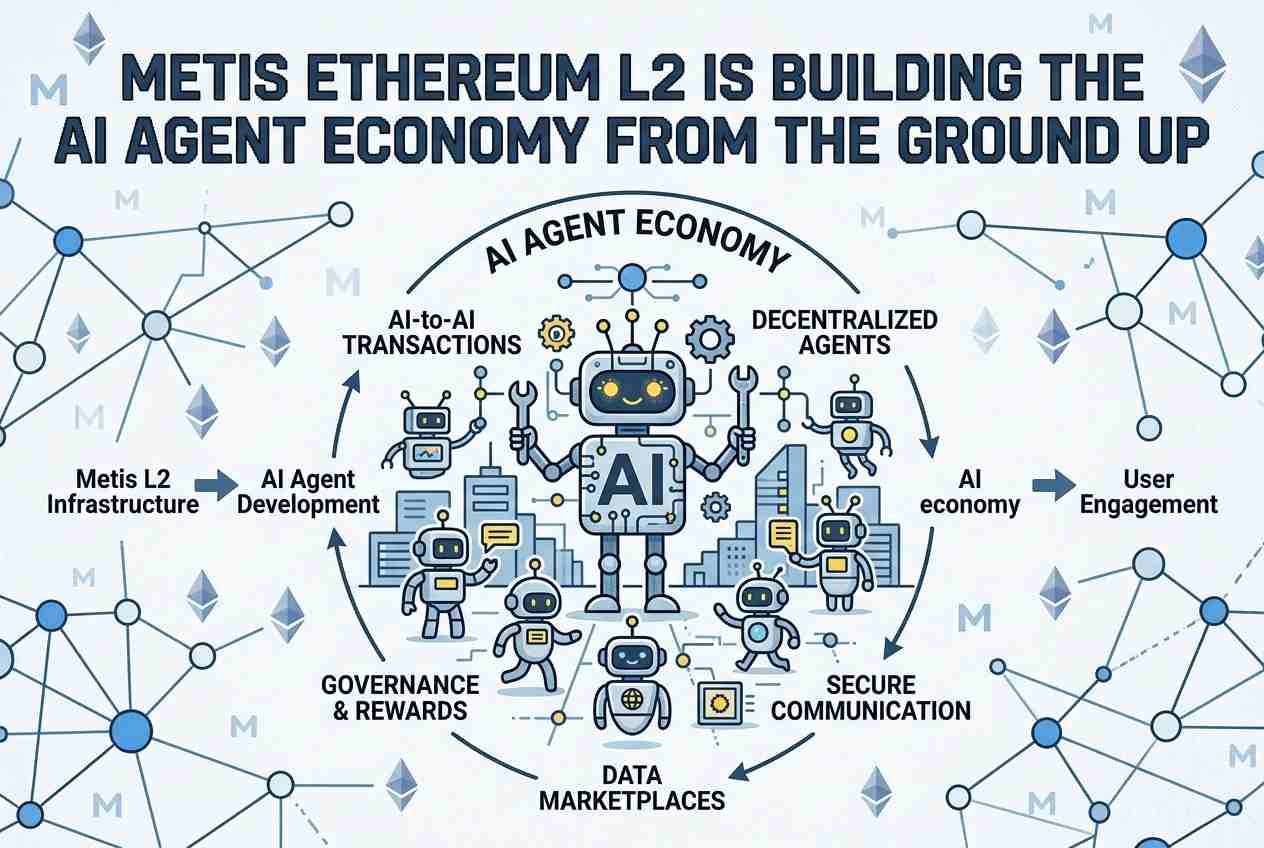
Most people still think of Metis as that Ethereum L2 doing Optimistic Rollup. That has not been true for a while. Since March 2025, Metis has been executing a dual-chain strategy that most observers have missed entirely: Andromeda, the original decentralized L2 where it became the first Ethereum rollup to hand transaction ordering to community participants rather than a central sequencer, running alongside Hyperion, a purpose-built AI-native execution layer targeting near-millisecond transaction finality. The tweet that brought Metis back into view on X on July 2 was about the OpenClaw Summer Builder Bootcamp, where Metis is co-organising a developer event with agent payments and AgentKit as featured infrastructure. That is not marketing. It is a signal about where Metis thinks the next wave of DeFi activity will come from: autonomous agents that need a chain fast enough to act like software, not like a database waiting to sync.
The broader Metis story in 2026 is a quiet but systematic build. METIS is down 99.2% from its all-time high of $323.54 and has a market cap of approximately $20 million as of early July, per CoinGecko. That price pain is real. But the infrastructure being assembled underneath it, a dual-chain architecture, an on-chain AI agent framework, a developer SDK for custom chains, and a governance system moving toward native on-chain voting, describes a project that has not stopped building through the bear market. Whether the market eventually prices that in is a separate question.
What Metis Actually Is in 2026: A Dual-Chain AI Infrastructure Play
Metis launched its Andromeda mainnet as a general-purpose Ethereum L2 built on Optimistic Rollup. Its primary differentiation from Arbitrum and Optimism was always the decentralized sequencer: where other L2s used a single centralized sequencer to order transactions (fast but a single point of failure and censorship risk), Metis distributed that function to community participants. The May 2025 Andromeda upgrade added real-time data availability migration and fraud-proof mechanisms, and Metis described it as making Andromeda the first truly decentralized Layer 2. L2Beat confirms the decentralized sequencer architecture, though it also flags that exit from Metis still requires the operator to be online, a centralisation dependency that exists across most Optimistic Rollup systems.
The March 2025 dual-chain announcement changed Metis’s positioning entirely. Rather than competing directly with Arbitrum and Base on the same general-purpose L2 battlefield, Metis built Hyperion as a separate high-performance chain specifically for AI workloads, gaming, high-frequency DeFi, and anything that needs execution speed that general-purpose rollups were not designed to deliver. Andromeda remains the decentralised, secure, general-purpose chain. Hyperion is the performance layer, and the two chains share liquidity through a common bridge framework. The METIS token underpins both.
Hyperion: What Near-Millisecond Finality Actually Requires
Hyperion’s performance claims are built on three specific architectural choices. First, MetisVM: a custom virtual machine that is EVM-compatible but adds AI-optimized instruction handling, dynamic opcode optimization, and speculative parallel execution. MetisVM processes transactions in parallel using Block-STM’s optimistic concurrency control and a dynamic directed acyclic graph scheduling algorithm. The combination is described by Metis as achieving approximately 30% faster execution than standard EVM processing, per BlockBeats and YBB Capital’s technical analysis. MetisDB, the storage layer, uses memory-mapped Merkle trees and multi-version concurrency control to deliver state access in nanoseconds rather than milliseconds, eliminating the storage bottleneck that slows high-frequency applications on conventional chains.
Second, a decentralized sequencer with leader rotation, timeout failover, and MEV-resistant ordering, which removes the single-point-of-failure risk while maintaining the speed that centralized sequencers provide on competing chains. Third, EigenDA integration for scalable data availability, giving Hyperion a path to increasing throughput without bottlenecking on Ethereum’s calldata costs. The practical result of combining these: Hyperion targets use cases that were previously impossible on-chain. On-chain LLM inference. Real-time AI agent decision-making where the agent’s trade or action must settle before the market moves. Gaming interactions that require blockchain certainty but cannot wait seconds for confirmation. These are not theoretical applications. The Hyperion testnet has been live since May 2025 with running dApps, and the HyperHack hackathon with a $200,000 prize pool has been running against it.
Hyperion vs Standard Ethereum L2: The Technical Gap
Why AI workloads need a different architecture | Sources: Metis, BlockBeats, YBB Capital | @cryptonewsbytes
Sources: Metis official, BlockBeats, YBB Capital research, PANews. Performance claims from Metis; independent benchmarks not yet publicly available | @cryptonewsbytes. Not financial advice.
LazAI and the On-Chain Agent Economy
The piece that connects Hyperion’s speed to a real market is LazAI, Metis’s decentralized AI network where users can create, train, and own AI models with every interaction tokenized. LazAI’s primary interface for developers is Alith, a framework for deploying on-chain AI agents that can execute DeFi strategies, manage wallets, interact with smart contracts, and process data, all verifiably on-chain. The Alith integration is what makes the OpenClaw Summer Builder Bootcamp partnership meaningful: OpenClaw, now processing millions of active users as an open-source AI agent platform with 350,000-plus GitHub stars, is the infrastructure that developers are already using to deploy agents across Telegram, Slack, and other messaging channels. Metis positioning its agent payments and AgentKit as featured infrastructure for that developer base is a distribution bet: if the agents the OpenClaw community is building need on-chain settlement, Metis wants to be the chain they settle on.
The February 2026 Metis blog post titled ‘The Agent Economy Has Begun’ described Metis’s AI agent EVE and the Debot framework, using blockchain as the verifiable identity and trust layer for agent-to-agent interactions. The vision is specific: in an economy where AI agents transact with each other autonomously, the trust problem is not who the human is but whether the agent executing a transaction is authorised, acting within its parameters, and settling verifiably. Blockchain does the second and third parts natively. Metis’s bet is that Hyperion does them fast enough for agents to function like software rather than like a settlement queue.
The Honest Picture: What Is Still Being Built and What the Risks Are
Hyperion mainnet has not launched yet as of July 2026. The testnet has been live since May 2025 with confirmed dApps and the HyperHack hackathon running against it, but CoinMarketCap’s tracker lists Hyperion Mainnet Launch as an upcoming milestone. Metis SDK, the modular toolkit for developers to build custom app-specific chains on Metis, is listed as a Q3 2026 target. L2Beat’s monitoring of Metis Andromeda flagged a 5-day-plus state update outage from June 13 to June 18, 2026, and a shorter outage on June 5. These are real operational data points that the marketing materials do not mention. For a chain positioning itself as infrastructure for time-sensitive AI agent workloads, uptime is not an afterthought.
The METIS token’s 99.2% decline from its $323.54 all-time high reflects the general L2 market compression of 2025 to 2026 and Metis’s smaller size relative to Arbitrum, Base, and Optimism. $20 million market cap puts it outside the top 800 tokens on CoinGecko. The infrastructure ambition is real; the market’s current valuation of it is not. That gap is either the opportunity or the warning, depending on whether Hyperion mainnet delivers on its performance claims and whether the AI agent use case generates the sustained on-chain transaction volume that would justify higher METIS demand for gas. One exchange has already delisted METIS margin trading, which reduces leverage access and signals concern about liquidity. The build is happening. The market validation is still ahead.
Frequently Asked Questions
What is the difference between Andromeda and Hyperion?
Andromeda is Metis’s original Ethereum L2, a general-purpose Optimistic Rollup with a decentralized sequencer. It prioritises security and decentralisation over raw speed. Hyperion is a separate high-performance chain purpose-built for AI and high-frequency applications, with MetisVM’s parallel execution and near-millisecond finality targets. The two share a bridge and the METIS token as their common economic layer.
Is the Hyperion mainnet live?
The Hyperion testnet has been live since May 2025, with dApps running on it and the HyperHack hackathon using it as a development environment. As of July 2026, Hyperion mainnet had not yet launched. Metis’s timeline places it as an upcoming milestone, with the Metis SDK for custom chains listed as a Q3 2026 target.
What is LazAI and how does it relate to Metis?
LazAI is Metis’s decentralised AI network where users create, train, and own AI models with tokenised interactions. Alith is LazAI’s developer framework for deploying on-chain AI agents. Together they form the AI layer of the Metis ecosystem, designed to run on Hyperion’s high-speed execution environment.
Further Reading
The regulatory backdrop that determines how AI agent tokens and L2 infrastructure tokens get classified. METIS’s status under the new framework matters for how US investors can access it.
The legislation that would place L2 tokens like METIS under CFTC jurisdiction as digital commodities.
On-chain agent payments that use stablecoins for settlement sit directly in the policy perimeter this legislation defines.
This article is for informational purposes only and does not constitute financial advice. Sources: Metis official blog February and March 2026, metis.io/blog, hyperion.metis.io, AICoin May 2026, BlockBeats, YBB Capital research, PANews, CoinStats AI, CoinMarketCap, CoinGecko, L2Beat Metis Andromeda entry, Bitget Metis news, CryptoNewsNavigator. Published July 2, 2026.