
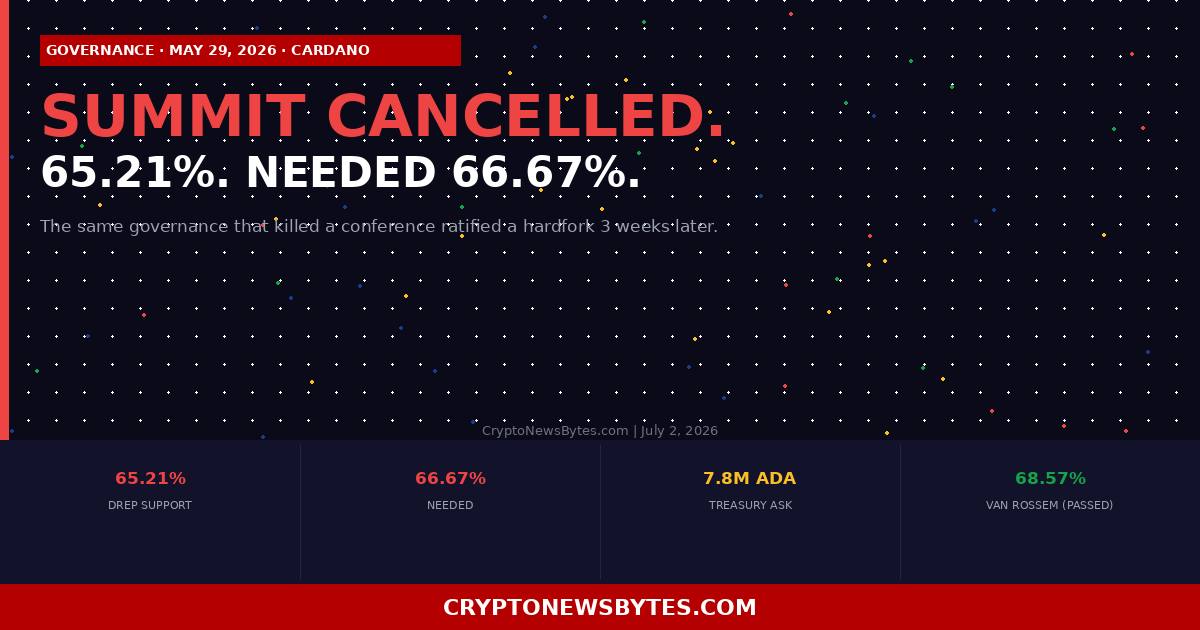
The Cardano Foundation’s flagship Summit 2026, planned for October 5 and 6 in Singapore, is not happening. Voting closed May 29 on a revised treasury proposal requesting 7.8 million ADA worth approximately $2 million. It received 65.21% support from DRep stake, which is 135 votes in favour and 61 against. That is a majority. It is not enough. Cardano’s constitution requires a supermajority of 66.67% for treasury withdrawals of this size. The proposal missed by 1.46 percentage points. The Foundation accepted the result the same day, began winding down logistics, and posted on X: ‘The Cardano community has spoken and we respect the outcome.’
Three weeks later, the same governance system ratified the Van Rossem hardfork cleanly: 68.57% DRep approval, 84% SPO readiness, 5 of 7 Constitutional Committee members signed off. Protocol Version 11 enacted June 18 at 21:45 UTC without incident. The contrast between those two outcomes is the actual story. Cardano’s Voltaire governance is not broken. It is working precisely as designed. The community said no to a $2 million marketing budget and yes to a protocol upgrade in the same month. Whether that is a feature or a problem depends on what you think decentralised governance is for.
How a Majority Vote Still Kills a Conference
The mechanics matter because they are counterintuitive. By headcount the Summit proposal won easily. 135 DReps voted yes, 61 voted no, 24 abstained. The Constitutional Committee, the elected body that reviews proposals for constitutional compliance, had already approved it. Charles Hoskinson and Cardano Foundation CEO Frederik Gregaard both urged DReps to vote yes in the final hours. The Foundation itself abstained from the summit ballot as a DRep, explicitly to avoid directing the community outcome despite holding voting power.
None of that was enough because Cardano’s treasury governance is stake-weighted, not headcount-weighted. Each DRep’s vote carries the weight of the ADA delegated to them, not a flat one-vote count. The yes bloc represented approximately 2.76 billion ADA in stake, or 65.21% of the participating total. The required threshold for treasury withdrawals is 66.67%, a strict supermajority written into the constitution. The proposal expired without ratification when voting closed. No resubmission has been announced.
The revised proposal was already a scaled-back version of an original 14.07 million ADA request that bundled the Summit with an EMURGO TOKEN2049 sponsorship. After DRep criticism of the combined size, the two were separated. The Summit budget was cut 22%, milestone gated payments were added, an independent oversight committee from DQuadrant, Intersect, NMKR and Sundae Labs was attached, and fund flows were committed to a public dashboard routed through audited Sundae Labs smart contracts. EMURGO’s separate 3.3 million ADA TOKEN2049 proposal passed independently. Cardano will have a presence in Singapore. It will not have its flagship conference.
Summit vs Hardfork: The Same System, Two Different Answers
May to June 2026 | Sources: adastat.net, Intersect update 116, CoinDesk, The Defiant | @cryptonewsbytes
Sources: adastat.net, crypto.news, The Defiant, CoinDesk, Intersect update 116 | @cryptonewsbytes
The IOG Budget Fight Running in Parallel
The Summit vote was not the only governance confrontation of the month. Running through June 8, a 32.9 million ADA proposal to fund IOG’s core research team for another year faced 81% active stake opposition, led primarily by Japanese DReps who argued the proposal lacked tight, auditable milestones and should be subject to a competitive open RFP process rather than an automatic institutional renewal. Hoskinson’s response was direct: ‘This doesn’t have anything to do with me. This has to do with destroying the entire core of our ecosystem. Cardano is the science coin. That’s our brand.’
The two votes together, the Summit loss and the IOG research budget opposition, paint a specific picture of where DRep sentiment sat in May and June 2026. The community was not anti-Cardano. It was anti-blank-cheque. The Developer Experience Initiative passed the same week the Summit failed. The Van Rossem hardfork ratified cleanly the following month. The DRep electorate was willing to approve spending when it came with milestones, audits and a clear technical outcome. It was unwilling to approve spending when the return was institutional visibility rather than a deliverable result. That is a coherent position, even if it is an uncomfortable one for the organisations that have historically run Cardano.
What This Actually Proves About Voltaire
The Cardano Foundation’s own statement contained the cleanest framing: ‘Governance requires not only participation, but also a commitment to accept collective decisions.’ That sentence was written about a vote the Foundation lost. Three weeks later the same sentence described a vote the protocol needed to win. Both outcomes came from the same system, operating correctly.
The harder question the Summit cancellation raises is whether decentralised governance can sustain the institutional presence Cardano needs to grow. The 2025 Summit in Berlin drew roughly $1.4 million from the treasury and generated $313,000 in commercial revenue from tickets and sponsorships. The 2026 Singapore plan projected $450,000 in revenue, ring-fenced for the 2027 event. Singapore vendor costs drove the budget higher than Berlin. DReps decided the math did not work. The Cardano ecosystem now goes into the second half of 2026 without its flagship institutional showcase, with the IOG research budget contested, and with TapTools, the most-used Cardano analytics platform, announcing a wind-down after its fifth senior executive departure. The Van Rossem hardfork enacted on schedule into that environment. Voltaire works. Whether it works fast enough is a different question.
Frequently Asked Questions
Can the Summit be revived with a different proposal?
The Foundation has not announced a resubmission or alternative funding plan. Any new proposal would need to clear the same 66.67% DRep stake threshold for a treasury withdrawal and would restart the full governance cycle including Constitutional Committee review and DRep voting. Whether the Foundation self-funds a smaller event from its own balance sheet or waits for 2027 is undisclosed as of June 2026.
Why did the Van Rossem hardfork pass when the Summit failed?
Different thresholds and different types of governance actions. Protocol upgrades under Voltaire require DRep approval but do not use the 66.67% treasury-withdrawal supermajority. The Van Rossem hardfork governance action cleared 68.57% DRep approval, 5 of 7 Constitutional Committee sign-off, and 84% SPO readiness on the technical side. The Summit was a treasury withdrawal requiring the strict supermajority. It also carried a different type of community scrutiny: spending on a conference versus activating a protocol change have different risk profiles in the DRep electorate’s judgement.
Further Reading
Governance and security are the two pillars of any blockchain’s long-term trust model. Zcash patched a critical flaw in four days. Cardano’s governance said no to a conference and yes to a hardfork in the same month.
The contrast case: a DeFi protocol with centralised governance that moved fast to rescue $200M. Cardano’s decentralised system moves slower and with more friction. Which model wins depends on what you are optimising for.
This article is for informational purposes only and does not constitute financial advice. Sources: The Block May 31, CoinDesk June 1, The Defiant June 1, FX Leaders May 31, CryptoRank June 1, Our Crypto Talk June 1, The Coinomist May 31, crypto.news May 22, adastat.net vote data, Intersect weekly update 116. Published July 2, 2026.