Key Points
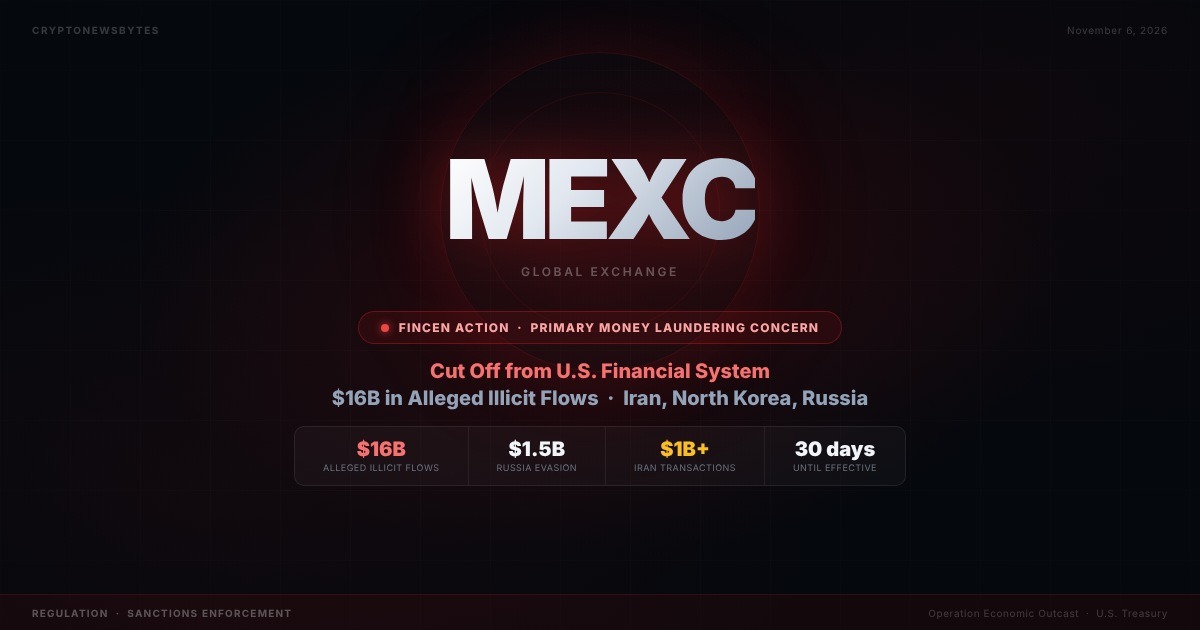
- FinCEN designated MEXC Global a “primary money laundering concern” on November 6, 2026, as part of Operation Economic Outcast.
- The order alleges MEXC processed at least $16 billion in suspicious transactions between May 2021 and May 2026 tied to Iran, Russia, and North Korea.
- U.S. financial institutions will be barred from processing any transfers involving MEXC once the order takes effect, 30 days after Federal Register publication.
- Russia-linked figures include roughly $1.5 billion, including alleged dealings with sanctioned exchange Garantex and its successor Grinex.
- Iran-linked figures include approximately $1 billion across more than 40 Iranian crypto exchanges, plus $22 million involving Iran’s central bank, the IRGC, and the Qods Force.
- This is not an OFAC SDN designation. It does not freeze MEXC’s assets globally or impose criminal liability on non-U.S. users today, but effectively severs MEXC from the U.S. dollar system.
What FinCEN Did and Why It Matters
On November 6, 2026, the U.S. Treasury’s Financial Crimes Enforcement Network issued a formal order designating MEXC Global, one of the world’s top-20 cryptocurrency exchanges by volume, a “primary money laundering concern” under Section 9714(a) of the Combating Russian Money Laundering Act.
The designation is a legal mechanism that stops short of placing MEXC on the OFAC Specially Designated Nationals list, which would impose worldwide asset freezes and near-universal criminal exposure for anyone transacting with the exchange. What this order does is narrower but still severe: it bars every U.S. financial institution from processing any transfer that touches MEXC. That cuts the exchange off from the U.S. dollar correspondent banking system entirely. No U.S. bank, payment processor, or financial intermediary can handle MEXC-related flows once the restriction takes effect.
The order is part of Operation Economic Outcast, a Treasury campaign launched in August 2026 specifically targeting financial entities that help Iran and other sanctioned states access the global financial system through crypto channels.
What FinCEN Says MEXC Did
The core allegation is that MEXC operated with “severely deficient” KYC (know-your-customer) and AML (anti-money laundering) controls for five years, allowing sanctioned entities and criminal networks to use the exchange as a conduit.
The Iran allegations are the most specific. FinCEN says MEXC processed approximately $1 billion in transactions with more than 40 Iranian cryptocurrency exchanges during the five-year window. Beyond that, it alleges $22 million in transactions directly involving Iran’s central bank, the Islamic Revolutionary Guard Corps (IRGC), and the IRGC’s Qods Force, both of which are U.S.-designated terrorist organizations.
On Russia, FinCEN alleges roughly $1.5 billion in sanctions evasion transactions, specifically naming Garantex, the Moscow-based exchange sanctioned by OFAC in 2022, and its alleged successor entity Grinex as counterparties. Garantex was accused at the time of its designation of processing hundreds of millions in ransomware proceeds and darknet market funds. FinCEN’s allegation is that MEXC continued processing transfers involving these entities well after the OFAC designations were public.
North Korea is cited in the broader $16 billion figure, consistent with Treasury’s longstanding attribution of Lazarus Group crypto thefts to Pyongyang’s weapons financing programs.
What This Means in Practice
The 30-day window before the restriction takes effect means U.S.-linked institutions can technically still process MEXC transfers until the Federal Register publication date plus 30 days. In practice, most U.S.-licensed banks and payment processors are likely to begin cutting ties earlier to avoid regulatory risk, as has happened in prior FinCEN designation cases.
For MEXC users outside the United States, today’s order does not create immediate legal liability. The designation is a U.S. domestic banking restriction, not a global asset freeze. Non-U.S. users are not automatically in violation of U.S. law by holding funds on MEXC. However, any withdrawal route that passes through the U.S. dollar correspondent banking system will be blocked once the order is effective, and exchanges operating in jurisdictions that follow U.S. guidance closely (UK, EU, Singapore, UAE) may begin rejecting MEXC-originating transfers proactively.
MEXC had not responded to press requests for comment as of publication. The exchange has not announced a legal challenge to the order.
Operation Economic Outcast: The Bigger Picture
The MEXC action is not an isolated enforcement move. Treasury launched Operation Economic Outcast in August 2026 as a coordinated campaign to identify and sever financial infrastructure being used by Iran to bypass the SWIFT-centered sanctions regime through cryptocurrency channels.
The pattern Treasury has described across multiple enforcement actions in the campaign is consistent: exchanges with weak or selectively applied KYC controls are exploited as intermediaries between Iranian entities and the global financial system. Rather than moving dollars directly through banks, sanctioned parties convert to crypto, route through poorly regulated exchanges, and exit into fiat in third-country jurisdictions. FinCEN’s designation mechanism is designed to collapse that corridor by removing the U.S. dollar leg of the transaction chain.
“MEXC’s severely deficient AML controls allowed sanctioned regimes and criminal networks to use the platform as a bridge to the U.S. financial system for five years.”
FINCEN ORDER SUMMARY, NOVEMBER 6, 2026
Key Distinctions: What This Is and Is Not
What MEXC Users Should Know
The 30-day window is the practical concern for anyone with funds on the platform. Once U.S. financial institutions are barred from processing MEXC transfers, fiat withdrawal routes that run through U.S. dollar correspondent banking will be blocked. Users in jurisdictions where local banking infrastructure runs dollar transfers through U.S. correspondent banks, which is most of the world, will find USD withdrawals unavailable.
Crypto-to-crypto transfers between non-custodial wallets are not affected by the FinCEN order, as those do not involve U.S. financial institutions. Users who hold assets on MEXC can withdraw to self-custody wallets and then move to other exchanges. The practical risk is that other regulated exchanges may begin rejecting MEXC-originating deposits as a compliance precaution, as happened to users of previously designated platforms like Garantex.
CryptoNewsBytes is not a legal or financial advisor. Users with funds on MEXC should consult their own legal and compliance counsel given the jurisdiction-specific nature of these restrictions.
Frequently Asked Questions
Further Reading
- The $1.5B Bybit Hack and EIP-7702: Two Threats Every Security Team Needs to Understand
- Trump Media Moves 4,259 BTC to Crypto.com, Arkham Labels as Convertible Note Collateral
- Hoskinson: CLARITY Act Failed Because of the Wrong Crypto Czar, Memecoin Partisanship