
⚡ 3 Key Takeaways
- Stablecoins are programmable money — and that programmability can enforce real-time financial rules indistinguishable from a social credit system, whether issued by a central bank or a private corporation
- The GENIUS Act requires all stablecoin issuers to plug into Treasury’s KYC/AML/sanctions pipe. The Clarity Act extends this to a potential $100-300 trillion tokenized asset market. Combined, they create the infrastructure for total transaction surveillance
- Geopolitical flashpoints involving Iran and BRICS nations may partly stem from efforts to eliminate “leakage” in global payment systems that don’t align with centralized digital control
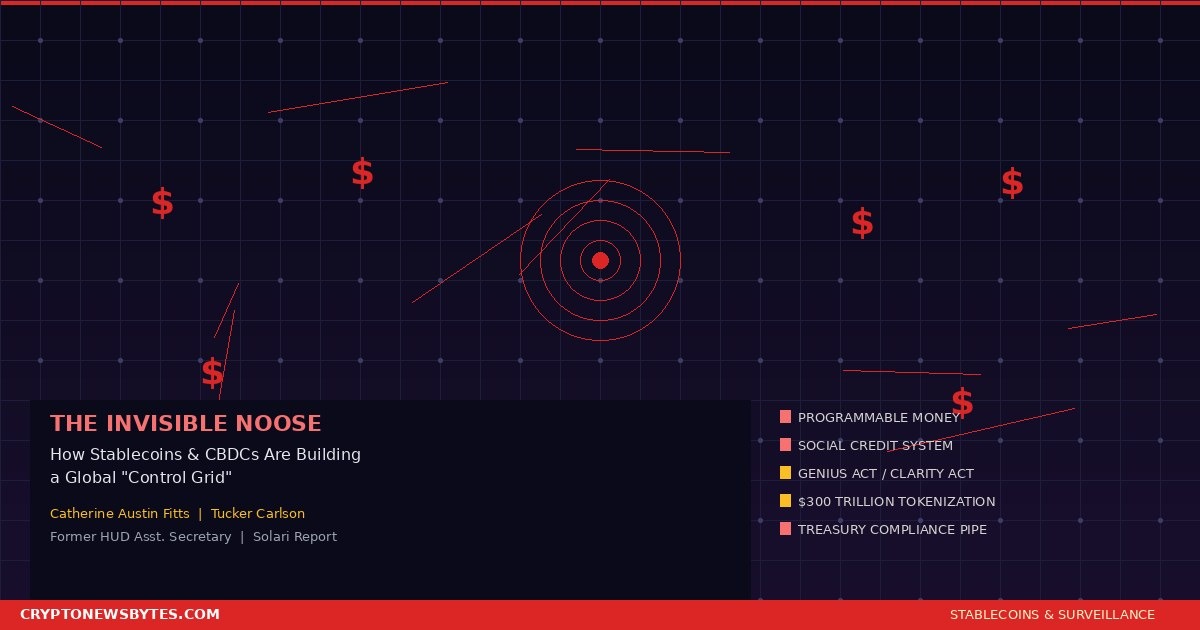
In a high-stakes discussion on the Tucker Carlson Network about stablecoins and the future of digital money, Catherine Austin Fitts — former Assistant Secretary of Housing and Urban Development, former Managing Director at Dillon Read & Co., and founder of the Solari Report — joined Tucker Carlson to pull back the curtain on what she calls the “fast approaching digital control grid.”
While the crypto industry often frames stablecoins as a bridge to financial freedom, Fitts warns that the underlying infrastructure, whether managed by central banks or private corporations, is being engineered for total surveillance. The conversation forces a question every crypto holder needs to confront: is the stablecoin revolution building liberation, or a digital cage?
For context on the regulatory frameworks Fitts references, see our detailed breakdowns of the GENIUS Act and the Clarity Act / SEC vs CFTC framework.
The Three Pillars: How Stablecoins Enable the Panopticon
According to Fitts, the shift toward a fully digital economy is not accidental. It is built on a deliberate three-pronged strategy to assert total governance over the individual:
Together, these three systems create what Fitts calls a “control grid” — a digital infrastructure capable of monitoring, restricting, and enforcing financial behavior at the individual level. The technology is not theoretical. The only question is whether the political and legal safeguards will prevent its full deployment.
Stablecoins: The Private Sector’s Trojan Horse?
A sobering takeaway for crypto users is Fitts’s assertion that a Central Bank Digital Currency (CBDC) is not even necessary for this grid to succeed. Private stablecoins can achieve the same level of control:
“The central bankers — whether they do it with a CBDC or private stablecoins — are setting the world up so they can control your financial transactions in real-time with the equivalent of a social credit system.”
— Catherine Austin Fitts
The mechanism is structural. Under the GENIUS Act, every stablecoin issuer must plug into the Treasury’s compliance pipe — KYC, anti-money-laundering, and sanctions enforcement. Fitts argues this pipe is the critical chokepoint:
“If you look at the stablecoin bill, the GENIUS Act, it is set up so that all stablecoin issuers have to plug into the Treasury’s pipe. And if you look at that pipe, it can be integrated with a full social credit system. Whereas CBDC applies the rules through the central bank, the stablecoins apply the rules through the Treasury.”
The distinction she draws is precise: the end result is the same programmable money with centralized enforcement. The only difference is which government institution holds the switch. The crypto community celebrated banning CBDCs without recognizing that the functional equivalent was being built through private-sector rails.
The Clarity Act: Stablecoins Meet a $300 Trillion Tokenized System
The scale extends far beyond stablecoins. The Clarity Act creates the regulatory framework for digital assets and tokens broadly. Fitts highlighted what this means:
“Larry Fink and BlackRock have said they’re planning on trading all stocks and bonds using tokens or digital assets. What that means is this is going to be potentially a $100, $200, $300 trillion market. They want to be able to trade all financial assets worldwide on a distributed ledger that can be turned into programmable money.”
Fitts noted a critical inconsistency: the Clarity Act’s House version banned CBDCs, but the Senate stripped that provision. “Apparently they want to reserve the right of the Central Bank to do that.” If you can implement all the same controls through stablecoins and digital tokens, banning CBDC is symbolic while leaving the functional equivalent intact.
Her warning: “If you end up with $250 trillion outstanding and you haven’t put the bridle and saddle on the horse, you’ve got a problem.”
AI and the Architecture of Spatial Control
The rush toward massive AI data centers is about more than large language models and chatbots. Fitts argues these are the “brains” of the control grid. AI’s mastery of spatial analysis means the system could mathematically restrict your money, and even your vehicle via embedded “kill switches,” from functioning outside a designated zone if your compliance score drops.
“Programmable money allows the bankers who’ve been running monetary policy to now control fiscal policy and essentially replace legislatures and the executive branch by making and enforcing the rules through the money,” Fitts explained.
Tucker Carlson captured the implication directly: “This is about replacing governments with a system where bankers dictate fiscal policy through code and AI.”
The integration of AI with financial infrastructure creates a feedback loop: AI monitors transactions, flags anomalies, enforces rules, and learns from behavior patterns to predict and preempt non-compliance. Each component (programmable money, digital ID, surveillance hardware, AI processing) reinforces the others. No single piece is dangerous alone. Together, they form what Fitts calls an inescapable “digital cage.”
The Geopolitical “Leakage”
Fitts connects financial infrastructure to current geopolitical flashpoints in ways that challenge conventional narratives. She suggests tensions involving Iran are less about nuclear capabilities and more about “leakage” in the centralized payment system:
“Iran right now is the big leakage in the system… because their oil and energy is very important, including for China… What the BRICS system is trying to do is create independent payment systems… you can’t afford leakage.”
In this framework, nations maintaining independent payment rails are not just geopolitical rivals but structural threats to the control grid. The system requires totality to function. Any economy operating outside the surveillance perimeter represents a leak that must be plugged. The same infrastructure that enables fast, cheap cross-border stablecoin transfers also enables the transaction-level monitoring needed to ensure no value moves outside the grid.
What States Can Do: The Solari Model
Fitts is not only raising alarms. Through Solari, she has developed model legislation for U.S. states to restrict misuse of programmable money. The logic is simple:
“We’re saying to the states: if you guys say you’re not going to do this, we can outlaw it now. Treasury’s saying, ‘Oh, we would never do that.’ The stablecoin companies are saying, ‘Oh, we would never do that.’ And we’re saying: if you would never do that, you don’t mind if we pass a law that says you can’t, right?“
She reports that neither Treasury nor the stablecoin industry has been enthusiastic about such legislation, which she views as revealing. States have the power to prohibit programmable money from being used for social credit enforcement, transaction-level behavioral control, or geographic spending restrictions within their jurisdictions. The question is whether they will act before the infrastructure is too deeply embedded to unwind.
What This Means for Crypto Users
Understand what “regulated” really means. The GENIUS Act is not just consumer protection. It creates compliance pipes that enable transaction-level oversight. Read the legislation itself, not just the industry celebration. Our GENIUS Act explainer breaks down the technical architecture.
Watch the Clarity Act debate. The framework for tokenized assets will determine whether programmable money controls extend from stablecoins to all financial assets. This is the $300 trillion question.
Diversify your custody understanding. If all stablecoins route through Treasury compliance infrastructure, self-custody of non-stablecoin crypto assets becomes a critical hedge. Understanding crypto custody and insurance matters more than ever.
Support state-level protections. Whether or not you agree with every element of Fitts’s analysis, the principle of “if you’d never abuse it, you shouldn’t mind banning the abuse” is sound policy for any technology with dual-use potential.
Editor’s Note: As we optimize for the future of Web3, the technology that enables instant global payments remains a double-edged sword. The crypto community must engage with these questions honestly. Whether you view Fitts as prescient or alarmist, the infrastructure she describes is real and being built now. The debate is not whether it can be used for control, but whether it will be.
Watch the full interview: Tucker Carlson Network — Catherine Fitts on the Control Grid
What do you think — game-changer for freedom, or stealthy path to control? Drop your take below, and follow @cryptonewsbytes for more unfiltered dives into the stories shaping crypto.
📰 Related Reading
- The GENIUS Act Explained: What Every Crypto Company Needs to Know
- SEC vs CFTC: The Clarity Act and Digital Asset Regulation
- MiCA Regulation: Crypto Compliance Guide 2026
- Crypto Insurance in 2026: Comprehensive Guide
- How to Get a Crypto License: Country-by-Country Guide
- Crypto Tax Reporting: CARF & DAC8 Guide
Disclaimer: This article is for informational and educational purposes only and does not constitute financial, investment, legal, or tax advice. Cryptocurrencies and stablecoins are highly volatile and involve significant risk of loss. The views expressed by Catherine Austin Fitts and Tucker Carlson are their own and do not represent the editorial position of CryptoNewsBytes. Always do your own research (DYOR) and consult a qualified professional advisor before making any decisions. CryptoNewsBytes and its contributors are not responsible for any losses incurred from reliance on this information.
CryptoNewsBytes — Cutting through the noise, one byte at a time. More on regulations, DeFi, and the evolving stablecoin landscape at cryptonewsbytes.com.