Key Points
Quantum Blockchain blockchain patent update: ASIC UltraBoost US patent 12756574 expected October 6. SHA-256 efficiency technology targeting Bitcoin ASIC manufacturers for licensing.
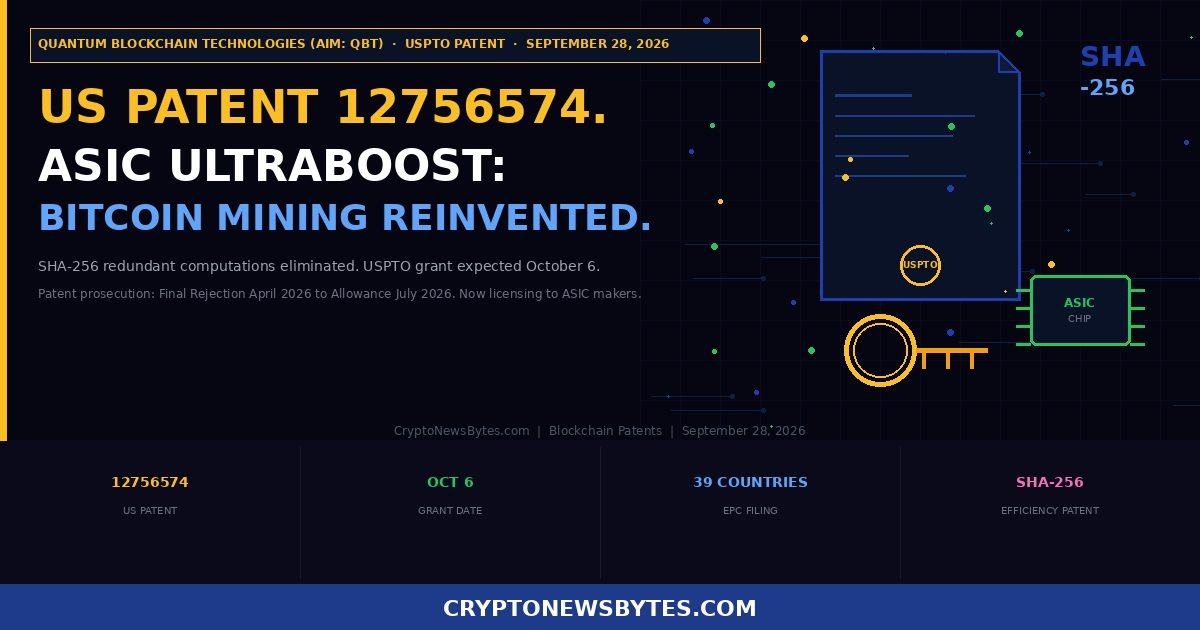
▶ Quantum Blockchain Technologies (AIM: QBT) expects US Patent 12756574 to be formally granted on October 6, 2026, per a USPTO Issue Notification dated September 23, 2026. The patent covers its ASIC UltraBoost technology.
▶ The patent application is formally titled “Message Scheduling for Cryptographic Hashing” (Application 18/696,073). It covers technology designed to eliminate redundant computations from the SHA-256 message-scheduling process used in Bitcoin mining ASICs.
▶ The Quantum Blockchain blockchain patent journey was not smooth: the USPTO issued a Final Rejection in April 2026, Quantum Blockchain filed amended claims after an examiner interview, and the Notice of Allowance arrived on July 23, 2026 and demonstrating the back-and-forth of real patent prosecution.
▶ Quantum Blockchain is also pursuing European Patent Convention protection across 39 countries. The EPO published its Message Schedule Arrays application in March 2026, raised objections, which Quantum Blockchain’s attorneys have addressed within the deadline.
▶ The commercial strategy: licensing to established ASIC manufacturers and semiconductor companies. Quantum Blockchain is recruiting sector experts to support licensing discussions. CEO Francesco Gardin confirmed early licensing talks have begun.
▶ Separately, Quantum Blockchain is progressing Method C (AI-based Oracle technology) using ASIC partner datasets, Method B (chaos mathematics variant), and has resumed quantum computing research on SHA-256. A new subsidiary, BlocKeeper Plc, was formed for virtual mining.
A Quantum Blockchain blockchain patent that covers one of the more technically specific approaches to Bitcoin mining efficiency is expected to be formally granted in one week. Quantum Blockchain Technologies (AIM: QBT), a London-listed research and development company, received a USPTO Issue Notification dated September 23, 2026, confirming that US Patent 12756574 and covering its ASIC UltraBoost technology and will be formally granted on October 6, 2026.
The patent application number is 18/696,073, formally titled “Message Scheduling for Cryptographic Hashing.” What that dry title describes is a specific engineering improvement to Bitcoin mining hardware: removing computations from the SHA-256 message-scheduling process that are mathematically redundant but currently performed by every ASIC Bitcoin miner on the market. If the technology works as described, it would allow existing ASIC hardware to perform the same mining work with fewer computational steps and translating directly into improved energy efficiency or hash rate per unit of power.
This article covers what the patent actually covers in plain English, the full prosecution history that shows how Quantum Blockchain got from a Final Rejection to a granted patent in six months, what the European filing situation is, how Quantum Blockchain plans to monetise the patent through licensing, and where its other Bitcoin mining technologies stand. This is also contextualised against the broader blockchain patent landscape CNB covered this week and where ZK proofs, cross-chain interoperability, and tokenized settlement mechanics are growing fastest, and where ASIC efficiency sits in that picture.
What Is the Quantum Blockchain ASIC UltraBoost Patent? The Technical Explanation
What is SHA-256 message scheduling?
SHA-256 is the cryptographic hash function at the heart of Bitcoin mining. Every time a miner’s ASIC chip tries a new nonce to find a valid block, it runs a SHA-256 computation. That computation has two phases: a message schedule phase (which expands the 512-bit input block into 64 32-bit words) and a compression phase (which processes those 64 words through 64 rounds of operations). The message schedule runs on every single hash attempt. In Bitcoin mining, ASICs run billions of these per second. Quantum Blockchain’s claim: part of the message scheduling computation produces the same result on every hash attempt for a given block header because the data being hashed does not change between attempts. Those computations are redundant. ASIC UltraBoost removes them.
The specific technical claim: in Bitcoin mining, the first 16 words of the SHA-256 message schedule are derived from the block header data. For a given block, most of this data is fixed between hash attempts and only the nonce field changes. This means a significant portion of the message scheduling computation produces identical results on every single hash attempt and can be pre-computed once rather than re-computed billions of times per second. Quantum Blockchain’s patent covers the method of identifying and eliminating these redundant computations from the ASIC’s execution pipeline.
The potential efficiency gain depends on what fraction of the total computation is captured by this optimisation and how much of an ASIC’s silicon area and power budget is currently dedicated to that redundant work. Quantum Blockchain has not published specific efficiency figures. CEO Francesco Gardin has described the technology as capable of improving mining efficiency and has confirmed that early testing indicated improved performance compared with conventional methods. Quantum Blockchain’s CEO has also framed this as potentially attractive to ASIC manufacturers seeking to differentiate their hardware on efficiency metrics in a competitive market.
What Is the Quantum Blockchain Patent Prosecution History? From Rejection to Allowance
Quantum Blockchain ASIC UltraBoost US Patent: Full Prosecution Timeline
Filed
Application 18/696,073 filed at USPTO under title ‘Message Scheduling for Cryptographic Hashing’. Covers the ASIC UltraBoost method of eliminating redundant SHA-256 message schedule computations.
March 2026
European Patent Office published the parallel ‘Message Schedule Arrays’ application. EPO raised objections in an examination report. Quantum Blockchain’s patent attorneys addressed those objections within the deadline.
April 2026
USPTO issued a Final Rejection of the US application. A Final Rejection is a formal USPTO position that the claims as filed are not allowable. It typically requires either an appeal or amended claims.
Post-April 2026
Quantum Blockchain’s patent attorneys requested and conducted an examiner interview with the USPTO. In an examiner interview, the applicant’s attorneys discuss the rejection directly with the examiner to understand what amended claims might be acceptable.
Post-interview
Quantum Blockchain filed amended claims following the examiner interview, addressing the specific objections raised in the Final Rejection.
July 23, 2026
USPTO issued a Notice of Allowance and formal notification that the amended claims have been accepted and the patent is approved for grant pending payment of issue fees.
September 23, 2026
USPTO Issue Notification confirmed Patent number 12756574 and confirmed grant date of October 6, 2026.
October 6, 2026
Patent 12756574 expected to be formally granted. Quantum Blockchain has indicated it will make a further announcement upon formal grant.
Sources: QBT Interim Results announcement September 28 2026, Proactive Investors July 24 2026, Share Talk July 27 2026, USPTO records (application 18/696,073) | @cryptonewsbytes
What does a USPTO Final Rejection mean and how does it get overturned?
A Final Rejection is not the end of the patent process. It means the USPTO examiner has reviewed the application and concluded the claims as currently written are not patentable. The most common reasons: the claims are too broad (covering prior art that already exists), or the claims are not sufficiently differentiated from existing patents. After a Final Rejection, applicants can: (1) file an appeal to the Patent Trial and Appeal Board, (2) file a continuation application with new or narrowed claims, or (3) request an examiner interview to discuss what amended claims would be acceptable. Quantum Blockchain took option 3. The examiner interview and subsequent claim amendments resolved the examiner’s objections and led to the Notice of Allowance.
What Is Quantum Blockchain’s European Patent Strategy Across 39 Countries?
Quantum Blockchain is pursuing protection under the European Patent Convention (EPC) rather than individual country filings in Europe. An EPC application, if granted, provides protection across all 39 EPC member states through a single filing and a significantly more cost-effective route than country-by-country European filings for a company at Quantum Blockchain’s stage.
The parallel European application is titled “Message Schedule Arrays” and a slightly different framing of the same technical concept covered by the US ASIC UltraBoost application. The EPO published the application in March 2026 and subsequently raised objections in an examination report. Quantum Blockchain’s patent attorneys have addressed those objections within the deadline. An EPO examination objection does not mean rejection and it is a standard part of the examination process where the office identifies prior art or clarity issues and the applicant responds. The EPO prosecution is ongoing.
If Quantum Blockchain secures both the US patent (Patent 12756574) and the EPC grant, it would have protection in the United States and 39 European countries covering the same SHA-256 message scheduling optimisation. Combined, that covers the majority of the major ASIC semiconductor manufacturing and Bitcoin mining infrastructure markets.
How Does Quantum Blockchain Plan to Make Money From This Patent?
Quantum Blockchain’s commercial strategy is licensing rather than manufacturing. The company is not building its own ASIC chips. It is developing the intellectual property and seeking to license it to established ASIC manufacturers, specifically to companies that already manufacture the specialist hardware used in Bitcoin mining at scale.
The target licensees are the ASIC manufacturers whose hardware runs SHA-256 mining at industrial scale. The largest Bitcoin ASIC manufacturers and Bitmain, MicroBT (Whatsminer), Canaan, and others and collectively supply the hardware that secures the Bitcoin network. If Quantum Blockchain’s ASIC UltraBoost optimisation is real and meaningful, these manufacturers would have two options: licence the technology from Quantum Blockchain, or risk Quantum Blockchain licensing to a competitor who then gains an efficiency advantage. That competitive dynamic is what makes the patent commercially valuable if the underlying technology delivers.
Quantum Blockchain stated in its interim results that it is recruiting sector experts to support licensing and commercial discussions with ASIC manufacturers. CEO Gardin confirmed at the Nashville Energy and Mining Summit that early licensing discussions have begun. The company has cautioned that the process is at an early stage with no certainty over timing, structure, or outcome.
The honest commercial reality
A US patent grant does not guarantee licensing revenue. The technology needs to demonstrate meaningful efficiency improvement in real ASIC hardware conditions. The claimed redundant computations may represent a small fraction of total ASIC work in practice. ASIC manufacturers may already have their own approaches to similar optimisations. And even if the technology is valuable, licensing negotiations with hardware manufacturers can take years. Quantum Blockchain has €1.1 million in comprehensive losses for H1 2026 and needs financing. The patent is an important milestone but the commercial path from patent to revenue is not short.
Quantum Blockchain’s Other Technologies: Method C, Method B, and Quantum Computing
Method C: AI-Based Oracle Technology
Method C is Quantum Blockchain’s artificial intelligence approach to Bitcoin mining optimisation. Rather than modifying the SHA-256 computation directly (as ASIC UltraBoost does), Method C uses AI to predict which nonces are more likely to produce valid hashes, reducing the total search space. Quantum Blockchain has been testing Method C using datasets provided by an ASIC industry partner and reports early testing indicating improved performance versus conventional mining. The technology is moving from laboratory validation toward live testing with manufacturer-supported data. No specific efficiency figures have been published.
Method B: Chaos Mathematics Variant
During H1 2026, Quantum Blockchain introduced a new version of Method B based on chaos mathematics. Chaos mathematics studies deterministic systems that are highly sensitive to initial conditions, producing behaviour that appears random but is governed by underlying mathematical laws. The application to Bitcoin mining is not detailed in the public announcement. Method B represents a separate technical approach to the nonce search problem from both ASIC UltraBoost (hardware pipeline optimisation) and Method C (AI prediction).
Quantum Computing Research on SHA-256
Quantum Blockchain resumed research into whether quantum computing could be applied to the SHA-256 algorithm that underpins Bitcoin mining. This is the most speculative of Quantum Blockchain’s research lines. Current quantum computers cannot meaningfully attack SHA-256 and the algorithm is considered quantum-resistant with sufficient key length. Quantum Blockchain’s research appears focused on whether quantum annealing or other near-term quantum approaches could provide any practical advantage in the mining nonce search, not on breaking SHA-256 cryptographically.
BlocKeeper Plc: Virtual Mining Subsidiary
Quantum Blockchain established BlocKeeper Plc as a new subsidiary to conduct virtual Bitcoin mining. BlocKeeper’s strategy is to obtain access to hash rate through contractual arrangements with existing mining operations rather than buying and operating hardware directly. This is effectively hash rate brokerage or contract mining and paying for a share of existing mining infrastructure’s output without the capital expenditure of building a mining facility. This creates a revenue line that does not depend on Quantum Blockchain’s own technologies being commercially deployed.
Where Does the Quantum Blockchain Blockchain Patent Fit in the 2026 Patent Landscape?
The CNB blockchain patents analysis published this week identified the three fastest-growing categories as ZK proof systems, cross-chain interoperability, and tokenized asset settlement mechanics. ASIC mining efficiency optimisation is a different category: it is not about new blockchain applications but about improving the computational infrastructure that secures the oldest and largest blockchain network.
Quantum Blockchain vs Major Blockchain Patent Filers: Position in the Landscape
Sources: USPTO, QBT filings, CNB blockchain patents 2026 analysis | @cryptonewsbytes
| Company | Portfolio Size | Focus Area | Strategy |
|---|---|---|---|
| IBM | 650+ | Identity, supply chain, financial services, ZK | Defensive moat + licensing |
| Bank of America | 200+ | Payment rails, digital assets, settlement | Defensive positioning |
| Mastercard | 150+ | Stablecoin rails, tokenized cards | Product differentiation |
| Circle | 40+ | Multi-chain USDC infrastructure | Infrastructure protection |
| Quantum Blockchain Technologies | 1-2 active | SHA-256 ASIC mining efficiency | Licensing to ASIC manufacturers |
Quantum Blockchain operates in a niche not contested by the major institutional filers. ASIC mining efficiency is separate from enterprise blockchain infrastructure. | @cryptonewsbytes
Quantum Blockchain sits in an unusual position in the patent landscape. It is a small-cap AIM-listed company with a narrowly focused but technically specific patent targeting a well-defined commercial application: ASIC manufacturers. IBM’s 650-patent blockchain portfolio and Bank of America’s 200-plus filings are enterprise defensive moats. Quantum Blockchain’s single granted patent and EPC filing are a licensing play targeting a specific market where the technology, if it works, has a clear commercial mechanism.
The ASIC mining efficiency patent category is not heavily contested by the major institutional filers. IBM’s blockchain patents focus on identity, supply chain, and financial services. Mastercard and Visa focus on payment rails and stablecoin integration. The specific niche of SHA-256 mining hardware optimisation is occupied primarily by the ASIC manufacturers themselves and by small specialist companies like Quantum Blockchain. If Quantum Blockchain’s patent withstands challenge and the underlying technology delivers measurable efficiency gains, the licensing opportunity within that niche could be significant even for a company of Quantum Blockchain’s size.
Frequently Asked Questions
What is Quantum Blockchain’s ASIC UltraBoost patent?
Quantum Blockchain’s ASIC UltraBoost patent, formally titled ‘Message Scheduling for Cryptographic Hashing’ (US Patent 12756574), covers a method of eliminating redundant computations from the SHA-256 message-scheduling process used in Bitcoin mining ASIC hardware. Bitcoin ASICs run SHA-256 billions of times per second. A portion of the message scheduling computation produces identical results on every attempt for a given block header because only the nonce changes. Quantum Blockchain’s invention pre-computes those fixed values once rather than recalculating them on every hash attempt.
When will Quantum Blockchain’s patent be granted?
Quantum Blockchain received a USPTO Issue Notification dated September 23, 2026, confirming that Patent 12756574 is expected to be formally granted on October 6, 2026. Quantum Blockchain has stated it will make a further announcement upon formal grant.
What happened with the USPTO Final Rejection?
In April 2026, the USPTO issued a Final Rejection of Quantum Blockchain’s ASIC UltraBoost application, meaning the claims as filed were not considered patentable. Quantum Blockchain’s attorneys requested an examiner interview, discussed the objections directly with the USPTO examiner, and filed amended claims. The amended claims were accepted, and the USPTO issued a Notice of Allowance on July 23, 2026.
How does Quantum Blockchain plan to make money from this patent?
Quantum Blockchain’s strategy is to license the ASIC UltraBoost technology to established ASIC manufacturers rather than manufacture chips itself. The target licensees are Bitcoin ASIC producers who would benefit from the SHA-256 efficiency improvement in their hardware. Quantum Blockchain is recruiting sector experts to support licensing and commercial discussions. Early discussions have begun but no agreements have been announced. The company has cautioned there is no certainty over timing or outcome.
What is Quantum Blockchain’s European patent status?
Quantum Blockchain is pursuing European Patent Convention protection across 39 countries for a parallel application titled ‘Message Schedule Arrays’. The EPO published the application in March 2026 and raised examination objections, which Quantum Blockchain’s attorneys have addressed within the deadline. The European prosecution is ongoing and an EPO examination objection is standard procedure and does not mean rejection.
Is Quantum Blockchain a good investment?
CNB does not give investment advice. Quantum Blockchain is an AIM-listed research company with €1.1 million in H1 2026 losses and a patent that has not yet generated licensing revenue. The commercial opportunity depends on the technology delivering meaningful efficiency gains, ASIC manufacturers agreeing to licence rather than design around the patent, and licensing negotiations concluding successfully. Patent grant is an important milestone but is not the same as commercial success.
Further Reading
The full landscape of blockchain patent activity in 2026: IBM’s 650-patent portfolio, Bank of America, Mastercard, and Visa filings, and the three fastest-growing categories. Context for where Quantum Blockchain’s mining patent fits.
Circle’s 2026 blockchain patent reveals USDC’s cross-chain infrastructure ambitions. A comparison: Circle’s financial infrastructure patent vs Quantum Blockchain’s mining efficiency patent and two different ends of the blockchain patent spectrum.
The security context for Bitcoin mining infrastructure: the Hacken Q2 2026 report on where crypto losses originate. ASIC hardware security is part of the broader operational security picture this report covers.
Sources: QBT Interim Results announcement September 28 2026 (primary: patent number 12756574, October 6 grant date, Method C progress, BlocKeeper formation, €1.1M loss), Share Talk July 27 2026 (primary: Notice of Allowance confirmed, Francesco Gardin quote, licensing strategy), Proactive Investors July 24 2026 (primary: examiner interview confirmed, application number 18/696,073), kalkinemedia.com July 24 2026 (Notice of Allowance details), USPTO patent records application 18/696,073 (primary: prosecution history), ADVFN September 28 2026 (EPC filing detail, 39 countries, March 2026 EPO publication) | Published September 28, 2026 | CryptoNewsBytes.com | Not financial advice.