⚡ Key Points
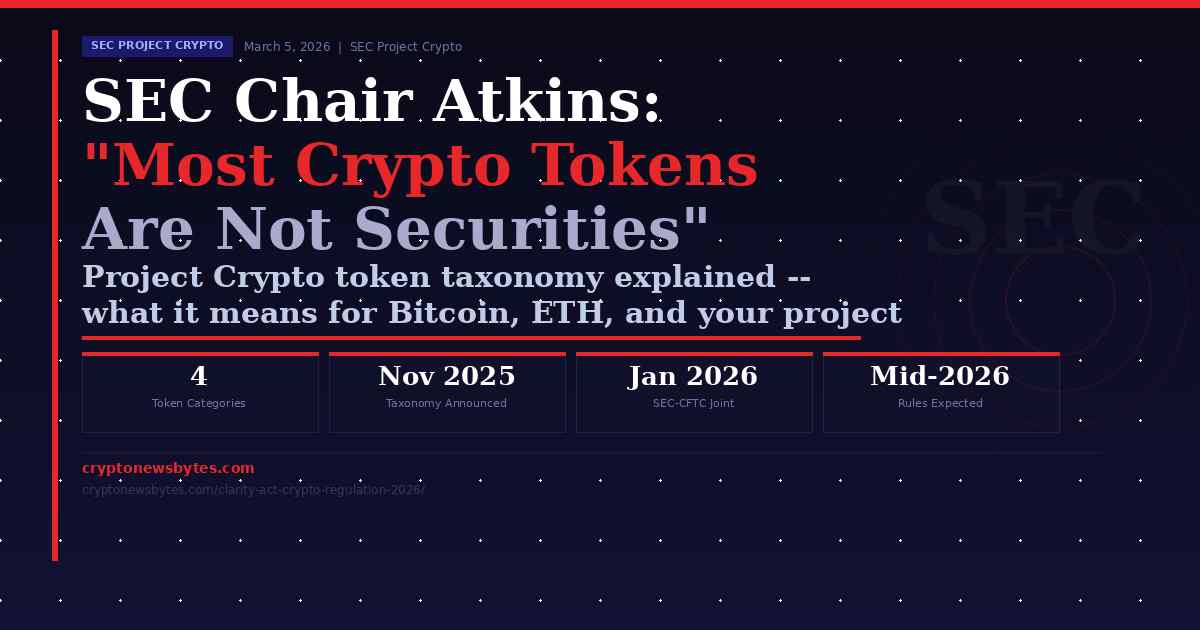
- SEC Chair Paul Atkins announced a token taxonomy in November 2025 — proposing four categories: digital commodities, digital collectibles, digital tools, and tokenized securities.
- Atkins declared that most crypto tokens trading today are not securities — a direct reversal of the Gensler-era enforcement posture.
- The taxonomy creates a pathway for tokens to exit securities status as their networks decentralize — directly addressing Hoskinson’s “security by default” concern about the CLARITY Act.
- In January 2026, Project Crypto expanded into a joint SEC-CFTC initiative — the two agencies are now coordinating on tokenized collateral, super-apps, and developer safe harbor provisions.
- The taxonomy complements the CLARITY Act but does not replace it — Atkins has been explicit that Congressional legislation is still needed for a permanent, statutory framework.
- New SEC rules are expected mid-to-late 2026 — but they could be reversed by a future administration. Only Congress can make the framework permanent.
For a decade, the defining question in U.S. crypto regulation was deceptively simple: is this token a security? The answer — delivered through enforcement actions, court battles, and years of regulatory ambiguity — was almost always: probably yes, until proven otherwise. That era is ending. In November 2025, SEC Chair Paul Atkins announced plans for a token taxonomy under the agency’s Project Crypto initiative — and opened with a statement that would have been unthinkable under his predecessor: most crypto tokens trading today are not securities.
This is what the token taxonomy means, how it works, how it interacts with the CLARITY Act, and what it means practically for token issuers, exchanges, developers, and investors.
What Is the SEC Token Taxonomy? The Four Categories Explained
Speaking at the Federal Reserve Bank of Philadelphia’s Fintech Conference on November 12, 2025, Atkins proposed four principal classifications for digital assets under federal securities law.
| Category | Description | Examples | Securities? |
|---|---|---|---|
| Digital Commodities | Network tokens whose value derives from use of the underlying blockchain; sufficiently decentralized | Bitcoin, Ethereum (post-Merge), mature L1 tokens | ❌ Not securities |
| Digital Collectibles | Non-fungible tokens representing unique digital items or art; no expectation of profit from issuer efforts | NFTs, digital art, gaming items | ❌ Not securities |
| Digital Tools | Tokens providing access to a platform, service, or functionality; utility-driven, not investment-driven | Access tokens, protocol governance tokens (mature) | ❌ Not securities |
| Tokenized Securities | Traditional financial instruments — stocks, bonds, fund shares — represented on a blockchain | Tokenized equities, tokenized Treasuries, RWA tokens | ✅ Remain securities |
The first three categories are generally not securities under Atkins’ framework. The fourth — tokenized securities — remains fully subject to federal securities laws regardless of their on-chain representation. As Atkins put it: “Securities, however represented, remain securities.”
The Howey Test Reimagined: Investment Contracts Can End
The most significant legal principle in the taxonomy is not the four categories themselves — it is what Atkins said about the Howey Test and the lifecycle of investment contracts.
“Networks mature. Code is shipped. Control disperses. The issuer’s role diminishes or disappears. At some point, purchasers are no longer relying on the issuer’s essential managerial efforts, and most tokens now trade without any reasonable expectation that a particular team is still at the helm.”
— SEC Chair Paul Atkins, Federal Reserve Bank of Philadelphia, November 12, 2025 · Source: SEC.govThis is a direct reversal of the Gensler-era position. Under Gensler, the SEC argued that if a token was ever sold as part of an investment contract — even at initial launch, even years ago — it remained a security forever, on every platform, in every transaction. Atkins says that position is wrong: investment contracts are relationships between parties, not permanent labels attached to objects. They can be performed, and they can expire.
For the industry, this means tokens that launched as securities offerings can mature out of that classification as their networks decentralize and issuer control diminishes. The SEC under Atkins intends to define the conditions under which that transition occurs — and will create a formal process for tokens to make the case that they have crossed the threshold.
Project Crypto: The Broader Initiative
The token taxonomy is one component of Project Crypto — Atkins’ umbrella initiative to modernize the SEC’s approach to digital assets. The initiative has several parallel workstreams running in 2026:
1. Super-Apps
Atkins has proposed allowing platforms to offer trading and custody of both securities and non-securities under a single regulatory licence — what he calls a “super-app” framework. This would allow a single exchange to handle tokenized stocks, Bitcoin, Ethereum, and NFTs without requiring separate registrations for each asset class.
2. Exemptions for Crypto Offerings
The SEC is considering a tailored offering regime for crypto assets that are part of or subject to an investment contract — essentially creating a lighter-touch registration path for token launches that don’t fit neatly into traditional securities offering frameworks.
3. SEC-CFTC Joint Initiative (January 2026)
In January 2026, Project Crypto expanded into a formal joint initiative with the CFTC. The two agencies are now coordinating on eliminating duplicate jurisdiction, drafting rules for tokenized collateral, enabling super-apps, and evaluating developer safe harbor provisions. This is the first time the two agencies have coordinated formally on crypto rulemaking — and it directly addresses the turf war that has hampered regulation for years.
How the Token Taxonomy Relates to the CLARITY Act
Atkins has been explicit that the token taxonomy is designed to complement, not replace, the CLARITY Act. The taxonomy is SEC rulemaking — it can be reversed by a future SEC chair. The CLARITY Act is statute — it can only be changed by Congress. This is why Atkins has repeatedly stated that Congressional legislation remains essential even as the SEC moves forward with its own framework.
The taxonomy also directly addresses Charles Hoskinson’s “security by default” criticism of the CLARITY Act — the concern that every new token starts as a security and must convince the SEC to reclassify it. Atkins’ framework sets out the conditions under which a token is not a security from the outset (digital commodity, collectible, or tool) and the conditions under which one that started as a security can transition out of that status. Whether the CLARITY Act incorporates these principles into statute — or leaves the SEC with discretion — is one of the key unresolved questions in the Senate markup.
What This Means for Token Issuers, Exchanges, and Developers
The practical implications of the Atkins taxonomy depend on where your project sits in the four-category framework.
If your token is a mature network token (Bitcoin, ETH, major L1s)
You are almost certainly in the “digital commodity” category and outside SEC jurisdiction. The CFTC has been asserting authority over Bitcoin and Ethereum for years, and Atkins’ taxonomy formalizes that position at the SEC level.
If your token launched via a securities offering (SAFT, ICO)
You are currently a security — but the taxonomy creates a pathway out. Atkins’ framework will define what “sufficient decentralization” looks like and what evidence the SEC will accept. This is the most important near-term development for projects that did compliant securities offerings and are now operating as mature, decentralized protocols.
If you are launching a new token
The taxonomy will define whether you launch as a security (requiring registration) or as a digital commodity or tool (outside the SEC’s purview). The conditions for launching directly as a non-security — rather than starting as a security and maturing out — are still being drafted. Watch for the SEC’s formal rulemaking proposal, expected mid-2026.
If you are a developer
The SEC-CFTC joint initiative specifically includes evaluating developer safe harbor provisions — the question of whether software developers who deploy but do not control protocols should be treated as regulated intermediaries. This is the same issue Hoskinson raised about the CLARITY Act. The SEC’s position here may influence what the Senate Banking Committee includes in its final draft.