What Just Happened
- The SEC and CFTC jointly published Interpretive Release No. 33-11412 on March 17, 2026: a 68-page interpretive rule under SEC Chairman Paul Atkins and CFTC Chairman Michael Selig, establishing five formal categories for digital assets and ending a decade of jurisdictional tug-of-war
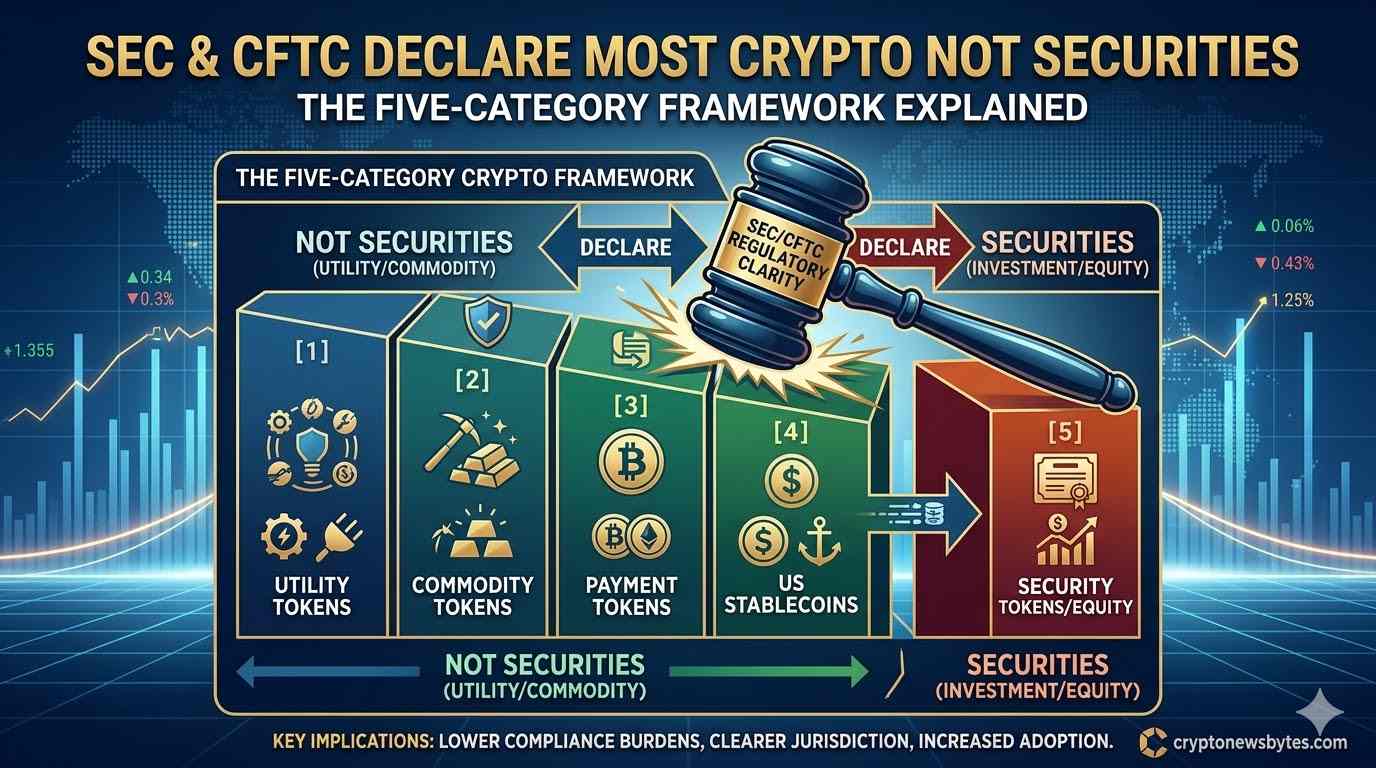
- Most crypto assets are not securities, SEC Chairman Paul Atkins confirmed. Only the fifth category, digital securities, falls under the SEC’s remit. The other four are outside securities law
- 16 major tokens officially named as digital commodities including Bitcoin, Ethereum, Solana, XRP, Cardano, Avalanche, Polkadot, Chainlink, Dogecoin and Shiba Inu, now under CFTC oversight and not the SEC
- Bitcoin mining, staking, airdrops and wrapping of non-security tokens are explicitly cleared. None constitute securities offerings under the new framework
- This ends over a decade of regulation by enforcement and replaces the Gensler-era approach of treating nearly all crypto as potential securities
The SEC crypto framework 2026 is the most significant US crypto regulatory shift in a decade. On March 17, 2026, the US Securities and Exchange Commission and the Commodity Futures Trading Commission jointly issued what will likely be remembered as the most consequential US crypto regulatory document ever published. The Interpretive Release No. 33-11412 establishes a formal token taxonomy for the first time, declares that most crypto assets are not securities, names 16 major tokens as digital commodities under CFTC jurisdiction, and clears Bitcoin mining, staking, and airdrops of securities law obligations.
The SEC crypto framework 2026 ends a dark chapter. After more than a decade of the SEC treating nearly every digital asset as a potential security, suing Coinbase, Ripple, Binance and dozens of others under that theory. The agency has now formally reversed course. This is not a proposed rule. It is a published interpretation that takes effect immediately and that the CFTC has committed to applying consistently with the Commodity Exchange Act.
The SEC Crypto Framework 2026: Five Categories Explained
The taxonomy sorts every digital asset into one of five buckets. Four of those buckets are explicitly outside securities law. Only the fifth category, digital securities, falls under SEC jurisdiction.
| Category | SEC/CFTC Status | Examples and Details |
|---|---|---|
| 1. Digital Commodities | Non-Security (CFTC) | BTC, ETH, SOL, XRP, ADA, LINK, DOT and others. Value derives from programmatic operations and market demand, not managerial efforts of others. |
| 2. Digital Collectibles | Non-Security | Most NFTs, meme coins, art and trading cards. Exception: fractionalized NFTs with profit-sharing may still qualify as securities. |
| 3. Digital Tools | Non-Security | Utility tokens used for access or specific services within a cryptographic system. Memberships, credentials, tickets. |
| 4. Regulated Payment Stablecoins | Non-Security | Stablecoins issued by authorised institutions meeting the 2025 GENIUS Act criteria. USDT, USDC, WFUSD and others issued under compliant frameworks. |
| 5. Digital Securities | Security: SEC Only | Tokenized stocks, bonds, or assets representing a clear investment contract with ownership rights, dividends, or profit-sharing. Only this category falls under SEC jurisdiction. |
The Howey Pivot: When a Token Becomes a Security
One of the most nuanced points in the 68-page release is the SEC’s clarification on investment contracts, and crucially, how that status can both begin and end over time.
| Scenario | Securities Status | Key Condition |
|---|---|---|
| Token itself | Not a security | A token is just code. It does not inherently constitute a security |
| Token sold with specific profit promises | Investment contract (security) | If issuer explicitly promises managerial efforts that generate profit for buyers, via whitepaper or official filings |
| Token after promises fulfilled / network decentralised | Investment contract status ends | Securities status can expire once the issuer’s specific promises are fulfilled or the network becomes sufficiently functional and decentralised |
This “investment contract lifecycle” concept is genuinely new. Under the Gensler-era SEC, once a token was deemed a security it essentially remained one forever. The new framework explicitly allows for decentralisation to cure securities status, a massive relief for projects that launched with early investor promises but have since built functioning networks.
Staking and Mining: The Safe Harbor Table
The guidance draws a precise line between activities that are cleared and those that remain under scrutiny:
| Activity | Status | Notes |
|---|---|---|
| Protocol mining | Cleared: Not a security | Bitcoin mining rewards do not constitute securities transactions |
| Solo staking | Cleared: Not a security | Staking your own tokens directly on a proof-of-stake network |
| Liquid staking protocols | Cleared: Not a security | Lido, Rocket Pool and similar non-custodial liquid staking are explicitly outside securities law |
| Airdrops of non-security tokens | Cleared: Not investment contracts | Removes a major legal cloud for DeFi protocols distributing governance tokens |
| Wrapping non-security tokens | Cleared: Not a security | WBTC and similar wrapped versions inherit non-security status |
| Centralised exchange staking with guaranteed yields | ✗ Not cleared and may face SEC oversight | Exchanges promising fixed returns on staked assets are excluded from the safe harbor. This is where the securities analysis still applies. |
Jurisdictional Split: Who Regulates What
| Regulator | Scope | Key Assets/Activities |
|---|---|---|
| CFTC | Spot markets for digital commodities | BTC, ETH, SOL, XRP and all other named digital commodities. Spot trading, derivatives, futures markets. |
| SEC | Digital securities + investment contract phase of new launches | Tokenized stocks, bonds, and tokens sold with investment contract promises during early fundraising phases. |
| Banking regulators (Fed/FDIC/OCC) | Stablecoins and tokenized deposits | WFUSD, JPMD, USDC issued by banks. Capital parity for tokenized securities (March 2026 guidance). |
What Is Coming Next: The Startup Exemption
Chairman Atkins signalled during the March 17 release that a “Fit-for-Purpose” Startup Exemption is coming within the next few weeks. This safe harbor will allow entrepreneurs to raise capital via crypto investment contracts for a limited period without full SEC registration, provided they meet specific transparency requirements.
The exemption is designed to address the chicken-and-egg problem that has plagued crypto startups: to build a sufficiently decentralised network you need funding, but raising funding under investment contract rules requires full SEC registration that is impractical at early stage. The exemption would give projects a time-limited window to raise capital with lighter disclosure requirements before they graduate to either full decentralisation (exiting securities status) or full SEC registration (if they remain investment contracts).
The 16 Tokens Named as Digital Commodities
For the first time in regulatory history, the SEC has named specific crypto assets and confirmed their status outside securities law. The 16 tokens explicitly categorised as digital commodities are:
| Token | Ticker | Regulator Going Forward |
|---|---|---|
| Bitcoin | BTC | CFTC |
| Ethereum | ETH | CFTC |
| Solana | SOL | CFTC |
| XRP | XRP | CFTC |
| Cardano | ADA | CFTC |
| Avalanche | AVAX | CFTC |
| Polkadot | DOT | CFTC |
| Chainlink | LINK | CFTC |
| Dogecoin | DOGE | CFTC |
| Shiba Inu | SHIB | CFTC |
| Polygon | MATIC | CFTC |
| Stellar | XLM | CFTC |
| Algorand | ALGO | CFTC |
| Aptos | APT | CFTC |
| Hedera | HBAR | CFTC |
| Litecoin | LTC | CFTC |
| Bitcoin Cash | BCH | CFTC |
What Is Now Explicitly Cleared
Beyond the taxonomy itself, the guidance resolves several longstanding legal questions that have created uncertainty for builders, miners, stakers and exchanges:
Bitcoin mining rewards: Receiving BTC as a mining reward does not constitute a securities offering or transaction. Miners are free to operate without SEC registration concerns.
Protocol staking: On-chain staking of digital commodities does not create a securities transaction. This directly removes one of the largest legal risks hanging over proof-of-stake networks and validators.
Airdrops: Certain airdrops of non-security tokens are explicitly cleared. Developers distributing tokens to users are not automatically running unregistered securities offerings.
Wrapping: Wrapping a non-security token (including Wrapped Bitcoin WBTC on Ethereum) does not automatically convert it into a security. The wrapped version inherits the non-security status of the underlying asset.
The Five Categories: Detailed Breakdown
Table 1: The Full Five-Category Taxonomy
| Category | SEC/CFTC Status | Examples and Details |
|---|---|---|
| 1. Digital Commodities | Non-Security | BTC, ETH, SOL, XRP, ADA, LINK, DOT and others. Value comes from programmatic operations and market demand, not the managerial efforts of others. |
| 2. Digital Collectibles | Non-Security | Most NFTs, meme coins, and trading cards. Exception: fractionalized NFTs with profit-sharing may still qualify as securities. |
| 3. Digital Tools | Non-Security | Utility tokens used for access or specific services within a cryptographic system. Memberships, credentials, and access rights. |
| 4. Regulated Payment Stablecoins | Non-Security | Stablecoins issued by authorised institutions meeting 2025 GENIUS Act criteria. USDT, USDC, and bank-issued stablecoins such as WFUSD. |
| 5. Digital Securities | Security: SEC Only | Tokenized stocks, bonds, or assets representing a clear investment contract with ownership rights and dividends. Falls entirely under SEC jurisdiction. |
Table 2: The Howey Pivot: When Does a Token Become a Security?
| Scenario | Security Status | Notes |
|---|---|---|
| Token itself (digital commodity) | Not a security | The asset is not a security regardless of how it was initially sold |
| Token sold with explicit profit promises | Investment contract | Issuer promises managerial efforts will generate profit for purchasers |
| Investment contract status: end date | Can expire | Status ends once issuer’s specific promises are fulfilled OR network becomes sufficiently decentralised |
| Fractionalized NFTs with profit-sharing | May be a security | Case-by-case analysis required |
| Standard NFT or meme coin | Not a security | Digital collectible, with no investment contract element |
Table 3: Safe Harbor for Staking and Mining
| Activity | Securities Status | Notes |
|---|---|---|
| Protocol mining (PoW) | ✓ Not a securities transaction | Explicitly cleared. Bitcoin miners have full safe harbour |
| Solo staking (PoS) | ✓ Not a securities transaction | Running your own validator node is cleared |
| Liquid staking protocols | ✓ Not a securities transaction | Lido, Rocket Pool and similar protocols cleared |
| Centralised exchange staking with guaranteed yields | ✗ Excluded from safe harbour | May still face SEC oversight. Coinbase and Kraken staking products require further review |
| Airdrops of non-security tokens | ✓ Not investment contracts | Explicitly cleared, removing a major legal cloud for DeFi protocols |
| Wrapping of digital commodities | ✓ Not a securities transaction | WBTC and similar wrapped tokens inherit non-security status |
Table 4: Jurisdictional Split: SEC vs CFTC Going Forward
| Area | Regulator | Scope |
|---|---|---|
| Spot markets for digital commodities | CFTC | BTC, ETH, SOL, XRP and all Category 1 tokens, with day-to-day trading oversight |
| Digital securities markets | SEC | Tokenized stocks, bonds, any Category 5 asset |
| New token launches (investment contract phase) | SEC | During the period when issuer promises are active, until the decentralisation threshold is met |
| Stablecoin issuers (GENIUS Act compliant) | Banking Regulators | Fed, OCC, state regulators under the GENIUS Act framework |
| Joint market surveillance | Both | MOU signed March 11, 2026, with coordinated enforcement going forward |
Table 5: What’s Coming Next: The Startup Exemption
| Development | Timeline | Details |
|---|---|---|
| Fit-for-Purpose Startup Exemption | Next few weeks | Safe harbour allowing entrepreneurs to raise capital via crypto investment contracts for a limited time without full registration, provided specific transparency requirements are met |
| CFTC spot market rules | 2026 | Formal rulemaking for digital commodity spot market oversight under the new framework |
| SEC crypto asset offering rules | 2026 | Separate rulemaking covering how tokens are issued. Today’s guidance is the framework, detailed rules still coming |
| CLARITY Act (Congress) | Ongoing | Legislation to codify the jurisdictional split in statute, which would make today’s interpretation law |
The Functionalized Test: Why These 16 Assets Qualify
The regulators applied a three-part “functionalized” test to determine which assets qualify as Digital Commodities. To make the list, an asset’s value must derive from all three of the following:
| Criteria | Description | Why It Matters |
|---|---|---|
| Programmatic Operation | Value comes from the code and protocol mechanics, not a centralised management team | Eliminates reliance on an issuer’s managerial efforts, the Howey test key question |
| Market Supply and Demand | Pure market dynamics, similar to gold or crude oil | Positions the asset as a commodity, placing it under CFTC rather than SEC |
| Decentralised Utility | No single entity holds “essential managerial efforts” that create profit expectations for others | Proves sufficient decentralisation, the threshold at which security status expires |
Chairman Atkins noted the list is not exhaustive. Additional assets will be added as they prove “sufficient decentralisation” or purely functional utility. The criteria for expansion mirror the three-part test above. Projects that demonstrate their networks operate independently of any centralised team can petition for Digital Commodity status.
On meme coin inclusion: The inclusion of DOGE and SHIB was widely noted as a major shift. The SEC now categorises most meme coins as Digital Collectibles or Digital Commodities because their value is driven by community sentiment and supply/demand, not a contractual promise of profit from a developer team. This ends years of uncertainty about whether meme coins could face securities enforcement.
Digital Tools: The Most Innovative Category
The Digital Tools category formalises the concept of genuine utility tokens without the baggage of previous years of SEC enforcement. It is distinct from Digital Commodities in that these tokens are designed for a specific, narrow functional use within a single ecosystem, not as decentralised stores of value or foundational network layers.
What Qualifies as a Digital Tool
| Criteria | Details |
|---|---|
| Exclusive Functionality | Used primarily to access a specific service, pay for a task (gas/fees), or represent a right within a functionalised system |
| Consumption Intent | Designed to be used up or redeemed rather than held for capital appreciation |
| System Integrity | Value derived from the utility of the underlying software or network, not from the managerial efforts of a centralised team |
Examples of Digital Tools
| Tool Type | Purpose | Context |
|---|---|---|
| Governance Tokens | Voting on protocol changes or treasury management | Pure governance tokens with no profit-sharing rights; for example, DAO voting tokens |
| Service Access | Required to use a specific decentralised app | Storage credits (Filecoin/IPFS usage) or API access tokens |
| Network Gas | Tokens used strictly to power transactions on a specific chain | Proprietary utility tokens for private or permissioned blockchains |
| In-Game Assets | Non-NFT fungible tokens within a gaming ecosystem | Virtual currencies that can be traded within a game |
The critical nuance is the “Attach and Detach” doctrine, also called Dynamic Conversion. A token might begin as a security during its fundraising phase, when proceeds are used to build the system. Once the system is fully operational and the token is being used for its intended purpose, it detaches from security status and becomes a Digital Tool. The SEC explicitly confirmed this lifecycle is now the standard framework.
Because these are tools and not investment contracts, they generally bypass SEC registration. The FTC (Federal Trade Commission) may still oversee them for consumer protection and fraud purposes, but the securities law burden is lifted.
Regulated Payment Stablecoins: The GENIUS Act Framework
The Regulated Payment Stablecoins category is a direct result of the GENIUS Act (Guiding and Establishing National Innovation for US Stablecoins Act), signed into law on July 18, 2025. For a full breakdown of how stablecoins fit into the broader US regulatory picture, see our World Liberty Financial USD1 Stablecoin guide. This category is unique. It removes these assets from the jurisdiction of both the SEC and the CFTC entirely, placing them under federal banking regulators: the OCC, Federal Reserve, and FDIC.
GENIUS Act Requirements for Issuers
| Requirement | Details |
|---|---|
| 1:1 Reserve Backing | Every stablecoin must be backed 100% by US dollars, short-term Treasuries, or deposits at insured banks |
| Monthly Audits | Issuers must publish monthly executive-certified reports detailing reserve composition and custody location |
| No Rehypothecation | Anti-FTX rule: issuers are strictly prohibited from lending out or pledging reserve assets to earn extra yield |
| $10 Billion Threshold | Issuers with over $10 billion in circulation fall under primary federal supervision. Below $10 billion can be state-regulated if rules are substantially similar to federal standards |
| Yield Ban | Regulated stablecoins cannot pay interest directly to holders. Offering a yield or dividend risks reclassification as a Digital Security |
What This Means for Major Stablecoins
| Stablecoin | Status Under GENIUS Act | Outlook |
|---|---|---|
| USDC (Circle) | Well positioned | Circle has moved toward national trust bank charter and strict reserve transparency, a strong GENIUS Act candidate |
| PYUSD (Paxos) | Well positioned | Paxos already operates under strict regulatory oversight, positioned as a primary leader in this category |
| USDT (Tether) | Steep climb | Faces significant challenge. The GENIUS Act’s stringent foreign issuer registration and 1:1 US-based custody requirements are difficult for Tether’s current structure |
| DAI and algorithmic models | Different category | Generally do not fit, more likely classified as Digital Tools or Digital Commodities depending on decentralisation and collateral structure |
| WFUSD (Wells Fargo) | Strong candidate | Bank-issued, likely to meet Permitted Payment Stablecoin Issuer criteria from launch |
Digital Securities: The SEC’s Remaining Domain
Digital Securities is the only category that remains strictly under the SEC’s remit. The SEC has transitioned from regulation by enforcement to a structured, disclosure-based approach for this sector.
Three Types of Digital Securities
| Type | Description | Examples |
|---|---|---|
| Tokenized Real-World Assets (RWAs) | Digital representations of traditional assets. See our complete RWA tokenization guide | Tokenized stocks, bonds, real estate: BlackRock BUIDL, Franklin Templeton BENJI |
| Investment Contracts | Tokens conferring economic rights such as profit-sharing, dividends, or enterprise asset claims | New token launches during fundraising phase before decentralisation |
| Synthetic Securities | On-chain tokens tracking the price of a traditional security without holding the underlying share | Tokenized NVDA or SPY exposure on-chain |
The Dynamic Conversion (Detachment) Principle
In a groundbreaking move the SEC acknowledged that a token is not a security for life. The lifecycle now has three phases:
| Phase | Status | Trigger |
|---|---|---|
| Fundraising Phase | Investment contract (security) | Team raising funds to build the network. Investors rely on the issuer’s managerial efforts |
| Detachment Event | Transitioning | Network becomes sufficiently functional and decentralised. Investors no longer rely on the issuer |
| Post-Detachment | Digital Commodity or Digital Tool | Token reverts to commodity status. CFTC jurisdiction applies, no SEC registration required |
New Pathways for Digital Securities
| Development | Details |
|---|---|
| $75M Token Safe Harbour | Coming soon. Chairman Atkins previewed a “Token Safe Harbor” allowing startups to raise up to $75 million via crypto investment contracts with streamlined disclosure, not full IPO-style registration |
| Broker-Dealer Flexibility | SEC staff directed to allow brokers to offer both crypto and traditional securities under a single harmonised licence, removing the multi-entity burden that previously existed |
| Generic Listing Standards | SEC approved new standards for exchanges to list commodity-based and security-based trust shares, making it easier for tokenized funds like BlackRock and Franklin Templeton |
| Liquid Staking Tokens (LSTs) | LSTs are generally not securities if the underlying asset is a non-security commodity (ETH, SOL) and yield comes from the protocol, not issuer management |
SEC Crypto Framework 2026: Master Summary of All Five Categories
| Category | Primary Regulator | Key Feature | Examples |
|---|---|---|---|
| 1. Digital Commodities | CFTC | Market-driven value from programmatic operation | BTC, ETH, SOL, XRP, ADA, AVAX, DOT, MATIC, LINK, DOGE + 6 more |
| 2. Digital Collectibles | FTC / States | Non-financial: art, culture, community | NFTs, most meme coins, trading cards |
| 3. Digital Tools | None (Utility) | Access/gas tokens: usage based, not investment | Governance tokens, storage credits, in-game currency |
| 4. Payment Stablecoins | Fed / OCC / FDIC | 1:1 USD backed, GENIUS Act compliant | USDC, PYUSD, WFUSD (bank-issued) |
| 5. Digital Securities | SEC only | Investment contracts and tokenized RWAs | Tokenized stocks, bonds, new token launches (fundraising phase) |
What This Does Not Fix
The guidance is landmark but it does not resolve everything. Three important caveats:
Tokens can still become securities. A non-security token becomes subject to an investment contract, and therefore securities law, if the issuer explicitly promises to undertake managerial efforts that will generate profit for purchasers. The promise must reach buyers through official channels such as whitepapers or regulatory filings. The key protection: investment contract status can also expire over time as a project decentralises.
This is an interpretation, not a law. The guidance clarifies how the SEC and CFTC interpret existing law. It does not create new statutory authority. Congress is still working on the CLARITY Act to formally codify the jurisdictional split in statute. A future administration could theoretically reverse this interpretation without Congressional action.
More rules are coming. The SEC is still working on separate rulemaking related to crypto asset offerings. Today’s guidance is a framework. The detailed rules governing how tokens are issued and traded are still being developed.
The Startup Exemption is next. Chairman Atkins signalled that a “Fit-for-Purpose” Startup Exemption is coming in the next few weeks. This safe harbour will allow entrepreneurs to raise capital via crypto investment contracts for a limited time without full SEC registration, provided they meet specific transparency requirements. This is potentially the most significant near-term development for crypto founders and early-stage projects.
The centralized staking carveout matters. The safe harbour for staking explicitly excludes centralized exchanges offering guaranteed yields. Coinbase and Kraken staking products, which promise specific returns to users, may still face SEC review. This is an important nuance that has been underreported in the initial coverage of this guidance.
Why the SEC Crypto Framework 2026 Matters: A Decade of Context
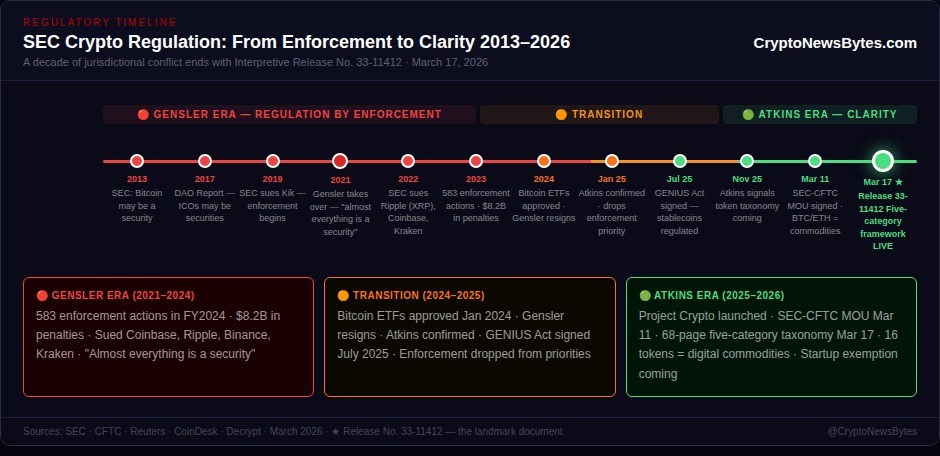
Under Gary Gensler’s SEC (2021–2025), the agency’s position was that almost all crypto assets (except Bitcoin) were potential securities subject to registration requirements. The agency initiated 583 enforcement actions in fiscal 2024 alone and imposed $8.2 billion in penalties. It sued Coinbase, Binance, Ripple, Kraken, and dozens of others.
Paul Atkins took over as SEC Chair, with Michael Selig confirmed as CFTC Chairman, in January 2025 under the Trump administration. By mid-2025 he announced “Project Crypto”, a programme for open-framework regulation. In November 2025 he first signalled a token taxonomy was coming. In January 2026 the SEC formally dropped crypto from its enforcement priorities. The March 17 guidance is the culmination of that policy shift.
The CFTC signed a Memorandum of Understanding with the SEC on March 11, six days before the guidance, formally agreeing on joint market surveillance and coordinated enforcement, and officially classifying Bitcoin and Ethereum as digital commodities under CFTC oversight. The MOU ended a years-long jurisdictional dispute between the two agencies.