⚡ Key Highlights
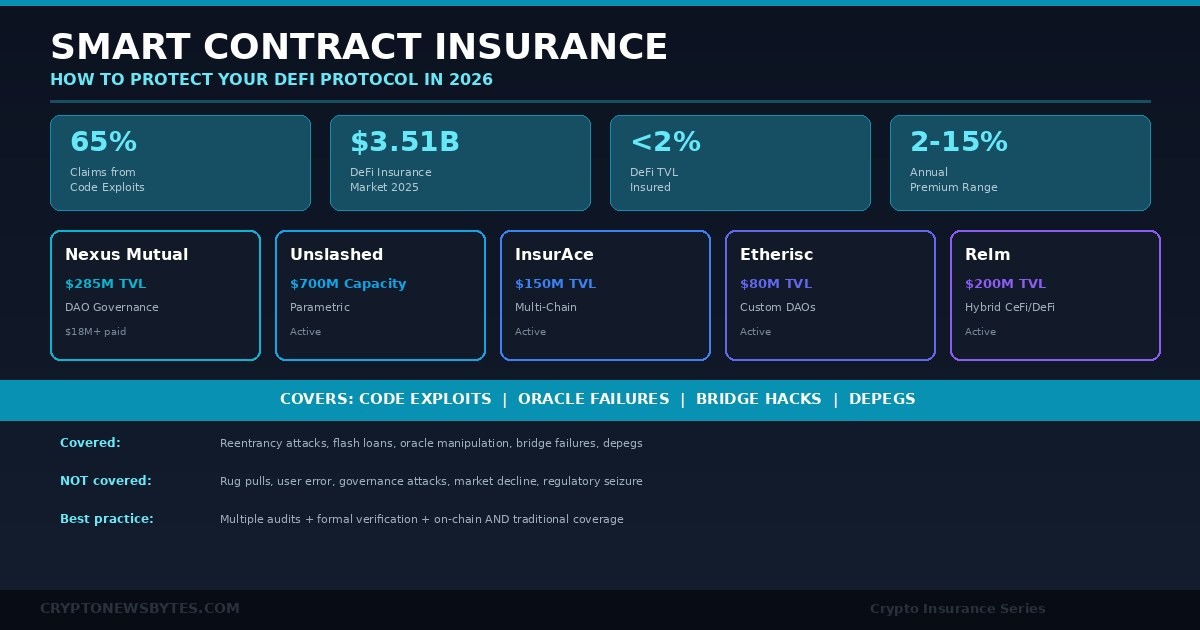
- Smart contract insurance protects DeFi protocols and their users against losses from code vulnerabilities, exploits, and technical failures. In 2025, smart contract exploits accounted for 65% of all DeFi insurance claims
- Coverage is available through two models: decentralized protocols (Nexus Mutual, InsurAce, Unslashed Finance) using pooled capital and DAO governance, and traditional insurers (Evertas, Relm, Coincover) offering conventional policies
- Less than 2% of total DeFi TVL ($119 billion) is currently insured. Analysts project 8-12% penetration by 2027 as parametric models reduce costs by 35-48% compared to traditional underwriting
- Premiums range from 2-15% annually depending on the protocol’s audit history, TVL, code complexity, and claims track record. Well-audited protocols with formal verification pay the lowest rates
- Key exclusions: governance attacks, user error, rug pulls by founding teams, regulatory seizure, and losses from protocols that have not been audited are typically NOT covered
- For DeFi founders, crypto insurance is becoming a competitive advantage. Protocols with coverage attract more TVL and institutional liquidity
Smart Contract Insurance: Why DeFi Protocols Cannot Afford to Skip It
In the first half of 2025, the Web3 ecosystem suffered approximately $3.1 billion in total losses. While the headline-grabbing Bybit hack ($1.4-1.5 billion) was an operational/key management failure, hundreds of millions more were drained through pure smart contract exploits: the Cetus overflow exploit cost approximately $223 million, Balancer rounding and access issues exceeded $120 million, and dozens of smaller protocol exploits compounded the damage. Smart contract vulnerabilities accounted for roughly 65% of all claims filed through on-chain insurance protocols. The average loss per smart contract exploit over the past four years has been approximately $1.9 million.
Yet less than 2% of total DeFi value locked ($119 billion) is insured. Smart contract insurance fills this critical gap. It is no longer a luxury for cautious founders. It is becoming table stakes for attracting TVL, especially post-audit, as institutional LPs increasingly demand proof of coverage before deploying capital. This guide covers what risks insurance addresses, how the coverage models work, who the leading providers are, and how your protocol can get insured. For broader context on the crypto insurance market, start there first.
Understanding the Risks: What Goes Wrong in DeFi
Before buying coverage, you need to understand what you are insuring against. The attack landscape has evolved significantly. While reentrancy was once the headline threat, the 2025-2026 threat profile is more diverse:
Access control failures remain the number one cause of critical exploits, according to OWASP’s Smart Contract Top 10. Misconfigured permissions, unprotected admin functions, and inadequate multi-sig enforcement allow attackers to drain funds through privileged operations.
Business logic flaws are protocol-specific bugs where the code does exactly what it was written to do, but the logic itself is wrong. These are the hardest to catch because automated tools cannot detect them. The Cetus overflow exploit in 2025 was a business logic error in the pricing math.
Oracle manipulation and flash loan attacks exploit dependencies on external price feeds. If an attacker can temporarily manipulate an oracle’s reported price (often using flash loans for capital), they can trick protocols into mispricing assets and extract value. Chainlink’s decentralized oracles have reduced but not eliminated this risk.
Reentrancy (evolving forms) continues in cross-chain and multi-call variants that bypass traditional guards. Read-only reentrancy, where an attacker exploits a state inconsistency during a view function call, is a newer variant that has caught several protocols.
Economic exploits include rounding errors, invariant breaks in AMM curves, and liquidation cascades triggered by edge-case conditions. These are not traditional “bugs” but rather unintended consequences of complex financial logic interacting with adversarial conditions.
Governance takeovers occur when attackers accumulate enough governance tokens (often via flash loans) to pass malicious proposals. This is a growing concern as DAO-governed protocols manage billions in TVL.
How Smart Contract Insurance Actually Works
Smart contract insurance comes in three structural models, each with distinct trade-offs:
Discretionary mutual pools (P2P model) are the most established. Members stake capital into a shared pool, protocols or users pay premiums, and claims are assessed via community governance votes. Nexus Mutual pioneered this model. The strength is flexibility: voters can assess nuanced, ambiguous events. The weakness is speed: claims take weeks and outcomes depend on voter incentives.
Parametric (automated) models define specific trigger conditions in advance. When oracles confirm the trigger (e.g., a protocol’s TVL drops 90% within 24 hours due to an exploit), smart contracts automatically release payouts. No votes, no adjusters. Unslashed Finance and Neptune Mutual use this approach. Fast and transparent, but limited to clearly definable events that oracles can verify.
Hybrid audit-plus-coverage models combine pre-launch security review with post-launch financial protection. Sherlock pioneered this, offering up to $10 million in exploit coverage as part of its audit package. If a vulnerability passes through the audit and is later exploited, Sherlock pays out. This aligns incentives directly: the auditor has skin in the game.
Additionally, traditional (off-chain) insurers like Evertas, Relm, and other specialized providers offer conventional policies covering smart contract failures alongside custody, crime, and D&O risks. Claims follow traditional processes with adjusters and investigations, but limits are typically higher ($10M-$100M+).
| Feature | Decentralized (On-Chain) | Traditional (Off-Chain) |
|---|---|---|
| Claims process | DAO vote or oracle trigger (hours to weeks) | Adjuster investigation (weeks to months) |
| Capacity | Limited by pooled capital ($80M-$700M per protocol) | Higher limits ($10M-$100M+ per policy) |
| Premiums | 2-8% annually (risk-scored per protocol) | 5-15% annually (higher due to underwriting costs) |
| Coverage scope | Specific events: exploits, depegs, oracle failures | Broader: code failures + crime + liability |
| Track record | Nexus Mutual: $18M+ paid since 2019 | Limited public claims data |
| Risk to user | Protocol insolvency if claims exceed reserves | Insurer solvency backed by regulatory capital |
What Smart Contract Insurance Covers
Covered events typically include: Code vulnerabilities and exploits (reentrancy attacks, integer overflow, logic errors), flash loan attacks that exploit protocol mechanics, oracle manipulation leading to incorrect price feeds, bridge failures resulting in trapped or stolen funds, stablecoin depeg events beyond defined thresholds, and liquidation cascades caused by technical failures rather than normal market conditions.
What is typically NOT covered: Governance attacks where token holders vote maliciously, rug pulls by founding teams (this is a crime/fraud issue, not a code failure), user errors such as sending to wrong addresses, losses from protocols that have not been professionally audited, regulatory actions including seizure or sanctions, general market downturns and price volatility, and front-running or MEV-related losses unless specifically included.
⚠️ Critical Gap
Cross-chain bridge risks are notoriously difficult to insure due to complex exploit dynamics that span multiple blockchains. Flash-loan-driven oracle manipulations are increasingly excluded unless oracles have tamper-proof aggregation. Read the policy wording carefully, especially exclusion clauses around “act of God,” double-spend definitions, and MEV losses.
Leading Smart Contract Insurance Providers in 2026
| Provider | Model | Capacity/TVL | Best For | Claims Track Record |
|---|---|---|---|---|
| Nexus Mutual | Discretionary mutual | $285M+ TVL, 180+ protocols | Broadest coverage: hacks, depegs, slashing, custody | $18M+ paid since 2019 |
| Sherlock | Audit + coverage bundle | Up to $10M post-audit; $250B+ TVL protected | Protocols wanting audit + insurance in one package | 370+ audits completed; UMA-arbitrated claims |
| Unslashed Finance | Parametric | $700M+ coverage capacity | Fast automatic payouts for defined events | Automatic via oracle triggers |
| InsurAce | Multi-chain hybrid | $150M TVL; Ethereum, BNB, Arbitrum | Stablecoin depeg, portfolio coverage, low premiums | 35% premium growth YoY |
| Etherisc | Custom parametric | $80M TVL | DAO-specific and non-standard risks | $13M+ in parametric payouts globally |
| Relm Insurance | Hybrid CeFi/DeFi | $200M TVL | Institutional-grade, regulatory compliance | Traditional claims + on-chain settlement |
Sherlock deserves special attention because it uniquely bundles audit and insurance. Sherlock assembles 11,000+ security researchers for audit contests, where multiple independent experts compete to find vulnerabilities simultaneously. Clients include Ethereum Foundation, Aave, Morpho, and LayerZero. The audit itself costs $60,000-$120,000 for a mid-complexity protocol, but includes up to $10M in post-audit exploit coverage at just 2% annually. If Sherlock’s audit misses a vulnerability that is later exploited, Sherlock pays from its staking pool. This skin-in-the-game model aligns incentives better than any traditional auditor.
Step-by-Step: How to Get Your DeFi Protocol Insured
✅ The Security + Insurance Playbook for Protocol Teams
Step 1: Secure multiple audits. No reputable insurer covers unaudited code. Get at least two independent audits from recognized firms (Trail of Bits, OpenZeppelin, Certik, Consensys Diligence) or use Sherlock’s contest model for broader coverage. A realistic pre-launch audit budget for a mid-complexity DeFi protocol in 2026 is $60,000 to $120,000 including remediation reviews.
Step 2: Launch a bug bounty program. Immunefi, the largest Web3 bug bounty platform, has paid out over $110 million in total bounties. An ongoing bug bounty complements the one-time audit by incentivizing continuous discovery on live code. An audit does not replace a bounty, and a bounty does not replace an audit. Mature protocols run both.
Step 3: Choose your insurance model. On-chain (Nexus Mutual, InsurAce) for crypto-native, permissionless coverage. Sherlock for audit-plus-coverage. Traditional (Evertas, Relm) for higher limits and institutional credibility. Many protocols use a layered approach combining multiple providers.
Step 4: Offer user-level coverage. Integrate insurance options into your protocol’s UI so users can purchase coverage on their deposits directly. This boosts user confidence, attracts TVL, and signals security maturity. OpenCover and Nexus Mutual offer integration APIs.
Step 5: Consider protocol-owned coverage. Some protocols allocate treasury funds to purchase coverage on behalf of all users, effectively self-insuring through on-chain pools. This is a powerful marketing and trust-building tool.
Step 6: Communicate transparently. Add “Audited + Insured” to your docs, roadmap, and marketing. Institutional LPs and exchanges evaluating listings increasingly treat insurance as a signal of maturity.
Benefits vs. Limitations: Is It Worth the Premium?
Why it is worth it: Insurance attracts institutional and LP capital (institutional DeFi allocators now routinely ask about coverage). It reduces user FUD after industry-wide hacks. It generates yield for underwriters who stake into coverage pools. And it signals protocol maturity to regulators as MiCA and other frameworks increasingly reference insurance requirements.
Where it falls short: Premiums (2-15%) are not trivial for early-stage protocols with thin margins. Coverage caps mean large protocols may only insure a fraction of their TVL. Discretionary claims take weeks and outcomes depend on voter behavior. Exclusions are real: rug pulls, governance attacks, user error, and unaudited code are almost universally excluded. And the insurance protocols themselves carry risk: they are smart contracts too.
When to consider alternatives: Ultra-experimental protocols on testnet or with minimal TVL may be better served by self-insurance (treasury reserves earmarked for exploit recovery), combined with time-locked admin functions and circuit breaker mechanisms that can pause the protocol automatically if anomalous withdrawals are detected.
Case Study: How Insurance Played Out in Recent Exploits
Nexus Mutual’s 2022-2025 payout record is the strongest evidence that on-chain insurance works. The protocol has paid $18M+ in claims across multiple events, including payouts for smart contract exploits and stablecoin depeg events. Conservative coverage-to-capital ratios (under 3:1) have kept the protocol solvent through every market cycle.
Euler Finance and Sherlock (2023) demonstrated both the value and limits of audit-plus-coverage. Euler partnered with Sherlock for $10M in smart contract coverage and a $1M Immunefi bug bounty before its mainnet launch. When Euler was later exploited for approximately $197M, the coverage was a fraction of the loss but represented the largest-ever DeFi insurance payout at the time and helped fund recovery efforts.
The Cetus overflow (2025, ~$223M) exploited a business logic flaw in pricing math, a category of vulnerability that is notoriously difficult to catch in standard audits. Most insurance policies would cover this if the protocol was audited and the exploit was a code-level vulnerability. This case underscores why multiple audit approaches (automated + manual + contest) produce better results than relying on a single review.
Protocols that added insurance and grew TVL: Multiple DeFi lending and DEX protocols have reported 15-30% TVL increases after publicly announcing insurance partnerships, particularly when combined with audit reports and bug bounty programs. The “Audited + Insured” signal has become a competitive moat.
The Future: Where Smart Contract Insurance Is Heading
Several trends will reshape this market by 2027-2028:
AI-assisted auditing will reduce premiums. Sherlock AI already delivers auditor-level analysis during development. As AI tools catch more vulnerabilities earlier, the residual risk that insurance must cover decreases, bringing down premiums for AI-reviewed codebases.
L2 and restaking integration. As DeFi activity migrates to Layer 2 rollups and restaking protocols like EigenLayer, insurance must follow. Cross-L2 coverage pools and restaking-specific policies are emerging to cover slashing events and bridge risks.
Regulatory linkage. The GENIUS Act requires stablecoin reserves to be backed by high-quality assets including insured deposits. MiCA requires CASPs to maintain adequate safeguards. As regulation matures, insurance becomes not just advisable but mandated.
Hybrid TradFi-DeFi models emerge. Traditional insurers (Aon, Lloyd’s syndicates) are entering the market with $100B+ in capacity, while DeFi-native protocols become more institutionalized. The convergence will produce hybrid products that combine on-chain automation with traditional solvency backing. For more on this trend, see our parametric vs traditional analysis.
Frequently Asked Questions
📰 Crypto Insurance & Security Series
- Crypto Insurance in 2026: Why the Industry’s Biggest Problem Is Not Hackers
- Best Crypto Insurance Providers in 2026 Compared
- $2.72B Stolen in 2025: The Crypto Insurance Lessons Every Founder Needs
- Cyber Insurance for Crypto Firms: What’s Covered and What’s Not
- You are here: Smart Contract Insurance: How to Protect Your DeFi Protocol
- Will Parametric Insurance for DeFi Replace Traditional Policies?
🏛 Regulation Series
Sources: NamecoinNews | MOSS | Relm Insurance | Founder Shield | Journal of Banking & Finance | Appinventiv
Disclaimer: This article is for informational purposes only and does not constitute financial or insurance advice. DeFi insurance protocols carry their own risks including smart contract vulnerability and capital pool insolvency. Consult qualified advisors before purchasing coverage.