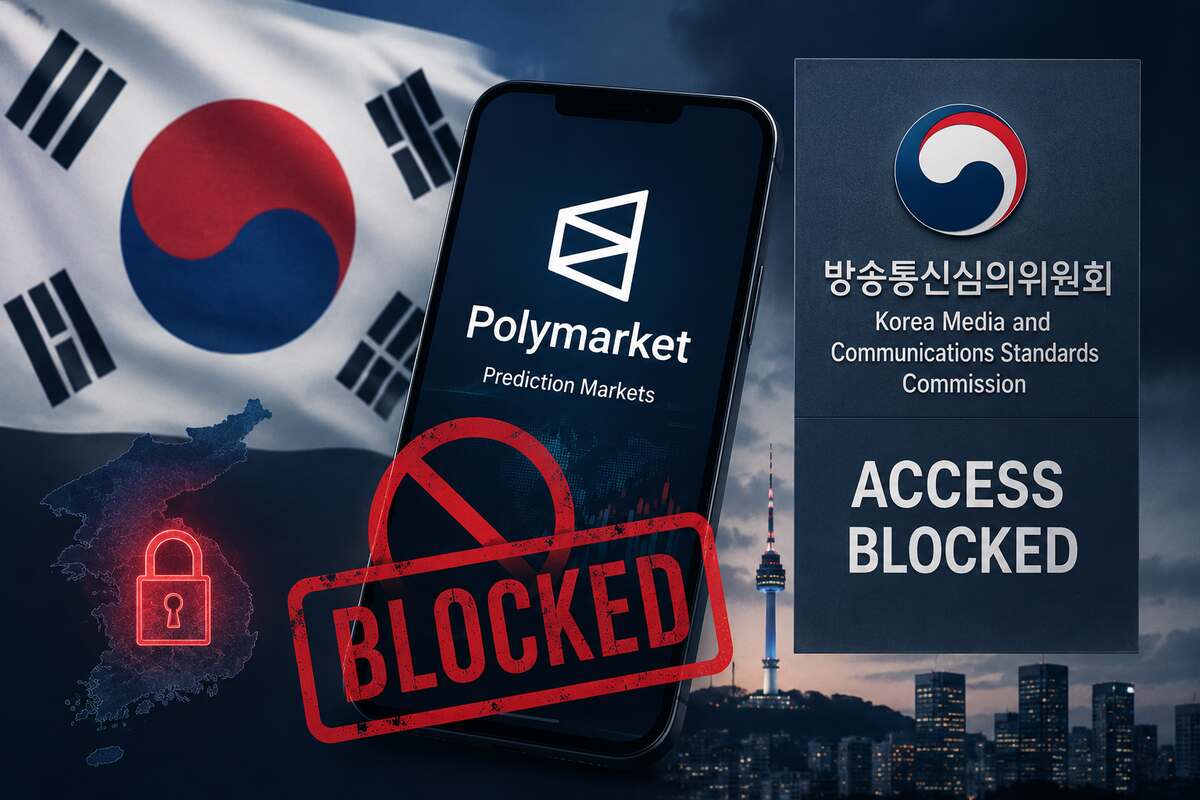
- South Korea ordered domestic access to Polymarket blocked over gambling concerns.
- Regulators said the platform’s market structure encourages speculative behavior.
- Polymarket said it had removed Korean-language services and does not support won payments.
South Korea has ordered Polymarket access to be blocked, adding the country to a list of more than 30 jurisdictions that restrict the prediction market platform. The Korea Media and Communications Standards Commission approved the move after concluding that Polymarket facilitates gambling and the operation of gambling venues under the Criminal Act, along with similar categories under the National Sports Promotion Act, according to local reports cited in the source. The review began in July after requests from police and gambling control authorities. Polymarket said it had removed Korean-language services, does not support won payments, and relies on non-custodial peer-to-peer transactions and smart contracts, but regulators did not accept that defense.
South Korea blocks Polymarket access
The Korea Media and Communications Standards Commission approved the domestic block after reviewing how the platform operates in South Korea. Local reports cited in the source said the commission found that the service facilitates gambling and the operation of gambling venues under the country’s Criminal Act, as well as similar categories in the National Sports Promotion Act.
The review of Polymarket access began in July after requests from the National Police Agency and the National Gambling Control Commission. Local media also reported that police separately opened an investigation into local users over suspected illegal gambling. That means the action came after both regulatory review and law enforcement scrutiny.
Why regulators challenged Polymarket access
Polymarket allows users to trade yes-or-no contracts tied to the outcome of real-world events. The source says those events include elections, sports, economic data, and the weather. It is described as one of the largest prediction markets, alongside Kalshi. The commission said this market structure encourages speculative behavior because users’ gains and losses depend on events beyond their control. Regulators also rejected the company’s defense, saying the operator still manages market creation and trading rules while providing crypto deposit, withdrawal, and settlement systems and charging fees.
Polymarket response to the South Korea decision
According to local media, Polymarket said it had removed Korean-language services before the block was approved. It also said it does not support payments in South Korea’s won fiat currency and uses non-custodial peer-to-peer transactions and smart contracts. The company did not immediately respond to CoinDesk’s request for further comment. The source also says Polymarket currently lists 39 countries as fully restricted from the platform, though South Korea was not yet mentioned on that list at the time of reporting.
Global pressure on Polymarket access
South Korea is not acting alone on Polymarket access. The source says France ordered internet service providers to block access to the website, adding to a wider pattern of restrictions in multiple jurisdictions. Those jurisdictions include Spain, Indonesia, Argentina, and Ukraine. In Ukraine, Dmitry Nikolaievskyi of the Project Office for the Development of Ukraine’s Digital Economy at the Ministry of Digital Transformation told CoinDesk there is no legal way for the platform to return.
Conclusion
The South Korean decision adds to the growing limits on Polymarket access as regulators in multiple countries continue to treat prediction market activity as a potential form of gambling. In this case, the communications regulator said the platform violated gambling-related rules, while police and gambling control authorities had already pushed for a review and investigation. Polymarket argued that it had removed Korean-language services, does not support won payments, and uses non-custodial transactions and smart contracts, but that did not change the outcome. With more than 30 jurisdictions already restricting the platform, pressure on Polymarket access appears to be widening rather than easing.
Disclaimer
The information provided in this article is for informational purposes only and should not be considered financial advice. The article does not offer sufficient information to make investment decisions, nor does it constitute an offer, recommendation, or solicitation to buy or sell any financial instrument. The content is opinion of the author and does not reflect any view or suggestion or any kind of advise from CryptoNewsBytes.com. The author declares he does not hold any of the above mentioned tokens or received any incentive from any company.
Featured image created by AI