Bitcoin did not crash this month because something broke in crypto. It crashed, in meaningful part, because the most exciting trade of 2026 is happening somewhere else. Reuters has explicitly tied Bitcoin’s weak 2026 performance to booming AI stocks and glittering new listings such as SpaceX, noting heavy ETF outflows from Bitcoin products alongside large inflows into semiconductor funds. The marginal dollar, the marginal unit of attention, and the marginal risk budget that fueled previous Bitcoin rallies are being redirected into the largest IPO in American history. South Korean retail alone generated roughly $1.5 billion in dollar purchases for SpaceX allocations. That money used to find its way to Bitcoin.
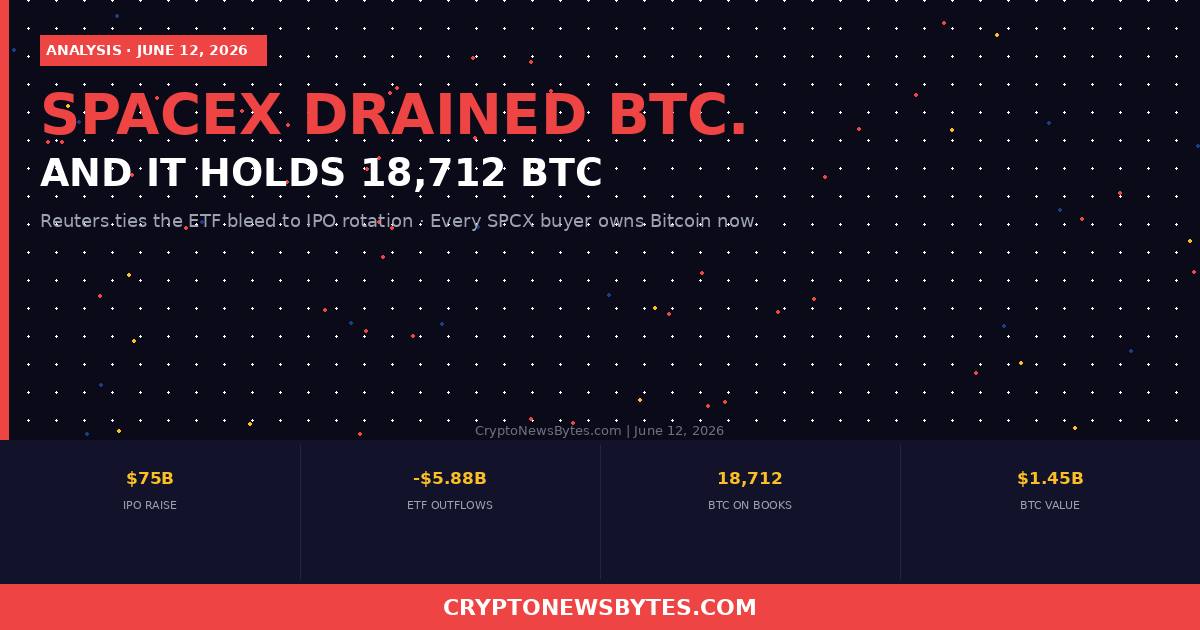
The numbers line up uncomfortably well. Bitcoin ETFs posted $2.30 billion in net May outflows, the largest monthly exit of 2026, followed by the multi-week streak that brought cumulative outflows near $5.88 billion, while the SpaceX book filled four times over at a $75 billion raise. With only about 7% of SPCX shares freely tradeable at launch and index providers preparing early inclusion rules that could force passive funds to buy, the demand pull continues well past listing day. A strong opening could even encourage investors who missed allocations to sell other assets and buy SPCX in the aftermarket. Bitcoin, still 56% of the crypto market, remains the most liquid thing those investors can sell.
The Twist: Every SPCX Buyer Now Owns Bitcoin
Buried in the S-1 is the detail that turns this from a simple rotation story into something stranger: SpaceX holds 18,712 BTC, valued near $1.45 billion at the time of disclosure. Every investor who rotated out of Bitcoin ETFs to buy SPCX shares re-acquired passive Bitcoin exposure on the other side, whether they wanted it or not. As one widely shared market commentary put it, that is not a footnote, that is a balance sheet argument. SpaceX joins Tesla and Strategy in the small club of mega-cap entities holding Bitcoin as a treasury asset, except SpaceX is doing it inside the largest IPO ever priced.
The template is the contagious part. OpenAI and Anthropic are the most likely candidates to copy the SpaceX playbook before year-end: OpenAI’s IPO filing is reportedly being drafted at an $852 billion post-money mark, and Anthropic’s pre-IPO valuation has already crossed $1 trillion on private markets. Analysts have suggested either company could disclose a BTC position specifically to capture a 5 to 8% premium from crypto-correlated allocators on the book. If the AI IPO class of 2026 adopts Bitcoin treasuries as a pricing strategy, the same listings draining Bitcoin’s spot liquidity become structural holders of it. The rotation that hurts Bitcoin this quarter could institutionalize it by next year.
The Rotation in One Chart: Out of BTC ETFs, Into the SpaceX Book
May-June 2026 capital flows | @cryptonewsbytes
Sources: Reuters, WEEX, Yahoo Finance, CoinShares, SpaceX S-1 | @cryptonewsbytes. Not financial advice.
What Breaks the Drain
The liquidity pull has a natural expiry. IPO allocations settle, the free float is tiny, and the won-dollar flows reverse once Korean allocations clear. The two catalysts that could flip the flow back: a weak SPCX aftermarket that burns the rotation trade and sends capital looking for the next oversold asset, which after a 15.5 RSI reading is Bitcoin, or the OpenAI and Anthropic filings confirming BTC treasuries, which would convert the AI-IPO complex from Bitcoin’s competitor into its largest new holder class. Watch the daily ETF flow prints over the next two weeks. The day they turn green while SPCX trades sideways is the day the rotation has run its course.
Frequently Asked Questions
Did SpaceX actually buy Bitcoin or is this an accounting artifact?
The S-1 discloses 18,712 BTC held as a treasury asset, valued near $1.45 billion at the disclosure date. SpaceX has held Bitcoin since at least 2021, when Elon Musk confirmed both Tesla and SpaceX held BTC. The IPO filing makes the position legally disclosed, auditable, and part of what every SPCX shareholder owns.
Is the SpaceX IPO actually bad for Bitcoin?
Short term, the capital and attention rotation has coincided with record ETF outflows and Bitcoin’s fall below $64,000, and Reuters has drawn the connection explicitly. Longer term, the picture is more nuanced: SpaceX brings Bitcoin onto the balance sheet of a $1.77 trillion public company, and if OpenAI and Anthropic follow the template, the AI IPO wave becomes a new institutional holder base. Rotation hurts flows now; the treasury template could matter for years.
Further Reading
The listing-day mechanics: perps vs real equity, and what convergence proves.
The outflow streak in full detail, and the oversold setup waiting for flows to reverse.
How the June crash unfolded, the leverage that amplified it, and the levels that matter now.
This article is for informational purposes only and does not constitute financial advice. Sources: Reuters, WEEX Wiki, BeInCrypto, Yahoo Finance, CoinShares, SpaceX S-1 filing, You Can Short It via X. Published June 12, 2026.