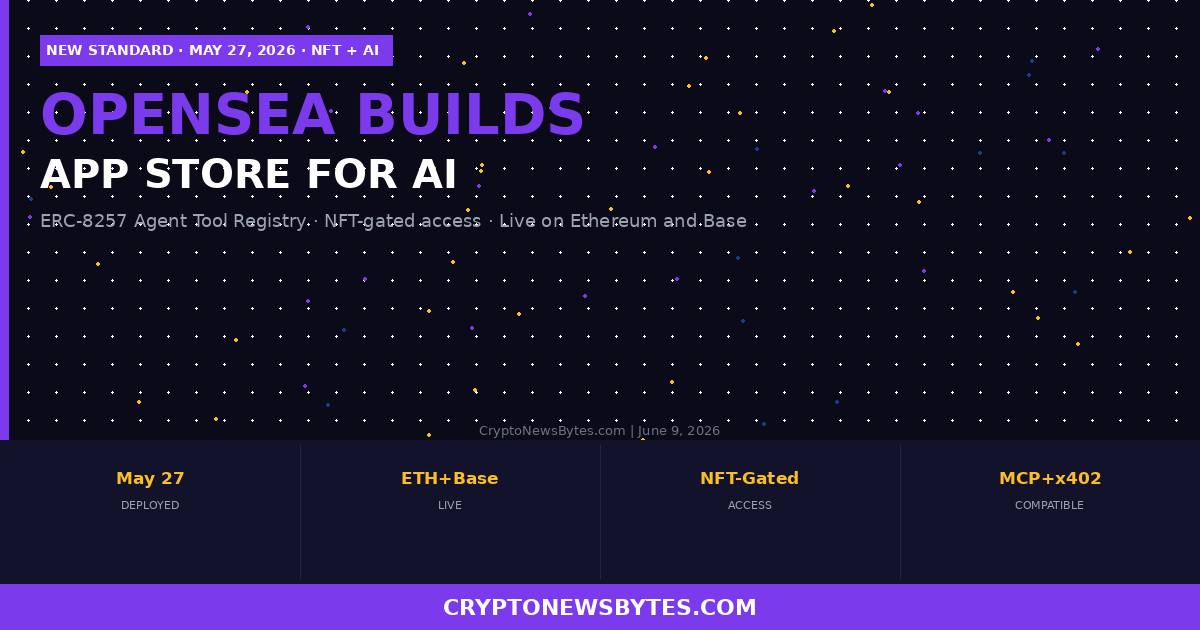
On May 27, 2026, OpenSea deployed ERC-8257, a new Ethereum standard it describes as an app store for AI agent tools. The standard creates a permissionless on-chain registry where developers can publish tools, set pricing and access rules, and allow AI agents to autonomously discover, pay for, and invoke those tools without any human in the loop. The SDK is public on GitHub, the contracts are live on both Ethereum and Base, and the EIP is in draft on the Ethereum Improvement Proposals site. OpenSea updated the tool-sdk repository as recently as June 8.
The part that matters most for NFT holders is the access model. ERC-8257 allows tool publishers to gate access using a smart contract predicate. One of the most immediately compelling predicates is NFT ownership: hold a specific token, get access to a specific AI tool. In a market where NFT utility has been the dominant question since the 2021 price collapse, this is a structural answer. Your NFT is not just a profile picture. Under ERC-8257, it can be the key that unlocks an AI agent capability.
What ERC-8257 Actually Does
Before ERC-8257, AI agents looking for external tools had to navigate fragmented proprietary catalogs, API key systems, and off-chain documentation. Discovery was manual. Access control was centralized. Payment was handled through traditional payment processors. ERC-8257 replaces all of that with an on-chain registry.
A tool publisher registers their tool on-chain by committing a manifest: name, description, endpoint, inputs, outputs, and pricing. They then point to an optional access predicate, a smart contract that decides who is allowed in. Any on-chain condition can serve as an access predicate: payment of a fee, holding a specific token, owning a specific NFT, or membership in a DAO. The registry is permissionless: anyone can publish. AI agents query the registry, find matching tools, satisfy the access predicate by paying or proving token ownership, and invoke the tool autonomously. No human intervention required at any step.
ERC-8257 is designed to work alongside the stack of emerging AI agent standards. ERC-8004, co-authored by contributors from MetaMask, Ethereum Foundation, Google, and Coinbase and deployed on 16 networks, handles agent identity and reputation. MCP handles tool discovery. x402 handles payment. ERC-8257 handles tool registration and access control. Together they form what OpenSea is positioning as the foundational infrastructure layer for autonomous AI agents operating on Ethereum.
The AI Agent Stack on Ethereum: How It Fits Together
Each standard handles one layer | @cryptonewsbytes
Agent Identity and Reputation
Defines who the agent is, its verifiable capabilities, and its on-chain reputation. Live on 16 networks including Ethereum and Base.
Tool Discovery
Anthropic’s Model Context Protocol. Open standard for AI applications to connect to external services. Travala’s Travel MCP, Claude Desktop, and hundreds of tools use this layer.
Tool Registry and Access Control (NEW)
OpenSea’s standard. On-chain registry of AI tools with permissionless publishing and NFT-gated access predicates. Live on Ethereum and Base.
Payment
Coinbase’s protocol for gasless USDC payments on Base. $0.01 per transaction, near-instant settlement. Already at 100M+ transactions.
Sources: OpenSea, Ethereum.org, KuCoin, Lazy.com newsletter | @cryptonewsbytes
Real Use Cases for NFT Holders and Builders
Reid Hoffman argued at Consensus 2026 that NFTs would make a comeback as identity infrastructure for AI agents. ERC-8257 is the first serious implementation of that thesis. Here is what it enables in practice.
For NFT collectors: a collection can bundle an ERC-8257 tool access predicate into its smart contract, so holding a specific NFT automatically grants access to an AI service: a trading analytics agent, a portfolio optimization tool, a royalty enforcement bot, or a minting assistant. The NFT becomes a software subscription key that is transferable, tradeable, and verifiable on-chain without a centralized authentication server. Collections that implement this can offer holders genuine utility that persists and compounds regardless of floor price.
For developers: any tool that currently requires an API key, a subscription, or a centralized authentication step can be registered in the ERC-8257 registry and exposed to any AI agent that satisfies the access predicate. The business model shifts from monthly subscriptions billed to a credit card to on-chain payments made autonomously by AI agents at the point of use. At x402’s cost of one cent per transaction, the economics favor high-frequency, low-value tool invocations that would be uneconomical under traditional billing models.
ERC-8257 Use Cases: NFT Meets AI Agent
What becomes possible when NFT ownership gates AI tool access | @cryptonewsbytes
Auto-trading with NFT-gated strategy tools
Hold NFT from analytics collection, AI agent gets access to real-time on-chain signals and executes trades autonomously.
AI-assisted minting and generative art
AI agent accesses generative model tool, mints NFT collection to spec without human clicking through a UI.
Autonomous royalty enforcement
AI agent monitors secondary sales, invokes royalty enforcement tool when violations detected, triggers on-chain remediation.
NFT valuation and floor monitoring
Agent queries registry, finds price data tools, pays $0.01 per call via x402, returns live valuation to the user without opening a browser.
Event and access token management
NFT serves as event ticket. AI agent verifies ownership via ERC-8004 identity, invokes access tool, grants entry with zero human friction.
Sources: OpenSea ERC-8257 specification, Lazy.com newsletter, KuCoin | @cryptonewsbytes
The Risks and Gotchas
ERC-8257 is still in draft. The standard is live and deployed, but it is actively seeking developer feedback, meaning the specification can change before finalization. Developers building on ERC-8257 today are building on infrastructure that is not yet hardened. Breaking changes are possible, which is the normal risk of building on emerging standards but worth flagging for anyone treating this as production-ready today.
The permissionless nature of the registry is a feature and a risk simultaneously. Anyone can register a tool with any manifest. An AI agent querying the registry for a price feed tool might invoke a malicious tool registered with a convincing manifest but designed to exfiltrate query data or manipulate outputs. The registry itself has no curation layer, which is a deliberate design choice consistent with permissionless crypto infrastructure but means agents need trust frameworks on top of the raw registry. ERC-8004’s reputation layer is designed to address this, but reputation systems take time to build meaningful signal.
The NFT-gating mechanic also creates a secondary consideration: as NFT utility becomes more concrete and measurable through AI tool access, the correlation between NFT ownership and software subscription pricing could make certain NFTs more valuable as functional keys than as speculative collectibles. That is not a risk but a repricing opportunity. Collections that move fastest to register high-quality tools behind ERC-8257 access predicates will be the first to find out whether utility can stabilize floor prices in a market that has been purely sentiment-driven for years.
Frequently Asked Questions
Do I need to own an NFT to use ERC-8257 tools?
It depends on the tool’s access predicate. Tool publishers can require any on-chain condition: payment of a fee in USDC, holding a specific NFT, membership in a DAO, or no restriction at all. NFT-gated tools require holding the relevant token, but many tools will simply charge a small USDC fee per invocation via x402 with no NFT requirement.
How is ERC-8257 different from just using an API?
Traditional APIs require centralized authentication, credit card billing, and rate limit management. ERC-8257 replaces all of that with on-chain access control and autonomous payment via x402. The key difference for AI agents is that discovery and access happen programmatically without any human setup steps. An agent can find, pay for, and invoke a tool registered in the ERC-8257 registry in a single transaction flow with no API key provisioning, no billing portal, and no centralized server managing access.
Further Reading
Travala’s Travel MCP is one of the first real-world tools that could register in the ERC-8257 registry. Both use MCP and x402. The convergence is not theoretical.
The same AI tooling that found the Zcash bug powers the audit capabilities that could protect ERC-8257 tools before they get exploited.
The permissionless nature of ERC-8257 means tool security is the publisher’s responsibility. What happens when that security fails is what the Flooring exploit showed yesterday.
This article is for informational purposes only. Sources: KuCoin, Lazy.com newsletter, OpenSea GitHub, OpenSea Docs, Bitget News, WEEX, Ethereum.org. Published June 9, 2026.