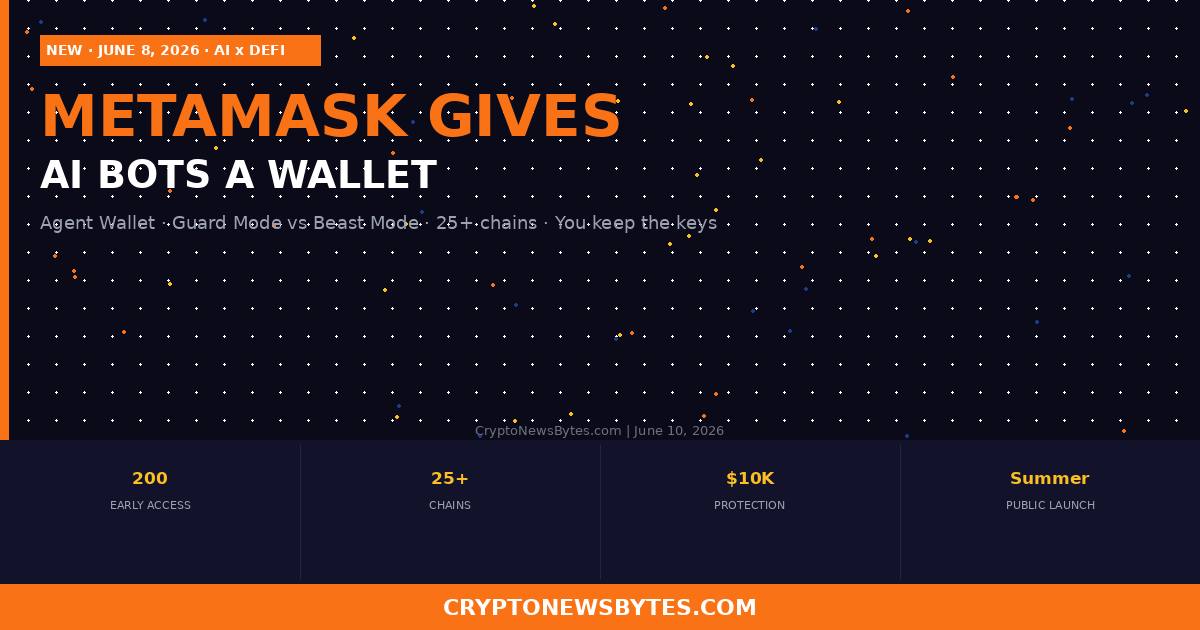
MetaMask launched Agent Wallet on June 8, 2026: a self-custodial wallet purpose-built for AI agents to autonomously execute trades, manage liquidity positions, and interact with DeFi protocols without a human approving every transaction. Roughly 200 users are in the Early Access Program via command-line interface, with general availability targeted for summer 2026. The agent gets its own dedicated wallet. The human keeps the keys. And the rules of what the bot can and cannot do are set before it touches a single dollar.
This is the third major AI agent infrastructure launch in a single week, and the one that completes the stack. Travala gave agents something to buy with its Travel MCP hotel booking protocol. OpenSea gave agents a tool registry with ERC-8257. MetaMask just gave them a wallet. Payments, tools, custody: the agentic economy now has all three layers live in production, and all three launched within seven days of each other. That is not a coincidence. It is a land grab.
Guard Mode vs Beast Mode: How the Control System Works
The central problem Agent Wallet tries to solve: AI agents are by definition acting on your behalf without asking permission for every move. Give a bot too little freedom and it is useless. Give it too much and it can drain your wallet the moment something goes wrong, whether through a malicious contract, a misinterpreted instruction, or a prompt injection. MetaMask’s answer is two operating modes and a hard security floor that neither mode can switch off.
Guard Mode is the default. Users pre-define spending limits, approved protocols, and allowlisted addresses before the agent starts. Anything outside those parameters triggers two-factor authentication before the transaction can proceed. MetaMask’s framing is deliberately bank-like: “Think of it like banks or exchanges, where you need to add recipients to an allowlist before you can send to them.” Beast Mode is the opt-in alternative that reduces prompts and gives the agent more latitude in ambiguous situations, while still requiring approval for transactions flagged as potentially malicious.
Under both modes, every transaction undergoes simulation, threat scanning, and MEV protection, and transactions deemed safe are backed by up to $10,000 in coverage through MetaMask’s Transaction Protection program. Key material sits inside a trusted execution environment supplied by Cubist, meaning signing happens in a secured enclave and the keys remain inaccessible to both MetaMask and Consensys. Users hold their own keys and can export their Secret Recovery Phrase at any time. The architecture bet is clear: policy enforcement beats permission prompts.
Guard Mode vs Beast Mode: What the Bot Can Do
Source: MetaMask official announcement, CoinDesk | @cryptonewsbytes
Guard Mode (default)
Pre-set spending limits enforced
Protocol allowlist required
Address allowlist required
2FA for anything outside parameters
For: most users, conservative automation
Beast Mode (opt-in)
Fewer prompts, more agent latitude
Agent decides in ambiguous situations
Still blocks flagged malicious txns
Simulation + MEV protection always on
For: active traders, high-frequency strategies
Always on, both modes: transaction simulation, threat scanning, MEV protection, TEE key custody (Cubist), $10K Transaction Protection coverage on safe-rated transactions, full key export available anytime.
Sources: MetaMask, CoinDesk, 99Bitcoins, Incrypted | @cryptonewsbytes
What the Agent Can Actually Do
At launch, Agent Wallet supports full DeFi access in one wallet: swaps, perpetuals, prediction markets, and liquidity provision across all EVM chains plus Hyperliquid, more than 25 networks total. The product is framework-agnostic, with support for OpenAI Codex, Claude Code, Cursor, Nous Research Hermes Agent, OpenClaw, and related agent environments. A tester could ask an agent to monitor a price range and rebalance an LP position overnight, scan prediction markets for mispriced odds, or run a perpetuals strategy on Hyperliquid within preset risk limits, all without touching the keyboard after the initial rules are configured.
The competitive timing is not subtle. Coinbase launched Agentic Wallets in February 2026. MoonPay integrated Ledger wallets for AI transactions and introduced the Open Wallet Standard, backed by PayPal and the Ethereum Foundation. Gemini lets users connect AI bots to trade on their behalf. MetaMask, with the largest self-custodial user base in crypto, was the missing player. Consensys framing leaned on Joe Lubin’s long-standing description of MetaMask as “a magic wand that hides all of the math”: Agent Wallet extends that to hiding the execution itself.
The Mandates Question: ETHConf Called This Exact Problem
The day MetaMask launched Agent Wallet, Dean Tribble of Agoric was on the ETHConf breakout stage giving a talk titled “Agents Need Mandates, Not Keys.” His argument: giving AI agents raw private keys creates too much risk and too little control, and the answer is user mandates enforced by smart contracts that bound what an agent is permitted to do. MetaMask’s Guard Mode is a version of exactly that idea, implemented at the wallet layer rather than the contract layer: the mandate is the spending limit, the allowlist, and the 2FA escalation path.
The risk that remains is the one no wallet architecture can fully solve: the agent itself. A prompt injection that convinces an agent a malicious swap is within its mandate, a poorly specified rule set that technically permits a catastrophic trade, or simply an agent misreading market conditions at 3 AM. The Humanity Protocol hack this week was a reminder that key compromise remains the dominant attack vector of 2026. Agent Wallet’s dedicated per-agent wallets at least contain the blast radius: a compromised or misbehaving agent can only lose what its specific wallet holds, within the limits its rules allow. That containment is the real innovation, more than the autonomy.
The Agentic Economy Stack: Complete in One Week
Three launches, seven days, June 2026 | @cryptonewsbytes
MetaMask Agent Wallet · June 8
Self-custodial wallets for AI agents. Guard/Beast modes, TEE signing, 25+ chains. The agent holds and moves funds within user-set rules.
OpenSea ERC-8257 · May 27
On-chain tool registry. Agents discover, pay for, and invoke tools autonomously. NFT-gated access predicates. Live on Ethereum and Base.
Travala Travel MCP · June 5
2.2M hotels bookable by AI agents. USDC on Base via x402 at $0.01 per transaction. Live through Claude Desktop.
All three covered in depth on CryptoNewsBytes. The agentic stack is live. | @cryptonewsbytes
Frequently Asked Questions
Does the AI agent get my private keys?
No. The agent receives its own dedicated, agent-specific wallet that is separate from your main MetaMask account. Key material is held in a trusted execution environment supplied by Cubist, where signing happens in a secured enclave inaccessible to MetaMask, Consensys, and the agent framework itself. You hold your own keys and can export your Secret Recovery Phrase at any time. Your main account is never exposed to the agent.
How do I get access to Agent Wallet?
The Early Access Program opened June 8, 2026 with roughly 200 spots for traders and developers, accessed via command-line interface at metamask.io/agent-wallet. The product currently targets crypto-native users who already understand on-chain workflows. General availability for the broader MetaMask user base is planned for summer 2026.
Further Reading
The commerce layer of the agent stack. Travala’s Travel MCP gives agents something to spend on; MetaMask gives them the wallet to spend from.
The tool layer. Agents with MetaMask wallets can discover and pay for ERC-8257 registered tools autonomously.
Why key containment matters. The dominant attack vector of 2026 is stolen keys, and per-agent wallets limit the blast radius.
This article is for informational purposes only and does not constitute financial advice. Sources: MetaMask official announcement, CoinDesk, 99Bitcoins, CoinMarketCap, Incrypted, Cryptopolitan. Published June 10, 2026.