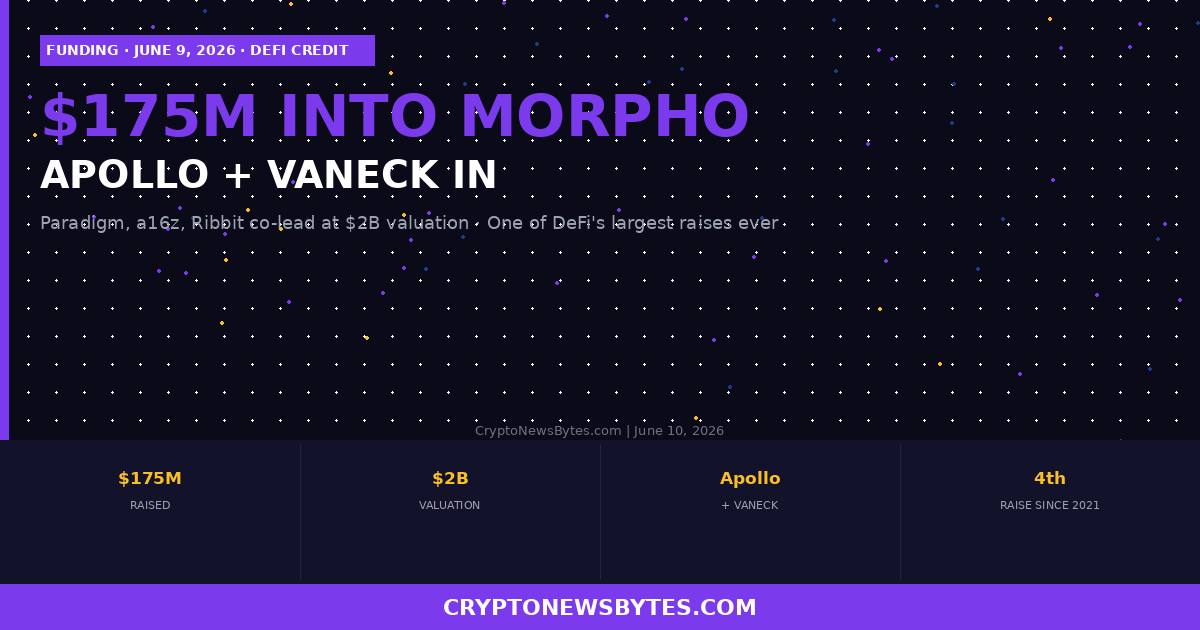
Morpho Association raised $175 million on June 9 in one of the largest funding rounds in DeFi history, at a $2 billion valuation. The round was co-led by Paradigm, a16z crypto, and Ribbit Capital. But the names that matter most are further down the participant list: Apollo Funds and VanEck. A $700 billion private credit giant and one of the oldest asset managers in America just wrote checks into a decentralized lending protocol. That is not a crypto venture bet. That is traditional finance buying infrastructure it intends to use.
The same day, Janus Henderson invested directly in Ethena’s ENA token, eyeing USDe distribution. Within recent months, BlackRock invested in Uniswap and Apollo backed Morpho’s ecosystem. CoinDesk framed the pattern explicitly: traditional asset managers backing DeFi infrastructure is now a trend, not an anomaly. The question institutional allocators were asking in 2024 was whether DeFi was investable. The question in June 2026 is which DeFi infrastructure to own before everyone else does.
What Morpho Is and Why Lending Is the Prize
Morpho launched in 2022 as a lending optimization layer and evolved into open credit infrastructure: a permissionless protocol where anyone can create isolated lending markets with custom parameters, and where institutions can launch tokenized credit products on neutral rails. Ribbit Capital’s Gabe Mennesson stated the thesis in the round announcement: lending is “the largest profit pool in financial services,” and Morpho is “the most ambitious effort we’ve seen to rebuild the credit stack from first principles.” He added the part that matters: “Some of the world’s leading institutions are already using Morpho to launch tokenized credit products, and we’re still in the early innings.”
The full participant list reads like a deliberate coalition: Apollo Funds, VanEck, Circle Ventures, Ledger, Cathay Innovation, Variant, Wintermute Ventures, Prelude, IOSG Ventures, HashKey Capital, SBI Group, Bpifrance, Mirana, NJJ Capital, and more than ten additional partners. Bpifrance is the French state investment bank. SBI is one of Japan’s largest financial groups. a16z’s Guy Wuollet noted Morpho’s technology “continues to push borrowing and lending forward for some of the world’s leading financial institutions.” This is Ribbit’s second major Morpho bet after leading the $50 million strategic round in 2024.
Who Backed Morpho: The $175M Coalition
June 9, 2026 · $2B valuation | Sources: The Defiant, The Block | @cryptonewsbytes
Paradigm · a16z crypto · Ribbit Capital (second major Morpho bet after leading the 2024 $50M round)
Apollo Funds ($700B+ private credit) · VanEck · SBI Group (Japan) · Bpifrance (French state bank)
Circle Ventures · Ledger · Wintermute Ventures · Variant · HashKey Capital · IOSG · Mirana · 10+ more
The TradFi-backs-DeFi pattern, last 12 months
BlackRock → Uniswap · Apollo → Morpho ecosystem · Janus Henderson → Ethena ENA (same day as this raise) · Apollo + VanEck → Morpho $175M. Traditional asset managers are no longer evaluating DeFi. They are buying it.
Sources: The Defiant, The Block, CoinDesk, Yahoo Finance | @cryptonewsbytes
The Timing: ETHConf Said This Out Loud Two Days Ago
Stani Kulechov of Aave opened ETHConf’s main stage on Monday with a talk titled “Building Credit Markets at Internet Speed,” arguing that the internet transformed information but credit has remained impossible to scale, and on-chain infrastructure is the unlock. Twenty-four hours later, Paradigm, a16z, Ribbit, Apollo, and VanEck put $175 million behind exactly that thesis, in Aave’s most direct competitor. The on-chain credit narrative went from conference keynote to nine-figure funding event in one news cycle.
The market context makes the signal stronger, not weaker. Bitcoin is at $63,000 fighting a four-week ETF outflow streak. The Fear and Greed Index is in extreme fear. CPI lands tomorrow and the Fed decides Thursday. Into that backdrop, some of the most disciplined capital allocators in finance deployed $175 million into DeFi lending infrastructure at a $2 billion valuation. Venture capital of this caliber does not buy tops. It buys infrastructure during fear, which is precisely when long-duration conviction is cheapest to express.
Frequently Asked Questions
Why does Apollo investing in Morpho matter so much?
Apollo is one of the largest private credit managers in the world, with over $700 billion in assets. Private credit is exactly the business that on-chain lending infrastructure could transform: originating, tokenizing, and distributing credit products with programmatic settlement. Apollo investing in Morpho is not a passive venture bet, it is a credit giant taking a stake in the rails it may use to distribute tokenized credit products. The same logic applied when Apollo backed Morpho’s ecosystem earlier and when BlackRock invested in Uniswap.
Does this raise affect the MORPHO token?
The raise went to Morpho Association, the entity behind the protocol, at a $2 billion valuation. Token impact depends on how the valuation translates to MORPHO’s market structure and on whether institutional adoption drives protocol fees and TVL growth. The direct read is on fundamentals: $175 million in runway and the explicit backing of Apollo, VanEck, and Circle Ventures strengthens the case that Morpho becomes default institutional credit infrastructure. As always, venture validation and token price are correlated over years, not days. This is not financial advice.
Further Reading
Stani Kulechov’s credit markets keynote and the institutional programming that previewed this exact funding wave.
The other half of the institutional on-chain finance story: banks tokenizing products while asset managers buy the DeFi rails.
Circle Ventures backed Morpho the same week Circle launched its Bitcoin product. The infrastructure consolidation is happening on every layer.
This article is for informational purposes only and does not constitute financial advice. Sources: The Defiant, The Block, CoinDesk, Yahoo Finance, Morpho press release. Published June 10, 2026.