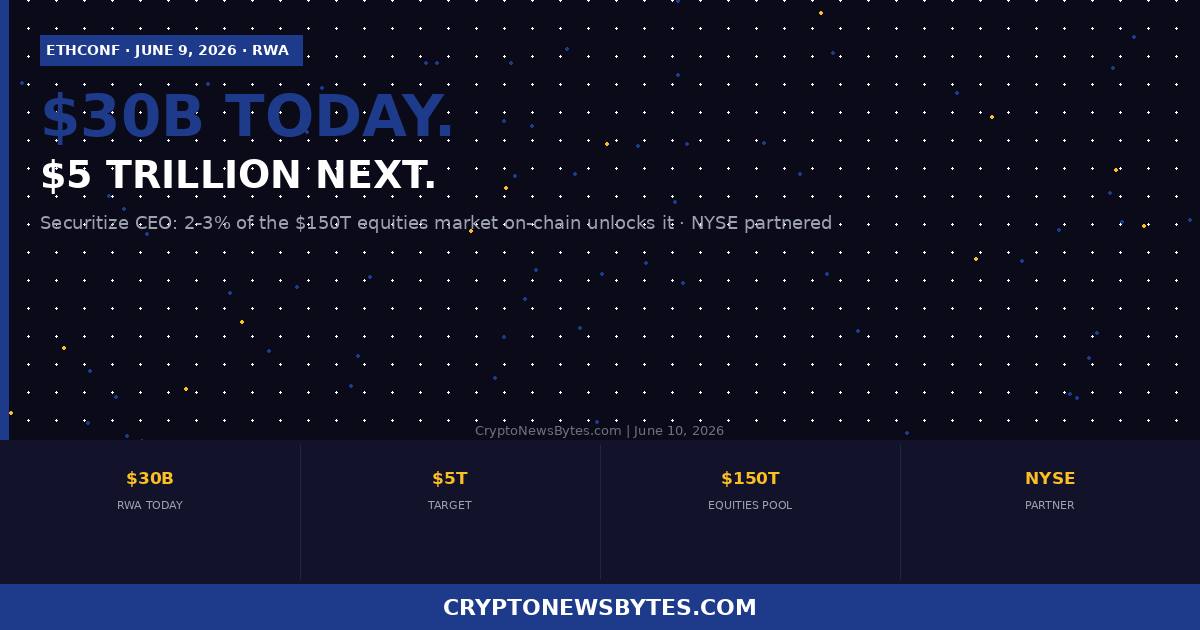
Carlos Domingo runs the company that tokenizes BlackRock’s funds. So when the Securitize CEO stood on an ETHConf panel in New York on Tuesday and put a number on where real-world assets are heading, the room paid attention. His math: “The entire equities and ETF market worldwide is probably like $150 trillion. Only if a small percentage of that, like 2% or 3%, moves onchain, it gets you very close to that $5 trillion.” Today’s entire tokenized asset sector is roughly $30 billion. Domingo is describing a market more than 160 times larger.
The claim lands differently coming from Securitize than from a conference futurist. The company is one of the largest tokenization providers for institutions including BlackRock, whose tokenized money market fund BUIDL Securitize administers. It is preparing to go public. And it has announced partnerships with the New York Stock Exchange and transfer agent Computershare specifically aimed at enabling on-chain trading and settlement of equities. This is not a prediction about what someone might build. It is a roadmap from the company building it.
The Math: $30 Billion Today, and Why Equities Change Everything
The current $30 billion RWA market is dominated by tokenized U.S. Treasuries, the category that BlackRock’s BUIDL, Franklin Templeton’s BENJI, and JPMorgan’s newly filed JLTXX occupy. Treasuries were the logical first asset: low-risk, yield-bearing, and easy to explain to compliance departments. But Treasuries are a small fraction of global capital markets. Domingo’s argument is that equities and ETFs, a $150 trillion pool, are the actual growth engine, and that even trivial on-chain penetration produces a market two orders of magnitude larger than today’s.
He also drew a line that matters for anyone evaluating the current crop of tokenized stock products: many so-called tokenized stocks today are wrappers and derivatives rather than actual on-chain equity with shareholder rights. This is the distinction we covered in the Bybit SpaceX launch: synthetic pre-IPO derivatives from Binance, Bitget, and Gate versus real 1:1 backed equity via xStocks. Securitize’s NYSE and Computershare partnerships target the genuine version: native on-chain trading and settlement where the token is the share, not a claim on someone’s promise about the share.
The RWA Opportunity: Today vs Domingo’s $5T Scenario
Bars on log-intuitive scale for readability | Sources: CoinDesk, ETHConf panel June 9 | @cryptonewsbytes
Why this is credible coming from Securitize
Securitize administers BlackRock’s BUIDL, is preparing its own public listing, and has announced NYSE and Computershare partnerships for on-chain equity trading and settlement. The infrastructure for the $5T scenario is being contracted now, not imagined.
Not financial advice. Sources: CoinDesk, Coin-Turk, ETHConf | @cryptonewsbytes
RWAs Are Decoupling From Crypto Sentiment, and This Week Proved It
Consider the split screen of this week. Bitcoin is at $63,000 in extreme fear, ETFs have bled $5.88 billion over four weeks, and the entire market is frozen waiting for CPI. Meanwhile, in the institutional lane: Bybit and Kraken opened SpaceX’s IPO to retail through tokenized equity. Circle launched cirBTC. Morpho raised $175 million from Apollo and VanEck. Janus Henderson invested in Ethena. JPMorgan’s JLTXX tokenized Treasury fund filing is in motion. And Securitize’s CEO put a $5 trillion number on tokenized equities while preparing his own IPO.
None of those institutional moves were paused for the crypto drawdown. That is the decoupling: RWA infrastructure decisions run on multi-year regulatory and product timelines, not on the Fear and Greed Index. The CLARITY Act vote window, the SEC’s posture shift visible at ETHConf, and the GENIUS Act stablecoin framework matter far more to this sector than whether Bitcoin holds $60,000 this week. For investors, it means the RWA sector’s growth thesis survives the dip in a way that pure crypto beta does not. This is the same dynamic we flagged in the Strive STRC analysis: instruments built on regulated structure attract capital that ignores spot sentiment entirely.
Frequently Asked Questions
What is the difference between a tokenized stock and a synthetic stock token?
A genuine tokenized stock is backed 1:1 by the actual share, held by a regulated custodian or transfer agent, and ideally carries shareholder rights. A synthetic token merely tracks the stock’s price through derivatives or issuer promises, with no underlying ownership. Domingo cautioned at ETHConf that many products marketed as tokenized stocks today are the synthetic kind. Securitize’s NYSE and Computershare partnerships target real on-chain settlement where the token is the legal share record.
Why would stocks move on-chain at all?
The case rests on settlement and access. On-chain settlement is near-instant and programmable versus T+1 clearing through legacy intermediaries; tokenized shares can serve as DeFi collateral, trade 24/7, and fractionalize natively; and global investors gain access without local brokerage infrastructure. The DTCC, which settles virtually all US securities, had its Managing Director on the ETHConf main stage this week discussing exactly this transition. When the incumbent settlement layer shows up to the conversation, the question shifts from whether to how fast.
Further Reading
Our analysis of how structured instruments built on regulated rails attract capital that ignores crypto sentiment, the same decoupling driving the RWA sector.
The real-vs-synthetic tokenized equity distinction Domingo flagged, playing out live in the SpaceX IPO products this week.
The credit side of the same institutional wave: TradFi buying the DeFi rails while Securitize tokenizes the assets that will run on them.
This article is for informational purposes only and does not constitute financial advice. Sources: CoinDesk, Coin-Turk, ETHConf panel June 9 2026. Published June 10, 2026.